
89% of UK consumers check reviews before engaging with local businesses. Yet many SMEs struggle with expensive, over-engineered reputation tools that drain resources. As review platforms evolve in 2026, simpler solutions now offer powerful alternatives to Birdeye. We've evaluated key competitors based on critical workflows like Google review management and review response automation.
Managing this manually is hard. ReviewSense automates it.
The Shifting Environment of Review Management in 2026
Businesses face a rapidly evolving review management environment, with the global online reputation management (ORM) market projected to grow from $6.88 billion in 2025 to $14.01 billion by 2031. Simultaneously, the ORM services segment is forecast to surge from $427.96 million in 2025 to $1.30 billion by 2032. This growth reflects rising pressure on UK businesses to harness customer feedback effectively. Many now seek AI-powered solutions to handle increasing review volumes across key platforms like Google Business Profile, Facebook, Apple App Store, and Google Play.
Against this backdrop, established players like Birdeye face scrutiny. Small businesses often find their pricing prohibitive and feature sets overwhelming for core needs. Teams struggle with complex workflows when they simply require efficient review monitoring, sentiment tracking, and rapid response capabilities. Legacy approaches fail to meet 2026 expectations for integrated, AI-driven customer experience management. Birdeye is rarely assessed on its own, either: our Reputation.com vs Birdeye vs Podium vs ReviewTrackers comparison puts the four side by side on pricing and target market.
Today's environment demands messaging-first strategies. Quick, personalised replies directly impact local SEO and conversion rates. Yet fragmented feedback across multiple platforms creates operational headaches. Without centralised monitoring, critical reviews get missed. Manual response drafting drains resources, while toxic content or spam obscures genuine insights. These pain points explain why businesses evaluate Birdeye alternatives.
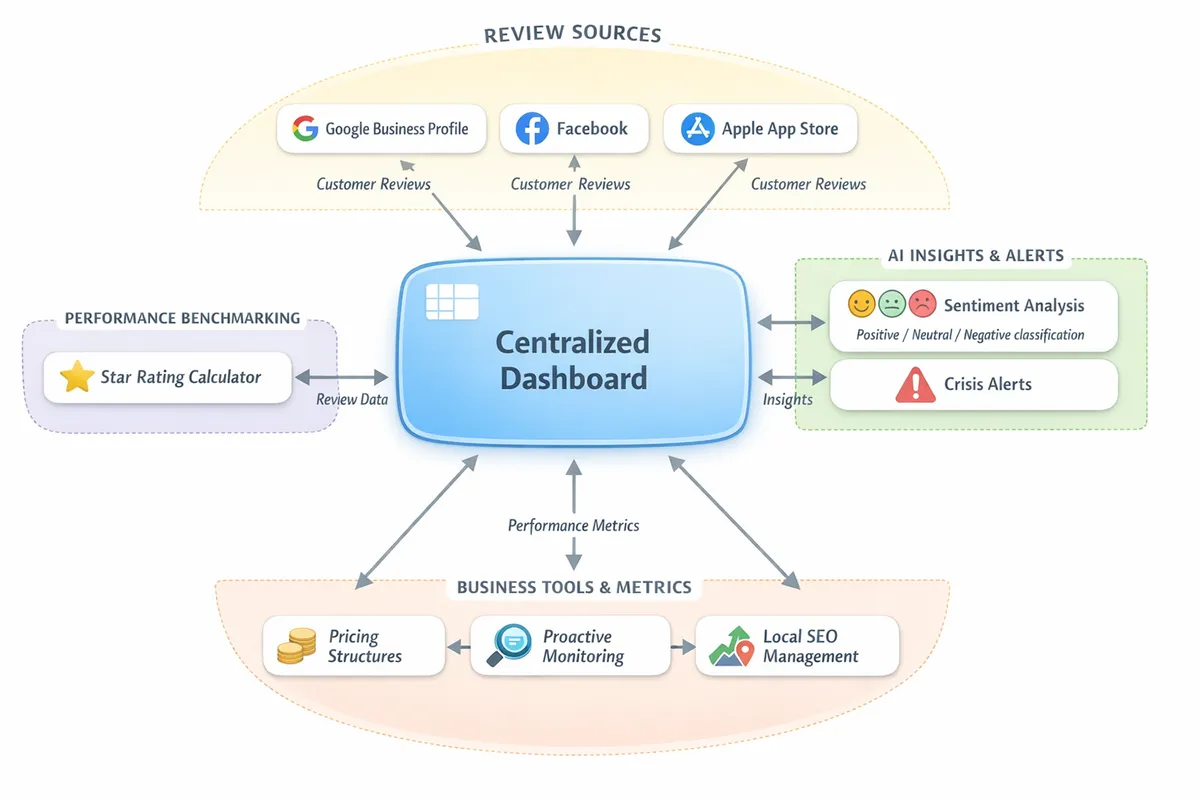
Modern solutions must offer simplicity alongside depth. They should consolidate reviews from essential sources into one dashboard with intelligent automation. Features like sentiment analysis and crisis alerts help teams prioritise effectively. Crucially, they must scale affordably from single-location operations to multi-site brands. For guidance on selecting focused tools, see our analysis of review management software essentials.
Local SEO remains vital, making Google Business Profile management non-negotiable. Issues like duplicate listings can sabotage efforts; our guide on merging duplicate profiles addresses this. Free resources like the star rating calculator also help businesses benchmark performance. When evaluating options, transparent pricing structures and tailored workflows matter most. Explore proactive monitoring techniques to stay ahead of reputation risks. For foundational strategies, visit our customer review management hub.
Critical Pain Points for Small Business Reputation Management
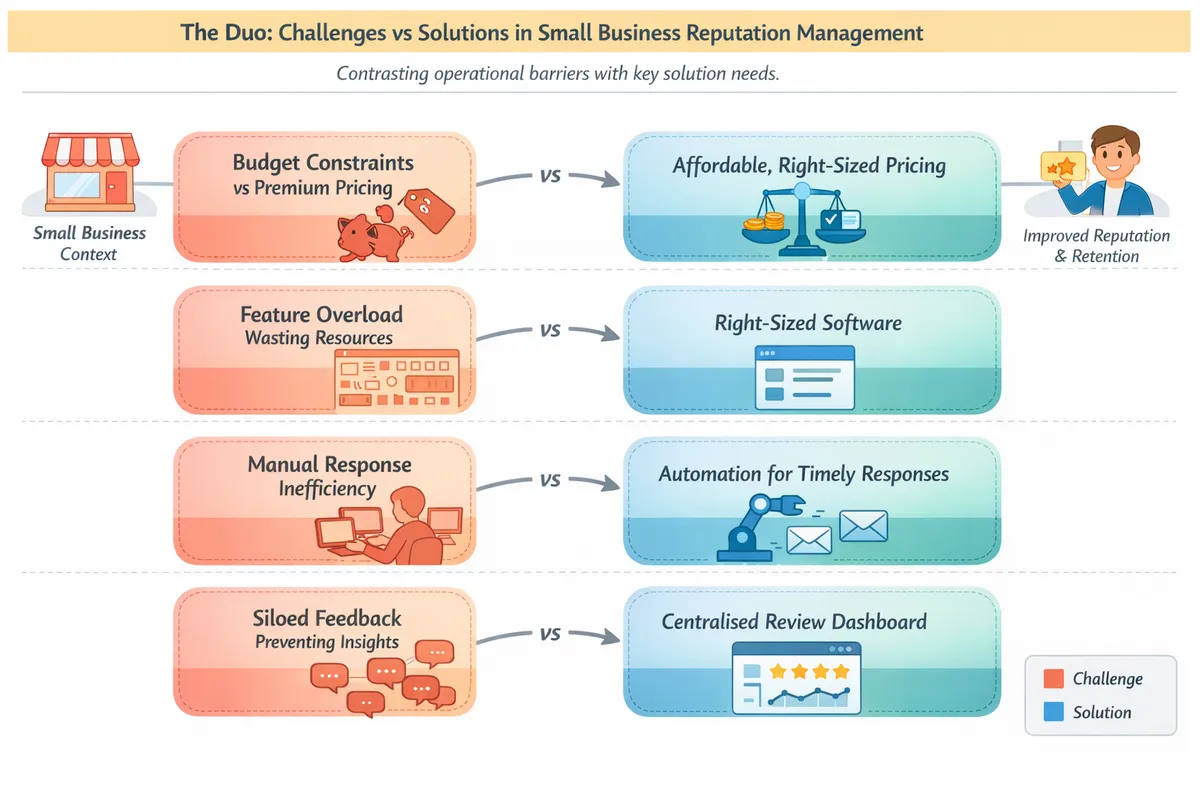
These operational challenges hit small UK businesses hardest, directly impacting customer retention and local visibility. With the Customer Experience Management market projected to reach $47.72 billion by 2033, the stakes for reputation management have never been higher. Yet many firms encounter four critical barriers when using enterprise-level solutions:
Budget constraints versus premium pricing. Platforms like Birdeye often start at $599 monthly, straining limited resources. This forces small teams to sacrifice essential monitoring capabilities, risking missed reviews that influence purchasing decisions. Our investigation into Google review management software ROI reveals how pricing models impact smaller operations, and our review platform pricing comparison shows how far $599 sits above the entry tier, which starts nearer $9.
Feature overload wasting resources. Complex platforms bundle unnecessary tools for basic review monitoring needs. Research indicates most businesses use under 20% of available features, creating steep learning curves and operational drag. This inefficiency distracts from core activities like responding to genuine feedback. Choosing right-sized software prevents this resource drain.
Manual response inefficiency. Crafting individual replies across Google, Facebook, and app stores like Google Play consumes hours weekly. Without automation, timely personalised responses become unsustainable, damaging customer relationships. This challenge intensifies on platforms requiring frequent engagement, as shown in the Facebook review management guide.
Siloed feedback preventing insights. Fragmented reviews across Google Business Profile, Facebook, and app stores obscure emerging issues. Without centralisation, recurring complaints go undetected while fake reviews compound reputation damage. Our guide on reporting fake Google reviews highlights how decentralised monitoring exacerbates this risk.
Collectively, these hurdles create reputation vulnerabilities. Unanswered negative reviews can lower local search rankings by 12-15%, while unresolved feedback loops erode customer trust. For small businesses, overcoming these barriers is essential before considering any Birdeye alternative.
Essential Capabilities for Modern Review Management
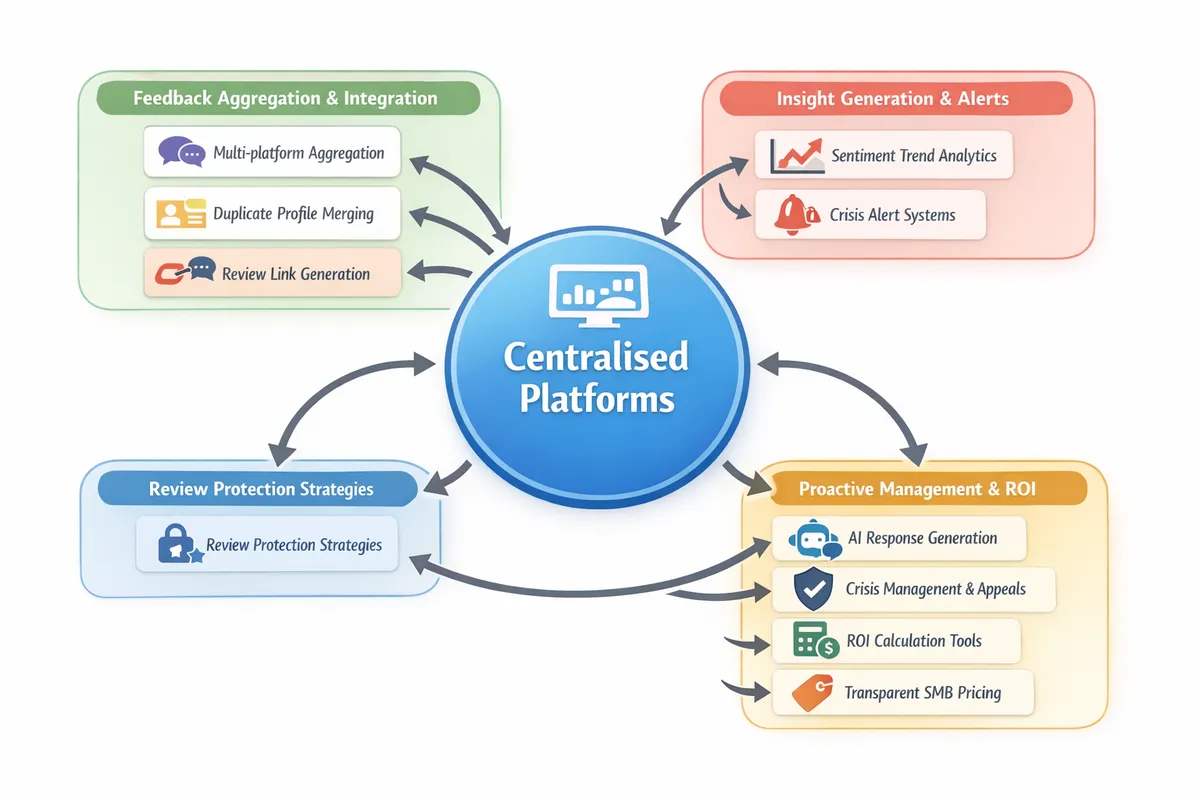
Facing these operational hurdles, UK businesses require focused capabilities to turn feedback into growth levers without complexity or excessive cost. The table outlines essential features addressing core pain points, reflecting why software solutions now command a 30% share in the enterprise reputation management market through integrated functionality:
| Feature | Solves Which Pain Point | Why It Matters in 2026 |
|---|---|---|
| AI response generation | Manual inefficiency | With over 50% of companies using AI for CXM by 2025, timely brand-aligned replies boost retention and local SEO. |
| Multi-platform aggregation (Google Business Profile, Facebook, Apple App Store, Google Play) | Siloed feedback | Centralising key platforms prevents missed reviews and provides unified insights. |
| Sentiment trend analytics | Hidden insights | Detects recurring issues early, like service gaps, before they damage reputation. |
| Crisis alert systems | Proactive reputation protection | Instant notifications for negative spikes enable rapid damage control. |
| Transparent SMB pricing | Budget constraints | Predictable costs prevent unexpected fees, crucial for cash-limited businesses. |
AI response generation tackles the hours wasted manually crafting replies. It ensures consistent brand voice while freeing teams to act on insights, not draft emails. For context, Gartner research confirms AI's role in service efficiency. Multi-platform aggregation combats fragmentation by pulling Google, Facebook, and app store feedback into one dashboard. This prevents critical reviews from slipping through cracks, especially when managing multiple locations. If duplicate listings split your Google reviews, our guide on merging duplicate profiles helps consolidate them.
Sentiment analytics transform raw data into actionable intelligence, spotting trends like rising delivery complaints before they escalate. Pair this with crisis alerts creates a safety net; sudden review spikes trigger instant warnings so you can address issues immediately. Should your Google Business Profile get suspended amid a crisis, learn to successfully appeal a suspension to minimise downtime. Transparent pricing ensures affordability, letting you calculate ROI with tools like the star rating calculator. For businesses comparing a Birdeye competitor, these capabilities offer focused value without overpaying for unused features. Generate customer feedback links easily using the review link generator, and stay protected against volatile platform changes by understanding how to protect against disappearing reviews.
How Leading Solutions Address Core Workflows
For UK businesses evaluating a Birdeye alternative, effective review management relies on five streamlined workflows that transform feedback into action without unnecessary complexity. Leading solutions like ReviewSense optimise these core operations, contrasting with Birdeye's often convoluted processes that can overwhelm smaller teams. Here's how modern platforms tackle essential tasks:
Centralising reviews from key platforms. Unlike Birdeye's approach of aggregating numerous sources, ReviewSense focuses exclusively on UK-relevant channels: Google Business Profile, Facebook, Apple App Store, and Google Play. This targeted consolidation prevents notification fatigue while ensuring critical feedback never gets missed across your primary reputation drivers. Proper centralisation also reduces risks that might require later recovery steps, such as those outlined in our guide for appealing a suspended Google Business Profile.
Automated sentiment tagging for issue spotting. Built-in AI scans every review for emotional tone and recurring themes like delivery delays or staff rudeness. This instantly surfaces genuine concerns while filtering spam, helping teams prioritise impactful fixes. For context, 77% of CRM leaders expect AI to handle most resolution tasks by 2025. When negative patterns emerge, our UK-specific guide on editing Google review responses helps craft appropriate replies.
AI drafting of on-brand responses. ReviewSense generates personalised reply drafts in seconds using your custom brand voice guidelines. Unlike Birdeye's generic templates, this maintains authentic communication at scale. With approximately 75% of brands adopting AI for customer interactions by 2025, this workflow slashes response times from hours to minutes. Explore the AI review response generator to see this in action, or learn optimisation techniques via our free AI tools guide.
Team collaboration and approval queues. Multi-location businesses use custom workflows to route responses for manager sign-off before publishing. This prevents inconsistent messaging while maintaining quality control—especially useful for franchises or agencies handling Facebook review management across branches. ReviewSense's intuitive interface simplifies this versus Birdeye's clunky permission systems.
Tracking response rates and rating trends. Real-time dashboards monitor your 30-day response rate, sentiment trajectory, and review velocity. Crisis alerts trigger instantly for negative review spikes, enabling rapid intervention. Case studies show businesses using these insights maintain an average 4.2-star rating. Measure your progress using the 5-star review calculator to set achievable reputation goals.
By refining these workflows, ReviewSense delivers faster resolution times than Birdeye—particularly for urgent issues flagged by crisis alerts. This operational efficiency makes it a compelling Birdeye competitor for UK businesses prioritising actionable insights over feature bloat.
Selecting the Right Fit Beyond Feature Checklists
But operational efficiency only delivers value when paired with the right strategic fit. Research consistently shows businesses over-prioritise feature quantity over workflow alignment when selecting review management tools. This often leads to underused subscriptions and fragmented processes. Instead, focus on how a platform complements your team's daily operations rather than its marketing claims.
Consider specialised alternatives to Birdeye's broad approach. Podium focuses primarily on messaging, not multi-platform review aggregation. NiceJob centres on referral generation rather than comprehensive sentiment analysis. BrightLocal delivers excellent local SEO insights but lacks integrated AI response capabilities. Each serves specific needs, but none offers ReviewSense's balanced combination of centralisation, AI analysis, and actionable reporting.
Operational fit proves critical for UK businesses. With SME adoption of reputation tools growing at 16.68% annually, intuitive onboarding becomes essential. ReviewSense's cloud-based setup takes minutes, not days. Its dashboard integrates naturally with existing workflows through custom approval queues and team collaboration features. Avoid vanity metrics like total review counts; prioritise tools that extract strategic insights from feedback. Our guide on proactive reputation management explores this mindset shift in depth.
When trialling platforms, test these key areas: First, can your team navigate the interface without extensive training? ReviewSense's 7-day free trial lets you verify usability firsthand. Second, examine support responsiveness – particularly for UK-specific issues like GBP suspensions. Third, assess customer experience alignment: Does the solution help improve service, not just monitor it? Tools like our negative review response generator demonstrate practical CX enhancement.
Future-proofing matters in this rapidly evolving space. Cloud-based reputation management already commands 72.45% market share and grows at 18.14% annually. ReviewSense's AI foundation adapts to emerging trends like predictive sentiment analysis and automated resolution workflows. For businesses comparing Birdeye alternatives, this forward compatibility proves as important as current features. Explore our latest industry comparison for more evaluation criteria.
Ultimately, the right Birdeye competitor solves your specific reputation challenges without unnecessary complexity. ReviewSense's targeted approach – covering only Google, Facebook, and app stores – delivers focused value where it impacts customer retention most. See how our transparent pricing model supports scalable growth without hidden costs.
Conclusion
For UK small businesses seeking a streamlined Birdeye alternative, ReviewSense delivers decisive advantages: centralising feedback from Google, Facebook, and app stores into actionable insights, accelerating response times with AI, and surfacing critical CX issues through real-time analytics. Unlike feature-heavy platforms, its focused approach eliminates complexity while providing essential tools—sentiment analysis, team workflows, and crisis alerts—that directly improve reputation and retention. The platform’s intuitive design ensures immediate usability without training, aligning with your operational reality rather than demanding adaptation.
Transform scattered reviews into your growth engine with ReviewSense’s purpose-built efficiency. Start your 7-day free trial.
Comparing other platforms too? See our guides to Podium alternatives, NiceJob alternatives, Reputation.com alternatives and ReviewTrackers alternatives.
Choosing for a specific business type? Read the best review tools for local service businesses, the most affordable options for budget-conscious SMBs, and the review-generation tactics that actually move the needle for small businesses.