
The global review and rating platform market is valued at approximately USD 0.82 billion in 2026, and with entry-level pricing for professional tools starting between $23 and $124 per month, the cost of doing nothing is higher than ever. Yet many businesses still overpay for features they don’t need, or underinvest and suffer the consequences of missed negative reviews. This guide breaks down exactly what the major platforms charge in 2026, what you actually get for your money, and how to avoid the pricing traps that waste your budget.
Managing this manually is hard. ReviewSense automates it.
The True Cost of Review Management in 2026
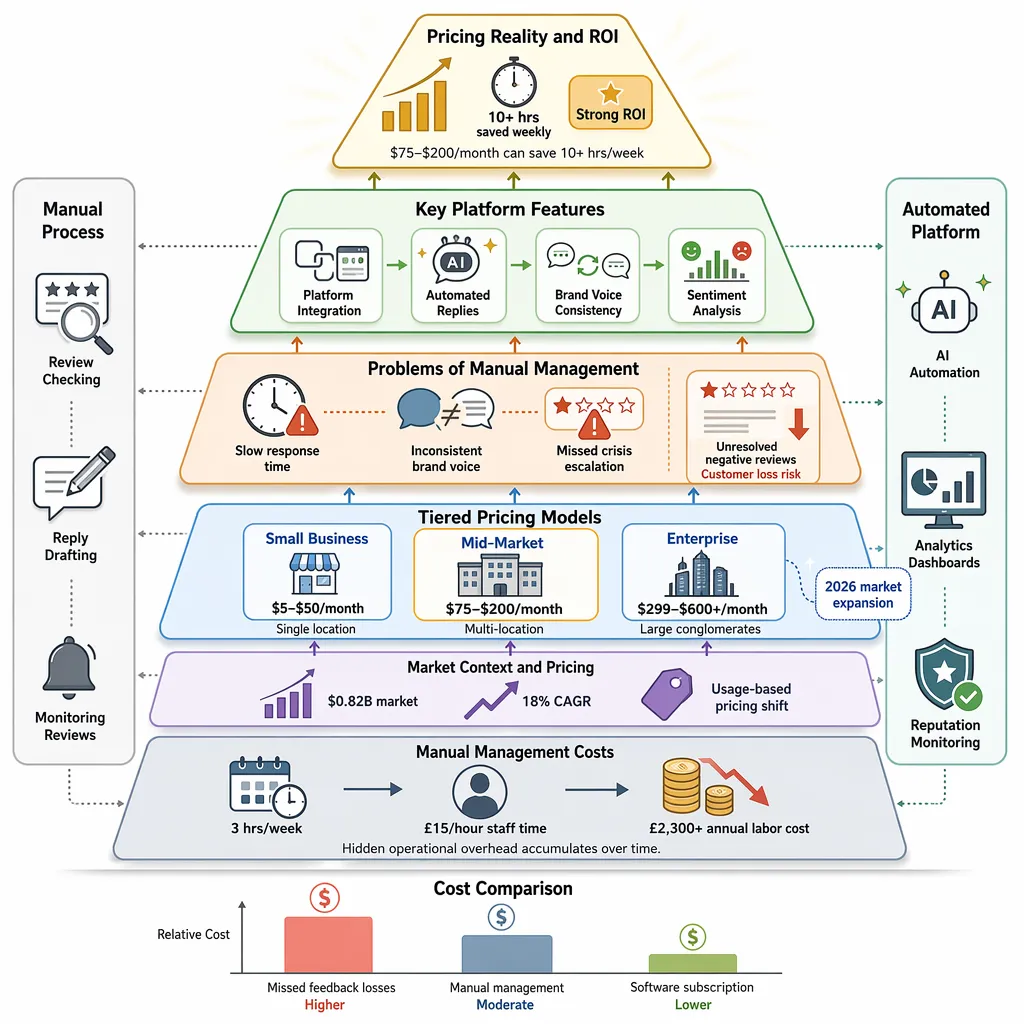
But chasing the lowest monthly subscription often misses the real cost. The most expensive review management strategy is doing it manually. Every hour a staff member spends logging into separate platforms, drafting replies, and chasing negative feedback adds up. For a UK small business paying someone £15 per hour, spending just three hours a week on reviews costs over £2,300 a year. That’s more than many annual software subscriptions.
The 2026 market context makes this clearer. The review management market is valued at $0.82B with an 18% CAGR, and pricing models are shifting toward usage-based tiers. Entry-level pricing for professional platforms typically starts between $23 and $124 per month. But the hidden cost is missed negative reviews. A single unresolved one-star review can cost a local business dozens of potential customers.
| Tier | Monthly Price Range | Best For |
|---|---|---|
| Small Business | $5 – $50/month | Single-location businesses needing basic automation |
| Mid-Market | $75 – $200/month | Small chains and multi-location businesses |
| Enterprise | $299 – $600+/month | Large multi-location conglomerates |
The hidden cost of manual management
Manual review management creates three expensive problems. First, slow response times. Research shows businesses that reply within 24 hours see better customer retention. Second, inconsistent brand voice across platforms. Third, the risk of missing a crisis. A sudden spike in negative reviews can damage reputation fast.
What to look for in a platform
When comparing options, focus on operational fit. Does the platform support the review platforms you actually use? Can it automate replies while keeping your brand voice? Does it offer sentiment analysis to spot recurring issues? These features directly affect your online reputation management cost.
The 2026 pricing reality
Most platforms charge per month, but the real cost depends on how many locations you manage and what features you need. Many businesses find that spending $75–$200 per month on a mid-market plan saves them 10+ hours of staff time weekly. That’s a strong return on investment.
For a practical comparison, use a star rating calculator to see how small rating changes affect your overall score. And if you manage multiple Google profiles, read the guide on how to merge duplicate Google Business Profiles without losing reviews.
How the 2026 Market Is Structured: Tiers, Trends, and Traps
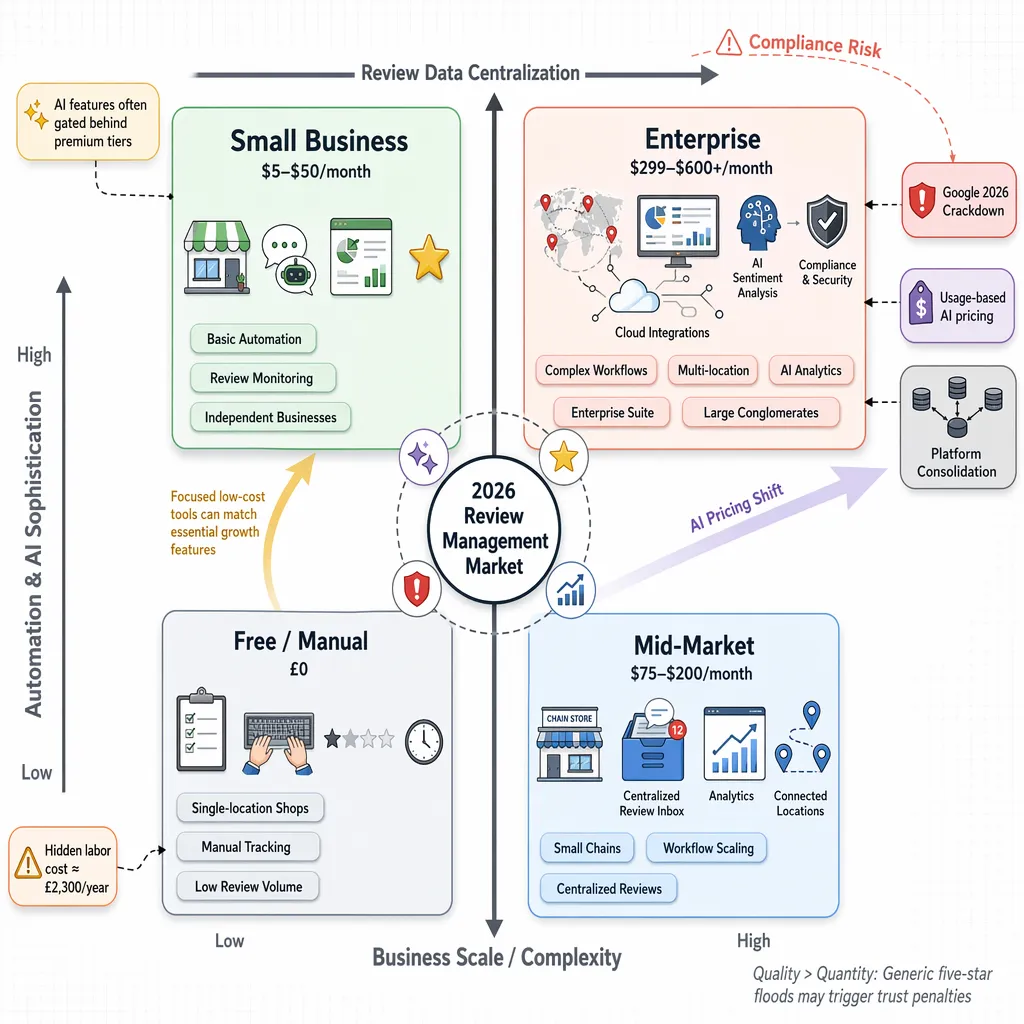
That £2,300 annual cost for manual review management is just the starting point. To understand what you're actually paying for, you need to see how the 2026 market is structured. The market breaks into four clear tiers, each with distinct trade-offs.
| Tier | Monthly Price Range | Best For |
|---|---|---|
| Free / Manual | $0 | Single-location shops with few reviews |
| Small Business | $5 – $50 | Independent businesses needing basic automation |
| Mid-Market | $75 – $200 | Small chains and multi-location operations |
| Enterprise | $299 – $600+ | Large conglomerates with complex needs |
The consolidation trap
A major trend is platform consolidation. G2's acquisition of Capterra and Software Advice has centralised review data. This matters because AI search engines now pull from these sources. If your reviews are scattered, you lose visibility. A focused tool costing $9–$99/month can deliver the same essential growth features as an expensive enterprise suite.
The AI pricing shift
Pricing models are moving toward usage-based tiers. Vendors add an 'AI tax' — gating sentiment analysis and auto-reply behind higher plans. The global review platform market is valued at USD 0.82 billion in 2026, growing at 18% CAGR. Meanwhile, the broader tech review market sits at USD 192.3 million in 2025 with an 8.6% CAGR. This growth fuels feature inflation.
Google's 2026 crackdown
Google now enforces stricter policies against manipulated reviews. Fake or incentivised reviews can trigger profile penalties. This raises the stakes for your online reputation management cost. A clean, authentic review profile is no longer optional.
The volume trap
More reviews aren't always better. A flood of generic five-star ratings can trigger a 'trust penalty'. Quality beats quantity. Focus on genuine feedback that builds real trust.
For practical tools, try the Google Place ID Finder to verify your business listings. And if you manage app store feedback, read the guide on how to manage app store reviews at scale.
Side-by-Side Pricing: What the Major Platforms Really Charge
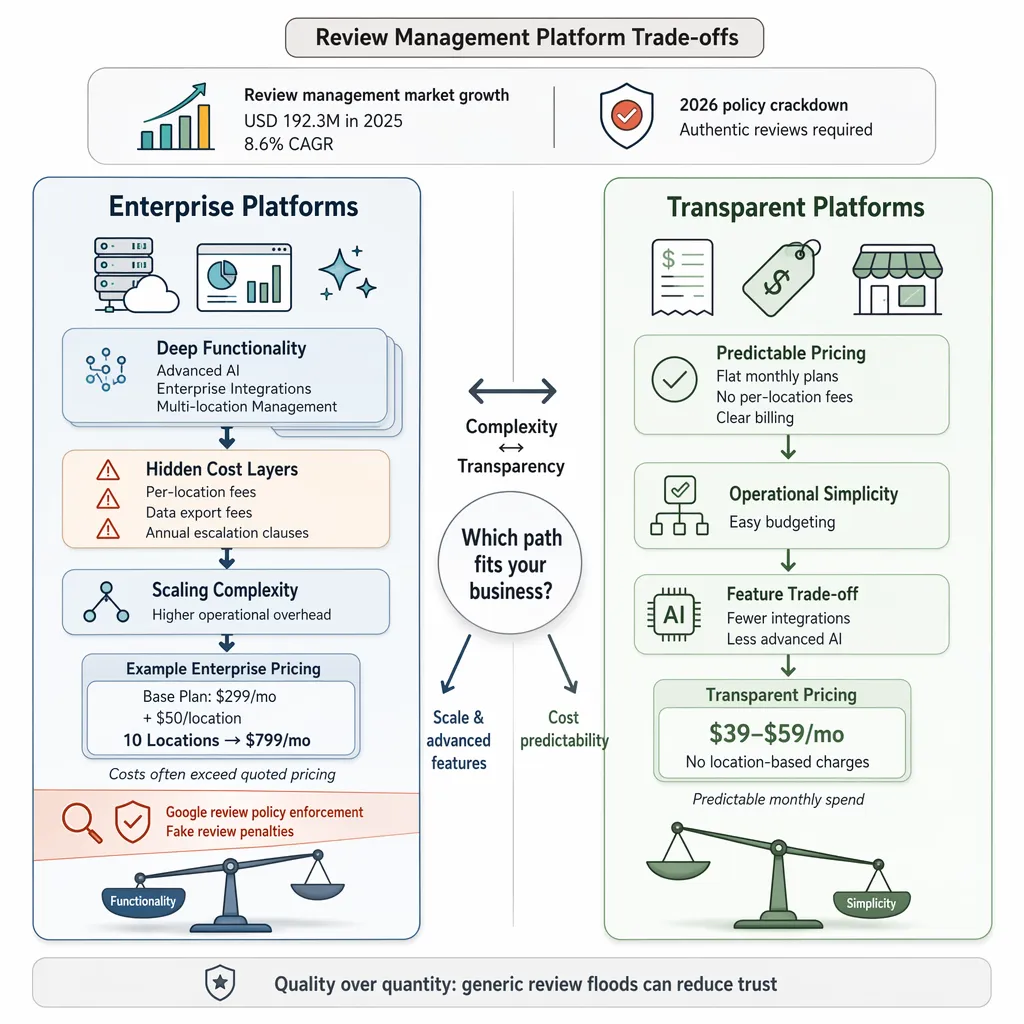
This brings us to the real cost of review management. The table below compares the major platforms head-to-head, based on verified 2026 pricing data. But the real cost often goes higher. Per-location fees can add $50–$100 per location each month. Data export fees appear when you want to leave. Multi-year contracts often include annual escalation clauses of 5–10%.
For a 10-location business, Birdeye's Starter plan begins at $299/month — and that's before any per-location or setup fees, which can add substantially to the total. Some smaller platforms take a simpler approach, with flat plans in the $39–$59 per month range. You know what you'll pay. This suits small businesses that want predictable costs. The trade-off is fewer integrations and less advanced AI features.
The choice comes down to complexity. Enterprise platforms offer deep functionality but carry hidden costs. Transparent platforms offer simplicity but may lack scale. Your online reputation management cost depends on which trade-off fits your business.
This page is the price data. If what you need is a method for weighing one vendor against another rather than the numbers themselves, our guide to comparing review management pricing and features sets out the questions to ask before you look at a single price. For a practical tool to verify your listings, try the Google Place ID Finder. And if you manage multiple profiles, the Google Review Management Software page explains how to centralise feedback.
Beyond the Price Tag: Evaluating Integration Depth and Automation Maturity
That pricing table reveals the headline costs, but the real question is: what does the tool actually do for your existing workflows? Most articles compare feature checklists — 'supports Google' — as if that's enough. It's not.
What Most Articles Get Wrong
A tool that requires manual data entry or a separate login is a liability, not a solution. The depth of integration matters far more than a list of supported platforms. If your CRM can't talk to your review tool, you're creating busywork, not removing it. This is where the concept of 'reputation infrastructure' becomes critical. You need a system that fits into your stack, not one that sits beside it.
The Seat Apocalypse
AI automation is changing how we pay for software. Per-seat pricing is becoming obsolete. As AI handles more replies and analysis, you need fewer human users but more utility consumption — more API calls, more data processing. The old model of paying per person doesn't reflect how modern teams actually use review tools. You should expect pricing that scales with usage, not headcount.
What to Look For
| Factor | Why It Matters |
|---|---|
| CRM-native integration | Eliminates manual data transfer |
| AI response quality | Saves time without sounding robotic |
| Sentiment analysis depth | Catches issues before they escalate |
| Crisis alerting | Enables rapid response to negative spikes |
How It Addresses These Gaps
ReviewSense centralises feedback from Google Business Profile, Facebook, Apple App Store, and Google Play into a single dashboard. You get instant alerts for new reviews and an AI response generator that produces on-brand replies in seconds. Built-in sentiment analysis flags recurring issues and detects spam, so your team focuses on genuine feedback. Crisis alerts notify you of negative spikes, letting you act fast. This isn't just review software — it's reputation infrastructure that reduces your online reputation management cost by cutting manual effort.
For a practical start, try the Star Rating Calculator to understand your current position. And if you manage app store feedback, the Apple App Store review management software guide explains the features that matter most.
Choosing the Right Platform for Your Business Size and Sector
That pricing table gives you the headline numbers, but the right platform depends on your business size and sector. A single-location café doesn't need enterprise features, and a 20-location chain can't rely on free tools alone. Here's how to match the tool to your situation.
| Business Type | Recommended Approach | Starting Price Point | Key Considerations |
|---|---|---|---|
| Single-location shop | Free foundations + low-cost tool | $9/mo | Avoid enterprise bloat; focus on Google Business Profile |
| Mid-market chain (3-20 locations) | Multi-location platform with collaboration | $39–$149/mo | Review velocity monitoring, queue workflows, brand voice |
| Enterprise / Agency | Custom pricing with white-label reporting | Varies | API integrations, crisis alerts, scalable analytics |
Single-location shops: start small, stay lean
If you run a local restaurant or service business, your priority is building a base of 10–20 legitimate reviews on Google Business Profile. Free tools like the Google Review Link Generator help you collect them without cost. For low-cost support, platforms like StarFlywheel at $9/mo or Ryviu at $6.99/mo offer basic functionality. Avoid enterprise platforms — you'll pay for features you never use.
Mid-market chains: collaboration and velocity matter
For businesses with 3–20 locations, you need multi-location support and team collaboration. ReviewSense fits this segment well. Its queue workflows let you assign replies across locations, and custom brand voice ensures consistency. Built-in analytics track sentiment trends and response rates. Monitoring review velocity helps you spot issues early — a key recommendation from the strategic section. The Online Review Management Guide explains how to scale these processes.
Enterprise and agencies: customisation and white-label
Larger operations need custom pricing, white-label reporting, and API integrations. ReviewSense scales to this level, offering custom integrations and crisis alerts for negative spikes. You can test the AI response quality with your own brand voice using the 7-day free trial. For app store feedback, the guide to Apple App Store review management covers the features that matter for high-volume teams.
Your online reputation management cost should match your needs. Start with the free trial to see if the tool fits before committing.
Conclusion
Choosing the right review platform isn't about the lowest price—it's about the best fit for your scale. For single-location shops, free tools and basic plans work. Mid-market chains need collaboration and velocity tracking. Enterprises require customisation and white-label reporting. Across all segments, look for CRM-native integration, quality AI responses, deep sentiment analysis, and crisis alerting. ReviewSense delivers these capabilities at transparent pricing, scaling from one location to hundreds without hidden fees. Stop guessing which feedback matters and start protecting your reputation. Turn scattered reviews into actionable insights that improve customer experience and drive growth. Start your 7-day free trial