
Is Reputation.com still the best fit for UK SMEs facing 2026's tighter regulations? Rising costs and complex features leave many small businesses overpaying for capabilities they rarely use. Modern alternatives now offer AI-powered simplicity, GDPR-compliant workflows, and specialised tools for managing Google reviews and social feedback at half the price. This guide compares solutions addressing UK-specific pain points.
Managing this manually is hard. ReviewSense automates it.
The Evolving UK Reputation Management Environment in 2026
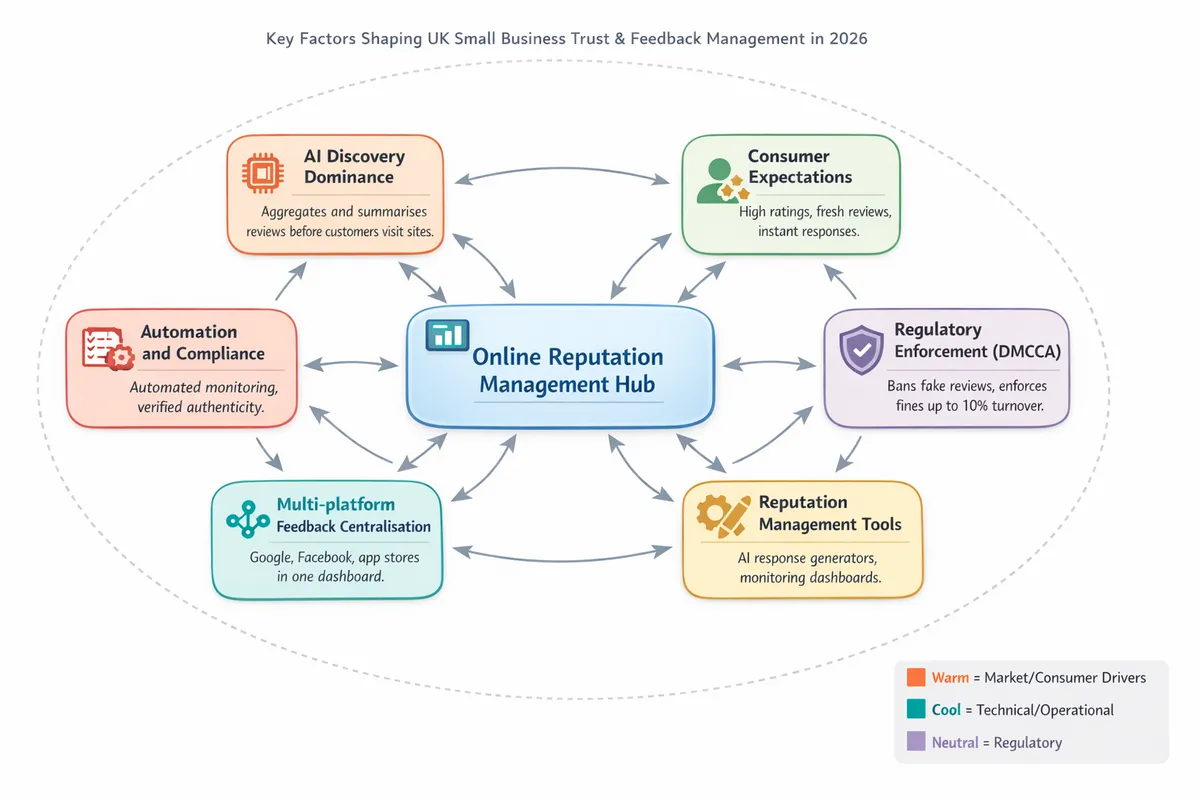
UK small businesses face a transformed reputation environment in 2026, driven by three critical shifts. First, AI answer engines like Gemini and ChatGPT now influence nearly half of UK consumer discovery journeys. This 45% adoption rate means your reviews are being aggregated and summarised by algorithms before customers even visit your website. If your ratings dip or feedback contains unresolved complaints, AI responses will surface these issues prominently, making consistent monitoring non-negotiable. The global online reputation management software market reflects this urgency, growing from $6.88 billion in 2025 to a projected $7.75 billion in 2026 according to Mordor Intelligence research.
Second, UK consumer expectations around reviews have intensified. 97% read reviews before engaging with businesses, while 31% automatically exclude companies with under 4.5 stars. Crucially, 22% only trust reviews posted within the last fortnight, demanding near real-time reputation management. This creates immense pressure to maintain high ratings and respond swiftly. Tools like the 5-star review response generator help craft timely replies, while the guide to 10-star rating calculations explains how minor fluctuations impact visibility.
Third, the UK's Digital Markets, Competition and Consumers Act 2024 (DMCCA) brings strict enforcement. It bans fake reviews entirely and empowers the Competition and Markets Authority to impose fines up to 10% of global turnover for violations. Businesses must now verify review authenticity and document moderation processes. The negative review response generator helps maintain compliance by creating transparent, professional replies, while the online review management guide details ethical practices. Failure to adapt risks both reputation damage and substantial penalties under the new regime.
These converging trends—AI discovery dominance, heightened consumer scrutiny, and regulatory tightening—make manual reputation management unsustainable. Solutions must centralise multi-platform feedback (Google, Facebook, App Stores), automate monitoring, and ensure compliance. For deeper insights, explore our analysis of Google review management software capabilities or learn about using free AI response tools to maintain authentic engagement.
Essential Criteria for Your Reputation Management Solution
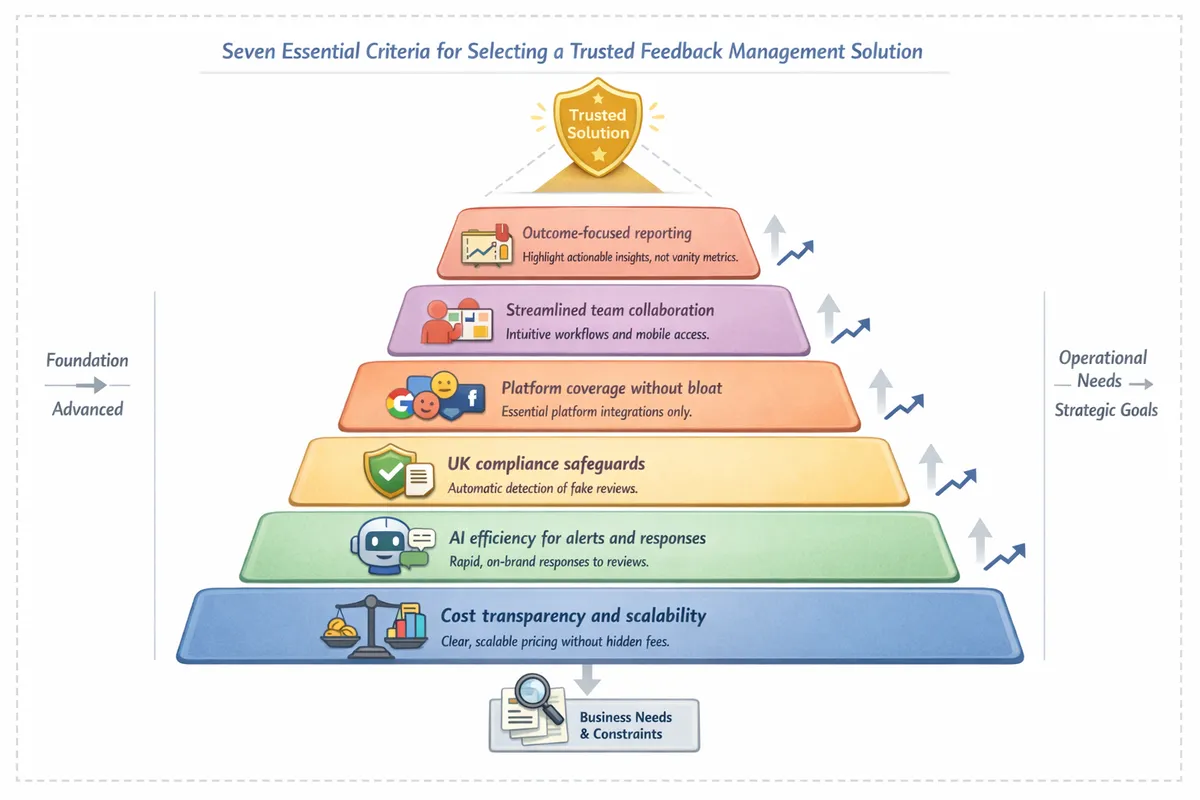
Given the regulatory pressures and shifting consumer behaviours outlined, UK small businesses need a reputation management solution that avoids common pitfalls of enterprise platforms. Many comparison articles overlook critical challenges SMBs face, pushing over-engineered tools with unnecessary complexity. Focus instead on these seven essential criteria when evaluating a reputation.com alternative:
Cost transparency and scalability: Avoid opaque enterprise pricing with hidden fees. Look for clear monthly/annual tiers that grow with your business, from single locations to multi-site operations. Industry analysts note that hidden costs in complex contracts often undermine ROI for smaller firms.
AI efficiency for alerts and responses: With Google's review policy changes in 2026 potentially removing older feedback, immediate response capabilities are non-negotiable. Prioritise AI that generates on-brand replies in seconds, not hours. Our analysis of Google's upcoming changes explains why speed matters more than ever.
UK compliance safeguards: Under the DMCCA, fake review detection isn't optional. Ensure your solution automatically flags for suspicious patterns and provides audit trails. Our online review management guide details compliance best practices for UK businesses.
Platform coverage without bloat: Focus on solutions covering essential UK platforms: Google Business Profile (use our Google review QR code guide for easy collection), Facebook, and app stores. Avoid paying for unused integrations with irrelevant directories. For app-based businesses, our app store management guide clarifies key requirements.
Actionable sentiment analysis: Basic positive/negative scoring isn't enough. You need topic extraction to identify recurring complaints like delivery issues or staff rudeness. This insight lets you fix root causes, not just symptoms. Track how improvements affect ratings with our star rating calculator.
Streamlined team collaboration: Complex approval workflows create response delays. Seek intuitive assignment features and mobile access for frontline staff. Avoid solutions requiring IT support for simple tasks.
Outcome-focused reporting: Dashboards should highlight reputation risks and opportunities, not vanity metrics. Prioritise response rate tracking, sentiment trends, and review volume alerts that prompt action.
When selecting reputation management software in the UK, remember that simplicity drives consistency. Overly complex systems lead to abandoned workflows. Focused solutions covering core needs deliver better protection without the bloat. If your shortlist runs wider than the Reputation.com alternatives below, our 2026 review management software comparison sets out its own selection framework covering vendor pricing, AI response quality and sentiment depth.
Leading Alternatives Compared
With those essential criteria established, let's evaluate how top reputation management platforms compare for UK small businesses needing a reputation.com alternative. We've analysed five leading options against core requirements like UK compliance, pricing clarity, and AI efficiency – focusing solely on their support for Google, Facebook, Apple App Store, and Google Play reviews as mandated by UK regulations.
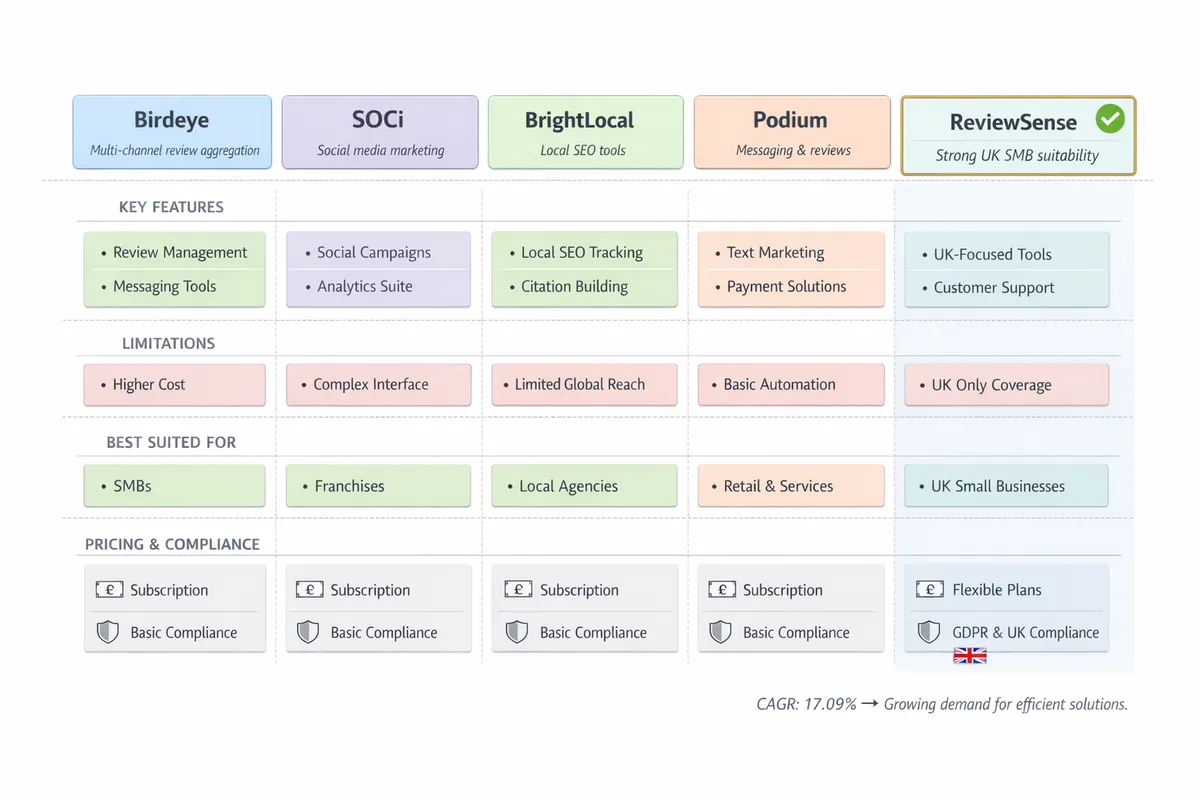
| Platform | Core Strengths | Ideal Business Size | AI Capabilities | UK Compliance Features | Pricing Transparency |
|---|---|---|---|---|---|
| Birdeye | High user satisfaction (G2 leader), broad feature set | Mid-market to multi-location | Review insights and response suggestions | Basic spam detection | Custom quotes only, annual contracts |
| SOCi | Enterprise social media integration | Large franchises, agencies | Limited to social content automation | Minimal UK-specific tools | Enterprise pricing, undisclosed minimums |
| BrightLocal | Local SEO focus, citation management | Single-location service businesses | New AI Insights feature | Basic flagging; key features require upgrades | Tiered plans, AI tools at premium tiers |
| Podium | Vertical-specific workflows, messaging integration | SMBs in retail/home services | Template-based responses | No dedicated UK compliance tools | Custom pricing with frequent add-ons |
| ReviewSense | Centralised dashboard, instant alerts, spam detection | Single-location to multi-site enterprises | Personalised response generation, toxic content filtering | Fake review flagging, DMCCA audit support | Clear monthly/annual plans, 7-day trial |
Key limitations emerge: Birdeye's enterprise pricing puts it beyond typical SMB budgets, while SOCi's complex interface suits large teams, not lean operations. BrightLocal excels at local SEO but requires premium plans for full AI functionality. Podium's vertical focus may exclude generic businesses, and its compliance support lacks UK specificity. For a direct read on how these platforms compare, see our Reputation.com vs Birdeye vs Podium vs ReviewTrackers comparison.
For UK small businesses, ReviewSense addresses critical gaps. Its AI response generator crafts on-brand replies in seconds, while built-in spam detection helps meet DMCCA requirements for fake review management – a process detailed in our step-by-step guide to removing fake Google reviews. Transparent pricing avoids unexpected costs, and free tools like the Google review link generator provide immediate value.
The reputation management software market grows at 17.09% CAGR to 2031, reflecting demand for efficient solutions. ReviewSense's platform-agnostic approach centralises key UK feedback sources without irrelevant integrations. For deeper analysis, see the Google Play review management or explore fundamental review management principles. Generate compliant replies instantly with the negative response tool, or compare all options in the 2026 industry rankings.
How Modern Platforms Solve Core Pain Points
For UK businesses seeking a reputation.com alternative, modern platforms directly address persistent operational headaches that drain resources. The significant growth in high-value contracts for solutions like Birdeye — with a 113% increase in customers spending over $100K as reported by Birdeye — reflects how targeted tools solve core challenges:
Fragmented Feedback: Manually checking Google Business Profile, Facebook, and app stores fractures your workflow. Centralised dashboards unify these streams into one actionable feed. This eliminates platform-hopping and ensures no review goes unanswered. ReviewSense's approach mirrors best practices in customer review management by consolidating key UK sources.
Response Overload: Crafting individual replies to every review drains hours. AI generators create personalised, brand-aligned responses in seconds. Approval workflows then let managers vet replies before sending. This cuts reply times from hours to minutes. Learn how AI response generators maintain consistency at scale.
Compliance Risk: Under the UK's Digital Markets, Competition and Consumers Act, fake review detection is mandatory. Automated spam and toxic content filtering flags suspicious patterns. This reduces legal exposure and prevents profile suspensions. The suspended GBP appeal guide details compliance safeguards.
Insight Gaps: Basic sentiment scores don't reveal why customers complain. Advanced analysis identifies recurring issues like delivery delays or staff rudeness. Real-time crisis notifications alert teams to negative spikes. Tracking improvements becomes easier with tools like the 10-star rating calculator for precise measurement.
Scalability Hurdles: Adding locations or team members shouldn't break your system. Custom brand voices ensure tone consistency across responders. Collaboration features let regional managers handle local feedback. Features like Google review link generation simplify multi-location rollouts.
By solving these fundamental challenges, platforms like ReviewSense deliver a practical reputation management software UK solution that scales with your ambitions, minus enterprise complexity.
Implementation and Compliance Best Practices
After choosing a reputation.com alternative that fits your UK operations, implementing it effectively ensures compliance and maximises impact. Start with free tools for immediate traction: the Google review link generator creates branded review prompts, while the review request email generator automates feedback collection. These require zero setup and help build review volume from day one.
Configure real-time alerts for new reviews across Google Business Profile, Facebook, and app stores. UK consumers expect responses within 24 hours—delays risk reputation damage. Set up queue workflows with tiered approvals to maintain brand consistency. For multi-location businesses, the Google Place ID Finder ensures accurate profile mapping during onboarding.
Use sentiment analysis to meet DMCCA obligations. It automatically flags suspicious patterns like fake reviews or toxic content that could trigger profile suppression. Regularly audit these alerts—our guide on merging duplicate Google Business Profiles helps resolve compliance risks from fragmented listings. This proactive monitoring prevents regulatory penalties.
Train teams to enhance AI-generated drafts with genuine empathy. As Gartner's research confirms, over-reliance on automation erodes customer trust. Balance efficiency with human nuance using the AI-powered response strategies.
Finally, use analytics for CX improvements. Track sentiment trends to identify recurring pain points like delivery delays. The star rating calculator quantifies progress, while the guide on choosing customer review software helps align data with UK compliance frameworks. This turns feedback into actionable operational refinements.
Conclusion
For UK small businesses seeking a Reputation.com alternative, the core challenges are clear: fragmented feedback across key platforms (Google, Facebook, Apple/Google app stores), compliance risks under UK regulations like the DMCCA, and scalability limitations. ReviewSense directly solves these by centralising reviews into one actionable dashboard, automating personalized responses with AI, and flagging fake or toxic content to maintain compliance. Its built-in analytics turn scattered feedback into clear operational insights—helping you improve CX and protect your reputation without enterprise complexity. Transform disorganised reviews into a growth engine with ReviewSense. Start your 7-day free trial.
Comparing other platforms too? See our guides to Birdeye alternatives, Podium alternatives, NiceJob alternatives and ReviewTrackers alternatives.