
Yet manual review management drains resources while platforms like Google purge ratings unexpectedly. This guide reveals tools that actually move the needle for SMBs—cutting through hype with hard data.
Managing this manually is hard. ReviewSense automates it.
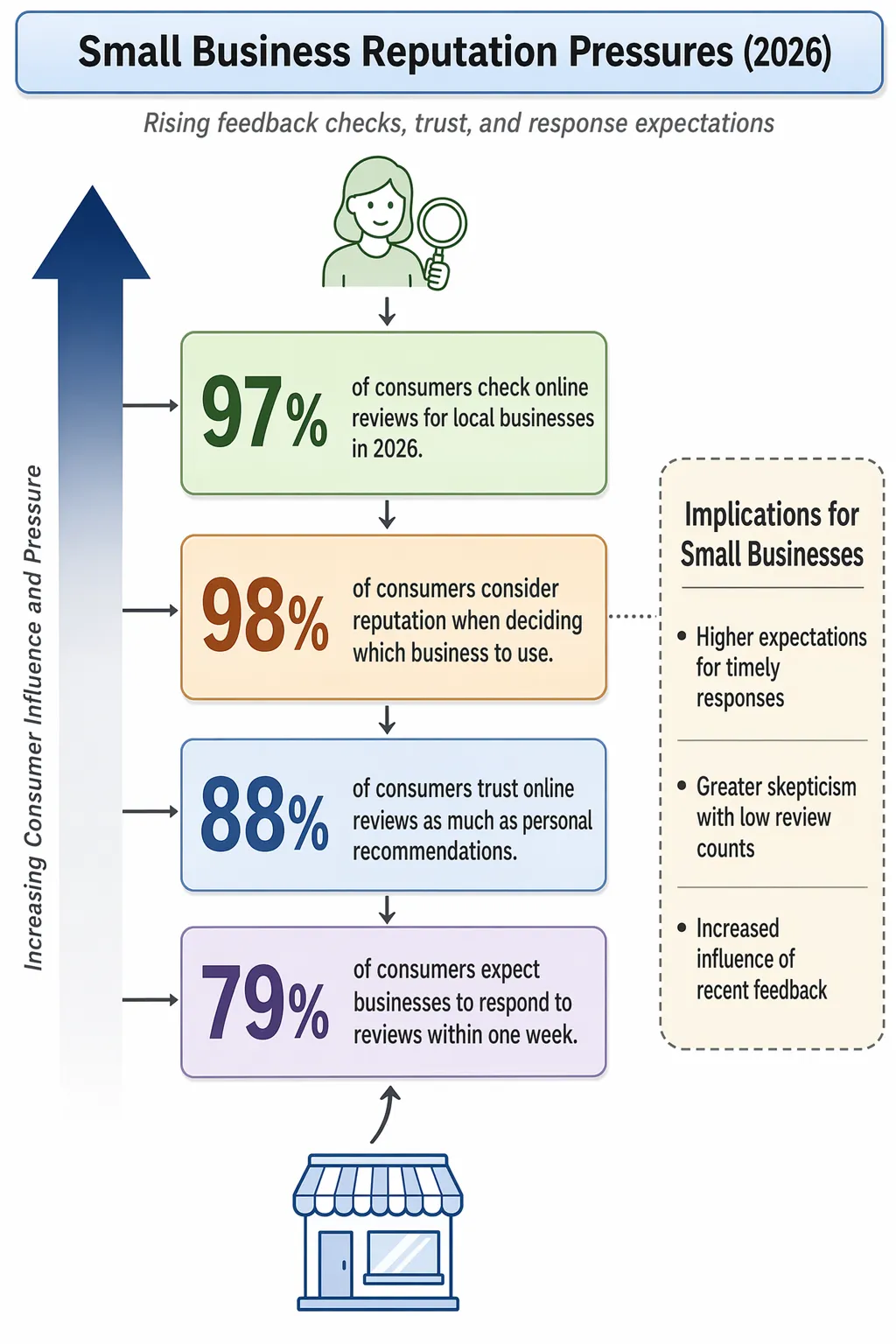
Why Reviews Make or Break Small Businesses in 2026
| Consumer Review Behaviour in 2026 | Key Statistic |
|---|---|
| Read reviews before choosing local business | 97% |
| Always read reviews when browsing | 41% (up from 29% in 2025) |
| Read reviews before online purchases | 98% |
| Trust reviews like personal recommendations | 79% |
The Make-or-Break Reality
These figures reveal an undeniable truth: reviews now fundamentally shape consumer choices. With 97% checking reviews before visiting and 98% researching before online purchases, your digital reputation directly impacts footfall and sales. The stakes are higher than ever - 41% now consistently scrutinise feedback during research, a sharp rise from just 29% last year. Crucially, 79% trust these opinions as much as recommendations from friends, making review management non-negotiable for credibility.
Beyond Star Ratings: The Hidden Expectations
Modern consumers evaluate more than just average scores. They actively seek recent feedback, prioritising reviews from the last three months to gauge current performance. Volume matters too - businesses with fewer than 20 reviews face scepticism. Response culture is equally vital, with most expecting replies to both praise and criticism. This engagement demonstrates you value customer voices. Neglecting these aspects risks alienating potential clients before they even contact you. Effectively managing this process is key, as highlighted in the guide on customer review management best practices.
The Crumbling Manual Approach
Attempting this manually creates unsustainable pressure. Only a small fraction of businesses still rely on spreadsheets and calendar reminders to track feedback across Google Business Profile, Facebook, and app stores. This fragmented approach leads to missed reviews, delayed responses, and overlooked trends. Without centralised monitoring, spotting fake or harmful content becomes reactive rather than proactive. Our step-by-step resource on handling fraudulent Google reviews illustrates the complexities involved. As expectations escalate, manual methods simply can't deliver the consistency modern consumers demand.
Essential Features That Actually Drive Results
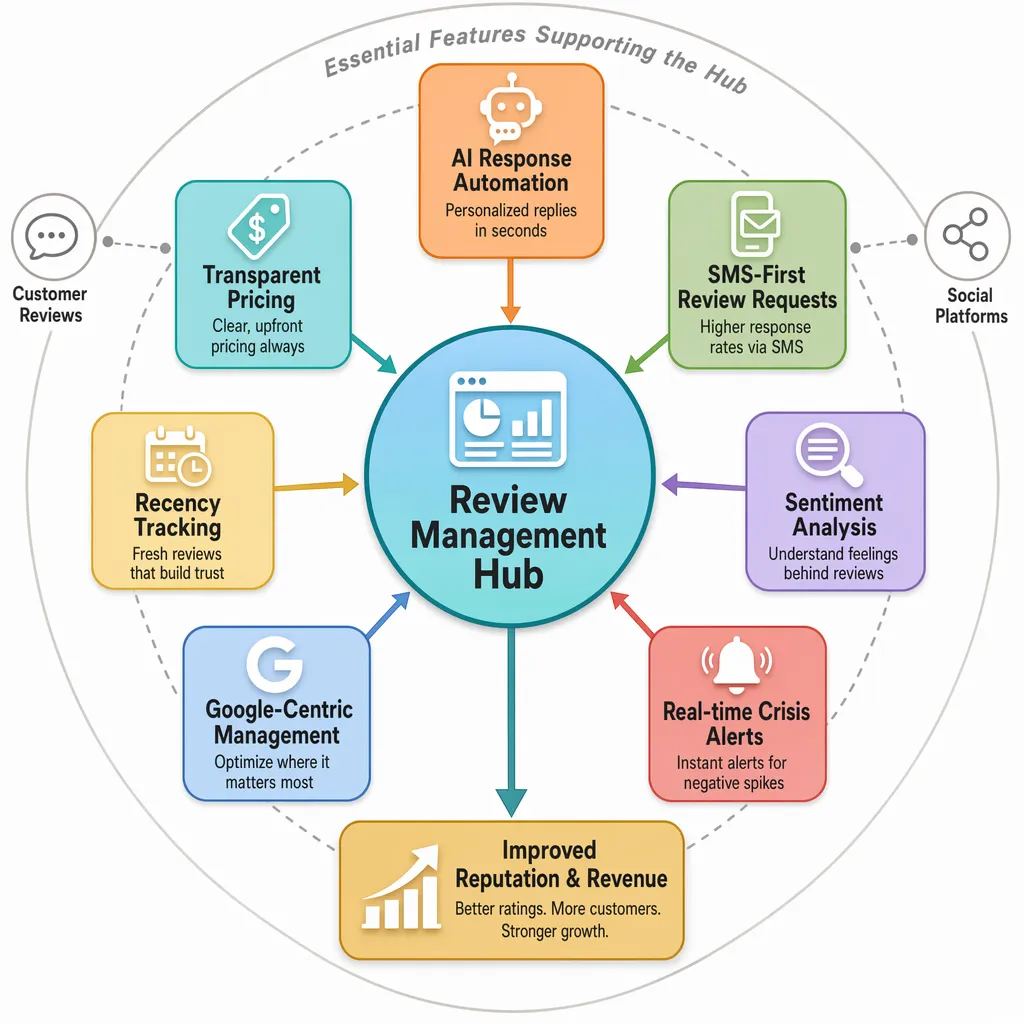
Given these pressures, small businesses need purpose-built tools that automate and simplify the review management process, turning scattered feedback into actionable insights. Automation earns its place only if the output still sounds like you, and our guide to automating responses without losing quality covers how to keep both.
| Essential Feature | Key Benefit |
|---|---|
| AI Response Automation | Overcomes 50% consumer aversion to generic replies with personalised, brand-aligned responses |
| SMS-First Review Requests | Leverages 98% open rates to ensure requests are seen and acted upon |
| Sentiment Analysis | Automatically flags recurring complaints and emerging issues across platforms |
| Real-time Crisis Alerts | Sends instant notifications for sudden negative review spikes |
| Google-Centric Management | Centralises control for the most critical review platform |
| Recency Tracking | Highlights recent feedback matching 74% consumer preference |
| Transparent Pricing | Provides clear costs with no hidden fees for straightforward budgeting |
For review management for small businesses, what actually works in 2026 centres on features solving core operational headaches. AI response automation tackles slow reply times by generating personalised responses in seconds, crucial when 19% expect same-day engagement. SMS-first invitations sidestep email clutter with 98% open rates, directly driving review volume, provided the link inside them lands on the right profile: our guide to using a Google review generator tool covers building that link. Sentiment analysis scans feedback across Google, Facebook and app stores, surfacing urgent issues before they escalate—complemented by crisis alerts that ping teams during negative spikes for immediate damage control.
Google-centric tools streamline management where most reputation-building happens, while recency tracking prioritises the last three months' feedback that 74% of consumers exclusively value. Transparent pricing eliminates budget surprises, letting you scale confidently. Together, these capabilities maintain the high star ratings that drive decisions—68% of consumers require at least four stars, and a one-star increase can boost revenue by 5-9%. For response efficiency, the AI review response guide offers practical implementation tips, while broader strategies are covered in the customer reputation playbook.
Top Contenders Compared: 2026 Tool Analysis
With essential review management features established, selecting the right platform requires balancing cost, capabilities, and business needs. Here's how 2026's top contenders compare for UK small businesses:
| Tool | Pricing | Key 2026 Features | Best For | Limitations |
|---|---|---|---|---|
| NiceJob | $75+/mo | SMS review requests, 4x conversion boost | Service trade businesses | No Apple/Google Play integration |
| Podium | $249+/mo | SMS-first inbox, payment links | Multi-location operations | Expensive for single sites, complex setup |
| Birdeye | $299+/mo | Operational insights, reputation analytics | Multi-location brands | High cost, steep learning curve |
| ReviewScout AI | $4.99+/mo | Budget-friendly AI responses | Micro-businesses, solopreneurs | Lacks team features, no sentiment analysis |
| Okendo | $19+/mo | Satisfaction surveys, UGC display | E-commerce brands | No GBP/Facebook support, app-store only |
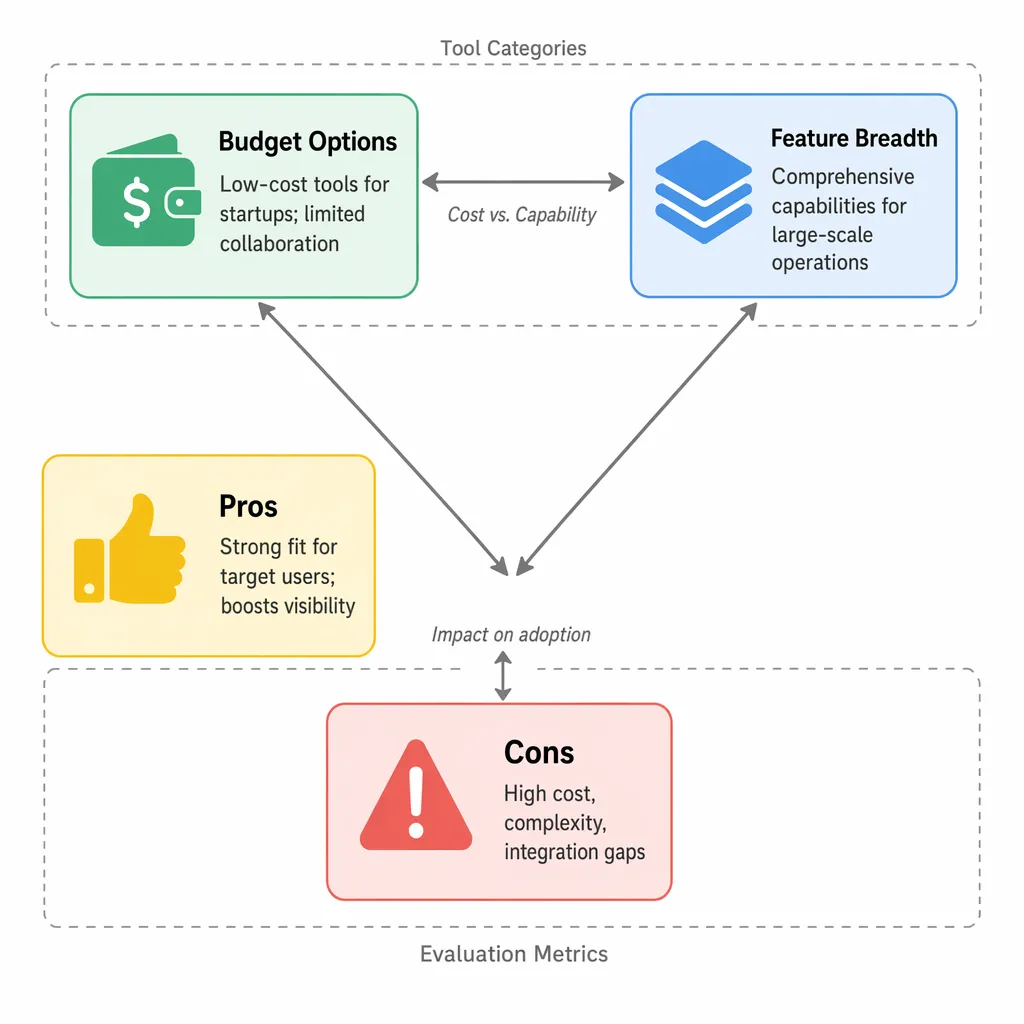
Budget vs. Breadth: Finding Your Fit
Lower-cost options like ReviewScout AI help startups begin gathering feedback, but lack critical team collaboration. Okendo excels for app-based commerce yet ignores local review platforms entirely. With 47% of consumers avoiding businesses under 20 reviews, volume remains critical. The 5-star review response generator helps counter resource gaps.
The Google Gap in 2026 Tools
Google Business Profile dominates local discovery, yet several tools neglect it. Okendo's app-only focus and ReviewScout's limited integrations create visibility blind spots. Reviewly AI goes the other way, covering Google reviews only and pairing SMS review requests and QR and NFC review cards with AI reply drafts, from $99 a month. Proper GBP setup prevents issues - use the Google Place ID finder to verify listings. For multi-location brands, merging duplicates without losing historical feedback is essential, as covered in the duplicate GBP resolution guide.
Response Expectations & Workflow Realities
Ignoring feedback damages trust:Podium's complex workflows suit enterprises but overwhelm independents. For app-focused operations, efficient triage is possible using scalable App Store workflows. Prioritise tools matching your team size and response capacity.
Avoiding Costly Pitfalls
Enterprise platforms like Birdeye offer depth but demand significant budgets and training - impractical for most independents. NiceJob hits a sweet spot for trades but lacks app review coverage. Remember that recent reviews impact decisions: businesses with fresh feedback see 50% higher engagement. For comprehensive 2026 comparisons, explore the best review management software analysis.
Avoiding Costly Mistakes in Review Management
Selecting the right tools matters, but strategic implementation separates effective review management from costly errors. Avoid these five common pitfalls undermining UK small businesses in 2026:
| Mistake | Impact | Strategic Fix |
|---|---|---|
| Prioritising tools over experience | Hospitality ratings drop 0.8 stars on average | Audit feedback monthly for recurring pain points |
| Generic AI responses | 50% of consumers distrust templated replies | Personalise with brand voice and specific details |
| Ignoring recency | Consumers heavily discount stale feedback | Highlight recent reviews in responses and marketing |
| Underestimating response expectations | 42% avoid businesses ignoring reviews | Set alerts for new reviews; aim for 48-hour replies |
| Overpaying for enterprise features | Strains budgets without proportional ROI | Use free tools and scalable platforms with transparent pricing |
Prioritising tools over experience leads to hollow reputation gains. Hospitality businesses focusing solely on review volume saw average rating drops of 0.8 stars when underlying service issues persisted. Fix this by analysing feedback monthly to identify recurring complaints. Address operational flaws before soliciting more reviews.
Generic AI responses erode trust. Half of UK consumers spot templated replies instantly, damaging credibility. Contrarian research confirms authenticity erosion when responses lack human nuance. Personalise AI-generated replies using specific customer details and your brand voice. Tools like the customisable response generator help maintain genuine engagement.
Ignoring recency diminishes review impact. Consumers prioritise recent feedback when making decisions. Businesses showcasing outdated testimonials appear out of touch. Feature your latest positive reviews in marketing materials and reference recent interactions when replying to demonstrate active listening.
Underestimating response expectations risks customer loss. 42% of consumers avoid businesses that ignore reviews entirely, while 81% expect replies within a week. Delayed responses signal indifference. Use real-time alerts to notify teams of new feedback. Aim to respond within 48 hours, especially for critical platforms like Google Business Profile.
Overpaying for enterprise features burdens micro-businesses. The review software market's growth to $19.56 billion in 2026 tempts overspending. Avoid complex suites with unused functionality. Start with free resources like the star rating calculator and scalable platforms offering pay-as-you-grow pricing. Focus on core needs: response efficiency and sentiment tracking.
Implementing a Future-Proof Strategy
Having addressed common pitfalls, let's establish a sustainable three-phase approach to review management that adapts to 2026's demands. This framework ensures your strategy evolves with changing consumer expectations and platform algorithms.
| Phase | Core Actions |
|---|---|
| Audit Gaps | Measure volume/response rates; identify weak platforms using free tools |
| Select Tools | Balance AI efficiency with human oversight; centralise key review platforms |
| Build Loops | Act on sentiment insights; integrate SMS/video requests; monitor trends |
Audit existing gaps before investing. First, calculate your target review volume using free resources like the star rating calculator – especially critical as AI-driven local search now favours businesses maintaining 4.5+ stars. Track response rates across Google Business Profile, Facebook, and app stores, as inconsistent engagement damages credibility. Identify platforms where you're underrepresented; many UK independents overlook Apple App Store feedback despite its mobile-first audience.
Select tools strategically, remembering that 78% of businesses now use specialised software. Prioritise platforms consolidating Google, Facebook, and app store reviews in one dashboard. Entry-level solutions start around $19 monthly, but verify they include sentiment analysis to detect recurring issues. Balance AI response generation with human oversight – generic replies backfire. For multi-location operations, ensure tiered pricing scales affordably, with mainstream SMB platforms starting around $75 monthly for team workflows.
Build actionable feedback loops using your data. Address operational flaws revealed by sentiment analysis – if customers repeatedly mention slow service, fix this before soliciting more reviews. Automate post-service SMS review requests; tools with "Review Engine" features boost conversion rates 4x by sending timely reminders. Encourage video testimonials, which consumers find more authentic than text. Finally, monitor analytics for negative spikes, using crisis alerts to protect your reputation during operational hiccups. This closes the loop between feedback and improvement. If email carries most of your requests, our review generation email playbook covers the sequencing that lifts reply rates.
This phased approach transforms reviews into a growth catalyst, whether you're a solo trader or small business or expanding multi-site business. By centralising key platforms and acting on insights, you'll build reputation resilience through 2026's shifts.
Conclusion
Mastering review management in 2026 requires avoiding critical pitfalls—like generic responses and delayed replies—while implementing a strategic three-phase approach: auditing gaps, selecting centralised tools, and building actionable feedback loops. By consolidating reviews from Business Profile, Facebook, and app stores into one dashboard with sentiment analysis and AI efficiency, businesses turn fragmented feedback into operational improvements and reputation resilience. ReviewSense delivers this exact solution, eliminating platform sprawl with real-time alerts, brand-aligned responses, and crisis detection for Google, Facebook, Apple App Store, and Google Play. Transform scattered reviews into customer experience insights and drive growth: Start your 7-day free trial.