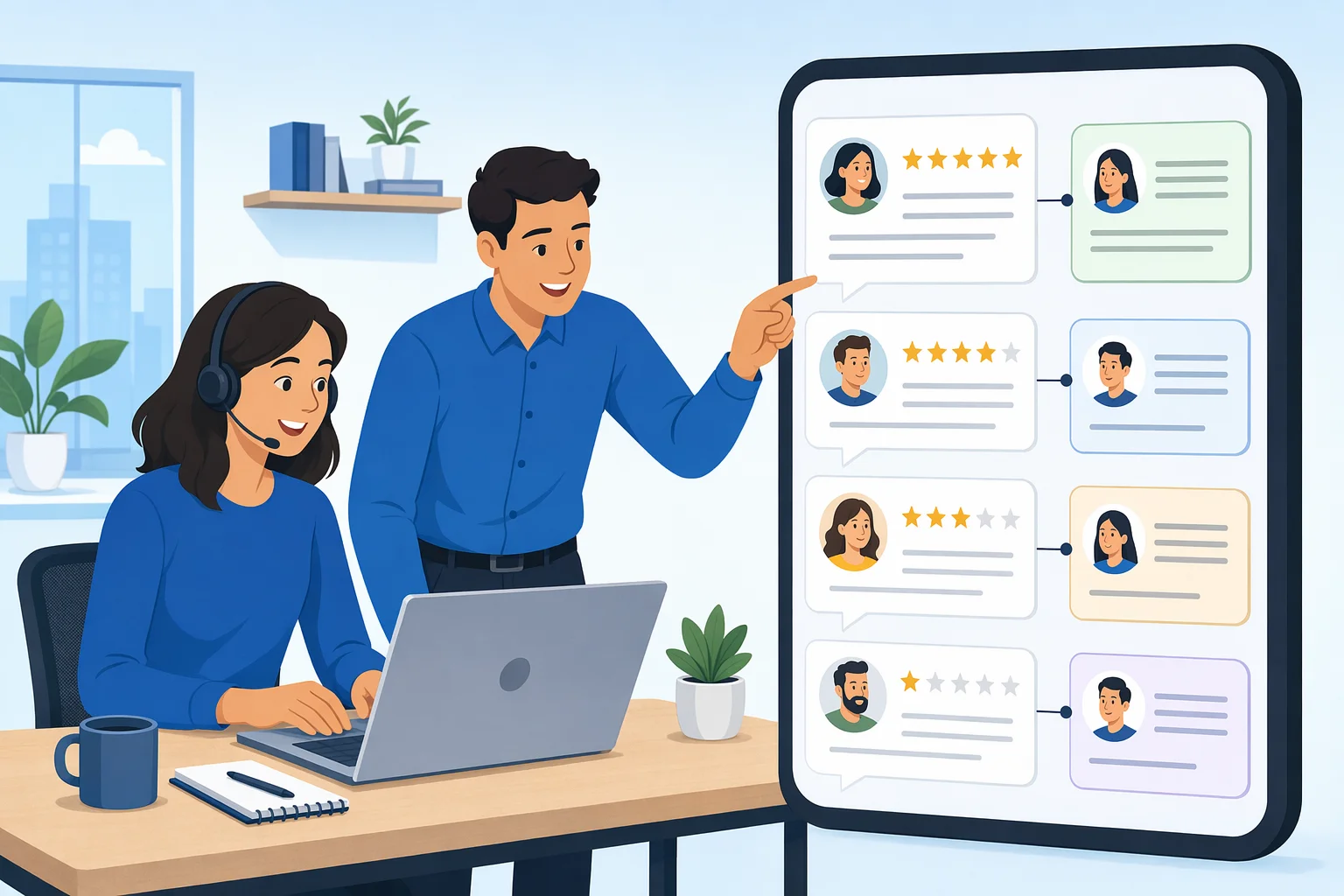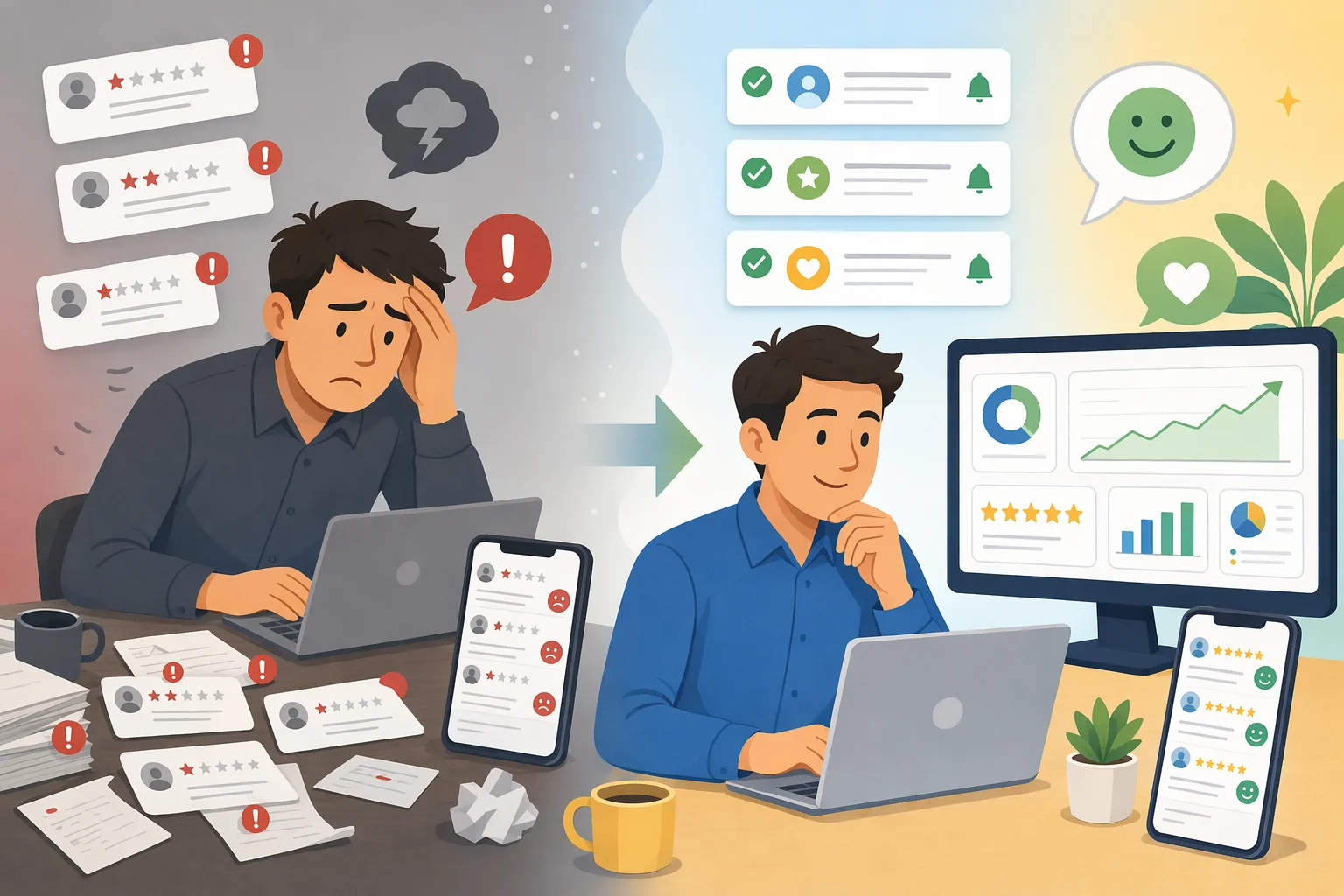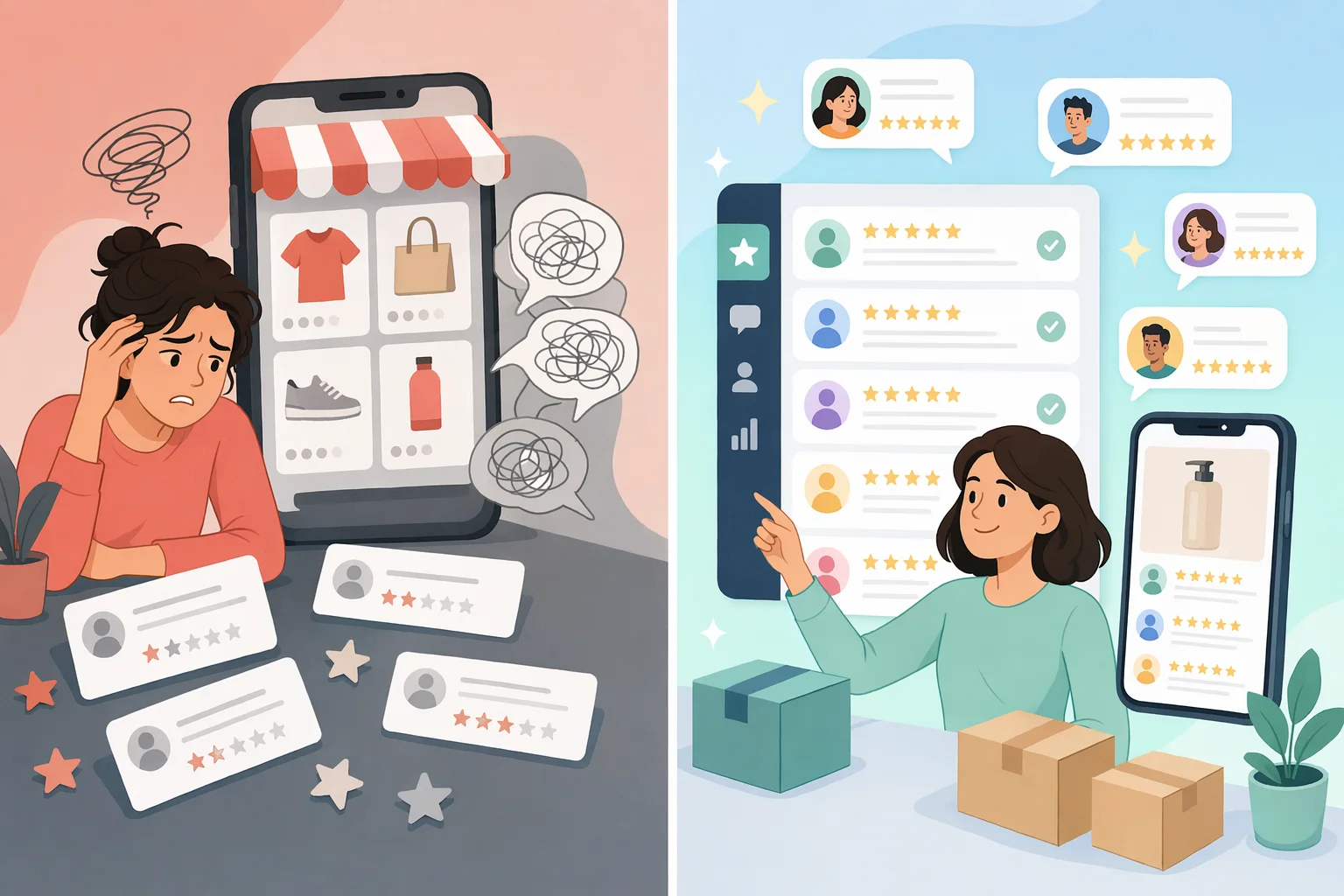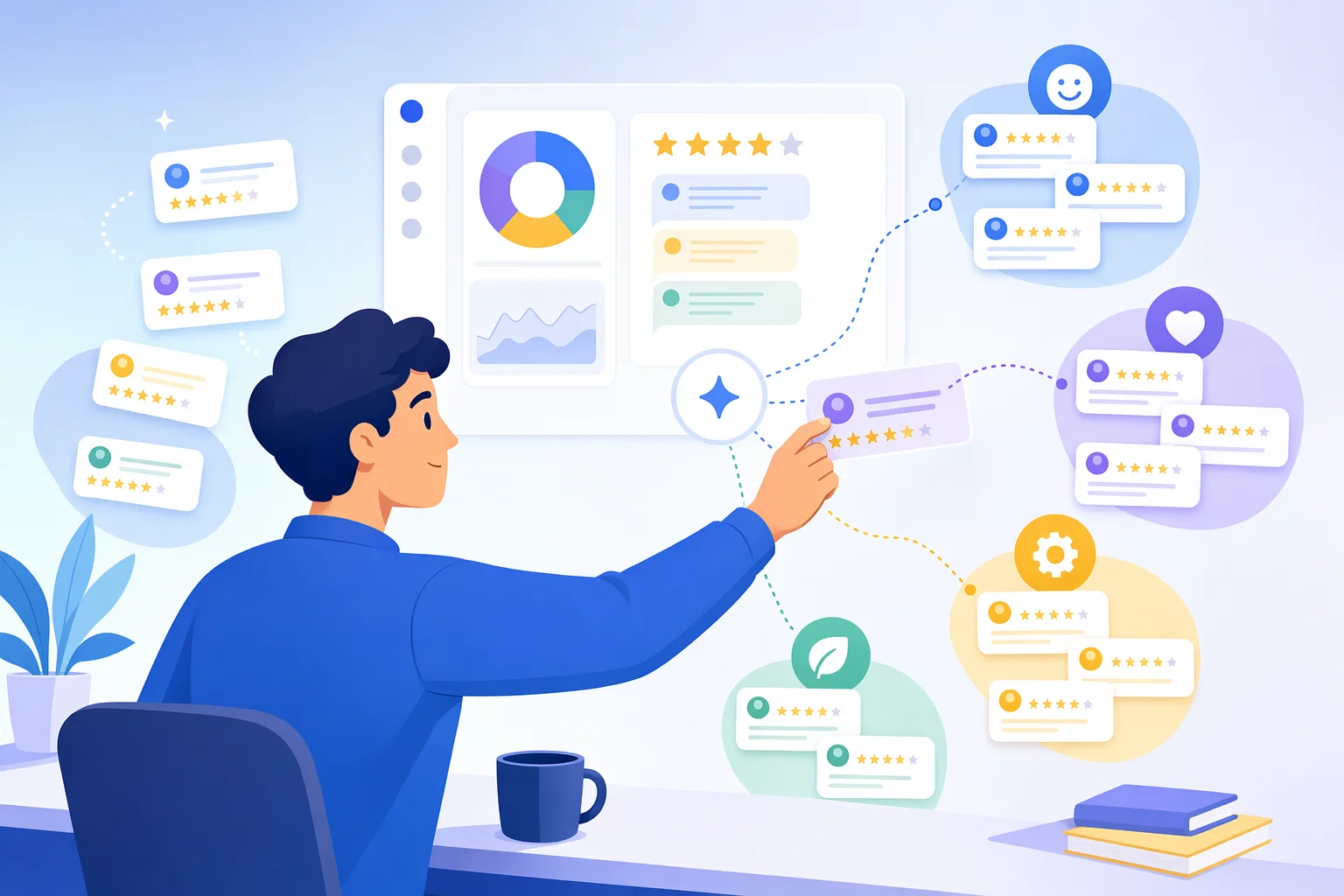
Approximately 80% of enterprise data—including customer reviews, support tickets, and call transcripts—is unstructured. That means the vast majority of what your customers are saying about you is locked away in raw text, impossible to action at scale. Manually reading thousands of reviews to spot that "battery life" is your top complaint isn't just tedious; it's a fool's errand. Modern businesses need to extract themes from customer reviews automatically, using sentiment analysis review software to turn noise into a clear competitive signal.
Managing this manually is hard. ReviewSense automates it.
Why Traditional Theme Extraction Fails Modern Businesses
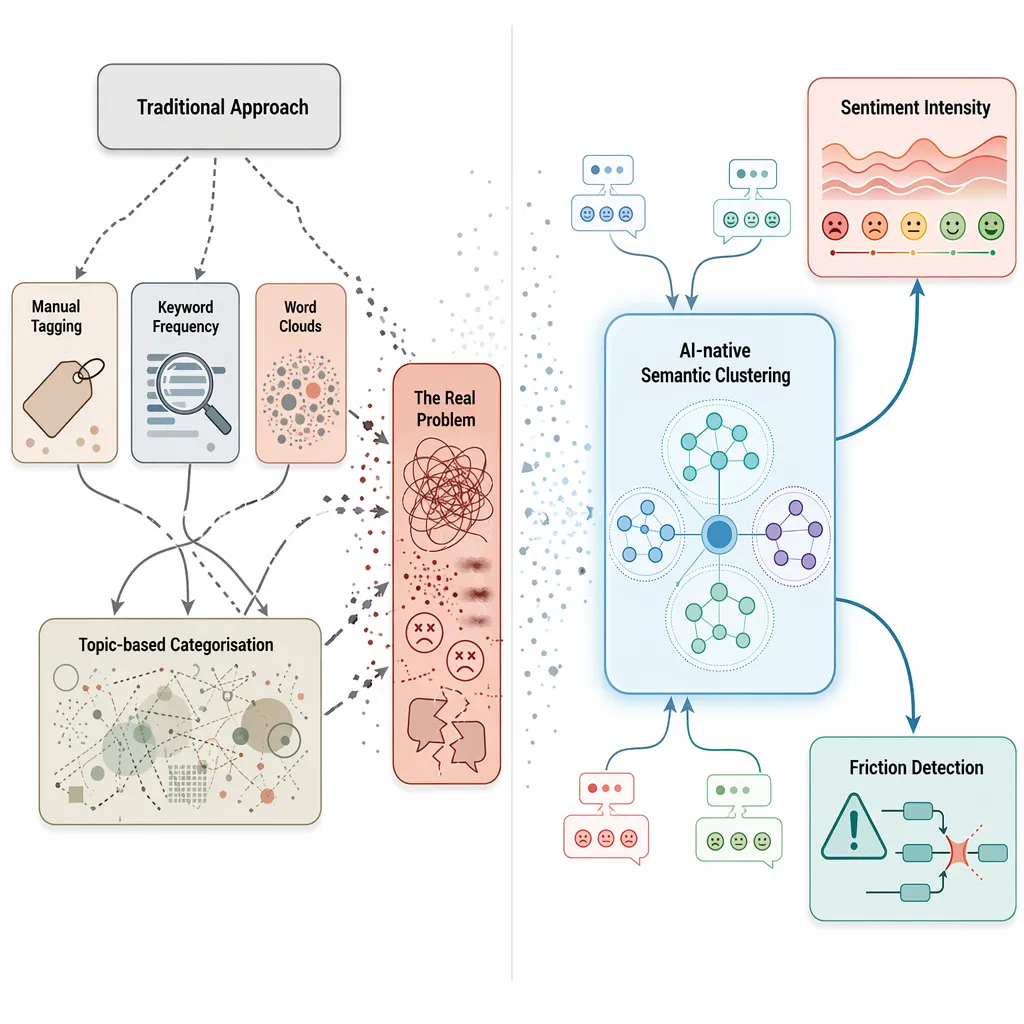
This gap between collecting feedback and acting on it stems from a fundamental flaw in how most businesses extract themes from customer reviews. Traditional methods—manual tagging and basic keyword frequency—simply cannot cope with the scale and complexity of modern feedback.
| Traditional Approach | The Real Problem |
|---|---|
| Manual tagging by support teams | Takes weeks to analyse 10,000 reviews |
| Keyword frequency counts | Confuses volume with importance |
| Word clouds and bar charts | Strips context, misreads sarcasm |
| Topic-based categorisation | Misses sentiment intensity and friction |
The core issue is that approximately 80% of enterprise data—including customer reviews, support tickets, and call transcripts—is unstructured. Manual analysis of 10,000 reviews takes weeks. By the time you spot a pattern, the problem has already escalated.
The frequency trap
Most teams assume that a frequently mentioned word like 'price' signals a critical issue. That assumption is wrong. Frequency is a vanity metric. A theme that appears in 40% of reviews might have zero impact on churn. Meanwhile, a low-volume issue—a specific checkout bug mentioned by only five customers—could be driving away high-value clients.
This is the 'Noise vs. Signal' problem. Word clouds make it worse. They strip away context and misclassify sarcasm. A review saying 'great, another price increase' gets lumped under 'price' as a neutral mention. The real sentiment—frustration—is lost.
Diagnosis versus thermometer
Think of traditional theme extraction as a thermometer. It tells you the temperature is rising, but it cannot tell you why. You need a diagnosis. That means understanding not just what customers mention, but how they feel about it and how urgently they need a fix.
Modern businesses need AI-native semantic clustering that focuses on sentiment intensity and friction, not just topic frequency. This is where customer review monitoring tools that use natural language processing can surface the issues that actually matter. They detect sarcasm, measure emotional weight, and group reviews by underlying problems rather than surface-level keywords.
The shift is from counting words to understanding meaning. Only then can you extract themes from customer reviews in a way that drives real improvement.
The New Standard: AI-Powered Sentiment and Theme Clustering
That diagnosis is exactly what modern AI delivers. The industry has moved beyond basic positive/negative labels. In 2026, the standard is contextual 'why' analysis. More than 60% of businesses now use AI tools to analyse customer feedback, according to recent industry research. That shift is driven by one thing: semantic clustering.
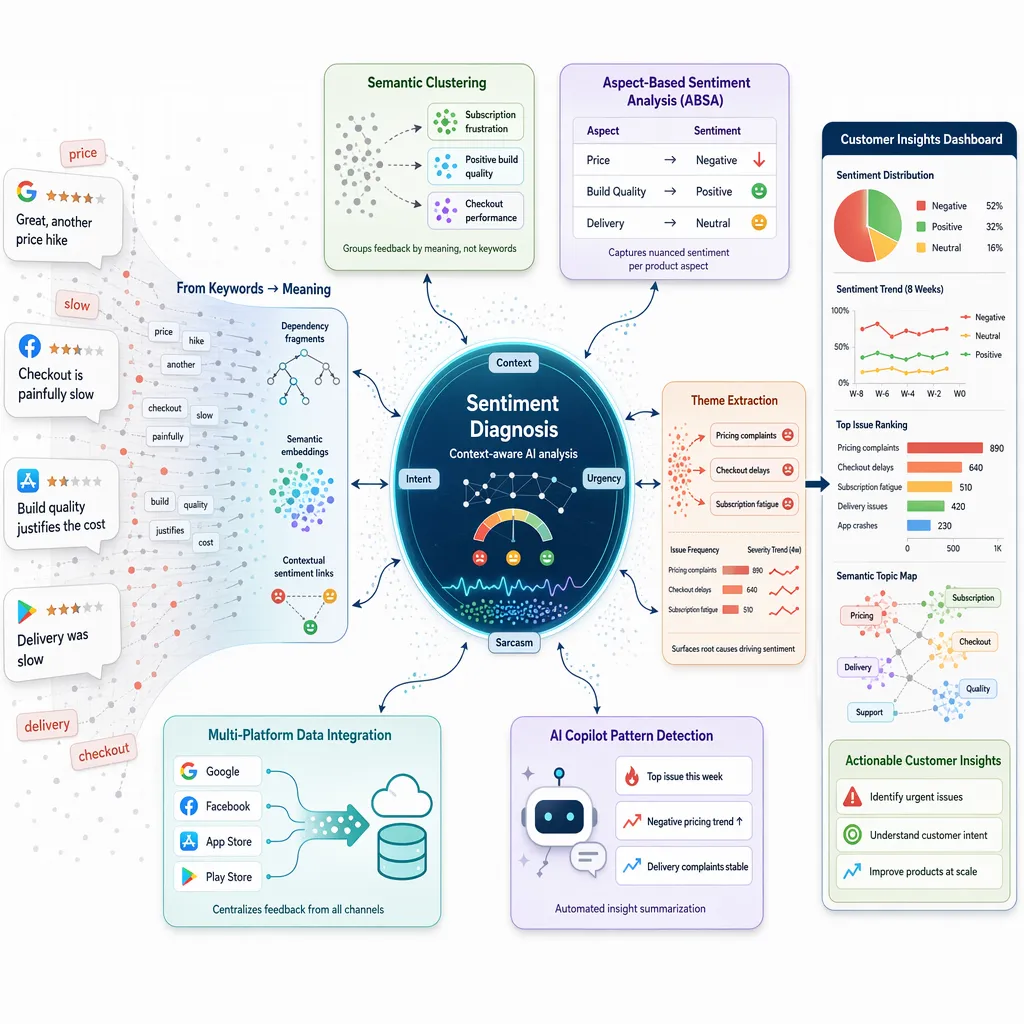
How semantic clustering works
| Old Approach | New AI Standard |
|---|---|
| Keyword frequency ('price' mentioned 200 times) | Semantic grouping ('frustration with subscription cost') |
| Positive/negative polarity | Aspect-Based Sentiment Analysis (ABSA) |
| Word clouds | Dependency parsing for context |
| Manual tagging | AI copilot pattern detection |
Semantic clustering groups feedback by meaning, not keywords. A review saying 'the build quality justifies the cost' and another saying 'the subscription fee is too high' both mention price. But the sentiment is opposite. ABSA captures that nuance. It tells you price is negatively associated with the subscription model but positively associated with build quality. This is where modern sentiment analysis review software differentiates itself — by moving beyond a thermometer reading to a full diagnosis.
Dependency parsing (from the contrarian section) is the engine here. It maps grammatical relationships. The AI learns that 'slow' connected to 'checkout' is a different problem than 'slow' connected to 'delivery'. It spots sarcasm too. 'Great, another price hike' gets tagged as negative sentiment on pricing, not neutral.
AI copilots now summarise these patterns automatically. They surface the three issues driving the most negative sentiment this week. No manual sifting. No spreadsheets. The right tool centralises this from every supported platform — Google, Facebook, App Store, and Play. That is how you truly extract themes from customer reviews at scale.
Closing the Loop: From Insights to Actionable Workflows
Semantic clustering reveals what customers feel. But knowing the problem is not the same as fixing it. That gap—between insight and action—is what Forrester calls 'execution debt.' Technology is ready. Organisational follow-through is the bottleneck.
McKinsey found that companies using AI for customer insights are 23% more likely to outperform competitors. Yet most teams still export themes into a spreadsheet and hope someone acts. Hope is not a workflow.
| The Gap | The Fix |
|---|---|
| Insights sit in a dashboard | Auto-routed to the right team |
| No owner for recurring issues | Assigned tickets in Jira or Asana |
| Negative spikes go unnoticed | Crisis alerts trigger immediate action |
| Manual approvals slow responses | Queue management with auto-reply |
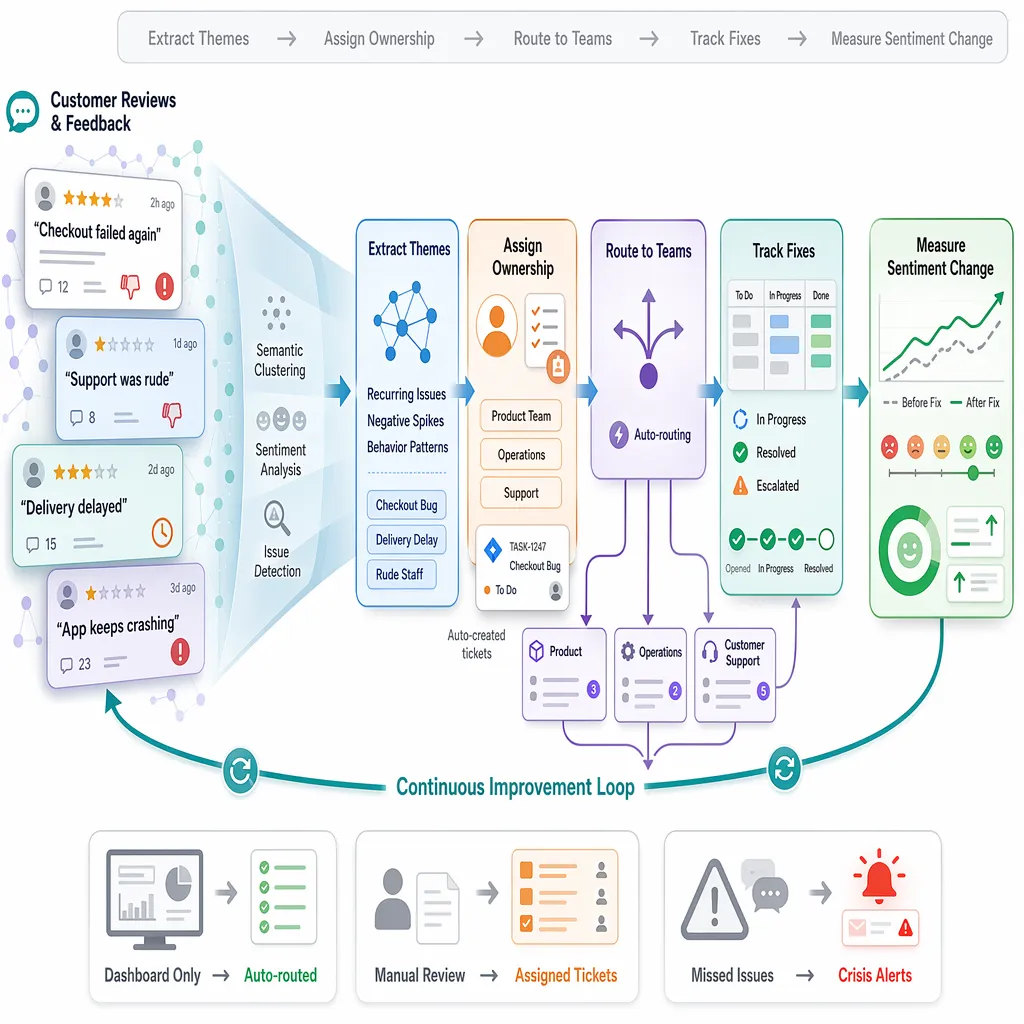
Insights without an owner are just noise. Extracting themes from customer reviews must automatically create tickets. A checkout bug mentioned five times should land in the product team's backlog. A complaint about rude staff should reach operations within minutes.
Platforms like ReviewSense solve this by linking feedback directly to workflow tools. When sentiment analysis review software detects a negative spike, it sends a crisis alert. The team can route the issue, assign ownership, and track whether the fix improves sentiment over time. No manual forwarding. No dropped balls.
Manual scaling fails here. Humans introduce bias and fatigue. A support agent might flag the same delivery complaint ten times but miss a subtle pattern in app crashes. Automation removes that risk.
The 'closing the loop' trend means feedback becomes a closed circuit. You extract themes, assign action, monitor results, and measure sentiment change. That is how you turn reviews into revenue. That is how you extract themes from customer reviews and actually improve the business.
ReviewSense offers free tools like a Google review link generator to start collecting feedback today. For teams ready to act, the AI Review Response Generator turns insights into replies in seconds.
How to Evaluate a Theme Extraction Platform: Key Criteria
That workflow integration is the real test of any tool. But before you commit, you need a framework to evaluate theme extraction platforms. Not all AI is equal. Here are the criteria that separate useful tools from expensive dashboards.
How to evaluate theme extraction: old vs new
| Evaluation Criteria | Old Approach | New AI Standard (2026) |
|---|---|---|
| Analysis method | Manual tagging by keyword frequency | AI-native semantic clustering by meaning |
| Focus | Sentiment polarity (positive/negative) | Contextual 'why' and business impact |
| Workflow integration | Siloed reports exported to spreadsheets | Integrated into roadmaps, Jira, Slack |
| Data sources | Isolated surveys only | Omnichannel: reviews, support tickets, chat |
| Handling anomalies | Buckets everything into predefined categories | Surfaces 'Uncategorizable' items as black swan insights |
Analysis method: semantic clustering wins
Manual tagging is slow and biased. Two people tag the same review differently. AI-native semantic clustering groups feedback by meaning, not keywords. It spots that 'slow checkout' and 'payment took ages' are the same problem. The best sentiment analysis review software should let you filter by emotional intensity, not just volume. That reveals which issues actually hurt retention.
Focus: from polarity to business impact
Old tools stop at polarity — positive, negative, or neutral. That tells you almost nothing about what to do next. The 2026 standard asks a different question: why. A platform built for contextual analysis explains which segment left a complaint and what it's likely to cost you in churn, not just how it sounds. Sentiment polarity is a label. Business impact is a priority list.
The contrarian test: does it surface anomalies?
Most tools force every review into a bucket. But the most valuable insights are the ones that don't fit. A review mentioning 'the new layout feels cold' might not match any existing category. Good platforms flag these as anomalies. They call them 'black swan' insights. If your tool only confirms what you already know, it's not doing its job.
Practical questions to ask
- Does it support only the platforms you use? ReviewSense covers Google, Facebook, Apple App Store, and Google Play. No more.
- Does it detect spam and toxic content? Fake reviews distort your data. Your tool must filter them automatically.
- Does it offer brand voice customisation? Generic AI replies damage trust. You need control over tone.
Workflow integration: closing the loop
Insights without action are noise. The platform must route themes to the right team. A checkout bug needs to land in product, not marketing. Crisis alerts for negative spikes should trigger immediate notifications. If your tool can't integrate with your roadmap, you'll never extract themes from customer reviews that actually drive change.
Data sources: omnichannel or nothing
Isolated survey tools only see one channel. A platform that only reads star ratings from one storefront is blind to the support ticket that explains why the rating dropped, or the chat transcript where a customer nearly churned. The 2026 standard is omnichannel: reviews, support tickets, and chat logs feed the same semantic model, so a theme in an app store review can be cross-referenced against the conversations that caused it.
Common Pitfalls and How to Avoid Them in 2026
That omnichannel ideal is the goal, but the path is littered with traps. Many teams invest in theme extraction only to realise their data is misleading. Here are the five pitfalls that will derail your 2026 strategy.
| Pitfall | Why It Fails | The Fix |
|---|---|---|
| The 'Representative Sample' myth | Review data is biased toward extremes (angry or ecstatic customers) | Treat reviews as diagnostic for edge cases, not market research |
| Linguistic complexity | Sarcasm, domain jargon, and mixed sentiment confuse basic models | Use ABSA and dependency parsing |
| The 'Automated Extraction' delusion | Pre-defined buckets miss new problems | Use AI to filter anomalies |
| Fragmented data silos | Feedback scattered across app stores, social media, and support | Centralise into one dashboard |
| The missing actionability loop | Insights die in PDFs or spreadsheets | Every theme must trigger a workflow |
The 'Representative Sample' Myth
Most teams treat reviews as a proxy for the entire customer base. They aren't. Review data skews toward the loudest voices — the furious and the delighted. The silent majority rarely writes. Treating reviews as market research leads to overcorrecting for fringe complaints. Instead, use them as a diagnostic tool for edge cases. They reveal what breaks, not what the average customer thinks.
Linguistic Complexity
Basic sentiment analysis review software struggles with sarcasm ('Great, another update that breaks the app') or mixed sentiment ('The staff were lovely but the wait was brutal'). Domain-specific terms like 'lag' in gaming versus 'lag' in logistics confuse generic models. The solution is Aspect-Based Sentiment Analysis (ABSA) combined with dependency parsing. This maps sentiment to specific features, not just the overall tone.
The 'Automated Extraction' Delusion
Pre-defined categories are a trap. If your tool only looks for 'price' and 'service', you'll miss the review that says 'the new checkout flow feels clunky'. Good platforms surface anomalies — feedback that doesn't fit any bucket. That is the real skill: telling signal from noise, not just collecting more of both. Use AI that flags uncategorizable items as potential black swan insights.
Fragmented Data Silos
Most teams collect feedback everywhere and centralise nowhere. App store reviews live in one dashboard, support tickets in a helpdesk, social mentions in a separate monitoring tool. Each source tells only part of the story, and the same complaint gets tagged three different ways depending on where it landed. That fragmentation hides cross-platform patterns — a checkout bug showing up as a one-star review, a support ticket, and a social post never gets analysed as one signal.
The Missing Actionability Loop
The final pitfall is the most common: insights that never leave the report. A theme extraction exercise that ends in a PDF or a shared spreadsheet has accomplished nothing — someone still has to notice it, care about it, and act. The fix is to treat every theme as a ticket, not a talking point: if it can't be routed to the person who owns that part of the product, it shouldn't have been surfaced. The winners in 2026 are closing that loop within 30 days, not the next quarterly review.
Conclusion
Extracting themes from customer reviews isn't about counting keywords—it's about surfacing the anomalies that reveal what's actually broken. The pitfalls are clear: biased samples, linguistic nuance, automated extraction that misses new problems, and fragmented data that dies in silos. To avoid them, you need a platform that centralises feedback from the platforms that matter (Google, Facebook, Apple App Store, Google Play), filters spam and toxicity automatically, and routes themes directly into workflows—not static reports. Without that loop, insights remain noise. Turn scattered reviews into actionable insights that drive real change. Start your 7-day free trial