
Over 60% of small businesses now use review management tools, yet many struggle with Podium's pricing and complexity. As the market evolves, SMBs are seeking alternatives that offer better value and simplicity. Building on the Best Review Management Software 2026 analysis, we break down top contenders, essential capabilities, and 2026 pricing trends. Discover what truly matters for local reputation growth.
Managing this manually is hard. ReviewSense automates it.
The Shifting Environment of SMB Reputation Management
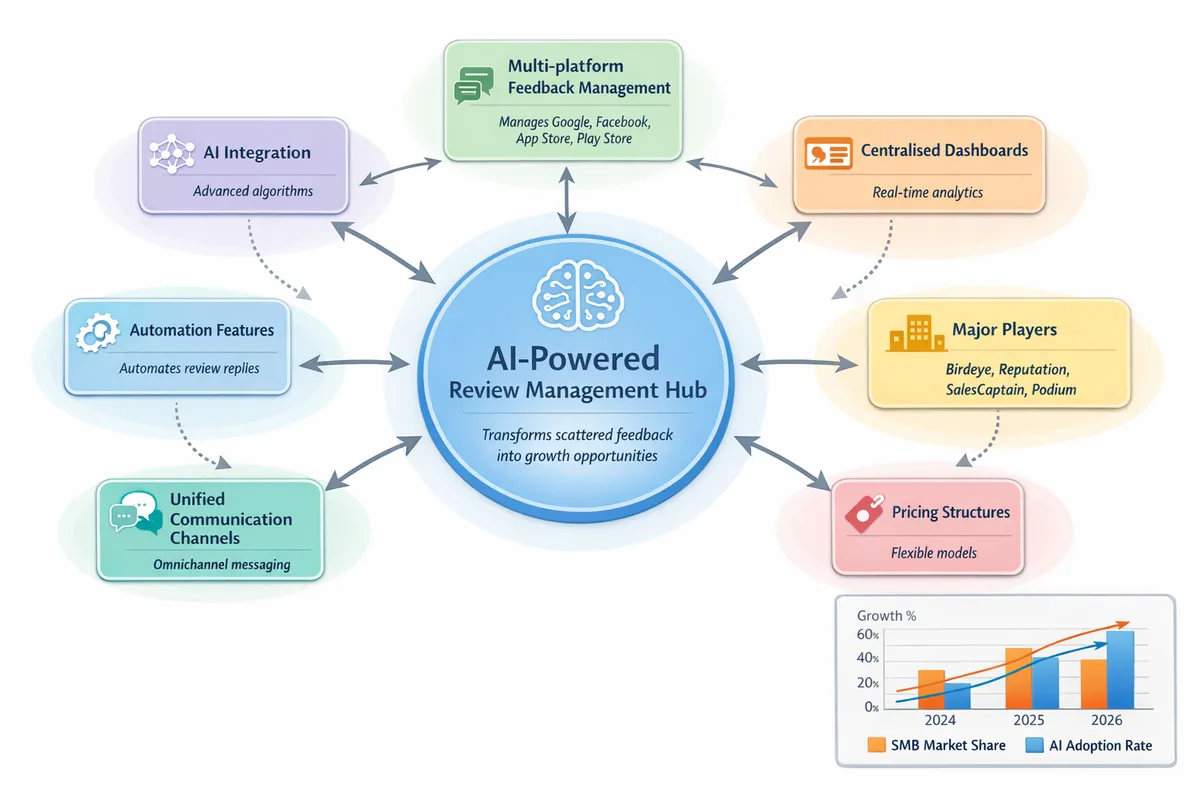
Small businesses now operate in a reputation economy where online reviews directly impact visibility and revenue. The communication platform-as-a-service (CPaaS) market reflects this shift, growing from $22.89 billion in 2025 to $29.70 billion in 2026. Small and medium-sized enterprises drive much of this expansion, representing 43% of the global CPaaS market share. Their adoption rate is accelerating faster than any other segment, with a compound annual growth rate of 10.80%. This momentum stems from urgent needs to manage multi-platform feedback efficiently across Google Business Profile, Facebook, Apple App Store, and Google Play without dedicated teams.
Key 2026 trends centre on AI integration. Platforms now automate review responses using generative AI, saving hours previously spent crafting replies. Sentiment analysis tools automatically flag recurring issues and filter spam, letting teams prioritise genuine feedback. For local businesses, AI boosts geographic search visibility by optimising content for location-based queries. Multi-location operations require centralised dashboards to maintain brand consistency while allowing local adaptations. Unified platforms that consolidate communication channels are becoming essential rather than optional.
Major players have responded with AI launches. Birdeye introduced AI Agents in January 2026 to automate customer interactions, while Reputation's AI Reputation Manager debuted in September 2025 for predictive analytics. SalesCaptain integrated AI-generated call summaries to unify voice and text feedback. Despite these innovations, Podium holds just 5.86% market share in customer satisfaction solutions, serving 21,687 companies. Birdeye captures a larger SMB audience, with 48.9% of its users being small businesses, partly due to scalable pricing structures. Seeing the whole field at once helps here, and our Reputation.com vs Birdeye vs Podium vs ReviewTrackers comparison sets the four against each other on price and who each one is built for.
For UK SMEs evaluating a Podium competitor, key considerations include transparent pricing without hidden fees and tools that adapt to single-site or multi-location needs. Solutions should offer centralised oversight of all major review platforms while eliminating manual processes. Features like our AI-powered review response generator demonstrate how automation handles routine replies, freeing staff for complex customer issues. When assessing alternatives, prioritise platforms offering tangible efficiency gains through workflow automation rather than vanity metrics.
Understanding these market shifts helps businesses select tools that turn scattered feedback into growth opportunities. For guidance on evaluating options, see our analysis of choosing the right customer review management software. The ideal solution scales with your business while providing immediate operational relief through intelligent automation.
Top Pain Points Driving the Search for Alternatives
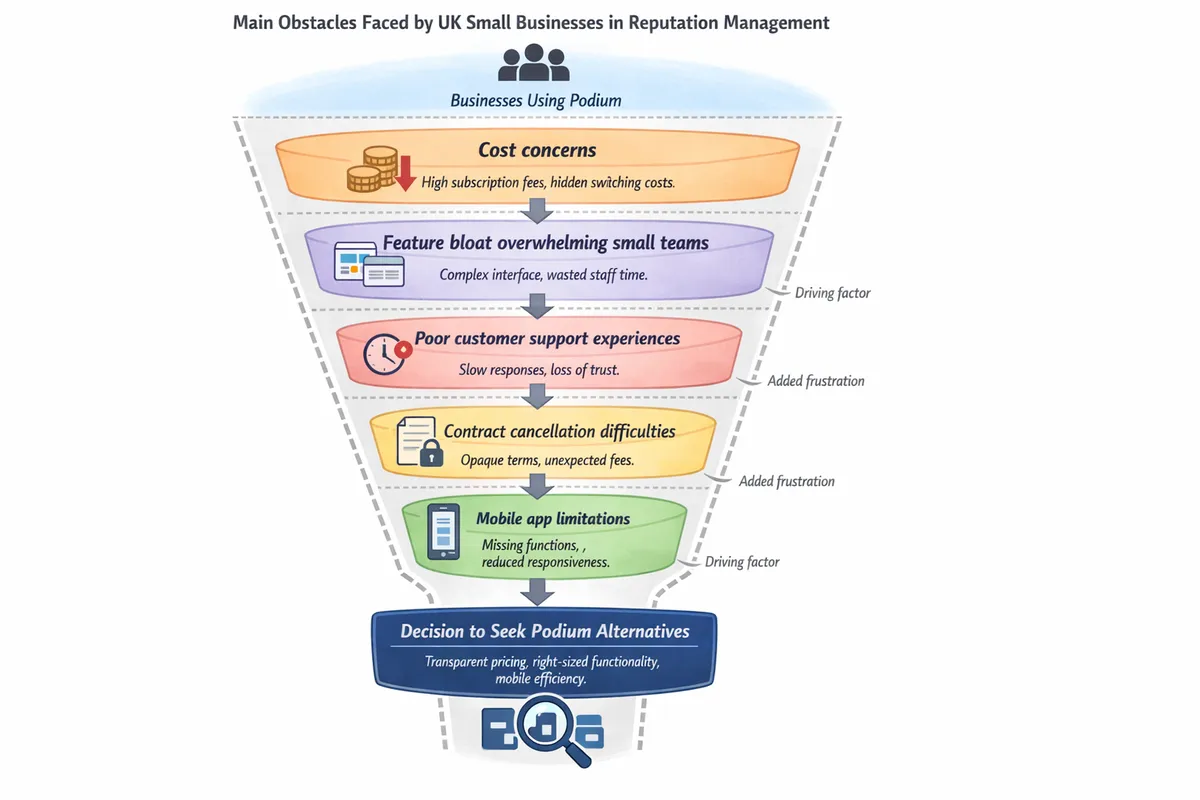
Yet for many UK small businesses, the promise of streamlined reputation management often clashes with operational realities when using established platforms. Despite Podium's significant small business user base (representing 60.1% of its audience according to G2 reviewers), common frustrations drive the search for alternatives. These pain points particularly impact teams without dedicated IT resources or large budgets.
Cost concerns: Podium pricing in 2026 starts at $399/month with binding annual contracts, straining tight budgets. A Leeds-based restaurant owner shared: "We're paying for premium features but only use basic review tracking." Hidden switching costs like staff retraining and data migration further complicate budget planning for potential alternatives. To see where $399/month sits against the rest of the market, our review platform pricing comparison puts the 2026 tiers side by side, from $9 entry plans to $600+ enterprise contracts.
Feature bloat overwhelming small teams: Overly complex interfaces frustrate time-poor staff. Users report wasting hours navigating unnecessary modules instead of responding to customers. One London agency noted: "Our team avoids the platform because dashboard customisation feels like solving a puzzle." Adopting simpler alternatives requires careful planning to avoid new learning curves.
Poor customer support experiences: Slow response times for critical issues damage trust. Multiple users cite 48+ hour delays for urgent review-related problems. While switching platforms offers relief, businesses risk losing accumulated institutional knowledge during migration without proper handover documentation.
Contract cancellation difficulties: Opaque termination clauses create exit barriers. Several businesses reported unexpected fees and prolonged cancellation processes. One Manchester retailer described it as "like trying to cancel a gym membership with penalty charges." This administrative friction often delays necessary transitions to better-fit solutions.
Mobile app limitations: Critical functionality gaps hinder on-the-go management. Users complain about missing features like draft saving for review responses or multi-location switching. This forces staff to use desktop interfaces for simple tasks, reducing responsiveness. Our guide on how to manage Google reviews effectively highlights mobile efficiency as essential for modern reputation management.
These challenges explain why UK small businesses increasingly evaluate Podium competitors offering transparent pricing and right-sized functionality. Free tools like the AI review response generator demonstrate how purpose-built solutions address specific pain points without overwhelming users.
Essential Capabilities for Modern Review Management
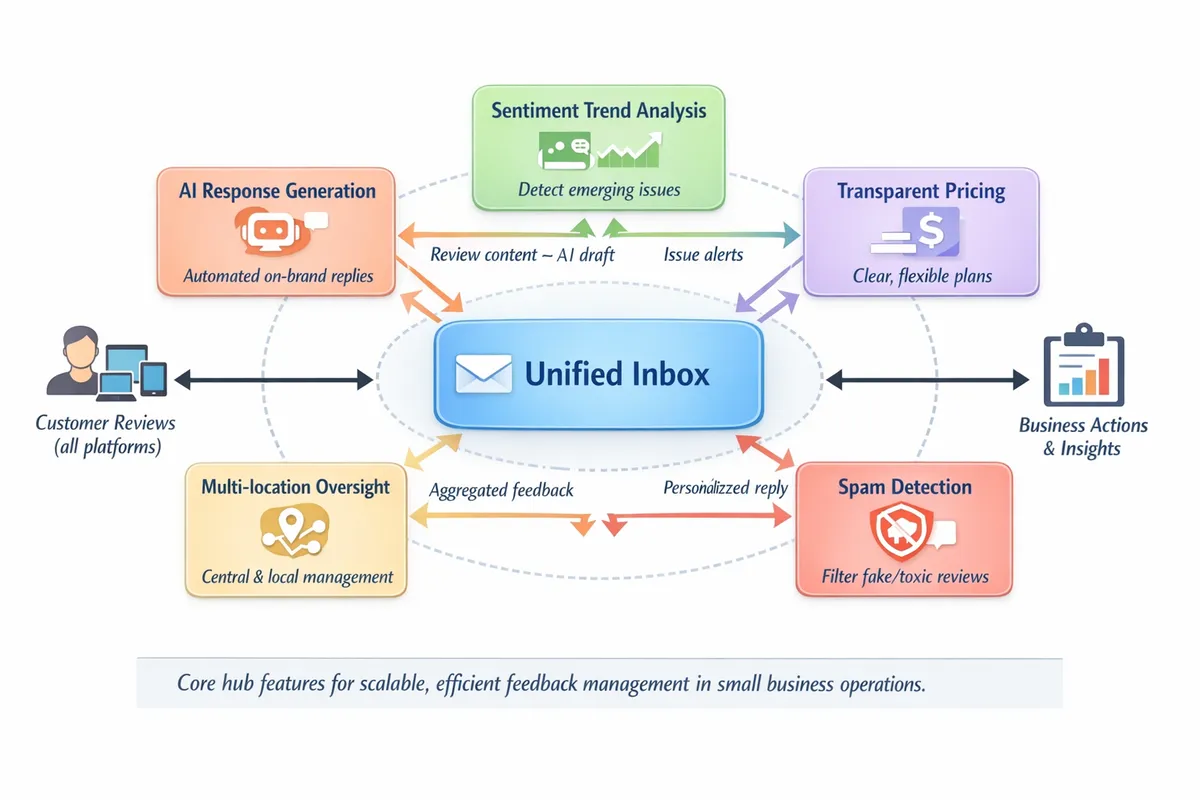
For UK small businesses seeking a Podium alternative, the right capabilities must directly tackle the operational headaches outlined earlier. Focus on these five essential features that solve real-world problems without creating new complexities:
| Feature | SMB Impact | Solution Approach |
|---|---|---|
| Unified Inbox | Eliminates platform-hopping fatigue | Centralises Google, Facebook, App Store and Play Store reviews in one dashboard, solving mobile limitations and feature bloat |
| AI response Generation | Reduces reply time from hours to seconds | Generates personalised, on-brand responses instantly, freeing staff from manual drafting |
| Sentiment Trend Analysis | Flags recurring issues before they escalate | Automatically surfaces negative patterns and key topics from genuine feedback |
| Transparent Pricing | Prevents budget shocks and contract disputes | Clear tiers without hidden fees, with flexible terms avoiding cancellation hurdles |
| Spam Detection | Stops wasted time on fake reviews | Filters out irrelevant or toxic content automatically using AI analysis |
A unified inbox directly combats mobile limitations by providing a single responsive interface for all platforms. This ends the frustration of juggling multiple apps. For multi-location operations, it enables central oversight while allowing localised management. Our guide on scaling app store reviews details efficient workflows for this capability.
AI response generation tackles feature bloat by automating core tasks without complex setup. It lets you maintain consistent brand voice while adapting to each review's sentiment. Experts confirm AI is now essential for keeping pace with customer expectations, especially during peak volumes.
Sentiment analysis cuts through noise without requiring dedicated analysts. It identifies emerging issues like service gaps or product flaws, letting you prioritise impactful improvements. Transparent pricing directly addresses cost concerns by offering straightforward plans. Unlike rigid contracts causing cancellation difficulties, flexible alternatives prevent lock-in. You can explore options risk-free through the 7-day trial.
Spam detection reduces support burdens by automatically hiding irrelevant content. This protects your team from wasting energy on fake reviews while safeguarding your online reputation. For deeper insights into maintaining review integrity, see our analysis of protecting reviews from deletion.
Together, these capabilities form a foundation for efficient reputation management that scales with your business. They transform fragmented feedback into structured actions, turning the search for a Podium competitor into an opportunity for growth.
How Leading Platforms Solve Real SMB Challenges
Building on that foundation, let's examine how specific platforms tackle common SMB hurdles with targeted solutions. RepliFast's five-minute setup directly counters implementation headaches, saving businesses 3-5 hours monthly that would otherwise be lost to technical configuration. This efficiency proves vital for time-strapped teams who can't afford lengthy onboarding.
Birdeye's 3,000+ integrations combat workflow fragmentation by connecting review data with existing CRM and helpdesk systems. This eliminates the platform-hopping that plagues many operations, though smaller businesses should assess whether they truly need such extensive connectivity. For cost-conscious firms, CommentAssist's £29/month model provides core functionality without budget strain. This transparent approach contrasts sharply with opaque pricing structures that complicate financial planning.
HubSpot's free tier enables genuine risk-free testing, letting businesses validate value before commitment. This flexibility is particularly relevant when evaluating Podium pricing 2026 alternatives, as it prevents lock-in to unsuitable contracts. Each solution addresses specific pain points: RepliFast for speed, Birdeye for connectivity, CommentAssist for affordability, HubSpot for trial flexibility.
However, a contrarian perspective deserves attention: low-volume businesses often find over-engineered solutions counterproductive. If you're receiving under 20 reviews monthly, complex platforms become unnecessary overhead. For these cases, manual monitoring combined with free tools like the 5-star review response generator may suffice. This balanced approach prevents paying for unused features while maintaining reputation management fundamentals.
When selecting a Podium competitor, match the solution to your actual volume and workflow needs. Multi-location operations benefit from centralised dashboards as detailed in our guide on managing app store reviews at scale, while single-location shops might prioritise simplicity. The key is avoiding both underinvestment in critical functions and overpayment for redundant capabilities. Focus on platforms that solve your specific challenges without introducing new complexities.
Evaluation Framework for Your Business
Follow this structured evaluation framework to ensure your chosen platform aligns with your needs without overcomplicating operations. It helps you avoid overpaying for unnecessary features while securing critical functionality like crisis alerts that protect your reputation. Many small businesses regret signing up for platforms with complex features they never use, leading to wasted budgets and operational headaches. This step-by-step approach prevents that by focusing squarely on what matters for your review management.
Audit your current review response time and volume across Google Business Profile, Facebook, and app stores. Slow replies damage customer trust and lose sales opportunities. Measure how long it takes your team to draft responses manually. Tools like the negative review response generator demonstrate potential time savings.
Prioritise must-have features to avoid bloat traps. Crisis alert functionality is non-negotiable for spotting sudden negative review spikes before they escalate. Ignore flashy extras that inflate costs. Focus instead on core capabilities like AI-generated responses and spam detection. Learn essential reputation protection tactics in our guide to removing fake Google reviews.
Test free trials for at least seven days. Verify if AI suggestions sound authentic and whether approval workflows fit your team's rhythm. During the trial, experiment with integrated tools like the star rating calculator and Google review link generator to assess real-world value.
Verify the mobile experience thoroughly. Since reviews often require immediate attention, test responding to Facebook or app store feedback directly from your smartphone. Can managers approve replies during site visits? Our guide on scaling app store review management covers mobile optimisation strategies.
Check integration capabilities with existing systems. If you use basic CRM or helpdesk tools, confirm whether the platform syncs data smoothly. Avoid over-engineering solutions if you're a single-location operation.
Pre-assess support responsiveness before committing. Submit a test query during the trial noting response time and expertise. When a crisis hits, like sudden one-star reviews on Google, you'll need immediate assistance. Build your defence using proven Facebook review management strategies.
This method prevents budget strain from platforms charging premium prices for features you won't use. When evaluating a Podium alternative for small business, remember that simplicity often beats complexity. Focused solutions with transparent pricing typically deliver better value than bloated competitors.
Conclusion
Choosing the right Podium alternative requires matching capabilities to your review volume and operational reality. Avoid overpaying for complex features if you're a low-volume business, but prioritise critical tools like crisis alerts and AI-generated responses to protect your reputation. ReviewSense solves this balancing act: it centralises feedback from Google, Facebook, and app stores into actionable insights, with free tools and transparent pricing eliminating guesswork. Transform scattered reviews into customer experience improvements without unnecessary complexity. Start your 7-day free trial
Comparing other platforms too? See our guides to Birdeye alternatives, NiceJob alternatives, Reputation.com alternatives and ReviewTrackers alternatives.