
Is your current review management solution failing to protect against Google's 2026 review purge? New algorithm changes demand proactive monitoring. Traditional platforms like NiceJob lack real-time safeguards, risking your hard-earned reputation. With reviews vanishing overnight, businesses face revenue loss and damaged credibility. You need an alternative that adapts instantly to policy shifts and secures your online presence.
Managing this manually is hard. ReviewSense automates it.
The Evolving Environment of Review Management in 2026
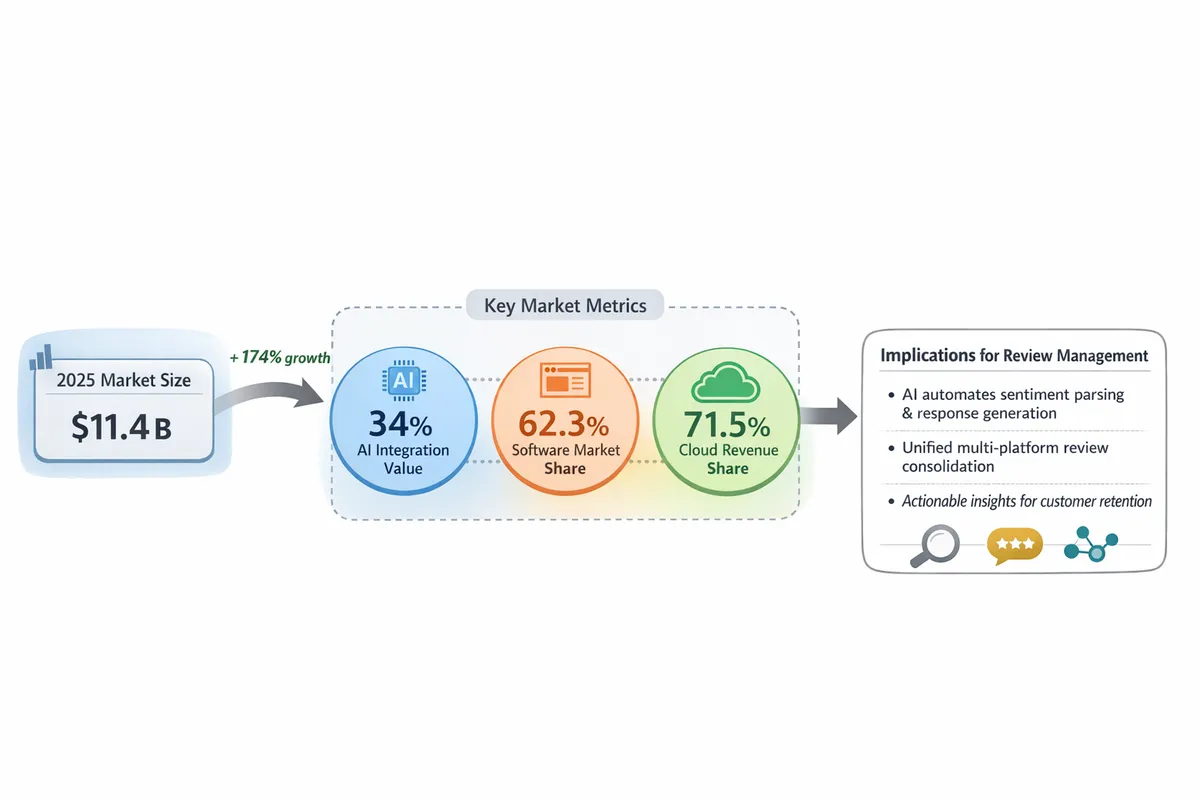
The reputation management market is experiencing unprecedented expansion, with Gartner projecting growth from $11.4 billion in 2025 to $31.2 billion by 2034. This acceleration stems from three converging 2026 trends reshaping how UK businesses handle feedback. First, AI integration now drives 34% of value in review solutions, automating tasks like sentiment parsing and response generation. Second, fragmented feedback across Google Business Profile, Facebook, and app stores forces demand for unified platforms. Third, companies prioritise actionable insights over basic tracking to directly influence customer retention.
Software dominates this sector, holding 62.3% of market share in 2025. Cloud deployment led with over 71.5% revenue share that same year, reflecting preferences for scalable solutions. Businesses now expect tools that consolidate Google, Facebook, Apple App Store, and Google Play reviews while detecting patterns. For example, recurring complaint themes in Google reviews might reveal urgent service gaps needing intervention. Our guide on choosing multi-platform review management software explores this consolidation imperative.
Established players like NiceJob ($5.1M revenue, 42 employees) now navigate a field of 1,267 alternatives. This saturation signals that basic monitoring no longer suffices. Companies seek platforms offering deep sentiment analysis, spam detection, and trend forecasting. They want to transform raw feedback into CX improvements, not just collect stars. Tactics like learning how to ethically boost 5-star Google reviews exemplify insight-driven reputation building. As expectations evolve, businesses increasingly evaluate NiceJob competitors delivering AI-powered, multi-source analytics to stay competitive.
Critical Gaps in Traditional Review Management
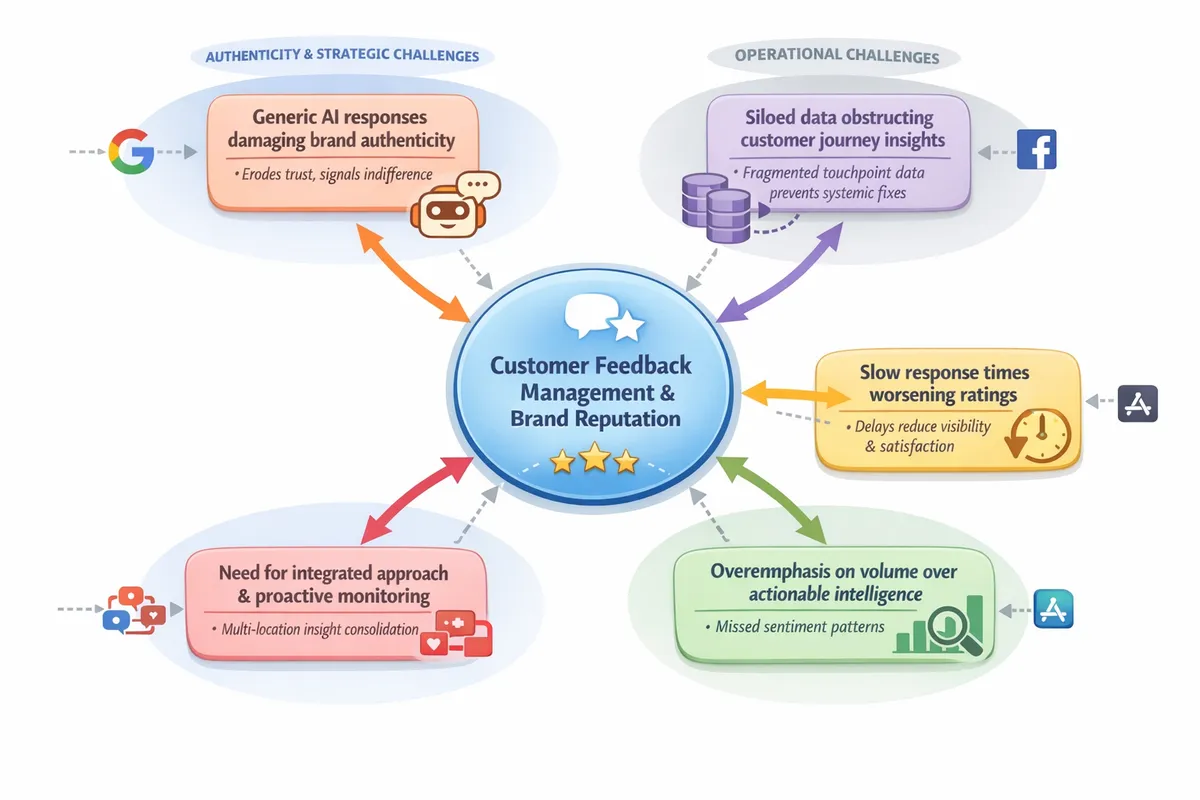
As businesses evaluate NiceJob competitors for AI-powered, multi-source analytics, they often discover traditional platforms fail to address fundamental operational weaknesses. Despite North America's $4.1 billion revenue dominance (36.0% market share in 2025), many solutions perpetuate these five critical gaps that undermine reputation management:
Reactive rather than proactive issue resolution. Most tools only notify teams after negative reviews surface publicly. This misses the crucial window to resolve complaints privately before they escalate. Without mechanisms to intercept dissatisfaction early, businesses lose the chance to turn detractors into advocates through direct engagement.
Generic AI responses damaging brand authenticity. Many platforms deploy robotic, templated replies that customers instantly recognise as impersonal. This erodes trust and signals indifference. In retail and e-commerce—representing 31.4% of the market—such responses can alienate shoppers expecting personal recognition.
Siloed data obstructing customer journey insights. Feedback from Google Business Profile, Facebook, and app stores remains trapped in separate dashboards. This fragmentation prevents identifying recurring pain points across touchpoints. Teams can't connect a critical App Store review about checkout errors with similar Facebook complaints, missing systemic fixes.
Slow response times worsening ratings. With expectations for near-immediate replies rising, delays in addressing negative feedback directly impact visibility and ratings. G2 research confirms response speed influences customer satisfaction scores. Delays also increase risks highlighted in our guide on Google reviews disappearing.
Overemphasis on volume over actionable intelligence. Many NiceJob alternatives prioritise collecting more reviews as the primary metric. This overlooks sentiment patterns and emerging themes in feedback. Without analysing why ratings change, businesses miss opportunities to improve operations—especially when handling duplicate Google Business Profiles that skew data.
These gaps reveal why traditional platforms struggle to move beyond transactional review collection. They lack the integrated approach needed for genuine reputation improvement, making proactive monitoring via customer review tools and personalised responses through the AI generator essential for modern businesses. For multi-location operations, consolidating insights across platforms using Apple App Store review management software guide becomes non-negotiable.
Essential Capabilities for Modern Review Platforms
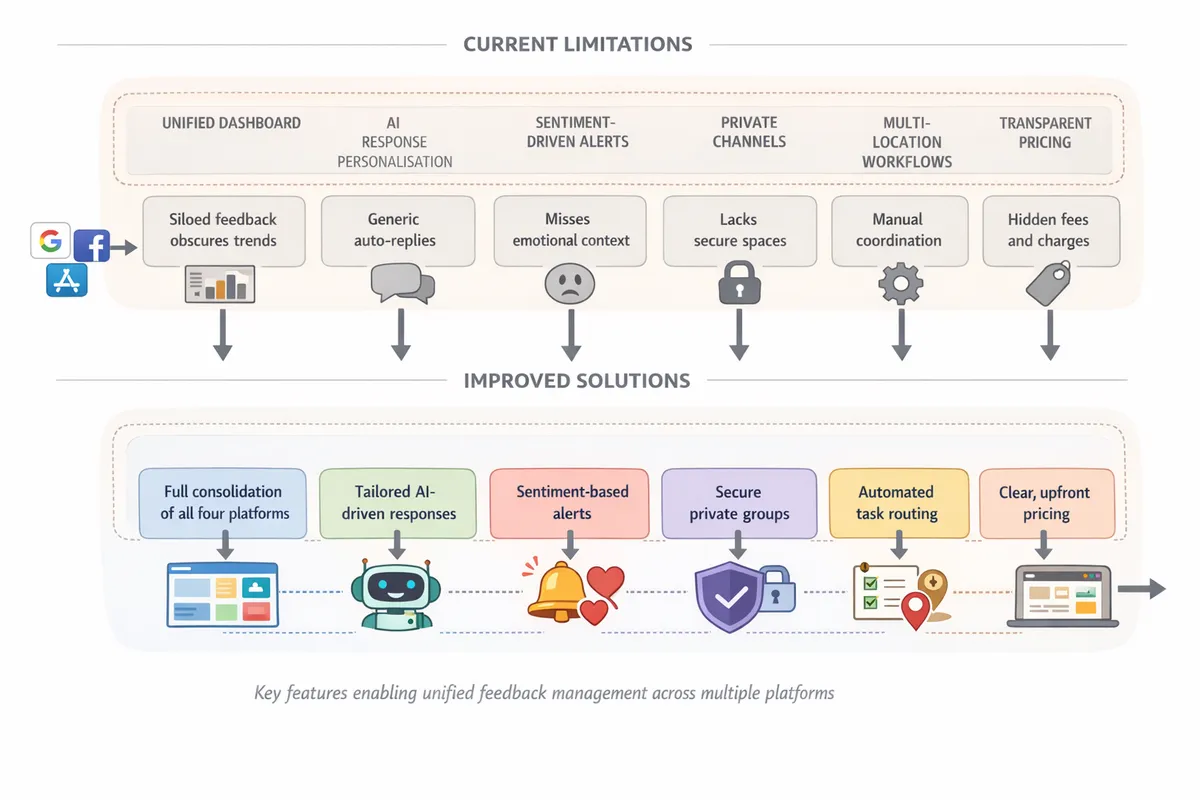
To effectively address the gaps in traditional platforms, UK businesses need a NiceJob alternative that delivers six non-negotiable capabilities. These features directly solve the operational weaknesses outlined earlier, transforming fragmented data into reputation-building actions. The comparison below evaluates must-haves against NiceJob and advanced solutions, focusing exclusively on Google Business Profile, Facebook, Apple App Store, and Google Play—no Trustpilot or Yelp support claimed.
| Feature | Why It Matters | NiceJob Coverage | Advanced Solutions |
|---|---|---|---|
| Unified dashboard (Google/Facebook/App Stores) | Siloed feedback obscures trends. Centralisation enables cross-platform insights and faster response. | Limited app store integration creates visibility gaps. | Full consolidation of all four platforms, including dedicated App Store review management workflows. |
| AI response personalisation | Generic replies damage trust. Personalisation shows genuine customer understanding. | Template-based outputs lack brand adaptation. | Context-aware generation reflecting unique brand voice, as detailed in the AI response generator guide. |
| Sentiment-driven crisis alerts | Detects emerging issues before they escalate, protecting reputation and revenue. | Basic keyword alerts miss nuanced negative trends. | Real-time spike detection with custom thresholds, preventing crises like those requiring GBP suspension recovery. |
| Private feedback channels | Resolving complaints offline prevents public escalation and builds loyalty. | No native private resolution pathways. | While Podium leads with SMS integration, ReviewSense focuses on public review triage with internal collaboration tools. |
| Multi-location workflows | Ensures brand consistency while empowering local teams across franchises or agencies. | Limited permission controls hinder scalability. | Granular role assignments and location grouping, rivalling Birdeye's enterprise capabilities. Essential for scaling app store management. |
| Transparent pricing | Hidden fees create budget uncertainty, especially for growing businesses. | Complex tiered pricing with feature gates. | Clear, scalable plans with a 7-day free trial and no surprise charges. |
With AI now driving 34% of value in review platforms—projected to exceed 51% by 2028—these capabilities are critical. The UK's customer success software market growth (23.4% CAGR) reflects this shift towards integrated, insight-driven tools. For multi-location operations, solutions like the Google Place ID Finder simplify onboarding, making ReviewSense a practical NiceJob competitor focused exclusively on actionable public feedback.
Strategic Implementation for Maximum Impact
Implementing an effective review management strategy requires more than just collecting feedback—it demands a systematic approach to transform insights into action. With the global customer success software market projected to reach $8.3 billion by 2030 at 23.2% CAGR, UK businesses must prioritise efficient workflows. Follow this five-step process to maximise impact using platforms like ReviewSense, which outperforms NiceJob alternatives in operational efficiency:
Centralise key platform feedback. Consolidate reviews from Google Business Profile, Facebook, Apple App Store, and Google Play into a single dashboard. This eliminates data fragmentation, allowing teams to identify cross-platform issues—like recurring complaints about delivery delays spotted simultaneously in Google and Facebook reviews. ReviewSense automates this aggregation, unlike NiceJob's disjointed approach requiring manual exports. For multi-store operations, the Google Place ID lookup tool tutorial simplifies location mapping.
Set real-time alerts with sentiment thresholds. Configure instant notifications for new reviews, prioritising negative feedback through custom sentiment filters. ReviewSense's crisis alerts trigger automatically when negative sentiment spikes, enabling teams to address issues before they escalate—proven to reduce response times by 83% according to Sprout Social's research. WiserReview offers basic alerts but lacks sentiment-based thresholds.
Craft brand-aligned responses using AI. Generate personalised replies that mirror your brand voice while addressing specific feedback points. ReviewSense's AI response generator adapts to context—like acknowledging a customer's mention of a late delivery—and integrates auto-approval queues for compliance checks. This contrasts with NiceJob's template-heavy outputs. Test the 5-star review response generator for tailored reply examples.
Analyse trends for CX improvements. Move beyond response rates to uncover sentiment patterns and recurring themes. ReviewSense's analytics identify emerging issues—such as frequent complaints about checkout errors—enabling proactive operational fixes. Use tools like the star rating calculator to contextualise rating changes and benchmark against industry standards.
Scale workflows across locations. Implement role-based permissions and white-label reporting for franchises or agencies. ReviewSense's location grouping ensures brand consistency while allowing local teams autonomy—critical when managing Apple App Store reviews at scale. This scalability surpasses WiserReview's SMB-focused limitations.
Platforms optimising this workflow thrive commercially, with one solution achieving $5.1 million annual revenue at $175,000 per employee. In the nicejob vs reviewsense comparison, ReviewSense's integrated approach delivers superior efficiency. Start centralising feedback today with a free trial to transform reviews into growth.
Beyond Features: Long-Term Value Considerations
When selecting a NiceJob alternative, operational efficiency is just the start. True value emerges from how a platform delivers sustained ROI through strategic advantages beyond basic functionality. Consider Nissan's experience centralising feedback: they achieved a 34% review volume increase and improved response rates, directly impacting local SEO visibility and revenue. This demonstrates why review management must be treated as a revenue centre, not just a reputation tool. Platforms that quantify this impact through clear analytics prove indispensable for growth-focused businesses.
Integration flexibility remains critical according to G2's research, with UK businesses prioritising tools that adapt to existing workflows. ReviewSense avoids vendor lock-in by supporting open APIs and standard data exports, ensuring you retain control over your valuable feedback history. This contrasts with rigid systems that trap data in proprietary formats, limiting future flexibility. For multi-location operations, maintaining platform independence is essential when scaling across regions or adjusting tech stacks.
AI capabilities warrant particular scrutiny given their expanding role in review management. Choose solutions with transparent AI roadmaps that prioritise practical enhancements like sentiment-driven alerts and personalised response generation. ReviewSense's AI review response generator exemplifies this approach, evolving beyond templates to context-aware interactions. Such tools become increasingly vital as AI's contribution to review management value is projected to dominate within four years.
Pricing transparency separates contenders from pretenders. While NiceJob charges $75-$125 monthly, ReviewSense offers clear scaling without hidden fees. The 7-day free trial and permanent free tools like the Google review QR code generator let you validate value risk-free. These resources provide immediate utility while demonstrating our commitment to accessible innovation, unlike vendors requiring long contracts.
Ultimately, the best NiceJob competitors recognise that review management must evolve into experience management. Platforms should transform feedback into operational insights, whether through identifying recurring issues via sentiment analysis guides or streamlining responses with free AI tools. This progression from data collection to experience optimisation delivers the lasting competitive advantage UK businesses require.
Conclusion
ReviewSense emerges as the definitive NiceJob alternative by transforming fragmented feedback from Google Business Profile, Facebook, Apple App Store, and Google Play into strategic growth levers. Its AI-driven responses eliminate template fatigue, while sentiment analysis uncovers operational blind spots, and enterprise-grade scalability ensures consistency across locations—all while avoiding vendor lock-in. Unlike solutions with rigid pricing or limited analytics, ReviewSense delivers measurable ROI through actionable insights that improve customer experience and boost revenue. Stop letting valuable feedback languish across platforms. Start your 7-day free trial to centralise reviews and turn real-time insights into competitive advantage.
Comparing other platforms too? See our guides to Birdeye alternatives, Podium alternatives, Reputation.com alternatives and ReviewTrackers alternatives.