
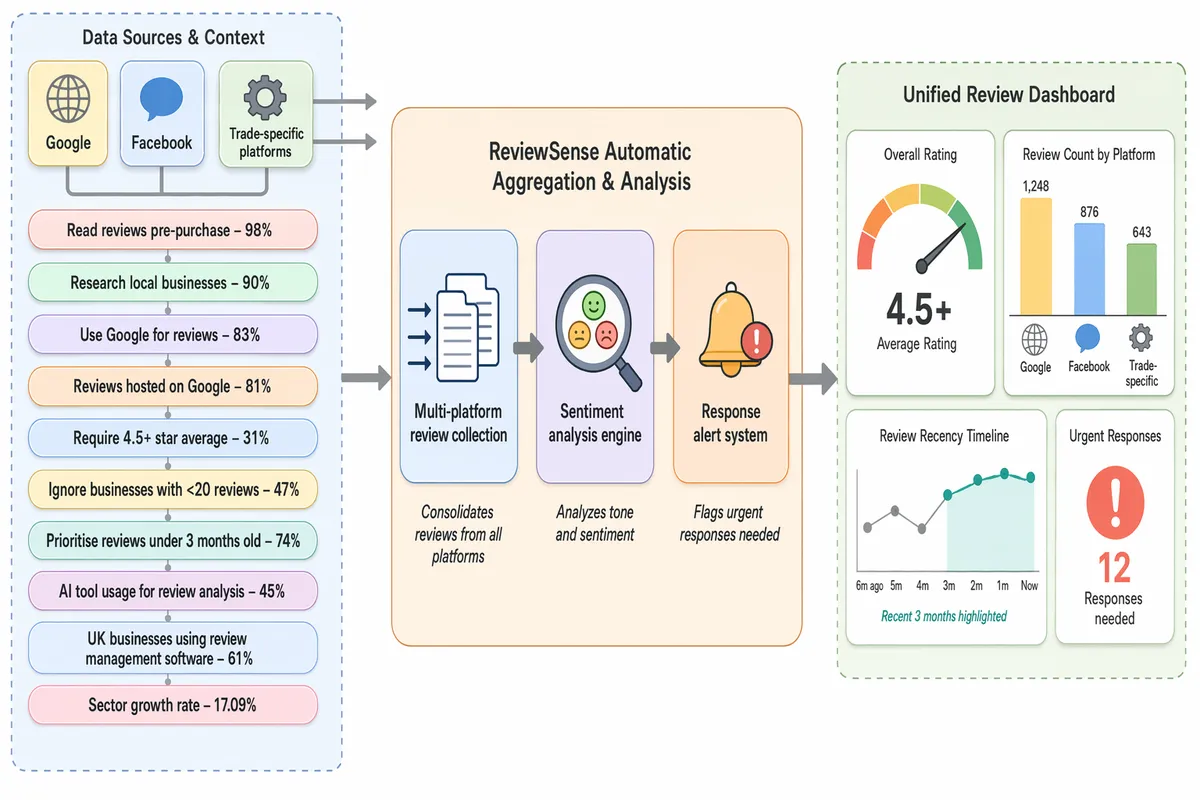
Did you know 98% of consumers read reviews before making a purchase? For plumbers, electricians, and tradespeople, a thin or poorly managed review profile can cost you bookings every week. Juggling Google, Facebook, and trade-specific platforms eats hours weekly, while slow responses damage trust. Effective review management is non-negotiable, yet manual tracking leaves gaps.
Managing this manually is hard. ReviewSense automates it.
The Critical Role of Reviews for Local Service Businesses
| Consumer Behaviour in 2026 | Percentage |
|---|---|
| Read reviews pre-purchase | 98% |
| Research local businesses | 90% |
| Use Google for reviews | 83% |
| Reviews hosted on Google | 81% |
| Require 4.5+ star average | 31% |
| Ignore businesses with <20 reviews | 47% |
| Prioritise reviews under 3 months old | 74% |
These figures reveal a harsh reality: reviews now dictate local business survival. The standards have escalated dramatically - nearly a third of customers automatically exclude businesses below 4.5 stars, while 47% dismiss those with under 20 reviews. Recency is equally critical, with 74% prioritising feedback posted within the last quarter.
Google remains the dominant force, hosting 81% of reviews and serving as the starting point for 83% of consumer research. However, its monopoly is weakening, dropping to 71% as review discovery diversifies across platforms. Simultaneously, consumer use of AI tools like ChatGPT for recommendations has surged from 6% to 45%, reflecting a shift in how people find local businesses. This fragmentation makes manual monitoring impractical for time-strapped local businesses.
Failing to respond promptly or address recurring issues signals indifference to potential customers. With 61% of UK businesses already using review management software and the sector growing at 17.09% annually, centralised platforms are becoming essential. They transform scattered feedback from Google, Facebook, and app stores into actionable intelligence. For strategies on improving ratings, see the guide on earning more 5-star reviews.
Choosing the best review management software for local businesses 2026 means finding solutions that handle multi-platform monitoring, sentiment analysis, and rapid response. Effective Google review management is particularly vital given its outsized influence on local visibility and conversion rates.
Top Review Management Challenges for Service Businesses
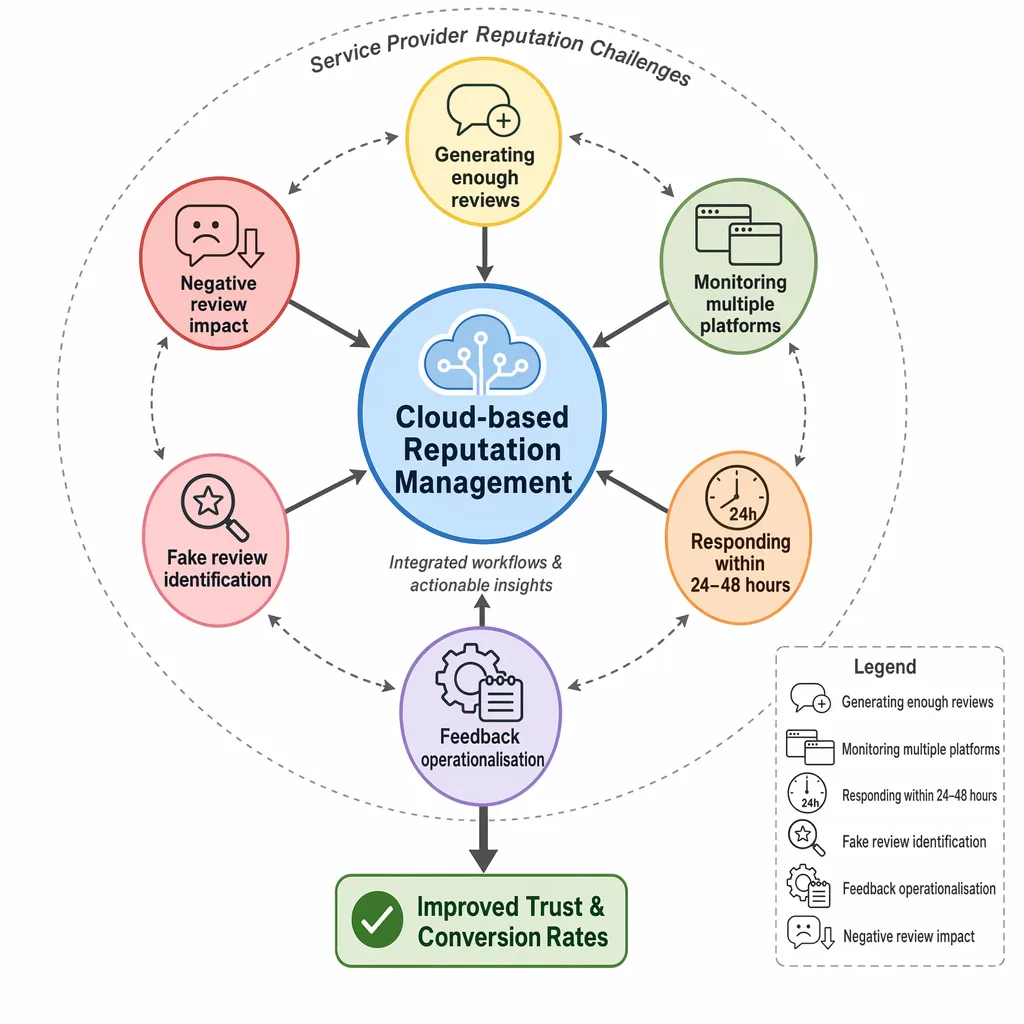
Navigating review management presents distinct hurdles for UK service providers, particularly when balancing customer expectations with operational realities. Below are the most pressing challenges:
| Challenge | Impact on Service Businesses |
|---|---|
| Generating sufficient volume | High customer abandonment rates |
| Multi-platform monitoring | Missed feedback across channels |
| Timely response management | Damaged reputation and trust |
| Limited SMB resources | Inconsistent review engagement |
| Fake review identification | Wasted effort and skewed insights |
| Feedback operationalisation | Missed improvement opportunities |
Generating enough reviews remains difficult despite their critical role in consumer decisions. Service businesses like home improvement contractors face particular trust barriers, where insufficient review volume directly impacts conversion rates. Without adequate feedback, potential customers often look elsewhere.
Monitoring multiple platforms compounds this challenge. Service providers must track Google Business Profile, Facebook, and app stores simultaneously, creating visibility gaps. A restaurant might miss critical feedback on Facebook while focusing on Google, directly affecting their ability to address service issues. For specialised guidance, explore the Facebook review management best practices.
Responding within the expected 24-48 hour window strains resources, particularly for small teams. Healthcare clinics, where patient trust is paramount, risk reputation damage when delayed responses leave concerns unaddressed. This urgency is reflected in the 16.68% annual growth of reputation software adoption among SMEs, as teams seek efficient solutions.
Distinguishing genuine feedback from fake reviews consumes valuable time. Hospitality businesses facing fabricated complaints might misallocate resources investigating non-existent issues rather than improving actual service gaps. Similarly, operationalising feedback into tangible improvements remains challenging without structured analysis. The guide on proactive customer review monitoring offers practical frameworks.
Negative reviews carry disproportionate weight, with many consumers actively avoiding businesses displaying poor feedback. Home service providers experiencing recurring complaints about punctuality, for instance, require systems to detect these patterns before revenue impacts occur. Understanding rating calculation mechanics helps contextualise feedback significance.
These interconnected challenges highlight why fragmented approaches falter. Cloud-based solutions now dominate reputation management for good reason – they consolidate these complex workflows into actionable systems.
Essential Features in Modern Review Management Solutions
Given these operational pressures, selecting the right tools requires understanding which features deliver tangible value. Below are the non-negotiable capabilities for 2026:
| Feature | Why It Matters | 2026 Adoption Trend |
|---|---|---|
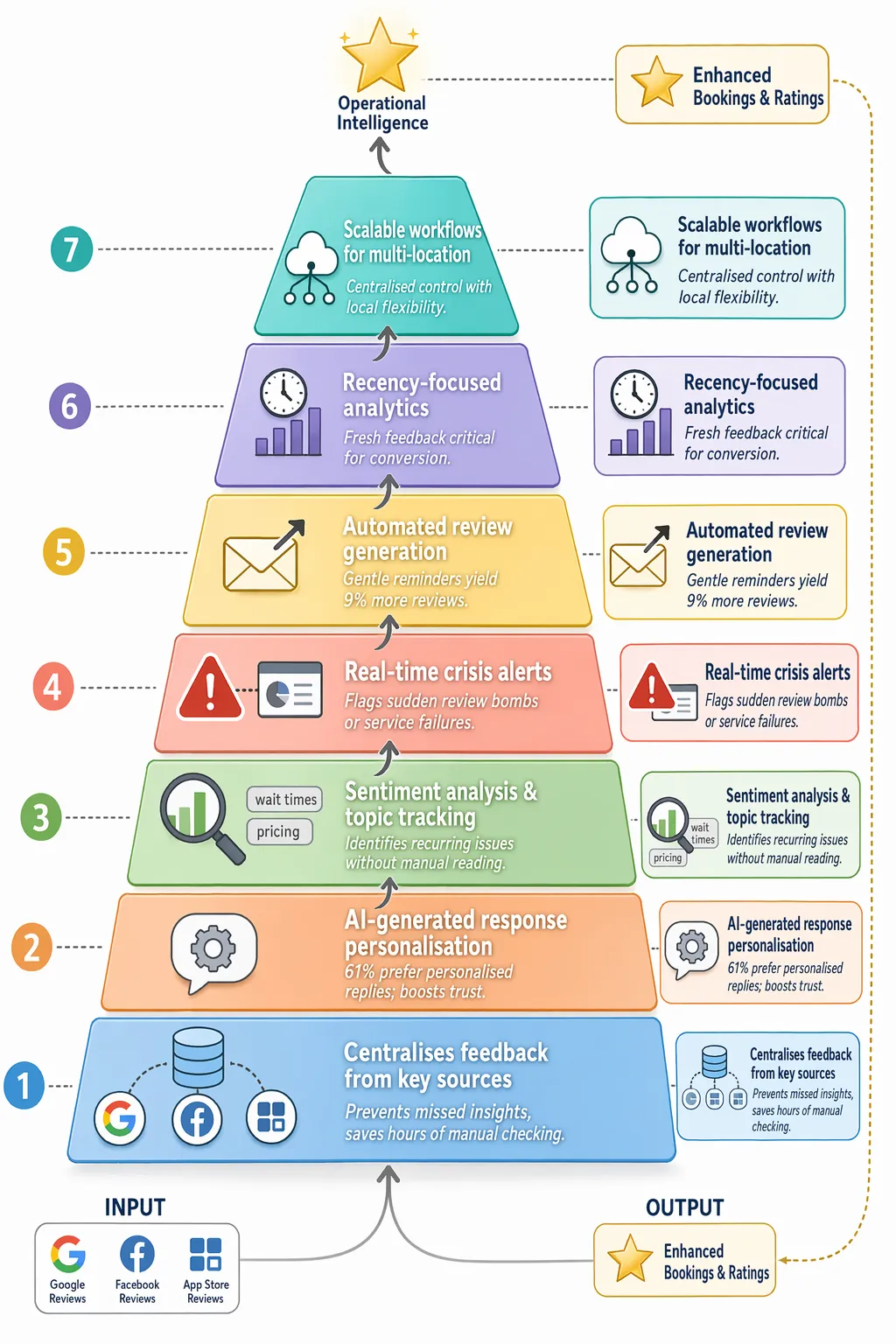
| Multi-platform aggregation (Google, Facebook, App Stores) | Centralises feedback from key sources, saving hours of manual checking | Standard across modern platforms |
| AI-generated response personalisation | 61% of responses are now personalised or manual rather than automated; builds trust | 61% of local businesses use review management software |
| Sentiment analysis & topic tracking | Identifies recurring complaints (e.g., "wait times" or "pricing") without manual reading | Core feature across enterprise platforms |
| Real-time crisis alerts for negative spikes | Prevents reputation damage by flagging sudden review bombs or service failures | Widely adopted in hospitality and services |
| Automated review generation | Gentle post-service reminders yield 9% more reviews; combats volume challenges | Integrated into leading solutions |
| Recency-focused analytics | Consumers prioritise recent reviews, making fresh feedback critical for conversion | Standard in modern platforms since 2025 |
| Scalable workflows for multi-location | Centralised control with local flexibility; essential for franchises and agencies | SME adoption growing at 16.68% CAGR; cloud solutions hold 72.45% market share |
These capabilities are no longer optional. With 75% of consumers reading reviews during research and 68% requiring at least a 4-star average, your review management directly impacts bookings. Platforms that aggregate Google, Facebook, and app store feedback prevent missed insights. For instance, 61% of responses are now personalised or manual rather than automated—a task made efficient by tools like ReviewSense's AI review response generator.
Sentiment analysis spots recurring issues before they escalate, while real-time alerts let you address crises promptly. Automated review requests can boost volume by 9%, helping businesses overcome the critical challenge of generating sufficient feedback. Recency-focused dashboards prioritise fresh content, aligning with consumer behaviour.
Scalable workflows are also key, with SME adoption of reputation tools growing at 16.68% annually. Cloud solutions dominate this space, offering centralised control for multi-location operations. For strategies on improving ratings, see the guide on earning more 5-star reviews. Ultimately, the best review management software for local businesses 2026 transforms feedback into operational intelligence.
Leading Platform Comparison for Service Business Needs
Given the operational demands outlined earlier, selecting the right platform requires matching specific business needs against solution capabilities. Below is a comparative overview of leading options for UK service businesses:
| Platform | Starting Price | Best For | Key Strength | Key Limitation |
|---|---|---|---|---|
| Podium | $399/mo | SMS-centric businesses | Integrated SMS marketing | High cost; limited platform support |
| Birdeye | $299+/location | Multi-location enterprises | Enterprise scalability | Complex pricing for smaller teams |
| NiceJob | $75/mo | Automated review generation | 4x conversion lift for services | Limited app store coverage |
| GatherUp | $99/location | NPS-integrated feedback | Survey-review unification | Higher per-location costs |
| Localith | $9/mo | Single-location Google focus | Extreme affordability | No Facebook/app store support |
A starting price is the least useful number in that table, because per-location billing and volume caps move the real figure a long way. Our guide to comparing review management pricing and features covers how to price these plans against your own location count before you commit. | ReviewSense | £49/mo | Centralised AI insights | Cross-platform sentiment analysis| Less SMS integration than Podium |
High-Cost Messaging Focus
Podium suits businesses prioritising SMS engagement but proves expensive for single-location operations. Its $399 monthly fee is hard to justify when 47% of consumers require substantial review volume before engaging.
Enterprise Scalability Challenges
Birdeye delivers for complex multi-location needs but pricing escalates quickly. At $299+ per location, it's often impractical for independent service providers despite strong centralisation features.
Automated Review Advantages
NiceJob's $75/month tier excels at generating feedback, crucial since reminder nudges boost responses by 9%. Its proven conversion lift helps trades overcome trust barriers, though app store coverage is weaker — see NiceJob alternatives if you need broader platform coverage.
Budget Constraints Considered
Localith offers Google-only management for $9/month, making it accessible for micro-businesses. However, this risks missing Facebook feedback where 32% of consumers specifically look for reviews from the last two weeks.
Balanced Cross-Platform Approach
ReviewSense addresses core SMB pain points at £49/month. It consolidates Google, Facebook, and app store feedback with AI analysis, vital when 74% of customers prioritise recent reviews. For businesses navigating duplicate listings, the merging duplicate Google Business Profiles guide complements this approach. With the feedback and reviews management software market growing 16.9% annually, solutions balancing cost and coverage like ReviewSense align with UK service sector needs.
Implementing a Future-Proof Review Strategy
Implementing your chosen solution effectively transforms review management from reactive to strategic advantage. Follow this action plan to build resilience:
| Step | Action | Critical Tactic |
|---|---|---|
| 1. Audit | Map profiles across Google, Facebook, Apple/Play stores | Use tools like the Google Place ID Finder to locate listings; merge duplicates to consolidate ratings |
| 2. Collection | Automate review requests via post-service emails/SMS | Generate direct review links with the Google Review Link Generator; gentle nudges boost response rates |
| 3. Response | Balance AI efficiency with personal touches | Customise AI-generated replies to reflect brand voice; address specific customer mentions |
| 4. Analysis | Extract actionable insights from feedback | Use sentiment analysis to spot recurring issues and improve service quality |
| 5. Monitoring | Track review velocity and recency | Prioritise responses to recent reviews; set alerts for sudden negative spikes |
| Crisis Plan | Develop predefined response protocols | Act within 24 hours to address negative feedback and demonstrate commitment |
| Free Resources | Utilise templates and trials | Access response templates and star rating calculators; test platforms with free trials |
Begin by auditing all review profiles across supported platforms. Duplicate listings fragment your ratings—consolidate them using the merging duplicate Google Business Profiles guide. This creates a unified reputation foundation.
Automate review collection next. Direct customers to leave feedback using branded links. Post-service nudges significantly increase volume.
When responding, blend AI efficiency with human nuance. Consumers value authenticity alongside speed — use AI drafts as starters, then add personal details showing genuine engagement.
Sentiment analysis turns feedback into improvement plans. Identify recurring complaints—like booking delays or communication gaps—and fix operational weaknesses. This directly impacts retention.
Monitor review velocity daily. Fresh feedback heavily influences decisions, so prioritise recent entries. Set crisis alerts for negative spikes, activating your playbook immediately. A swift, empathetic response often converts critics into advocates.
Use free tools like response templates and star calculators during implementation. Most platforms offer trials—test how features like ReviewSense's sentiment tracking fit your workflow before committing. This structured approach ensures reviews become your most valuable CX asset.
Conclusion
For local service businesses, effective review management hinges on consolidating feedback from Google, Facebook, and app stores while balancing cost and functionality. ReviewSense delivers this equilibrium: its £49/month platform centralises critical feedback with AI-powered analysis, sentiment tracking, and crisis alerts—directly addressing the need to prioritise recent reviews and operationalize insights. Unlike limited-budget tools or feedback-focused alternatives, it transforms scattered data into clear paths for reputation growth and retention.
Stop reacting to reviews—start driving customer experience improvements. Transform your scattered reviews into actionable insights today with ReviewSense: Start your 7-day free trial