
With But picking between Reputation.com, Birdeye, Podium, and ReviewTrackers in 2026 feels like comparing apples to slightly more expensive apples. Each promises unified dashboards, AI-powered responses, and review generation, but their pricing and focus differ wildly. This comparison strips away the marketing fluff to reveal exactly what you get for your budget — and where these platforms fall short for multi-location teams.
Managing this manually across four platforms is a nightmare. ReviewSense automates the whole workflow instead.
The 2026 Reputation Management Environment: Four Platforms Compared
That shift from reactive monitoring to proactive strategy is not just a trend—it's a market reality. The global online reputation management software market is projected to grow at a CAGR of roughly 13.2% to 14.0%, with some forecasts estimating it will surpass $14 billion by 2031. Reputation now represents up to 63% of a company's total market value, according to recent industry research. That makes it a core business asset, not a nice-to-have.
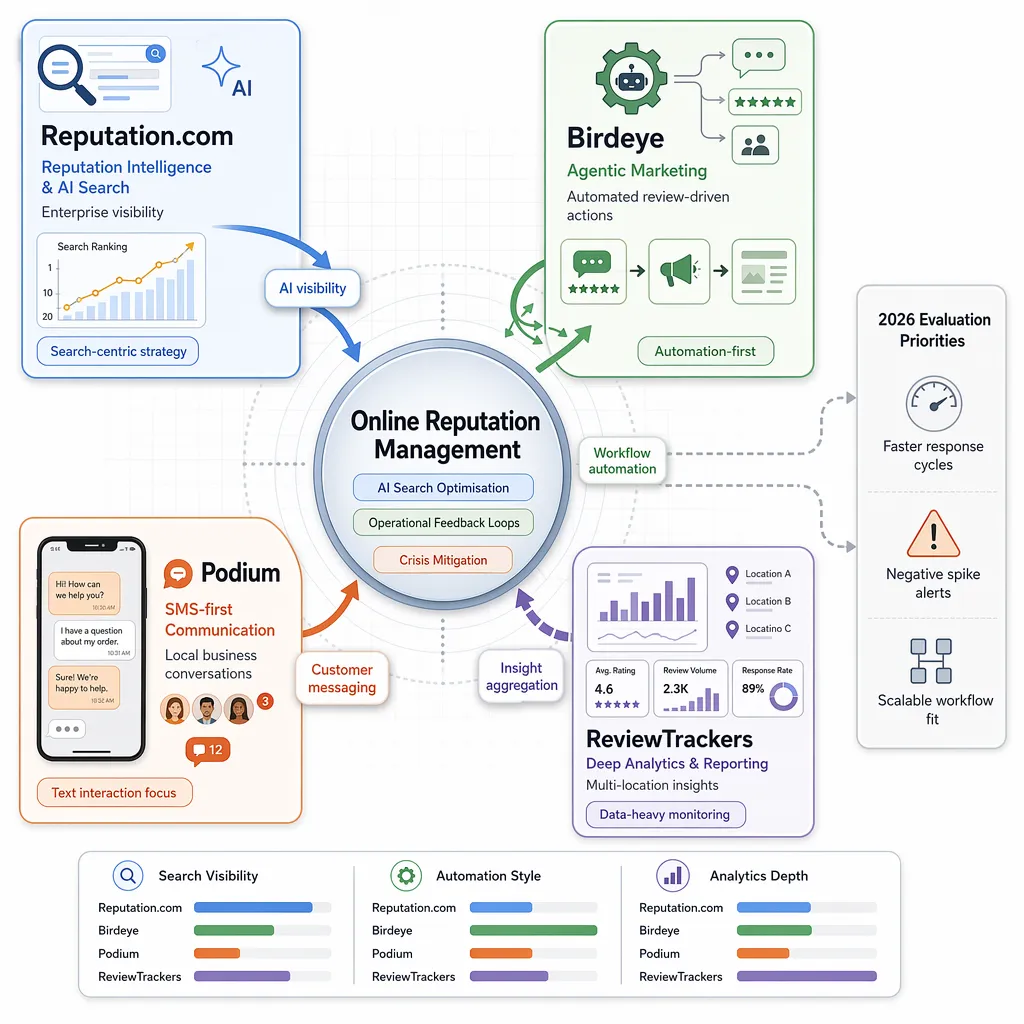
Four platforms dominate this space: Reputation.com, Birdeye, Podium, and ReviewTrackers. Each takes a different approach. Reputation.com focuses on 'Reputation Intelligence' and AI search readiness. Birdeye pushes 'Agentic Marketing'—automated actions based on feedback. Podium is SMS-first, built for local businesses that want to text customers. ReviewTrackers offers deep analytics for multi-location teams.
Here is a quick comparison to frame the discussion:
| Platform | Core Focus | Best For |
|---|---|---|
| Reputation.com | Reputation Intelligence & AI Search | Large enterprises needing search visibility |
| Birdeye | Agentic Marketing | Businesses wanting automated marketing from reviews |
| Podium | SMS-first communication | Local businesses prioritising text conversations |
| ReviewTrackers | Deep Analytics & Reporting | Multi-location teams that need data insights |
What to look for in 2026
You should look beyond feature checklists. Evaluate each platform on three criteria: operational feedback loops, AI search optimisation, and crisis mitigation. A tool that helps you reply faster is useful. One that spots a negative spike and alerts your team before it spreads is essential. The right choice depends on your scale and your biggest risk. For example, a single-location shop might prefer Podium's simplicity, while a chain of 50 stores may need ReviewTrackers' analytics or Birdeye's automation. Reputation.com suits enterprises that live or die by local search rankings.
This comparison will help you decide which platform fits your actual workflow. We'll cover pricing, features, and real-world trade-offs. You'll also see how a tool like ReviewSense compares when you need centralised review management across Google, Facebook, and app stores without the enterprise price tag. Check the guide to choosing customer review management software for a broader view.
What to Look for in a 2026 Reputation Platform
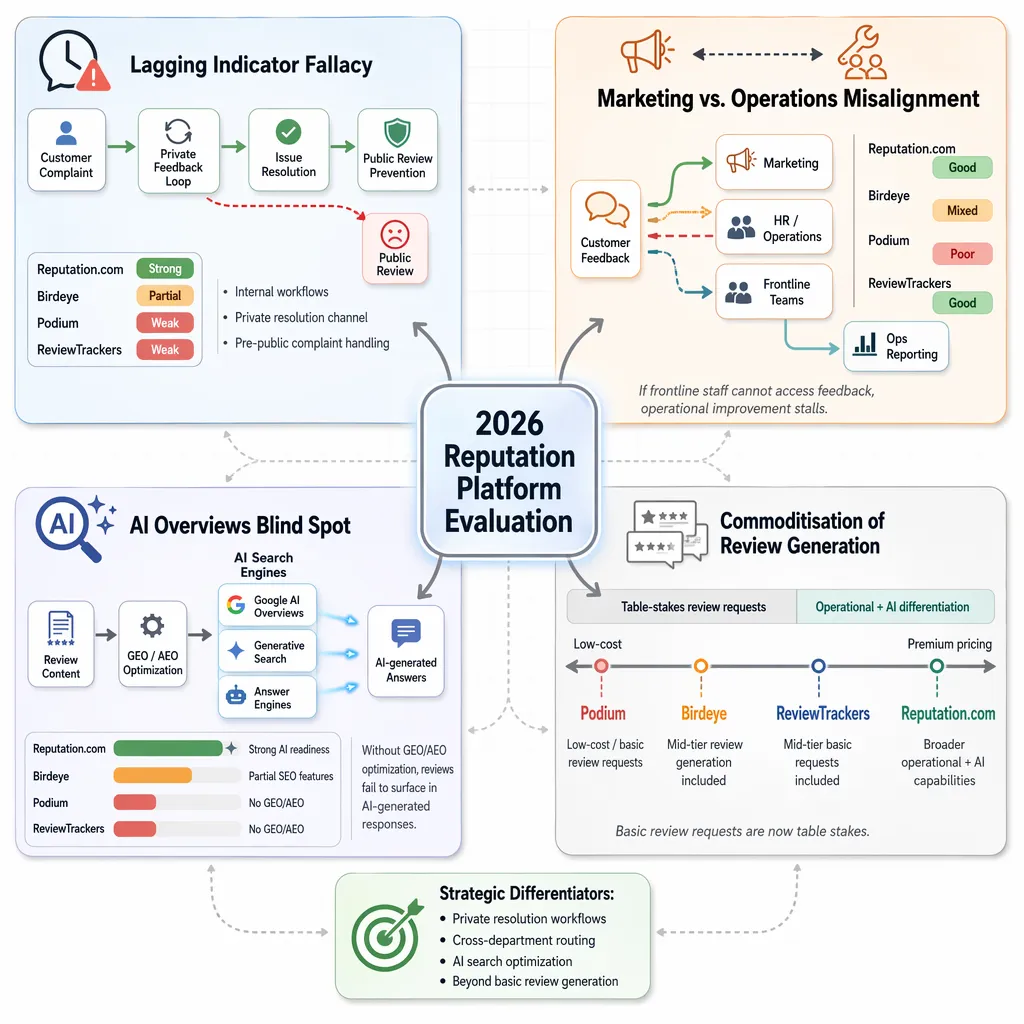
Building on that comparison, the real test is whether a platform helps you prevent problems, not just polish the aftermath. Here are four criteria to judge any reputation tool in 2026.
| Criterion | Why It Matters | Reputation.com | Birdeye | Podium | ReviewTrackers |
|---|---|---|---|---|---|
| Lagging Indicator Fallacy | Reviews are post-facto; tools must create private feedback loops | Strong: offers internal feedback workflows | Partial: automated surveys but limited private resolution | Weak: SMS-first, no private loop | Weak: analytics-heavy, no prevention |
| Marketing vs. Operations Misalignment | Data must flow to HR/ops, not just marketing | Good: shares insights across departments | Mixed: marketing automation focus | Poor: no operational routing | Good: detailed reports for ops teams |
| AI Overviews Blind Spot | Platforms must optimise for AI search engines (GEO/AEO) | Strong: built for AI search readiness | Partial: some SEO features | Weak: no AI search focus | Weak: no GEO/AEO features |
| Commoditisation of Review Generation | Basic review requests are now table stakes, not premium features | Premium pricing for basic requests | Mid-tier: includes review generation | Low-cost: review requests included | Mid-tier: basic requests included |
1. The Lagging Indicator Fallacy
Reviews tell you what already happened. A smart platform creates private feedback loops to catch issues before they go public. Reputation.com offers internal workflows for this. Birdeye automates surveys but lacks a private resolution channel. Podium and ReviewTrackers focus on public-facing responses. You need a tool that flags a complaint and lets you resolve it privately first.
2. Marketing vs. Operations Misalignment
Reputation data should reach your service teams, not just your social media manager. Reputation.com shares insights across departments. Birdeye pushes marketing automation but doesn't route feedback to operations. ReviewTrackers gives detailed reports that ops teams can use. Podium offers no operational routing. If your frontline staff can't see the feedback, you're missing the point.
3. AI Overviews Blind Spot
Google's AI Overviews and other AI search engines pull from review content. Platforms must optimise for generative engine optimisation (GEO) and answer engine optimisation (AEO). Reputation.com leads here with AI search readiness. Birdeye offers partial SEO features. Podium and ReviewTrackers lack GEO/AEO capabilities entirely. Without this, your reviews won't surface in AI-generated answers.
Pricing and Value: What You Actually Pay in 2026
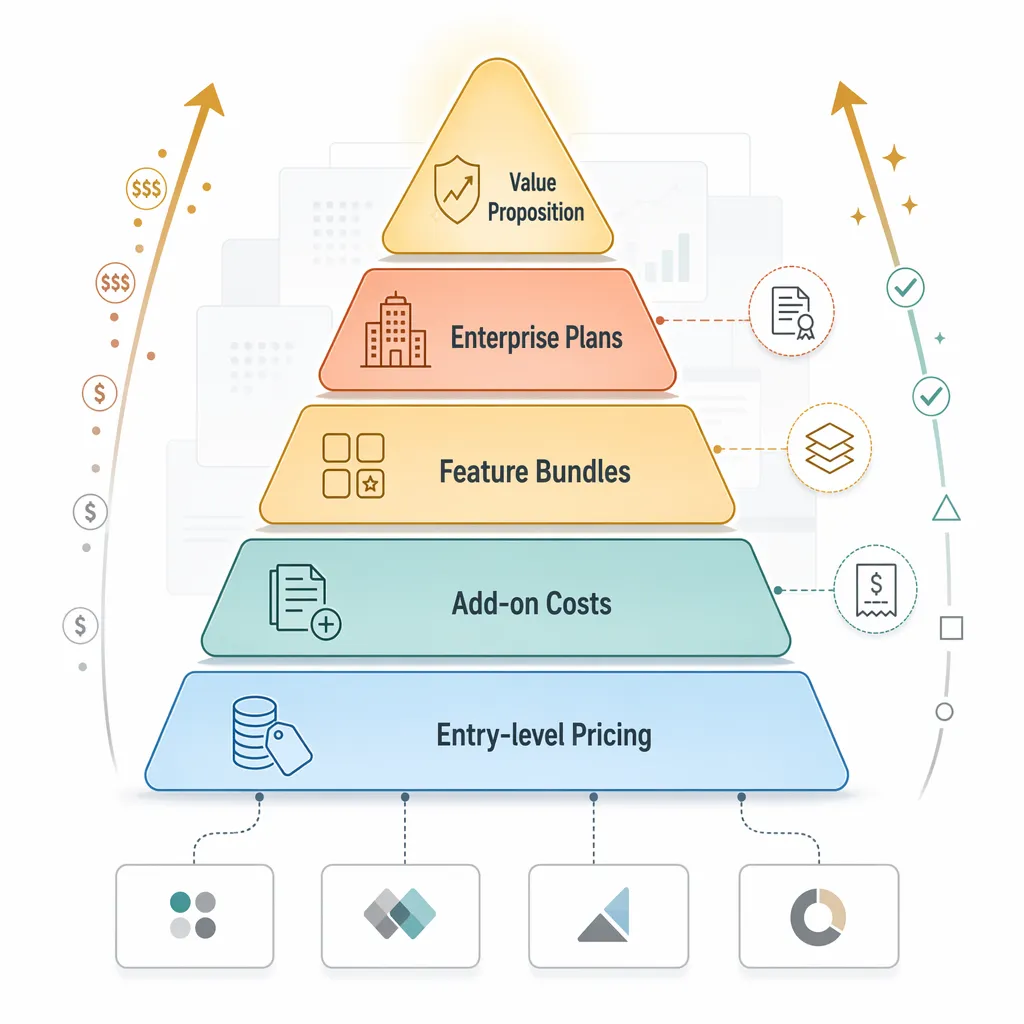
That blind spot matters when you consider what you're actually paying for. Here's how the pricing stacks up in 2026.
| Platform | Starting Price (Monthly) | Typical Range | Hidden Costs & Considerations |
|---|---|---|---|
| Reputation.com | $80/location | $80–$150/location | Enterprise plans for 125+ locations are custom-quoted. Annual contracts often required. AI features may be add-ons. |
| Birdeye | $299 | $299–$349 | Per-location fees stack fast. AI response generator is a paid upgrade. Annual commitment expected. |
| Podium | $399 | $399+ | SMS credits sold separately. Review request limits on lower tiers. No per-location discount for multi-site. |
| ReviewTrackers | $49 | $49–$89 | Cheapest entry point, but analytics depth costs extra. Limited automation without higher tiers. |
All four vendors use quote-based models. You won't see a transparent price until you book a demo. That makes comparison shopping harder than it should be.
The real cost of 'enterprise' tools
Birdeye reported 113% year-on-year growth in its enterprise segment, especially among healthcare, finance, and hospitality chains. That tells you large organisations see value in unified reputation management. But the price tag reflects that demand. At $299–$349 per location per month, a 50-location chain's bill scales accordingly before add-ons. Podium starts at $399 and climbs from there. These platforms bundle features you may not need—like SMS marketing or lead generation—and charge for them anyway.
Where changes the equation
ReviewSense offers transparent pricing and a 7-day free trial. You evaluate the product before committing. Free tools like the Google review link generator and negative review response templates give immediate value, no credit card required. The platform supports exactly four channels: Google Business Profile, Facebook, Apple App Store, and Google Play. It does not support Trustpilot, Yelp, or Tripadvisor. That focus keeps costs down and complexity low. For teams that only need those four platforms, it's a cleaner fit than paying for a suite that covers channels you'll never use. Compare that to Birdeye vs Podium vs ReviewSense—the latter gives you AI-powered replies, sentiment analysis, and crisis alerts without the enterprise markup. Check the Google Play review management for a deeper look at app store tools.
How It Addresses Core Pain Points Across Industries
The pricing gap between enterprise platforms and smaller teams is stark, but the real test is how each tool handles the daily grind of different industries. A restaurant chain and a law firm face very different review challenges. Here's how the major platforms stack up against sector-specific pain points.
| Sector | Core Challenge | Reputation.com | Birdeye | Podium | ReviewTrackers |
|---|---|---|---|---|---|
| Hospitality & Restaurants | High volume, fast response needed | Strong: auto-reply workflows | Good: agentic marketing for chains | Weak: SMS-first, slow for volume | Moderate: analytics but slow reply |
| Professional Services | Trust-building through reviews | Good: Rep Score for credibility | Moderate: survey-based feedback | Strong: SMS for quick client contact | Weak: no trust-building features |
| Healthcare | Compliance and privacy | Strong: Rep Score flags sensitive data | Moderate: some compliance filters | Weak: no healthcare-specific tools | Weak: no compliance features |
| E-commerce | 24/7 monitoring across app stores | Moderate: multi-channel support | Weak: limited app store integration | Weak: no app store support | Moderate: app store analytics |
Hospitality and restaurants need speed. A single negative review about a cold meal can cost you a weekend of bookings. Reputation.com offers auto-reply workflows that help. Birdeye's agentic marketing suits multi-location brands but doesn't prioritise speed. Podium's SMS focus works for one-to-one chats, not high-volume review triage. ReviewTrackers gives you the data but not the speed. This is where the Birdeye vs podium vs reviewsense comparison matters most. ReviewSense sends instant alerts the moment a review lands, and its AI response generator drafts a reply in seconds. Your team approves or edits it, then publishes. No lag.
Professional services — solicitors, accountants, architects — rely on trust. A single 1-star review can deter high-value clients. Reputation.com's Rep Score helps monitor sentiment. Birdeye's surveys catch issues early. Podium's SMS works well for local service businesses that want private feedback loops. ReviewTrackers offers deep analytics but no prevention tools. ReviewSense flags negative sentiment immediately and lets you respond with a custom brand voice. You maintain professionalism without sounding robotic.
The Contrarian View: Why Most Comparison Articles Get It Wrong
That pricing gap leads to a bigger problem: most comparison articles focus on the wrong things. They tally features like a shopping list. Here's why that misses the point.
Myth vs. Reality: Three Ways the Industry Gets It Wrong
| Myth | Reality |
|---|---|
| More features = better platform | You need operational feedback loops, not just review management |
| AI response generators are a luxury | With 95% of unsatisfied customers returning if issues are resolved quickly, AI-assisted responses are a necessity for 2026 |
| You should optimise for star ratings | You must optimise for AI search summaries (GEO) – 68% of consumers refuse to engage with businesses under 4 stars |
Myth 1: Feature bloat over feedback loops. Reputation.com and Birdeye pack in lead generation, SMS marketing, and listing management. That sounds impressive. But for a UK dental practice or a regional hotel chain, those extras add cost without solving the core problem: closing the loop with customers. Podium leans hard into SMS, which works for service businesses but ignores app store reviews entirely. ReviewTrackers gives you analytics but no built-in response workflow. ReviewSense focuses on actionable intelligence — sentiment analysis, topic extraction, and spam detection — so you fix what's broken, not just track what's said. Use the customer review management tools to build real feedback loops.
Myth 2: AI replies are optional. They're not. A fast, on-brand response to a negative review can recover a customer relationship. Recent industry research shows that 95% of unsatisfied customers return if their issue is resolved quickly. Reputation.com and Birdeye offer AI replies as paid add-ons. Podium's AI is tied to its SMS system. ReviewTrackers has no native AI response generator. ReviewSense includes it in every plan, with custom brand voice controls. The AI review response generators let you test the approach before committing.
Conclusion
The right review management platform isn't the one with the most features—it's the one that turns feedback into action. Reputation.com, Birdeye, Podium, and ReviewTrackers each solve parts of the problem, but none close the loop with the speed, precision, and simplicity that modern businesses need. ReviewSense centralises reviews from Google, Facebook, and app stores, alerts you instantly, drafts on-brand replies with AI, and flags sentiment shifts before they escalate. For hospitality, professional services, and e-commerce alike, that operational feedback loop is what protects reputation and drives growth. Don't settle for feature bloat or missing pieces. Start your 7-day free trial and turn scattered reviews into actionable insights that improve customer experience.