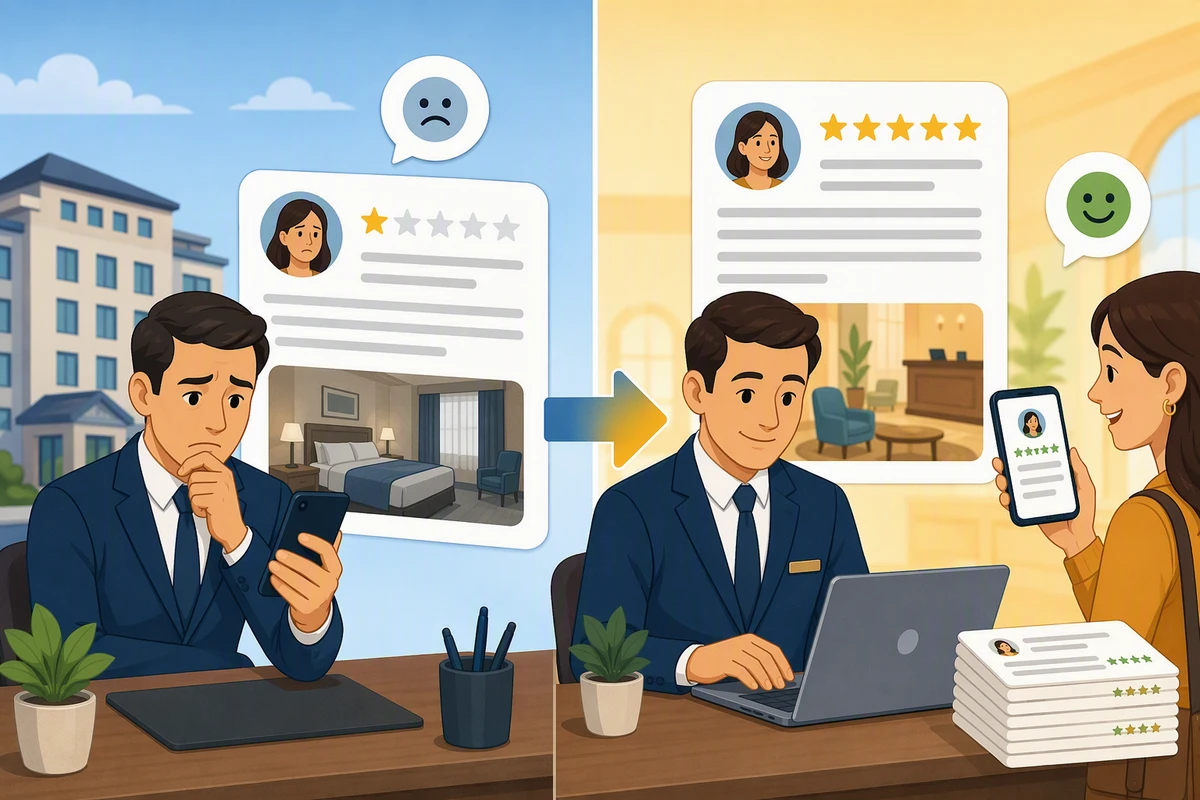
89% of travellers say their impression of a business improves after reading a thoughtful response to a negative review. Yet most hoteliers and restaurateurs either ignore reviews or paste generic replies that signal indifference. The difference between a booking and a bounce often comes down to how you craft those few lines of public dialogue. Here’s how to respond to TripAdvisor reviews with templates that build trust and drive revenue.
Managing this manually at scale is hard — especially when you’re juggling dozens of platforms. ReviewSense automates your entire response workflow.
Why Response Strategy Matters More Than Response Volume
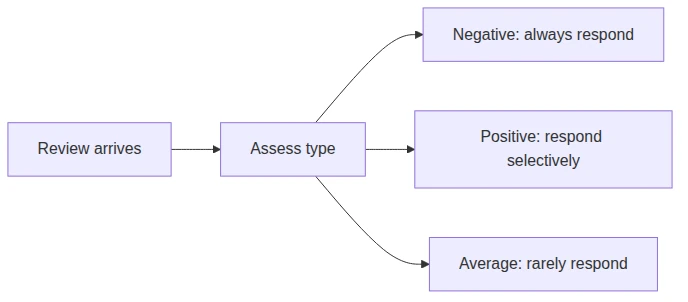
That instinct to reply to every single review might actually be working against you. Research from Cornell Hospitality found that after hitting roughly a 40% response rate, hotels see diminishing returns on their reputation scores. More replies don't always mean better results.
A 2019 study by Tripadvisor and Ipsos MORI found that 63% of travellers are more likely to book when owners respond to most reviews. That's a survey-based figure, not a guaranteed lift. But it points to a clear signal: coverage matters more than perfection.
| Response Type | Strategic Value | When to Use |
|---|---|---|
| Negative | High — shows accountability | Always respond |
| Positive | Medium — reinforces loyalty | Selectively |
| Average (3-star) | Low — minimal impact | Rarely or never |
A 2024 study in Information & Management distinguished between active-constructive responses (specific, personal) and passive-constructive ones (generic, transactional). The former drives trust. The latter wastes time.
Your primary audience isn't the person who wrote the review. It's the future guest reading it. Every response acts as a public product demonstration. It shows how your business handles mistakes. It signals that you listen. A generic "thanks for your feedback" does none of that.
PhocusWire's expert advice cuts through the noise: respond to all negative reviews, a few positive ones, and none of the average ones. That's the strategy that scales. It frees your team to focus on genuine feedback that impacts reputation and retention.
This article exists to give you frameworks, not copy-paste paragraphs. The templates below are designed to be adapted, not recited. They help you master how to respond to TripAdvisor reviews with intention. For businesses managing reviews across multiple platforms, tools like App Store Review Management can centralise that workflow. But the principle remains the same: strategy beats volume every time.
The Anatomy of an Effective Tripadvisor Review Response
That strategy hinges on knowing what to say. A structured response turns a complaint into a demonstration of care. Here is the six-part framework backed by industry research.
| Component | Purpose | Example |
|---|---|---|
| Thank the guest | Opens with courtesy | "Thank you for sharing your experience." |
| Personalise with a specific detail | Shows you read the review | "We're glad you enjoyed the harbour-view room." |
| Acknowledge the emotion or inconvenience | Validates their feeling | "I understand how frustrating a delayed check-in can be." |
| Address facts briefly without argument | Corrects errors, not opinions | "Our pool hours are 7am–9pm, as listed on our website." |
| State the action taken or investigation underway | Builds trust | "We have retrained the front-desk team on check-in procedures." |
| Invite private contact for sensitive details | Moves conflict offline | "Please email manager@hotel.com so we can discuss this further." |
Why this structure works
A Tripadvisor study found that 79% of travellers find responses more useful when they mention specific details from the guest's review. Generic replies signal indifference. Personalised ones signal care.
Handling negative reviews with precision
Tripadvisor's business guidance recommends prioritising negative reviews and addressing factual inaccuracies without arguing. A 2026 Which? investigation found that AI summaries can soften serious complaints. Never imply a safety issue is an opinion. Use the example from the research: "We're sorry to hear about [specific issue]. We have [specific action]."
Privacy and tone constraints
Avoid room numbers, booking details, or accusations. Tripadvisor's management-response guidelines prohibit sharing personal data. Keep it professional.
Matching response length to property type
A Cornell Hospitality Quarterly study found that luxury properties benefit from longer, GM-level responses. Budget properties need conciseness. Tailor your tripadvisor review response to your brand voice.
For teams managing high volumes, tools like ReviewSense's AI response generator can help automate responses while keeping quality high. But the framework stays the same: structure builds trust.
When to use this for positive reviews
Apply the same six-part structure to positive reviews. Thank the guest, personalise with a detail, and invite them back. It reinforces loyalty without sounding robotic.
Mastering how to respond to tripadvisor reviews means treating every reply as a public signal. Future guests read them. Make each one count.

Templates for Positive, Negative, and Mixed Reviews
That six-part structure works for any review type, but the tone and emphasis shift depending on the rating. Here are three distinct templates to guide your tripadvisor review response strategy.
Templates at a Glance
| Review Type | Core Approach | Key Action |
|---|---|---|
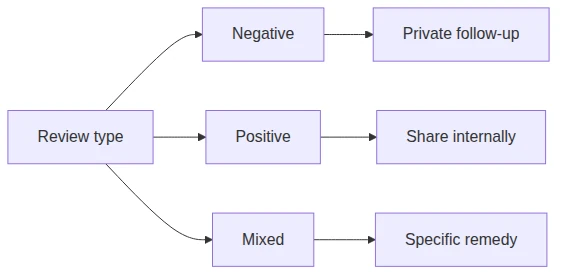
| Negative | Thank → Acknowledge → Context (no excuses) → Action | Invite private follow-up |
| Positive | Thank → Personalise → Share internally | Avoid promotional overreach |
| Mixed | Recognise the positive → Address the shortcoming | Offer a specific remedy |
Negative Reviews: The Four-Part Framework
Start with gratitude: "Thank you for taking the time to leave feedback." Then acknowledge the specific issue: "I understand your frustration with the slow check-in." Provide context without making excuses: "We've since added a second front-desk agent during peak hours." Close with an action or invitation: "Please email manager@hotel.com so we can make this right."
A Tripadvisor study found that 89% of travellers view a thoughtful response favourably. Another 84% value politeness and respect above all else. Avoid defensiveness. Never argue with the reviewer.
Positive Reviews: Less Is More
A study in Communications of the Association for Information Systems found that responses to positive reviews can backfire when they appear opportunistic. Don't pitch upgrades or ask for referrals. Use this simple template: "Thank you for mentioning [specific employee or amenity]. We'll share your kind words with [team member]." It reinforces loyalty without sounding transactional.
Mixed Reviews: Balance and Specificity
For a 3-star review, recognise the compliment first: "We're glad you enjoyed the location." Then address the shortcoming: "We're sorry the room temperature was inconsistent." Offer a concrete fix: "We've serviced the thermostat in that room."
A critical caveat: these templates are frameworks, not final copy. Every response must be personalised. Tripadvisor guidelines also prohibit offering discounts or making promotional claims in public responses. Keep it factual and professional.
For teams managing high volumes, tools like ReviewSense's AI response generator can help automate responses while keeping quality high. But the framework stays the same: structure builds trust.
Mastering how to respond to TripAdvisor reviews means treating every reply as a public signal. Future guests read them. Make each one count.
How to Handle Difficult Scenarios Without Damaging Trust
Those templates work for standard reviews, but some scenarios demand a different approach. A poorly handled response can damage trust faster than the original complaint. Here is how to navigate five high-risk situations.
Scenario-by-scenario response guide
| Scenario | Core principle | Key action |
|---|---|---|
| Factually inaccurate review | Correct facts, not opinions | Cite specific details without attacking |
| Safety or misconduct allegation | Acknowledge directly, move offline | Use a serious tone, offer private contact |
| Abusive or fraudulent review | Report, don't debate | Use Tripadvisor's flagging system |
| Recurring complaint about same issue | Fix operations first | Show the change, not a new apology |
| Unrealistic expectations | Validate disappointment, clarify honestly | Avoid admitting fault for things outside your control |
Factually inaccurate reviews
A guest claims your pool was closed when it was open. Tripadvisor's own guidance recommends prioritising factual misstatements. Calmly state the correct information without attacking the reviewer. Example: "Our pool operates from 7am to 9pm daily, as listed on our website. We're sorry if this wasn't clear during your stay."
Safety or misconduct allegations
Never treat a safety issue as an opinion. A 2026 Which? investigation found that AI summaries can soften serious complaints, but your response must not. Use direct language: "We take your report of [specific issue] very seriously. We have investigated and taken [specific action]. Please contact us at manager@hotel.com for a private discussion."
Abusive or fraudulent reviews
Do not engage publicly. Tripadvisor's reporting process exists for this reason. Flag the review and move on. Your response, if any, should be brief: "We have reported this review to Tripadvisor for violating their guidelines."
Recurring complaints about the same issue
The best response is an operational fix, not better wording. Research from the Communications of the Association for Information Systems shows that acknowledgment combined with action improves future ratings. Example: "We heard similar feedback about wait times. We've added a second front-desk agent during peak hours."
Reviews from guests with unrealistic expectations
A guest complains your beachfront hotel is not on the sand. Acknowledge the disappointment without admitting fault: "We understand your frustration. Our listing clearly states 'beachfront' means a five-minute walk to the shore. We're sorry this didn't meet your expectations."
Building a Sustainable Review Response Workflow
Those templates handle individual reviews, but a sustainable workflow requires more than good phrasing. Speed matters, but usefulness matters more. MARA research found that 80% of hoteliers respond within one day. Yet a fast reply that ignores the core issue can do more harm than a slower, thoughtful one.
Prioritise by Impact, Not by Inbox Order
| Review Type | Priority | Why |
|---|---|---|
| Negative with specific operational feedback | Highest | Fix the problem, then reply. |
| Reviews near the top of recent listings | High | Future guests see these first. |
| Reviews that could mislead future guests | High | Correct factual errors publicly. |
| Positive reviews | Low | Thank quickly, no need for deep analysis. |
Fix First, Then Write
A broken shower needs a plumber, not a polished apology. Fix the operational issue before crafting a response. This principle applies to recurring complaints too. Track recurrence of issues in your dashboard. If the same problem appears three times, your response should describe the fix, not repeat the apology.
AI Should Draft, Not Decide
ReviewSense can centralise feedback from Google Business Profile, Facebook, Apple App Store, and Google Play into a single dashboard. Instant alerts and AI-generated draft responses help managers move fast. But the 2026 Which? controversy showed that AI summaries can soften serious complaints. Human verification remains essential for factual claims, safety allegations, and brand voice. Use the AI draft as a starting point, then personalise it.
Measure the System, Not the Prose
Track three metrics: recurrence of specific issues, rating trends after operational fixes, and the percentage of responses that contain a verifiable action. A response that says "we fixed the thermostat" is better than one that says "we value your feedback."
Ready to start? Use the free tools like the Google review link generator and negative review response templates. They'll help you build a workflow that works today.
Conclusion
Responding to TripAdvisor reviews demands more than templates. Fix the operational problem first, then write. Prioritise by impact, not inbox order. Human oversight remains essential—AI drafts help, but you verify the facts and tone. Track recurrence, rating trends, and verifiable actions in your responses.
A single dashboard can centralise this entire workflow. ReviewSense consolidates feedback from Google, Facebook, Apple App Store, and Google Play. Instant alerts catch new reviews. AI generates draft replies for your team to personalize. Sentiment analysis flags recurring issues before they escalate.
Stop chasing scattered reviews across platforms. Start your 7-day free trial and turn scattered feedback into actionable insights that protect your reputation.