
Are you still waiting for negative feedback to surface before taking action? Reactive strategies no longer work in today's fast-paced digital market. If a disgruntled buyer leaves a scathing comment, the damage spreads within hours. Proactive customer review monitoring flips the script. A free mention alert will not get you there either, and our piece on why Google Alerts fails for reputation management explains what it misses. Instead of scrambling for damage control, you anticipate issues, identify trends, and engage with your audience before a minor complaint becomes a full-blown crisis.
Scaling this manually is nearly impossible, but ReviewSense automates the heavy lifting so you can focus on growth.
In this guide, we will explore the essential tools and techniques you need to safeguard your brand, including how dedicated review management software can streamline your entire feedback loop and keep your online reputation spotless.
The Evolution of Customer Review Monitoring in 2026
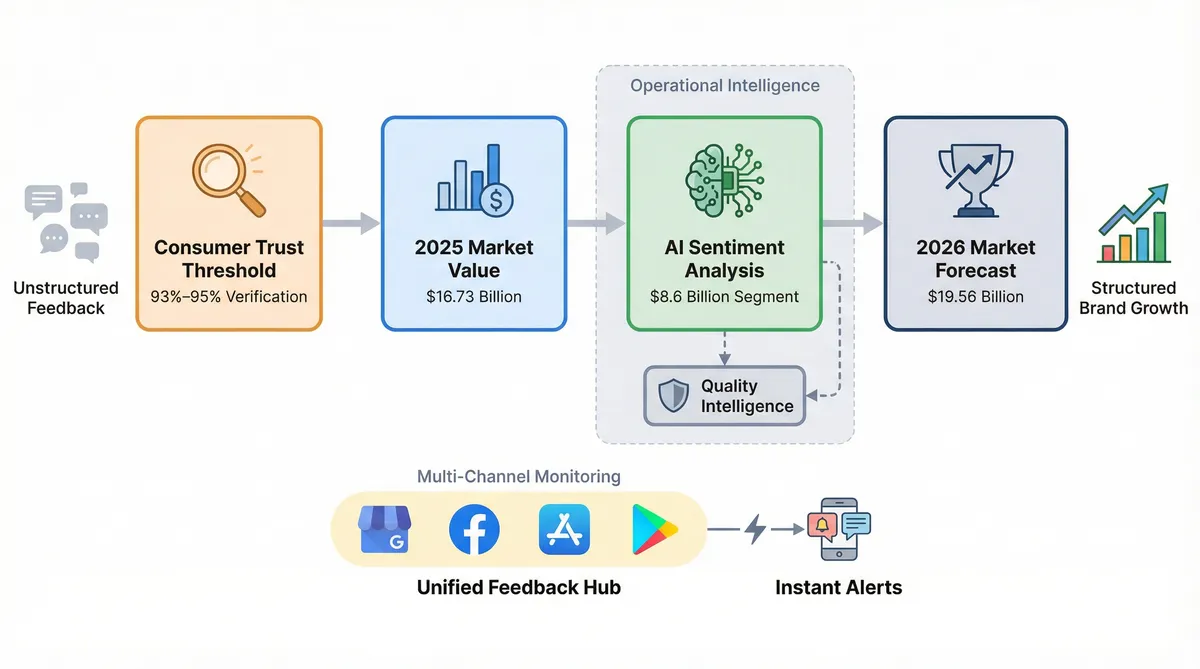
Effective customer review monitoring isn't a reactive PR task. It is an operational requirement for British businesses. You can't afford to treat feedback as an afterthought. Between 93% and 95% of consumers read online reviews before making a purchase decision. This creates a strict 'Zero Action' threshold. Most buyers simply won't engage with your brand until they verify your reputation.
The financial stakes reflect this shift. The global feedback software market is valued at $16.73 billion in 2025. It is projected to reach $19.56 billion by 2026. Google Business Profile remains the dominant platform for consumer feedback. Managing this volume requires dedicated tools. If you are struggling with visibility, investigating Google review management software reveals how automation prevents missed opportunities.
Industry analysts confirm this operational shift. Gartner highlights the need for 'Quality Intelligence', urging companies to move review data directly into CRMs. Forrester offers a stark warning for customer experience teams. They predict a 'death spiral' for brands that cling to legacy dashboard practices instead of extracting actionable insights. You must integrate feedback into daily workflows.
This urgency extends beyond search engines. Monitoring feedback across the Apple App Store, Google Play, and social channels is just as vital. Learning how to manage Facebook reviews and recommendations ensures a unified brand voice. Platforms like ReviewSense centralise these diverse channels. Teams receive instant alerts for new comments, allowing them to address recurring issues without delay.
Basic tracking isn't enough to stay competitive. The specific market for AI-driven sentiment analysis tools will reach $8.6 billion in 2025. This growth highlights a clear demand for deeper understanding. Businesses need systems that detect toxic content and extract key topics automatically. Transforming scattered comments into structured data drives real growth.
Why the 'Perfect 5.0' is a Trap: Contrarian Truths About Reputation Management
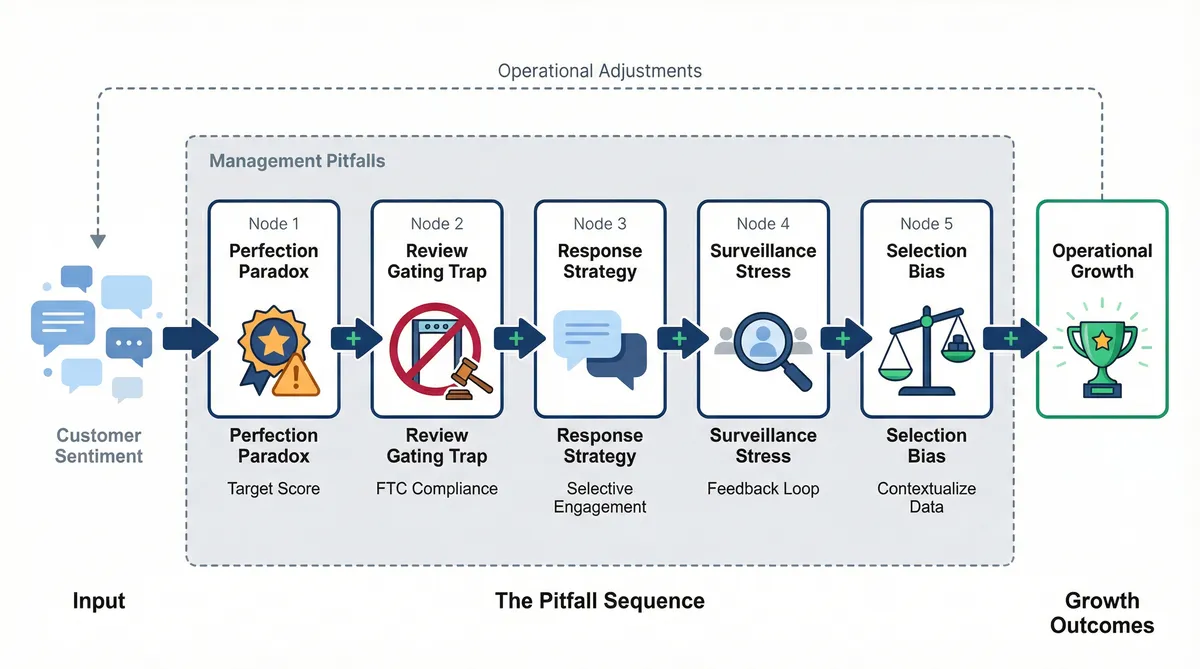
Transforming structured data into growth requires abandoning vanity metrics. Many brands obsess over maintaining a perfect image. Modern customer review monitoring reveals a different reality.
The 'Perfection Paradox': A 5.0 rating triggers consumer scepticism. Buyers seek out negative feedback to verify authenticity. A score between 4.2 and 4.5 converts better. Products with just 5+ reviews are 270% more likely to sell than those with none. Volume matters more than perfection. While learning how to get more 5-star Google reviews helps build that volume, occasional criticism proves your business is real.
The Review Gating Legal Trap: Pre-screening customers to filter out bad experiences is dangerous. The recent FTC 16 C.F.R. Part 465 enforcement targets review suppression. You must invite feedback from everyone. If you encounter malicious attacks, follow proper channels to report and remove fake Google reviews rather than hiding them. Since 81% of shoppers check Google reviews first before visiting a local business, transparency is vital.
The 'Desperation' of Responding to Everything: Replying to every single rating clutters your feed. It can look defensive. Be selective with your replies. Acknowledge negative feedback professionally to show you care. However, you should only respond to positive comments that add new information or highlight specific staff members.
Surveillance Stress: Using monitoring tools to discipline staff creates a toxic culture. Employees will hide mistakes if they fear punishment. Customer review monitoring should function as a product feedback loop. It's a tool for identifying operational bottlenecks, not a weapon for micromanagement.
Selection Bias: Reviews represent extreme emotions. You hear from thrilled advocates or angry detractors. The silent majority rarely posts online. Keep this context in mind when adjusting your operations. Don't overhaul your entire business model based on a few vocal complaints.
Step-by-Step Techniques for Proactive Reputation Intelligence
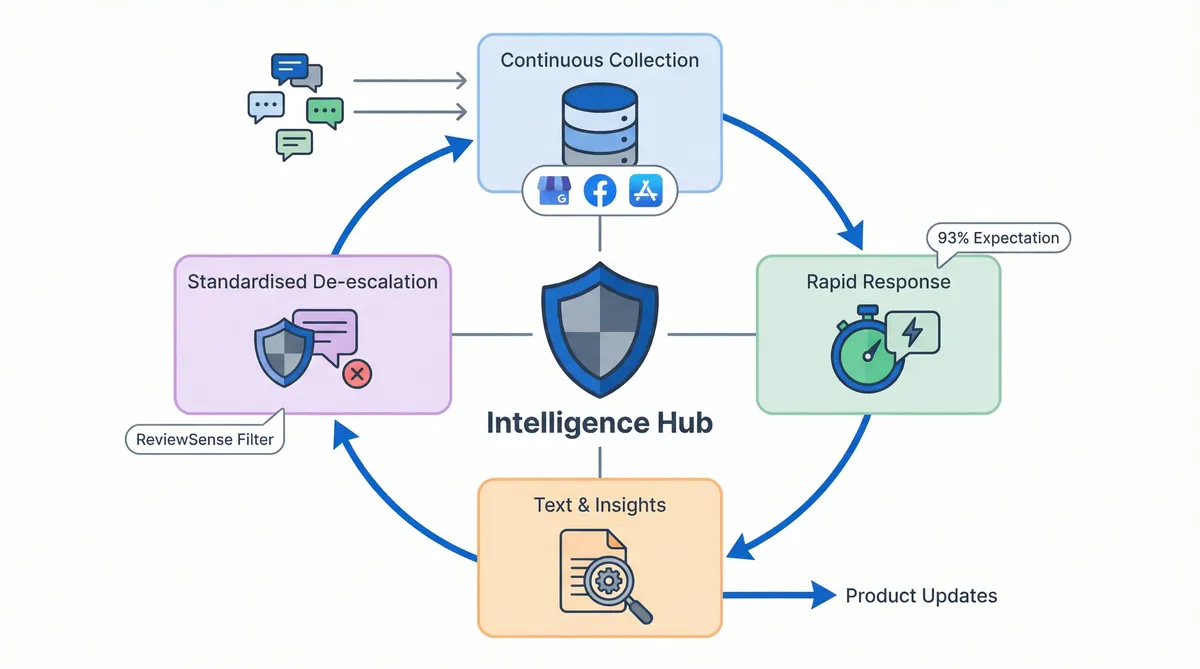
Acknowledging the silent majority means you must actively engage the vocal minority. A structured approach to customer review monitoring transforms raw feedback into operational intelligence. Only 17% of companies have a formal reputation plan, even though 84% of executives rank reputation risk as their top external concern.
Establish Continuous Collection: Consumers prioritise recent feedback. Old ratings fade fast. You need a system that constantly pulls in new data. Centralising comments across Google Business Profile, Facebook, and the Apple App Store ensures you never miss a fresh perspective.
Implement Rapid Response Protocols: Speed matters. A full 93% of customers expect a response to their reviews. Ignoring them is costly. Failing to reply can increase customer churn by up to 15%. On the flip side, Learning how to use free AI review response generators to improve customer communication helps teams meet these expectations without burning hours.
Mine Text for Product Insights: Look beyond the star rating. Natural language processing uncovers product flaws. Fixing these minor issues often leads to sales bumps. Effective AI-powered review management extracts recurring themes automatically. This allows your product team to prioritise updates based on user friction.
Standardise Responses for Irrational Feedback: You will face toxic comments. Don't feed internet trolls. Adopt a 'listen carefully, respond standardly' approach. De-escalate emotional outbursts with calm replies. ReviewSense flags spam and toxic content upon arrival. This protects your brand voice while keeping your team focused on genuine issues.
Score Yourself Against the Sector, Not Last Quarter: Your own trend line cannot tell you whether a 4.3 average is strong or ordinary for your category. Review benchmarking tools compare your rating, review velocity and response rate with the businesses you actually compete against, which turns monitoring into a target rather than a number.
Real-World Lessons: Successes vs. Failures in Review Management
Moving from theory to practice reveals stark contrasts in how companies handle public criticism. Effective customer review management separates market leaders from PR disasters. The comparison below illustrates how different approaches impact brand survival.
| Brand | Strategy | Outcome |
|---|---|---|
| Amazon | Mines reviews for product gaps | Created billion-dollar 'Amazon Basics' line |
| Best Buy | Localised responses & NPS tracking | Saved company from bankruptcy |
| Hilton | Real-time 'Stay Scores' | Resolves issues before checkout |
| Amy's Baking Co. | Attacked negative reviewers online | Forced closure |
| Nestle | Censored critical Facebook comments | Massive viral backlash |
Proactive brands treat feedback as a product roadmap. Amazon monitors complaints about third-party items to design superior alternatives for its Amazon Basics line. Best Buy survived a severe retail decline by empowering local store managers to address complaints directly. This local accountability rebuilt consumer trust and saved the company. Online stores can run the same loop at smaller scale, and our best review management platforms for ecommerce covers the tooling that supports it.
Hilton uses real-time surveys to catch unhappy guests before they leave. This intercepts complaints and prevents public venting. It's crucial to act fast. While 53% of reviewers expect a response to negative feedback within seven days, 87% of businesses fail to deliver. Using a 5-Star Review Response Generator helps teams meet these tight deadlines.
Defensive postures fail. Amy's Baking Company famously insulted patrons who left poor ratings. The resulting media storm destroyed their business. Nestle tried deleting critical comments during a complex supply chain crisis. This censorship provoked a massive boycott. Attempting to control the narrative backfired and ruined their immediate sales.
You can't hide from public opinion. Brands must embrace transparency instead of fighting it. Implementing AI-driven monitoring can reduce reputational risk response times by over 30%. Leading AI sentiment tools in 2026 have reached 85–90% accuracy in detecting sarcasm and cultural nuances. Listening to your audience costs less than fighting them.
Essential Tools and Features for Automating Review Management
The Shift Toward Predictive Intelligence
Embracing transparency requires software that matches the speed of modern consumers. Building on high sentiment accuracy and faster response capabilities, the technological shift toward AI-driven monitoring changes how teams handle public feedback. By 2026, 38% of CX leaders use AI-inferred sentiment to predict potential customer escalations.
This predictive approach is vital as platforms evolve. Google now uses AI-moderated responses and features like 'Ask Maps' to surface rapid answers. You need tools that adapt to these changes. Recency dominates consumer trust. According to BrightLocal’s 2026 Survey, 74% of consumers focus on reviews written in the last three months.
A further 18% demand reviews written within the last week. Manual tracking can't keep pace with this need for fresh interactions. Learning how to manage Google reviews effectively requires automation.
Centralising Your Reputation Data
To solve these speed challenges, ReviewSense centralises your feedback into a single dashboard. It exclusively pulls data from Google Business Profile, Facebook, Apple App Store, and Google Play. This focus eliminates tab-switching and ensures you catch every critical comment.
When a new rating drops, the AI response generator crafts personalised replies in seconds. You can set up auto-reply workflows to handle routine feedback without delay. Built-in sentiment analysis flags recurring issues and detects toxic content.
Scaling Your Response Strategy
This filtering keeps your team focused on genuine concerns. Effective Facebook review management becomes simple when spam disappears. The platform scales from independent shops to large agencies, and the same playbook applies to verticals like dental practices and automotive dealerships. You can test these features with a 7-day free trial.
Try the free Google review link generator, the review request email generator, or the star rating calculator to start improving your online presence today. You can also measure customer loyalty with our free NPS calculator and CSAT calculator.
Conclusion
Proactive reputation management is no longer optional—it is a critical driver of customer trust. As leading brands demonstrate, embracing transparency and responding rapidly to feedback prevents escalations and uncovers valuable product insights. Conversely, ignoring public opinion only damages your credibility.
To keep pace with consumer demands for swift, authentic interactions, businesses must abandon slow manual tracking. Centralising your feedback from Google Business Profile, Facebook, the Apple App Store, and Google Play is essential for maintaining control over your digital presence and spotting trends before they become crises.
Stop letting valuable feedback slip through the cracks. Ready to transform scattered reviews into actionable insights that improve customer experience and drive growth? Start your 7-day free trial with ReviewSense today.
Going multi-location or multi-platform? See our deep dives: a multi-platform review management strategy, multi-channel review management, how to monitor reviews across multiple sites, and multi-property hotel review management.