
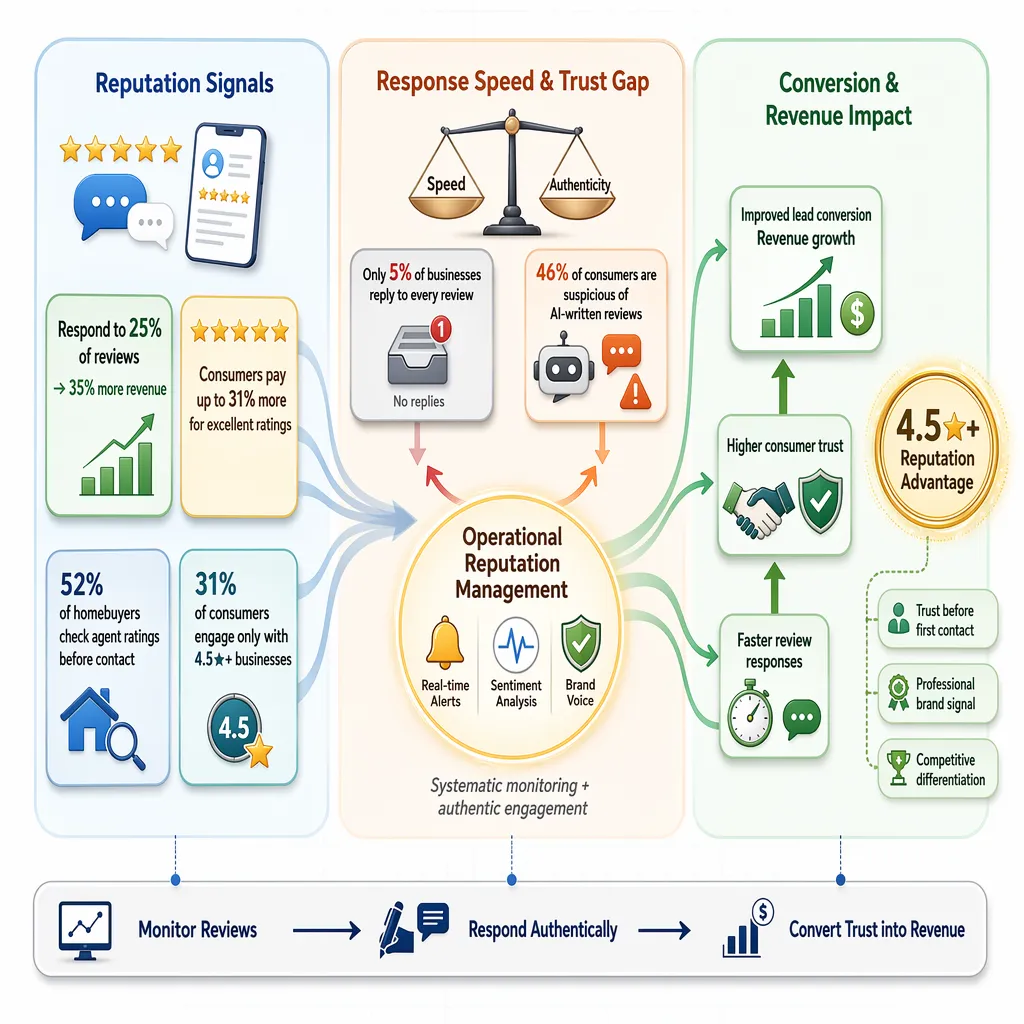
** For real estate brokerages, where trust is the currency of every deal, that single bad comment can cost you a six-figure commission. Yet most agents still treat reviews as an afterthought, leaving their online reputation to chance. The truth is, review management for real estate brokerages isn't just about damage control — it's a growth engine. Brokerages that respond to just 25% of reviews see 35% more revenue, and consumers will pay up to 31% more for businesses with excellent ratings. If your realtor reputation management strategy is still reactive, you're leaving money on the table.
Managing this manually across multiple agents and platforms is nearly impossible. ReviewSense automates it.
Why Brokerages Can No Longer Afford to Ignore Review Management
That disconnect between expectation and execution creates a real vulnerability. In 2026, a brokerage’s digital reputation directly drives lead conversion and talent acquisition. The numbers are stark: 52% of homebuyers review agent ratings before making initial contact, according to recent industry research. Worse, 31% of consumers will only engage with a business rated 4.5 stars or higher — a figure that has nearly doubled from 17% in the previous year. That’s the high-standard threshold, and it’s rising fast.
The Competitive Gap
Here’s the opportunity: only about 5% of businesses reply to every review. Most ignore negative feedback or post generic responses. That leaves a massive gap for brokerages willing to engage properly. Active review management signals professionalism and care. It builds trust before the first phone call.
The Trust Crisis in AI-Generated Content
There’s a catch. 46% of consumers are suspicious of AI-written reviews. They can spot generic, robotic replies. So automation alone won’t cut it. You need a system that balances speed with authenticity. Real-time alerts, sentiment analysis, and brand-voice controls help teams respond quickly without sounding fake. This is where realtor reputation management becomes operational — not just aspirational.
What This Means for Your Brokerage
Ignoring reviews isn’t neutral. It’s a competitive disadvantage. Every unaddressed negative review pushes potential buyers toward a rival. Every ignored positive review misses a chance to reinforce your brand. The solution isn’t just collecting stars — it’s a systematic approach to monitoring, responding, and improving. Tools like a Google Review Link Generator make it easy to capture feedback at scale. But the real work lies in turning that feedback into action.
Solving this requires more than a dashboard. It demands a workflow that fits your team’s daily rhythm. That’s where the operational shift begins.
The Hidden Costs of a Fragmented Reputation Strategy
Solving the operational gap requires first understanding where most brokerages trip up. The hidden costs of a fragmented reputation strategy aren't always obvious — they show up in missed leads, slow responses, and lost revenue. Let's break down the four most common failures.
| Failure | The Real Cost |
|---|---|
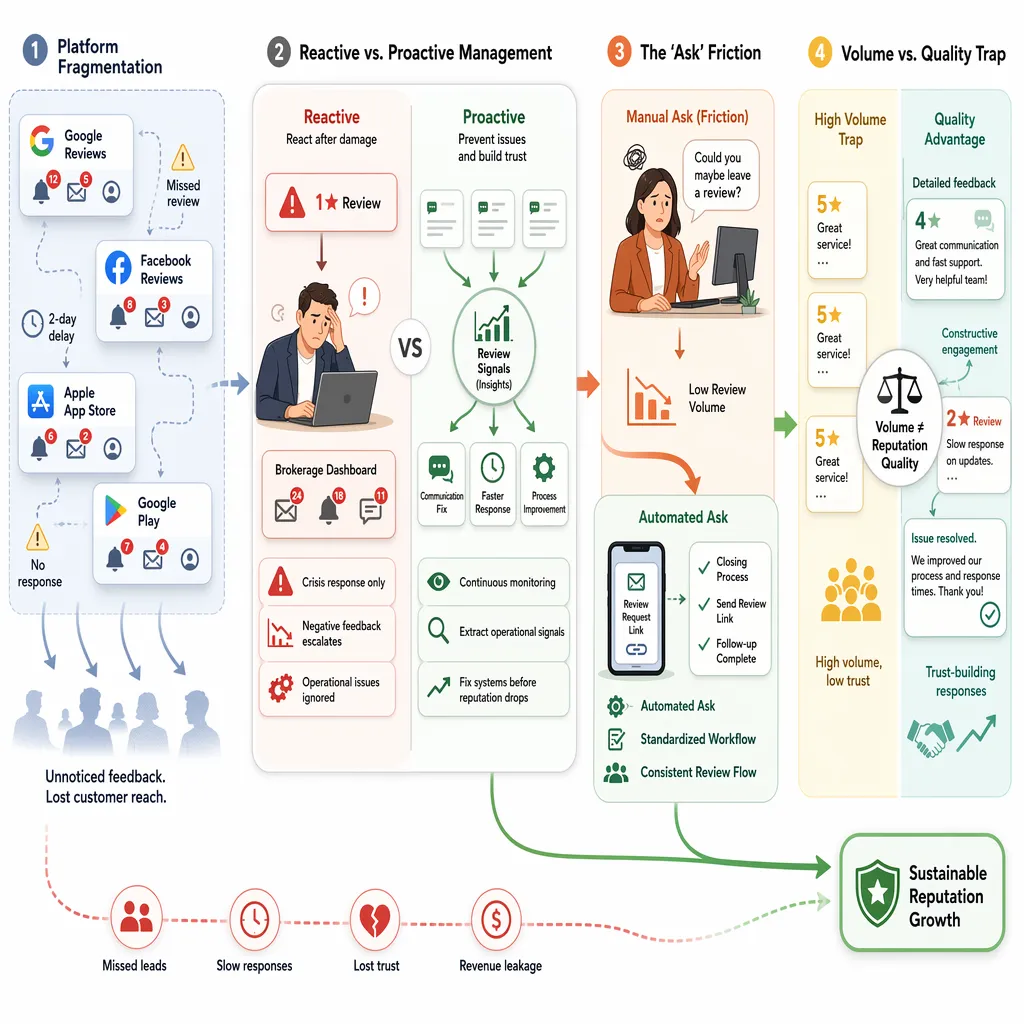
| Platform fragmentation | Reviews scattered across Google, Facebook, Apple App Store, and Google Play. 86.2% of consumers use Google, but Facebook still drives 28.9% of review volume. Miss one platform, and you miss a chunk of your audience. |
| Reactive vs. proactive management | Most firms only engage with negative reviews. They ignore the operational data hidden in feedback — like communication gaps or slow response times — that could fix systemic issues. |
| The 'ask' friction | Agents find it awkward to request reviews. This leads to low volume and a skewed reputation. Making requests a standard part of the closing checklist solves this. |
| Volume vs. quality trap | Obsessing over star ratings while ignoring review content. A well-handled negative review builds more trust than ten generic 5-star reviews. |
Platform Fragmentation: The Silent Leak
Reviews live everywhere. Google Business Profile, Facebook, Apple App Store, Google Play. Each platform has its own login, notification system, and response workflow. For a brokerage with multiple agents, this creates chaos. Reviews go unnoticed for days. Negative feedback festers. Potential buyers see silence and move on. Recent research shows that Speed matters.
Reactive vs. Proactive: The Missed Opportunity
Most brokerages treat reviews as a crisis management tool. They only react when a 1-star review appears. This is a mistake. Every review — positive or negative — contains data. A pattern of complaints about slow communication isn't a reputation problem; it's an operational one. Fix the process, and the reviews improve naturally. Tools like Customer Review Monitoring: Tools and Techniques for Proactive Reputation Management help teams shift from reactive to proactive.
The 'Ask' Friction
Agents hate asking for reviews. It feels awkward, pushy, or desperate. But without a steady flow of new reviews, your rating stagnates. The solution is simple: make review requests a standard step in the closing process. Automate the ask with a Google Review Link Generator. It removes the friction and ensures consistent volume.
Volume vs. Quality Trap
How Centralised Monitoring Transforms Scattered Feedback Into Actionable Data
The trap is seductive: chase volume, ignore substance. But a brokerage with 50 agents might have reviews scattered across Google, Facebook, and app stores. That fragmentation makes it impossible to spot trends or respond consistently. The first step to fixing a fragmented strategy is aggregating all feedback into one place.
The Problem: Scattered Feedback, Missed Signals
| Challenge | Impact |
|---|---|
| Reviews spread across 4+ platforms | No single view of reputation health |
| No instant alerts | Negative feedback sits for days |
| No trend analysis | Recurring issues like 'communication delays' go unnoticed |
| No crisis detection | A spike in 1-star reviews catches you off guard |
The Solution: One Dashboard, Real-Time Control
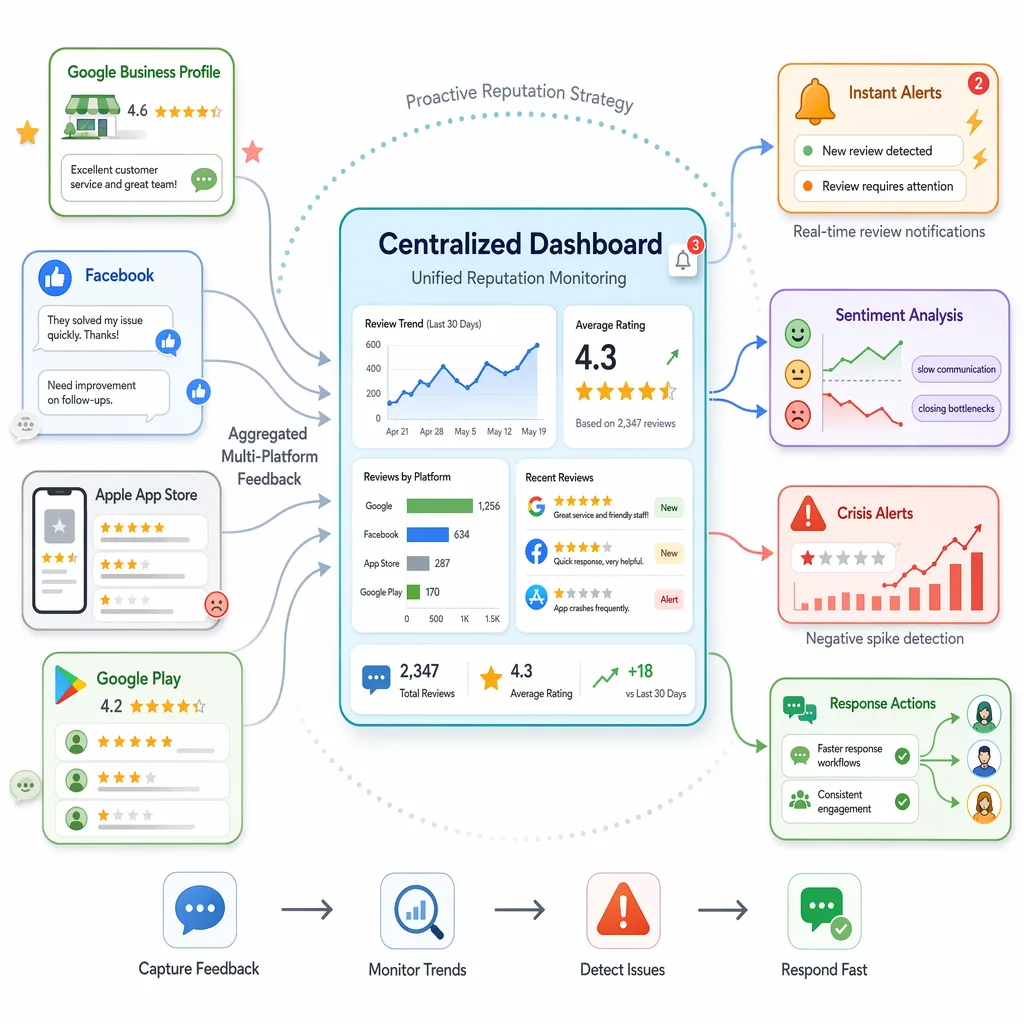
A centralised dashboard changes everything. It pulls reviews from Google Business Profile, Facebook, Apple App Store, and Google Play into one view. Instant alerts for new reviews prevent negative feedback from falling through the cracks. Research shows that responding to at least 25% of reviews correlates with 35% more revenue. Yet only about 5% of businesses reply to every review. That gap is a competitive opportunity.
Built-in sentiment analysis surfaces recurring issues. You might spot a pattern of 'closing bottlenecks' or 'slow communication' across multiple agents. These aren't just reputation problems — they're operational improvements waiting to happen. Crisis alerts for negative spikes let teams act fast, before a bad week becomes a bad month.
For brokerages, this transforms realtor reputation management from a reactive chore into a proactive strategy. Tools like a Google Review Link Generator make it easy to capture feedback. But the real power lies in turning that feedback into action. Platforms like ReviewSense offer this centralised approach, helping teams spot trends, respond consistently, and improve customer experience at scale. The result? Scattered feedback becomes actionable data that drives growth.
Balancing Authenticity and Efficiency in Review Responses
That shift from reactive to proactive monitoring creates a new challenge: how to respond at scale without sounding robotic. The tension between authenticity and efficiency is real. Here's how to balance both.
| Challenge | Solution |
|---|---|
| Generic AI replies erode trust | Use a response generator with brand voice guardrails |
| Slow manual replies hurt engagement | Implement queue-based approval workflows |
| Inconsistent agent responses | Train teams on experience-based review requests |
| No visibility into response quality | Track sentiment trends and response rates |
Step 1: Acknowledge the Trust Crisis
Consumers are wary of automated content. A generic "Thanks for your feedback" reply does more harm than good. It signals that you don't care enough to write something personal. The goal isn't to automate away the human touch — it's to free up time for meaningful engagement.
Step 2: Use AI with Guardrails
A response generator should create personalised, on-brand drafts, not cookie-cutter templates. ReviewSense allows you to set custom brand voice parameters. This means every reply sounds like your brokerage, not a chatbot. You get speed without sacrificing authenticity.
Step 3: Human-in-the-Loop Approval
Queue systems let senior team members review and approve replies before they go live. This ensures every response feels specific to the client's experience. It's a simple workflow that maintains quality control at scale. For multi-agent brokerages, this is essential for consistent realtor reputation management.
Step 4: Train Agents on Experience-Based Requests
Teach agents to ask specific questions like "What moment during the closing gave you the most confidence?" This generates detailed, trust-building reviews. It also makes the ask feel natural, not transactional. Use a Google Review Link Generator to simplify the process.
Step 5: Monitor and Improve
Track response rates and sentiment trends via analytics. A professional response to a negative review is a powerful sales tool. It shows you care about fixing problems. That builds more trust than ten generic 5-star reviews. The best review management for real estate brokerages combines AI efficiency with human oversight. That's the sweet spot.
Choosing the Right Review Infrastructure for Multi-Location Teams
That balance between authenticity and efficiency demands the right infrastructure. For multi-location teams, the choice of review management system determines whether you scale trust or scale noise. Here's how three common approaches compare.
| Approach | Pros | Cons |
|---|---|---|
| Manual, ad-hoc management | Zero cost; agents control their own responses | No central oversight; inconsistent brand voice; missed reviews; no trend data |
| Basic automation tools | Increases review volume; sends automated requests | No cross-platform aggregation; limited analytics; robotic replies damage trust |
| Full-stack reputation infrastructure | Centralised dashboard; sentiment analysis; role-based workflows; white-label reporting | Higher upfront investment; requires team training |
Manual management is cheap but risky. With 46% of consumers suspicious of AI-written reviews and 49% believing there are too many fakes, a scattered approach makes it hard to maintain authentic responses. One agent might reply warmly, another with a terse "thanks." That inconsistency erodes brand trust.
Basic automation tools fix the volume problem but introduce a new one: generic responses. If every reply sounds the same, customers notice. And without cross-platform aggregation, you still can't spot trends across locations. For brokerages where 93% of homebuyers research online, that blind spot is costly.
Full-stack infrastructure solves both problems. A platform like ReviewSense aggregates reviews from Google, Facebook, and app stores into one dashboard. Sentiment analysis flags recurring issues — say, "slow communication" across three branches. Role-based workflows let senior staff approve replies, ensuring consistent brand voice. White-label reporting gives agencies a polished deliverable for clients. This is where realtor reputation management becomes a strategic asset, not a chore.
When evaluating tools, prioritise transparency. Look for clear pricing, a free trial, and support for the platforms you actually use: Google, Facebook, Apple App Store, and Google Play. Avoid vendors that claim to manage unsupported platforms. The right infrastructure turns scattered feedback into a competitive advantage. Use a 5-Star Review Response Generator to test response quality, and explore the Best Review Management Software 2026 guide for comparison.
Conclusion
For real estate brokerages, the difference between a reputation that drives growth and one that creates risk comes down to infrastructure. Manual management leaves you blind to trends and vulnerable to inconsistency. Basic automation generates volume but sacrifices the authenticity that 93% of homebuyers demand. The right solution combines AI efficiency with human oversight—aggregating reviews from Google, Facebook, and app stores into a single dashboard, using sentiment analysis to flag recurring issues, and enabling role-based approvals to maintain brand voice across every location. With transparent pricing and a 7-day free trial, there's no reason to settle for scattered feedback. Turn scattered reviews into actionable insights that improve customer experience and drive growth. Start your 7-day free trial.