
For law firms, ignoring your digital reputation is no longer an option — it’s a direct hit to your bottom line. A single one-star increase in your rating can boost revenue by up to 9%, yet most firms still leave this critical asset to chance. In 2026, law firm reputation management isn’t just marketing; it’s a core business strategy that determines who gets hired and who gets overlooked.
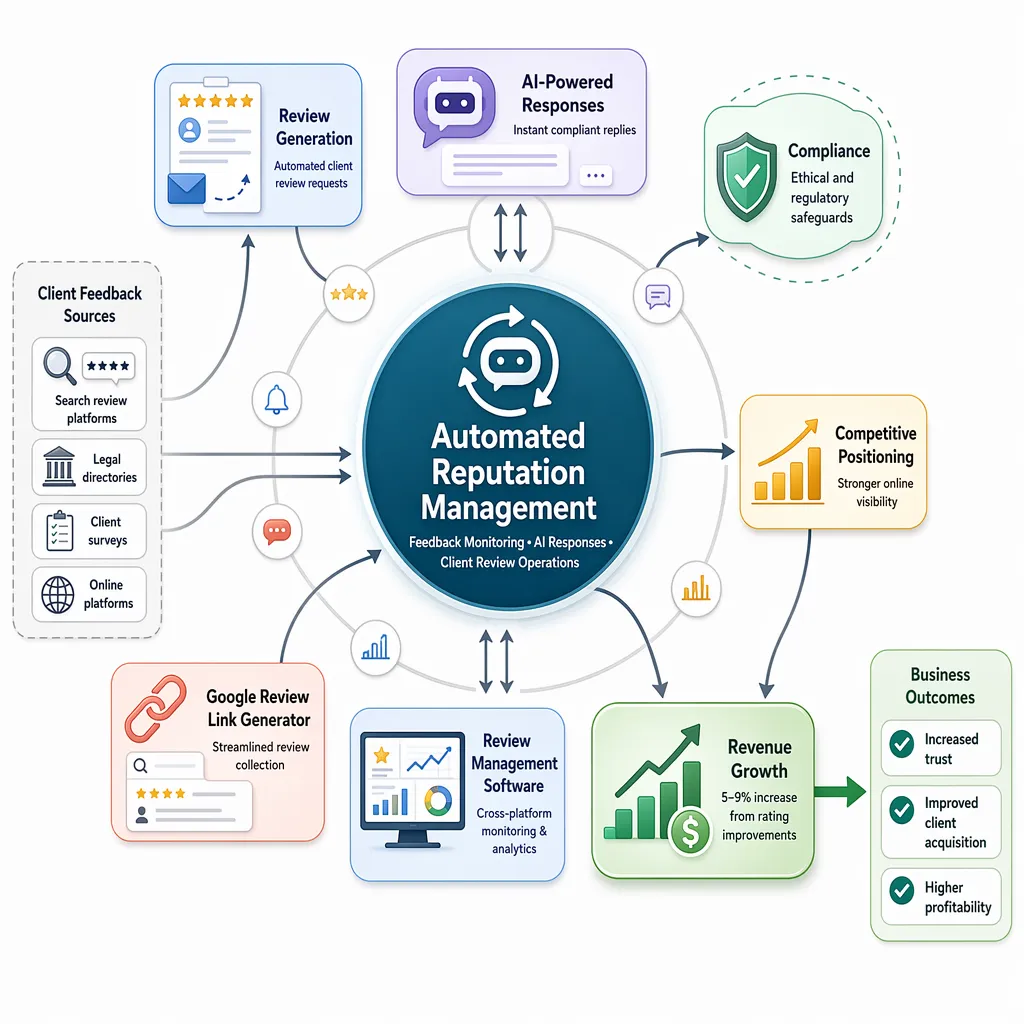
Managing reviews manually across multiple platforms is time-consuming and error-prone. ReviewSense automates the entire process, from review generation to AI-powered responses, so your firm stays compliant and competitive.
Why Reputation Management for Lawyers Is Now a Core Business Strategy in 2026
Reputation management for lawyers has shifted from a passive marketing activity to an operational necessity. The legal sector now operates under a new reality: approximately 49% of clients trust online reviews as much as personal recommendations, according to recent industry research. This means a potential client is almost as likely to trust a stranger's Google review as a recommendation from a friend.
For solicitors and barristers, this creates a direct link between review quality and client acquisition. The old model of relying solely on peer awards or directory listings is fading. Clients now prioritise what we call 'horizontal authority' — the collective voice of past clients over traditional accolades.
A one-star rating increase can boost revenue by 5–9%. That's not a marginal gain; it's a material shift in firm profitability. Law firm reputation management directly impacts your bottom line. Firms that ignore this trend leave money on the table.
The challenge is scale. A single negative review on Google Business Profile can deter dozens of potential clients. Without a system to monitor, respond, and analyse feedback across platforms, you're flying blind. That's where dedicated review management for lawyers becomes essential. Tools like a Google Review Link Generator simplify the process of collecting fresh reviews, while understanding Google Review Management Software helps firms choose the right approach.
This isn't about damage control anymore. It's about building a systematic approach to client feedback that drives growth. Firms that treat reputation as a revenue driver — not a reactive chore — will win in 2026.
The Hidden Costs of Ignoring Law Firm Reputation Management
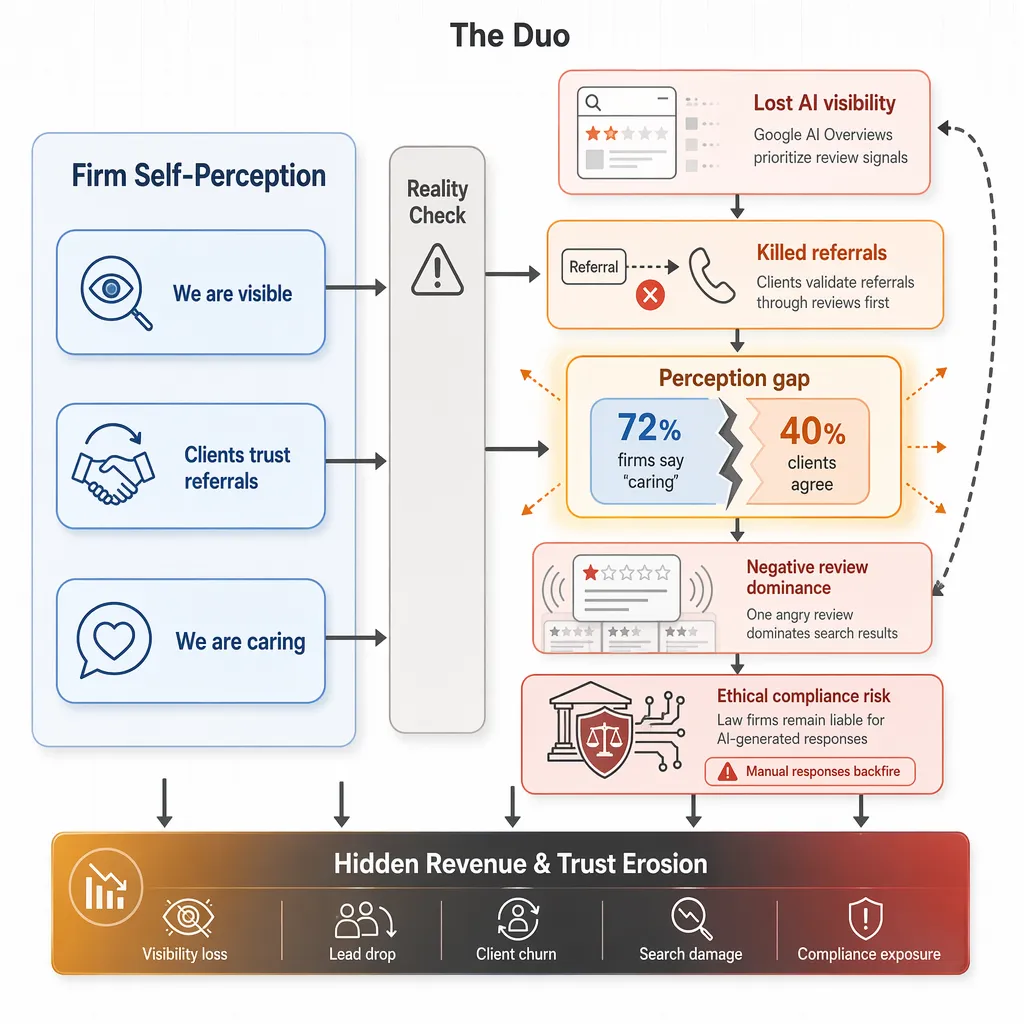
The financial upside of a strong reputation is clear, but the costs of neglect are equally significant. Ignoring law firm reputation management creates hidden liabilities that erode revenue and trust.
| Hidden Cost | Impact on Your Firm |
|---|---|
| Lost AI visibility | Google AI Overviews now pull review data directly; firms with weak signals vanish from results. |
| Killed referrals | Even referred clients check reviews before calling. A poor digital presence stops the deal. |
| Perception gap | 72% of firms call themselves 'caring' but only 40% of clients agree — this drives churn. |
| Negative review dominance | One angry client's review can dominate search results for weeks. |
| Ethical compliance risk | Bar associations hold lawyers responsible for AI-generated content. Manual responses backfire. |
1. AI-driven search is killing passive visibility
Google AI Overviews have reduced organic click-through rates by 34–35%. For law firms, this means your website alone won't bring clients. Search engines now pull review data directly into featured snippets. Firms without strong, recent reviews simply disappear from the conversation. As recent analysis from Brand24 shows, review signals are now a ranking factor. You need a system that monitors and responds across platforms like Google and Facebook. That's where dedicated Google Review Management Software becomes essential.
2. The validation phase kills referrals
Even clients who arrive via a personal recommendation enter a 'validation phase'. They check your Google Business Profile before picking up the phone. A profile with few reviews or unanswered negative feedback kills the referral instantly. This is a hidden cost: you paid for that referral through years of relationship building, then lost it to a neglected profile.
3. The perception gap drives churn
Research from CaseStatus reveals a stark disconnect: 72% of law firms describe themselves as 'caring', but only 40% of clients agree. This perception gap directly impacts retention. Clients who feel unheard leave. They also leave negative reviews. A systematic approach to review management for lawyers closes this gap by showing clients their feedback matters.
4. Negative review spikes dominate search
What to Look for in a Review Management Solution for Legal Teams
That spike in negative feedback can dominate search results for weeks. The right review management solution helps you regain control. Here's what to look for when evaluating tools for your firm.
| Capability | Why It Matters for Law Firms |
|---|---|
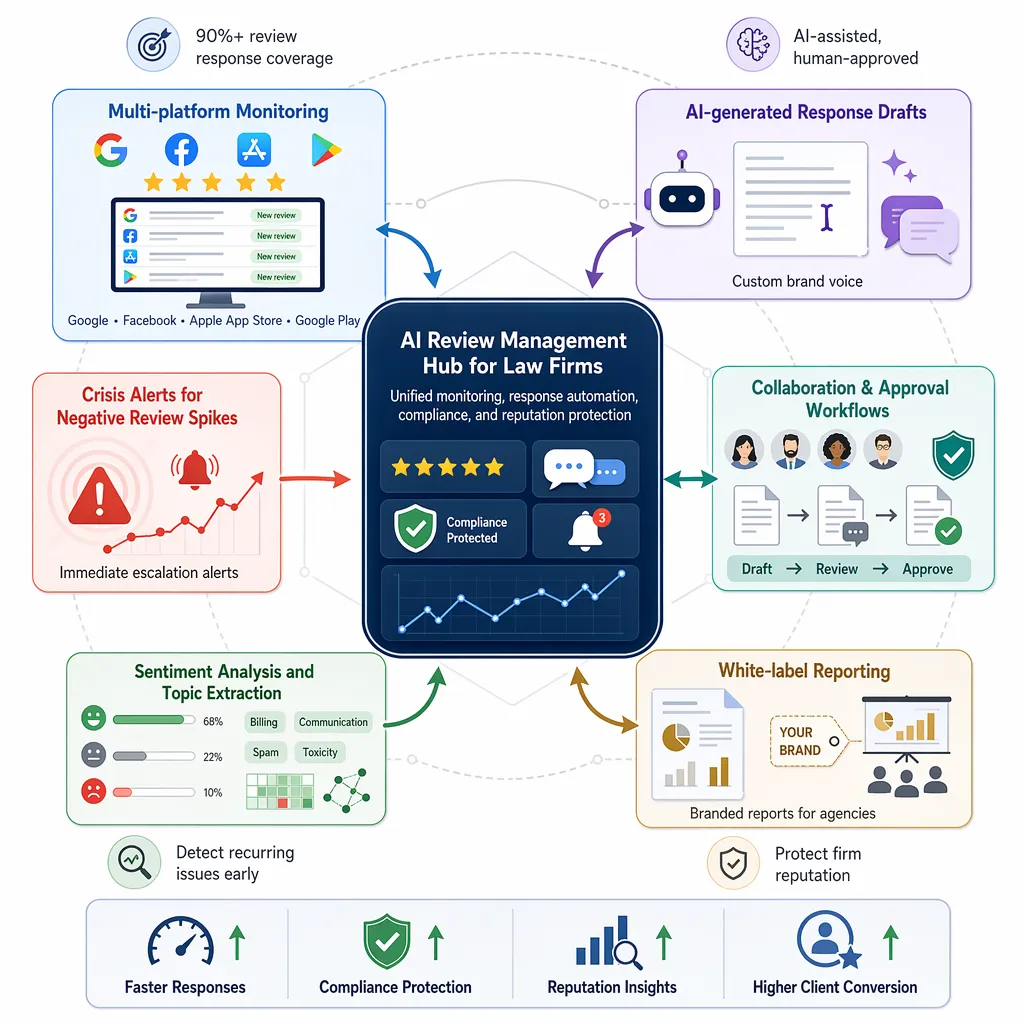
| Multi-platform monitoring — Google Business Profile, Facebook, Apple App Store, Google Play | Clients find you across different channels. Missing a review on one platform means missing a signal. A single dashboard prevents that. |
| AI-generated response drafts with custom brand voice | Saves hours of partner time. Maintains a professional, consistent tone across every reply. Critical for firms handling high volumes. |
| Sentiment analysis and topic extraction | Flags recurring issues like billing complaints or communication gaps. Detects spam and toxic content before it harms your reputation. |
| Crisis alerts for negative review spikes | Essential for firms in litigation or controversial practice areas. Immediate alerts let you act before a crisis escalates. |
| Collaboration and approval workflows | Ensures compliance before replies go live. Multiple team members can review and approve responses, reducing risk. |
| White-label reporting for agencies | Agencies managing multiple firms need branded reports. White-label capabilities build client trust and streamline reporting. |
Why these capabilities matter for law firm reputation management
Law firms face unique pressures. A single misstep in a response can breach ethical guidelines. Tools like an AI Review Response Generator help maintain compliance while saving time. According to The Law Society, solicitors must ensure any AI-generated content is reviewed by a qualified professional. Collaboration workflows make that possible.
Firms that actively respond to 90% or more of their reviews see a 25% higher conversion rate from inquiries. That's a direct return on investment. Meanwhile, 63% of clients now find their solicitor online. If your review profile is weak, you're invisible to that majority.
The right tool turns scattered feedback into actionable insights. It helps you spot trends, respond faster, and protect your firm's reputation. For a deeper comparison of available options, see the guide to the Best Review Management Software 2026.
A Step-by-Step Process for Building a Bulletproof Law Firm Reputation Strategy
The tools exist, but a strategy without structure is just intention. Here is a repeatable process for law firm reputation management that turns reviews into a growth engine.
| Step | Action | Why It Matters |
|---|---|---|
| 1 | Audit your digital footprint on Google, Facebook, Apple App Store, and Google Play | Missing profiles create blind spots; AI search penalises inconsistency |
| 2 | Automate review requests post-case resolution via CRM triggers | Ethical, scalable, and compliant with bar rules |
| 3 | Implement a rapid response workflow prioritising speed | Firms responding to 90%+ of reviews see 25% higher conversion |
| 4 | Use sentiment analysis to close the perception gap | 72% of firms call themselves caring, but only 40% of clients agree |
| 5 | Monitor hyper-local SEO signals for Map Pack visibility | AI search now pulls review data directly into featured snippets |
Step 1: Audit your current digital footprint
Start by checking every supported platform. Many firms have duplicate Google Business Profiles or outdated listings. A single missing profile means lost visibility. Use a tool like the Google Review Link Generator to confirm each location has a live, claimable link. Consistency across platforms signals trust to AI-driven search.
Step 2: Automate review requests ethically
After a case closes, trigger a review request through your CRM. The Solicitors Regulation Authority prohibits offering incentives for reviews. Automation removes the risk of human error. It also ensures every client is asked, not just the happy ones. This builds a representative sample of feedback.
Step 3: Build a rapid response workflow
Speed is a ranking signal. Firms that reply to 90% or more of their reviews see a 25% higher conversion rate from inquiries. A dedicated review management for lawyers workflow lets you triage, draft, and approve replies in minutes. Use an AI Review Response Generator to create compliant drafts, then route them through a partner for final sign-off.
Step 4: Close the perception gap with sentiment analysis
Most firms think they are doing well. The data often says otherwise. Sentiment analysis flags recurring issues like billing confusion or slow communication. Addressing these gaps improves retention and reduces negative review volume. It turns feedback into a roadmap for operational change.
How Leading Firms Are Turning Reputation Into a Competitive Advantage
This process of closing the perception gap leads to a more strategic insight: the most forward-thinking firms have stopped trying to bury negative reviews. They use them as trust signals instead. A single 1-star review from an opposing party can act as a badge of honour. It signals to ideal clients that a lawyer fights hard. This contrarian approach reframes law firm reputation management from damage control to brand positioning.
Some firms now run a deliberate filtering strategy. They fire the bottom 10% of clients whose cases generate friction and poor feedback. This improves the average quality of their reputation profile. It also frees capacity for higher-value work. The logic is simple: a reputation built on serving the right clients is stronger than one built on pleasing everyone.
Automated tools make this scalable. AI-powered sentiment analysis, similar to the platform Aderant launched in March 2026, helps firms identify which client segments generate the most friction. You can spot patterns in billing complaints or communication breakdowns before they become public. For multi-location firms, white-label reporting allows you to benchmark reputation performance across offices. This turns review management for lawyers into a measurable business function.
The core thesis is simple. Reputation is the sum of expectations set and promises kept. Firms that invest in systematic reputation management now will own their local markets in the years ahead. If you want to see how your current profile stacks up, try the Star Rating Calculator to benchmark against competitors. The firms that act first will define the standard for everyone else.
Conclusion
For law firms, reputation is no longer just a measure of past performance—it's a strategic asset that drives future growth. The key takeaways are clear: audit your digital footprint across Google, Facebook, Apple App Store, and Google Play; automate ethical review requests post-resolution; respond rapidly to 90%+ of reviews; use sentiment analysis to close the perception gap; and monitor hyper-local SEO for Map Pack visibility. Leading firms are already turning negative reviews into trust signals and using data to serve the right clients. The firms that act on these principles now will define their markets. Don't let scattered feedback remain noise—turn it into a competitive advantage that improves client experience and drives growth. Start your 7-day free trial