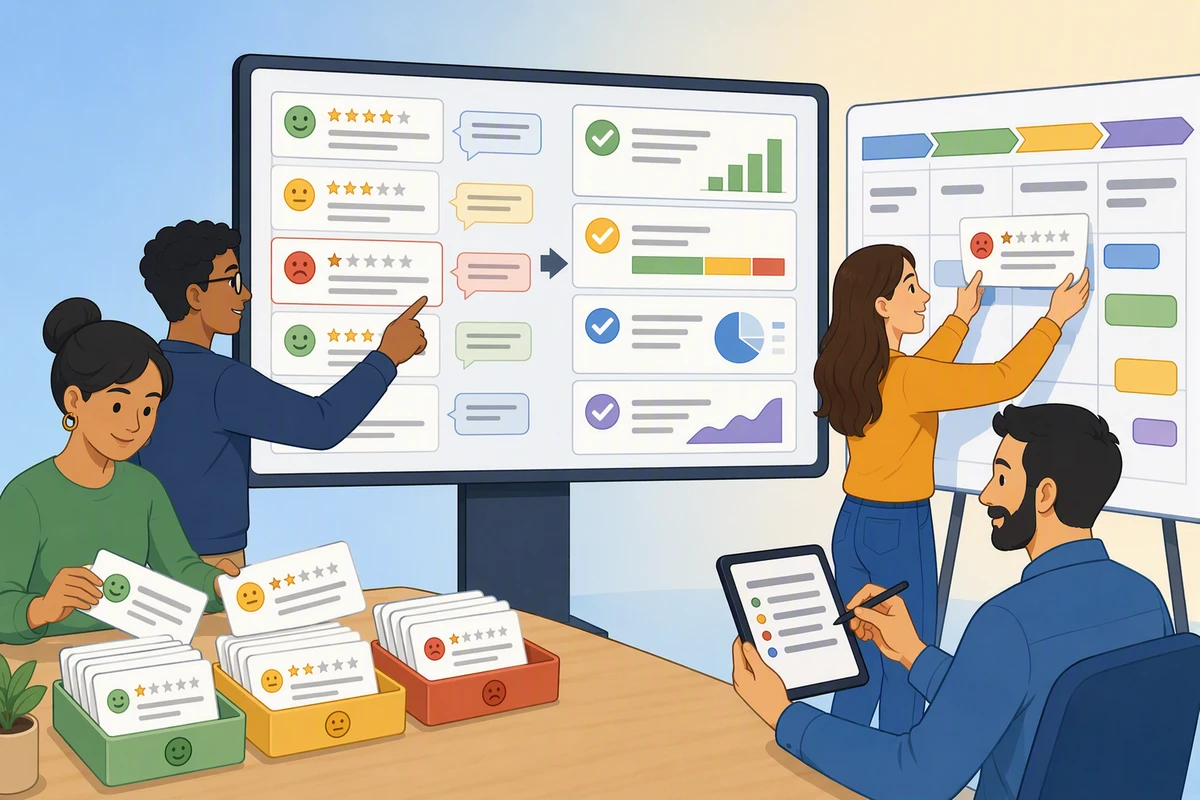
97% of consumers read reviews for local businesses, yet most testimonial pages still feel like afterthoughts. A generic quote grid won’t cut it anymore. The best testimonial page examples treat social proof as a conversion engine — not decoration. They centralise video, display aggregate ratings, and respond to negative feedback. When done right, these pages can push conversion rates well above the 6.6% landing-page benchmark.
Managing this manually is hard. ReviewSense automates it — from collecting video testimonials to analysing review sentiment across multiple platforms.
Why Most Testimonial Pages Fail to Convert
Many testimonial pages look credible but fail to convert. They optimise for what feels like proof rather than what actually helps a buyer decide. This is credibility theatre: big logos, generic praise, and no friction.
What most pages get wrong
| Mistake | Why it fails |
|---|---|
| Featuring famous brands over similar customers | A local buyer doesn't relate to a Fortune 500 logo. They want someone like them. |
| Treating all testimonials as interchangeable | Every review gets the same template, so none feels specific. |
| Overvaluing video without context | A talking head means little if the speaker's situation isn't clear. |
| Using carousels that hide proof | Users see one quote and miss the rest. Overly polished pages raise suspicion. |
Specificity beats impressive numbers
A testimonial that says "revenue grew 40%" sounds strong. But a quote that explains how — "we centralised feedback from Google and Facebook into one dashboard" — builds real trust. The CXL Institute found that social proof works best when uncertainty is high and the proof is credible, relevant, and specific. Vague praise does nothing to reduce a buyer's risk.
Selection bias kills credibility
Pages that only show five-star reviews feel dishonest. Buyers know not every experience is perfect. Including a balanced mix — even a mention of a problem that was resolved — signals authenticity. A page that acknowledges imperfection actually converts better.
Measuring the wrong metrics
Teams track page views or time on page. They should track whether visitors click "Get Started" after reading. A testimonial page that doesn't drive action is just decoration.
The solution
Effective testimonial page examples address these failures directly. They feature customers with similar profiles, use specific outcomes, and avoid hiding evidence. They treat each testimonial as a decision-making tool, not a trophy. For a deeper look at how review data shapes trust, read the guide on AI Review Management in 2026. And if you manage multiple locations, the Multi Location Review Management page shows how centralised feedback improves response rates.

The Anatomy of a High-Converting Testimonial Page Design
These failures point toward a better blueprint. A high-converting testimonial page design doesn't just collect praise; it structures proof to match how buyers actually decide. The table below outlines the recommended structure for 2026, based on behavioural research and conversion data.
| Section | Purpose | Key Detail |
|---|---|---|
| Headline with specific outcome | State a measurable result | "Increased repeat bookings by 34% in 90 days" |
| Aggregate proof | Show rating + review count | 4.8 stars from 1,200 reviews on Google |
| Featured case study | Deep dive into one customer story | Problem, solution, result with timeline |
| Testimonial grid | 5-12 short quotes with photos | Filterable by industry or use case |
| Video section | 3-5 captioned testimonials | 93% of marketers view video as important (Wyzowl 2026) |
| Filters | Industry, use case, company size | Helps visitors find relevant proof fast |
| Objection-handling section | Address common fears | "We worried about setup time — it took 20 minutes" |
| Clear CTA | One action, no distraction | "Start your free trial" |
Place proof where buyers hesitate
The CXL Institute recommends placing testimonials near friction points, not just on a separate page. A pricing page or demo form is where doubt peaks. Drop a relevant quote there. For law firms, this means adding client stories near the consultation booking form. The Law Firm Review Management page shows how centralised feedback builds that trust.
Quality over quantity matters
Medill Spiegel Research found that purchase likelihood jumps 270% with five reviews versus none. But diminishing returns set in after roughly five. So a testimonial page examples that works doesn't need 50 quotes. It needs five strong, specific ones. Each should name a concrete outcome: "Our response rate went from 12% to 89%."
External proof beats internal selection
NN/g research shows that third-party review badges are more trusted than company-curated quotes. Embed your Google rating or Facebook score near the CTA. For multi-location businesses, the How to Monitor Reviews on Multiple Sites: 2026 Guide explains how to centralise that data.
Filters turn noise into relevance
A visitor from a dental practice doesn't care about a retail chain's testimonial. Let them filter by industry, use case, or company size. This makes each customer testimonial examples feel personal, not generic.
Objections are opportunities

How to Write Customer Testimonial Examples That Build Trust
That blueprint works only if the testimonials inside it carry real weight. Writing a testimonial that converts means moving beyond generic praise to a structured story. The most effective customer testimonial examples follow a clear arc: challenge, solution, result. HubSpot’s research confirms that buyers trust stories over statements. A story feels human. A statement feels like marketing.
The three-part structure that works
| Element | What to include | Why it matters |
|---|---|---|
| Challenge | The customer’s original problem | Creates relatability and shows you understand their pain |
| Solution | What they used and how they implemented it | Proves your product or service works in a real context |
| Result | A specific, measurable outcome | Reduces buyer uncertainty with concrete proof |
Each part needs concrete detail. Avoid phrases like “great service” or “amazing support.” Instead, write: “We reduced onboarding time from 10 days to 3 and increased completed applications by 28%.” That level of specificity signals truth. The CXL Institute found that social proof works best when uncertainty is high and the proof is credible, relevant, and specific. Vague praise does nothing to reduce a buyer's risk.
Why the best result isn’t the biggest number
A 500% revenue jump sounds impressive. But if your buyer runs a single-location shop, that number feels irrelevant. The most believable result is the one that matches the reader’s situation. A dental practice cares about new patient bookings, not enterprise ARR. So match the metric to the audience. Recent industry research shows that personalised proof drives higher conversion than generic stats. Pick a result that feels achievable, not aspirational.
Include balanced feedback for authenticity
Medill Spiegel Research found that purchase likelihood peaks at 4.2–4.5 stars, not a perfect 5.0. A flawless score raises suspicion. So include a mention of a minor friction point that was resolved. For example: “We worried setup would take weeks, but we were live in 20 minutes.” That admission makes the rest of the testimonial feel honest. It also pre-empts a common objection.
Write for AI readability in 2026

Overcoming the Biggest Challenges in Collecting Testimonials
That blueprint works only if you can actually collect the testimonials to fill it. Many businesses hit a wall here. The problem isn't a lack of happy customers. It's that those customers cannot safely appear on a testimonial page examples page.
Six industry-wide patterns block collection. Healthcare providers face HIPAA rules. A patient's name alone can violate privacy. Legal firms deal with confidentiality. A client's case details are privileged. Financial advisors navigate SEC marketing rules. A single client quote can become a regulated claim. Supplement brands face FTC scrutiny. A wellness claim like "cured my insomnia" triggers legal risk. Enterprise B2B buyers sign NDAs. Their company name never appears. Nonprofits serve vulnerable populations. A success story can expose a shelter resident's identity.
Each pattern shares a root cause: the customer cannot be safely identified, or the outcome becomes a regulated claim. The solution isn't to give up. It's to change the format.
| Challenge | Practical Alternative |
|---|---|
| Customer cannot be identified | Anonymised testimonial with role and industry only |
| Outcome is variable | Quantified aggregate results (e.g., "87% of clients saw X") |
| Testimonial becomes a regulated claim | Independently verifiable third-party reviews |
| Incentives undermine credibility | Expert explanation of the process, not the outcome |
| Customer bound by confidentiality | Process evidence: screenshots of workflow, redacted |
| Customer is not the true buyer | Carefully reviewed case study with buyer's permission |
[Recent industry research](https://www. com/resources/local-seo-statistics/) shows that 97% of consumers read reviews for local businesses. That stat underscores the cost of silence. If you cannot collect testimonials, you lose trust with nearly every prospect.
The 2026 development from Guideflow confirms that testimonial collection has become a dedicated software workflow. HubSpot's research positions customer advocacy platforms as a measurable growth channel. Both trends point to the same truth: collecting proof is now a system, not an afterthought.
For a dental practice bound by HIPAA, a testimonial page design that uses anonymised quotes with verified aggregate scores works better than a blank page. For a B2B SaaS company, a customer testimonial examples page featuring redacted case studies with quantified time savings beats generic praise. The format shifts, but the proof remains.
Metrics That Matter: Measuring Your Testimonial Page Performance
That collection system is only half the battle. The other half is knowing whether your testimonial page examples actually drive business. Most teams measure the wrong thing. They track page views, time on page, or bounce rate. Those are vanity metrics. They tell you nothing about revenue impact.
What to measure instead
| Metric | Why it matters |
|---|---|
| Conversion rate for visitors exposed to relevant proof | Shows whether testimonials reduce purchase friction |
| Qualified lead rate | Indicates if proof attracts the right audience |
| Sales-stage progression | Reveals if testimonials help move deals forward |
| Close rate | Direct revenue impact |
| Time to close | Shorter cycles mean stronger proof |
| Objection frequency | Fewer objections suggest testimonials pre-empt concerns |
| Self-reported influence | Ask buyers: "Did the testimonial page affect your decision?" |
| Assisted pipeline | Track how often the page appears in multi-touch attribution |
The benchmark you need
Unbounce data shows median landing-page conversion rates sit at 6.6%. SaaS companies average 3.8%. Professional services firms hit 6.1%. Your testimonial page design should match or beat those figures. If it doesn't, the proof isn't working.
The contrarian insight
A page producing fewer clicks but better-qualified opportunities may outperform one with high click-through rates. Medill Spiegel Research found that purchase likelihood jumps 270% when a buyer sees five reviews. That means a small number of strong customer testimonial examples can have outsized impact. Quality beats volume.
Test with discipline
Run A/B tests on layout, testimonial placement, and CTA. But never test without statistical significance. A 2% lift from 50 visitors means nothing. Use a calculator. Wait for enough data. Baymard's research found that 60% of sites made submitting reviews unnecessarily difficult, while 80% failed to respond to negative reviews. That's a warning. Don't let your testing process become another friction point.
Conclusion
Testimonials fail when they rely on vague praise or unverifiable claims. Effective ones solve a specific problem: proving trust without breaking confidentiality, regulation, or compliance. Anonymised quotes, aggregate scores, and redacted process evidence preserve credibility where traditional testimonials cannot. Measuring the right metrics—conversion rate, close rate, objection frequency—reveals whether your proof actually works. Quality beats volume; five strong testimonials can shift purchase likelihood by 270% versus none. Stop guessing. Turn scattered reviews into actionable insights that drive real business outcomes. Start your 7-day free trial