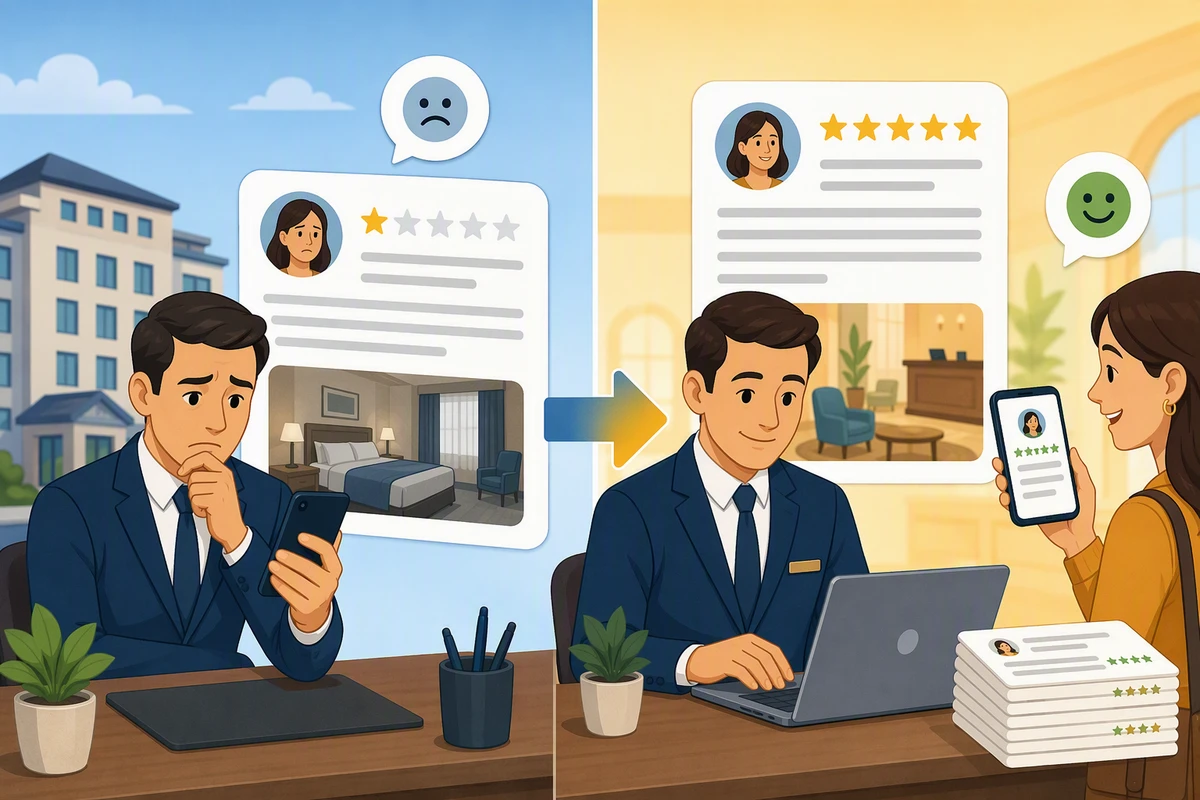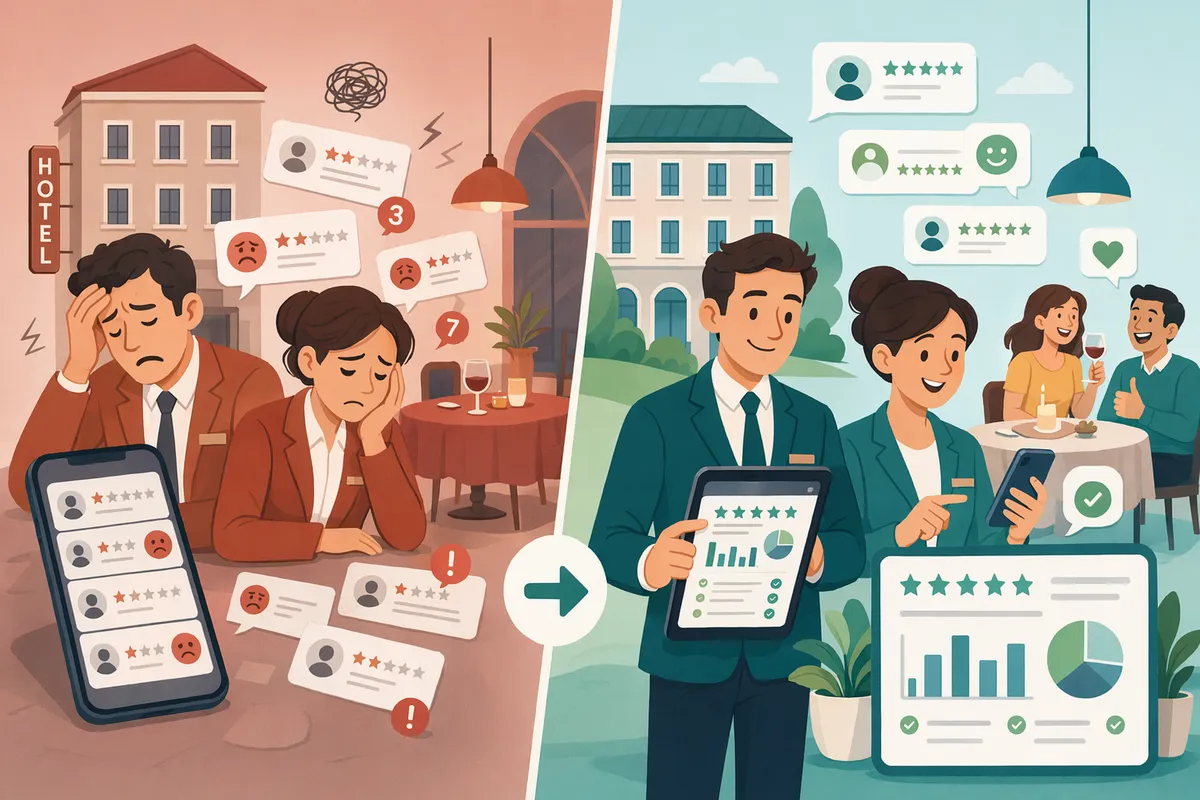
Can your hotel group afford losing bookings to competitors with higher review scores in 2026? Guests now check 3+ platforms before booking, making fragmented feedback management impossible manually. This guide analyses specialised tools that centralise responses, track ratings, and turn insights into actionable improvements across locations.
Managing this manually is hard. ReviewSense automates it.
The Evolving Review Environment: Key Challenges for Hospitality in 2026
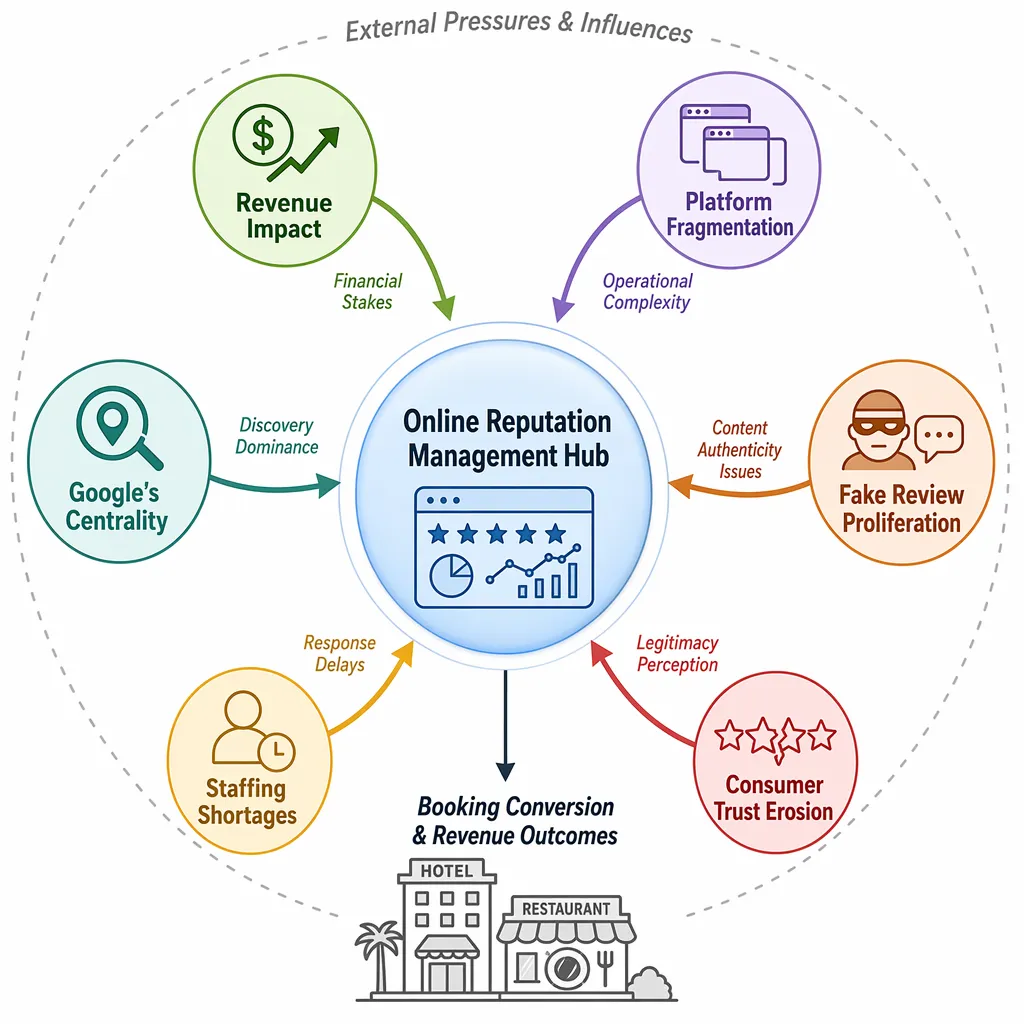
As we look towards 2026, hospitality businesses face an increasingly complex review ecosystem where reputation directly impacts bookings. For restaurants, a one-star increase on review platforms can boost revenue by 5-9%, highlighting the financial stakes. Hotels face similar pressures, where ratings heavily influence traveller decisions across all digital touchpoints. Use the 5-star review impact calculator to model potential revenue gains for your property.
| Challenge | Key Insight |
|---|---|
| Revenue Impact | Star ratings directly influence booking conversion and revenue |
| Platform Fragmentation | Managing across Google, Facebook and app stores creates inefficiency |
| Fake Review Proliferation | AI-generated content complicates authenticity verification |
| Consumer Trust Erosion | Travellers increasingly question review legitimacy |
| Staffing Shortages | Delayed responses damage reputation recovery chances |
| Google's Centrality | Dominant platform for discovery and decision-making |
Managing feedback across Google Business Profile, Facebook, Apple App Store and Google Play creates operational strain. This fragmentation proves particularly challenging for hotel groups needing multi-location review management across diverse booking sites. Staff shortages compound the hospitality sector's struggles, risking delayed responses when timely engagement matters most.
AI-generated fake reviews further complicate authenticity verification, while many travellers express growing doubt about online feedback legitimacy. Google's dominance means it's often the first platform travellers encounter during research. Negative reviews here carry immediate consequences, especially as algorithms prioritise recent feedback. Analysing topic-level sentiment around service or cleanliness provides deeper insights than overall ratings alone.
With the online reputation management software market projected to reach USD 24.96 billion by 2035, the importance of proactive management keeps growing. Businesses must also navigate evolving platform policies, including Google's 2026 updates that may impact review visibility. Learn protective measures in the guide Why Google Is Deleting Your Reviews in 2026.
Essential Features of Modern Review Management Platforms
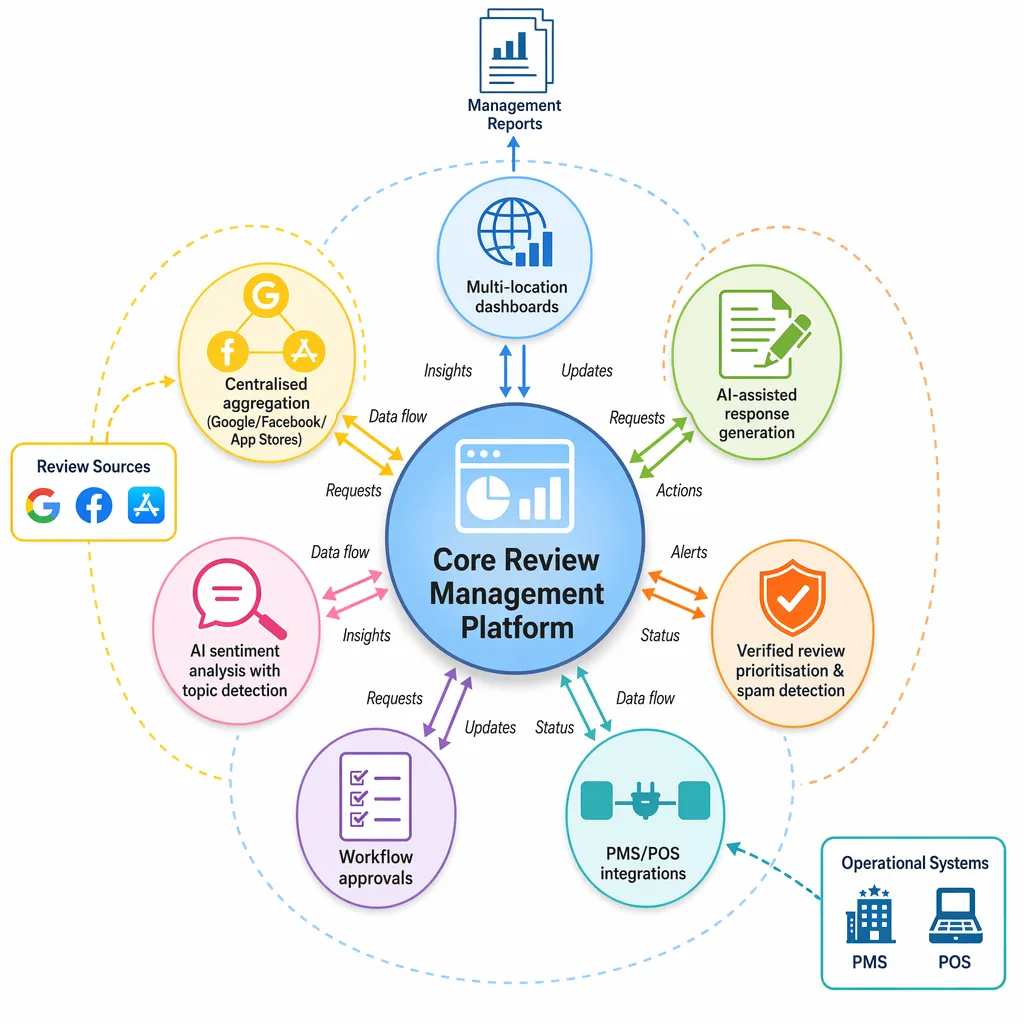
Navigating these challenges requires purpose-built tools that consolidate feedback while enabling swift, informed action. Modern review management platforms must offer these essential capabilities:
| Essential Feature | Why It Matters |
|---|---|
| Centralised aggregation (Google/Facebook/App Stores) | Solves platform fragmentation with single-view monitoring |
| AI sentiment analysis with topic detection | Identifies recurring issues like cleanliness or wait times |
| AI-assisted response generation | Maintains brand voice while reducing reply times |
| Verified review prioritisation & spam detection | Filters fake content to focus on genuine feedback |
| Workflow approvals | Enables team collaboration with custom permissions |
| PMS/POS integrations | Operationalises feedback for immediate improvements |
| Multi-location dashboards | Centralises oversight for hotel groups with local control |
Consolidating Fragmented Feedback
Centralising Google, Facebook, and app store reviews eliminates platform-hopping, crucial for understaffed teams. This consolidation reveals patterns across sources – a negative service mention on Google and Facebook signals systemic issues needing attention. For restaurants, the 5-star review impact calculator demonstrates how a 4.5-star rating drives 47% more bookings than 3.5 stars.
Automating Analysis and Engagement
AI sentiment analysis mirrors Google's system, flagging recurring topics like room cleanliness or check-in delays without manual tagging. With 35% of hotel responses now AI-assisted, quality tools generate on-brand replies indistinguishable from staff-written ones. Combine this with spam detection to ignore fake reviews, focusing on feedback impacting reputation. Use the response generator to maintain consistent engagement.
Operationalising Insights at Scale
Direct PMS/POS integrations turn feedback into action – a spike in 'dirty room' complaints can trigger housekeeping audits. Multi-location dashboards let hotel groups benchmark performance while enabling local managers to respond contextually. Workflow approvals ensure compliance for chains with strict branding. For implementation guidance, see the multi-platform software guide and review management fundamentals.
Comparative Analysis: Leading Solutions for Hospitality
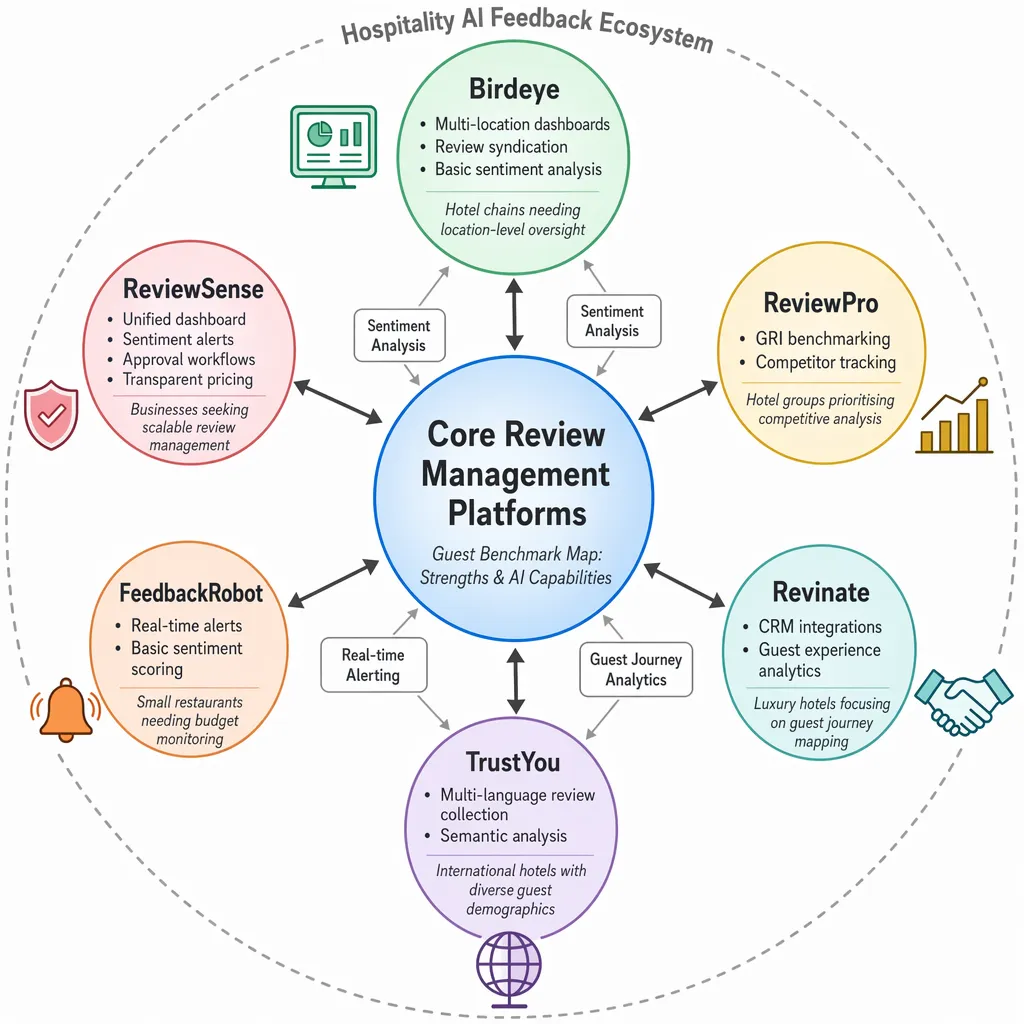
With the essential features established, how do leading solutions compare for hospitality sector needs? Our evaluation focuses on core capabilities for hotels and restaurants:
| Platform | Key Strengths | Hospitality-Specific AI | Ideal Use Case |
|---|---|---|---|
| Birdeye | Multi-location dashboards, review syndication | Basic sentiment analysis | Hotel chains needing location-level oversight |
| ReviewPro | Global Review Index (GRI) benchmarking, competitor tracking | GRI benchmarking across 175+ OTAs | Hotel groups prioritising competitive analysis |
| Revinate | CRM integrations, guest experience analytics | Deep PMS integrations for luxury brands | Luxury hotels focusing on guest journey mapping |
| TrustYou | Multi-language review collection, semantic analysis | Strong multilingual processing | International hotels with diverse guest demographics |
| FeedbackRobot | Real-time alerts, basic sentiment scoring | Minimal hospitality customisation | Small restaurants needing budget monitoring |
| ReviewSense | Unified dashboard for supported platforms, sentiment alerts, approval workflows, transparent pricing | Spam detection, topic analysis for service/cleanliness | Businesses seeking efficient, scalable review management |
| Note: platforms claiming Yelp/TripAdvisor support often lack depth; verify coverage before committing. |
Hospitality operators face pressure to act on feedback quickly. With 85% of hospitality IT decision-makers expecting to allocate at least 5% of their IT budget to AI tools in 2026, features like ReviewSense's sentiment alerts and spam detection prove critical. The platform's focus on Google, Facebook, and app stores ensures deep coverage where most travellers leave feedback.
For multi-location hotel groups, centralised oversight with local flexibility matters. Solutions like Birdeye and ReviewSense support this, though ReviewSense's approval workflows streamline team collaboration across properties. Groups running a single brand across many properties often need mention and news monitoring on top of review handling, which is the category our guide to brand reputation management software covers. Its AI helps teams prioritise genuine feedback at scale – vital when a 2025 study estimated 15-20% of hotel reviews are now AI-generated.
Transparent pricing remains rare among enterprise tools. ReviewSense's clear model helps budget planning, while its free trial enables risk-free testing. For properties aiming to boost ratings, the guide on generating 5-star reviews offers practical tactics. When negative feedback arises, use the negative review response generator to maintain professionalism.
Beyond Technology: Operationalising Feedback for Genuine Improvement
| Common Tool Focus | Operational Improvement Focus |
|---|---|
| Automated response generation | Training staff using recurring feedback patterns |
| Review volume tracking | Addressing root causes of negative sentiment spikes |
| Star rating monitoring | Showcasing verified guest testimonials to build trust |
While review management platforms provide essential capabilities, technology alone cannot resolve underlying service failures. High staff turnover in UK hospitality means processes often break without continuous improvement. AI insights must drive operational changes, not just faster replies. For instance, sentiment analysis revealing recurring kitchen delays should prompt workflow restructuring, not just templated apologies.
Consider a restaurant using these insights: when sentiment analysis surfaces 'slow service' as a recurring theme in negative feedback, the most effective response is operational, not automated. Rather than relying on templated replies, management can reorganise kitchen workflows and cross-train staff to address the root cause. Over the following months, wait-time complaints typically fall as the underlying problem is fixed. This demonstrates how transforming feedback into staff training materials creates lasting change. The guide on AI-powered review management strategies details this approach.
Trust remains critical as review authenticity concerns grow. With human readers identifying fake reviews only 38% of the time, and 52% of travellers now doubting review legitimacy, verified content becomes essential. Video testimonials from actual guests counter this scepticism effectively. Ensure your genuine reviews stay visible by understanding why Google deletes reviews.
For multi-location hotel groups, centralised sentiment tracking must inform group-wide training programmes. A spike in 'check-in delays' at one property could indicate systemic staffing issue requiring policy changes. ReviewSense's transparent pricing supports scaling these operational improvements across estates. Ultimately, the best tools bridge the gap between customer feedback and frontline service adjustments.
Implementation Roadmap: From Selection to Results
To transform feedback into operational improvements, follow this structured implementation plan:
| Phase | Key Actions | Expected Outcome |
|---|---|---|
| Audit & Setup | Inventory reviews across Google, Facebook, app stores; configure dashboard | Centralised visibility of all feedback channels |
| AI Calibration | Test response quality, adjust brand voice, train staff on AI collaboration | Human-sounding replies that maintain brand tone |
| Integration & Alerting | Connect property systems, define negative sentiment thresholds | Proactive issue resolution and closed feedback loops |
| Measurement | Track response rates, sentiment trends, and star rating changes | Quantifiable reputation improvement |
Audit your current presence across Google Business Profile, Facebook, and app stores. Identify gaps in coverage and response consistency. For multi-location hotel groups, this reveals which properties need urgent attention.
Prioritise operational needs like response speed for restaurants versus detailed reporting for hotel chains. Centralised oversight is critical for multi-location review management, while cafes might value rapid reply tools. Use ReviewSense's transparent pricing to match features to budget.
Test AI response quality rigorously. Can replies pass as human-written? Aim to exceed the 35% indistinguishability benchmark. Calibrate tone using real guest interactions - a pub chain might need more warmth than a boutique hotel. With 71% of hospitality professionals seeing AI as transformative force, precise calibration matters.
Configure crisis alerts for sudden sentiment drops. Set thresholds for keywords like "bed bugs" or "food poisoning" to trigger immediate team notifications. This prevents isolated complaints escalating.
Integrate with PMS/POS systems to operationalise feedback. Link negative comments about check-in delays directly to front-desk rota planning, turning data into staff training. This closes the loop between criticism and improvement.
Measure impact monthly via response rates and sentiment trends. Target a 0.5-star aggregate rating increase within six months. ReviewSense's analytics track progress, while 82% of hospitality leaders plan increased AI adoption, proving this approach aligns with industry direction. For deeper strategies, explore the guide on AI-powered review management.
Conclusion
In today's competitive hospitality environment, managing reviews across Google, Facebook, and app stores is non-negotiable for reputation and retention. The most effective strategies centralise feedback to identify operational gaps, transform critiques into staff training, and deploy AI for human-sounding responses that preserve brand voice. Proactive crisis alerts prevent minor issues from escalating, while sentiment analytics pinpoint systemic improvements—like optimising check-in or kitchen workflows. For hotels and restaurants, this isn't just about replying faster; it's about closing the feedback loop to directly enhance guest experiences. Ready to turn scattered reviews into actionable insights? Start your 7-day free trial.
Related reading: a multi-platform review management strategy, multi-channel review management, and how to monitor reviews across multiple sites.