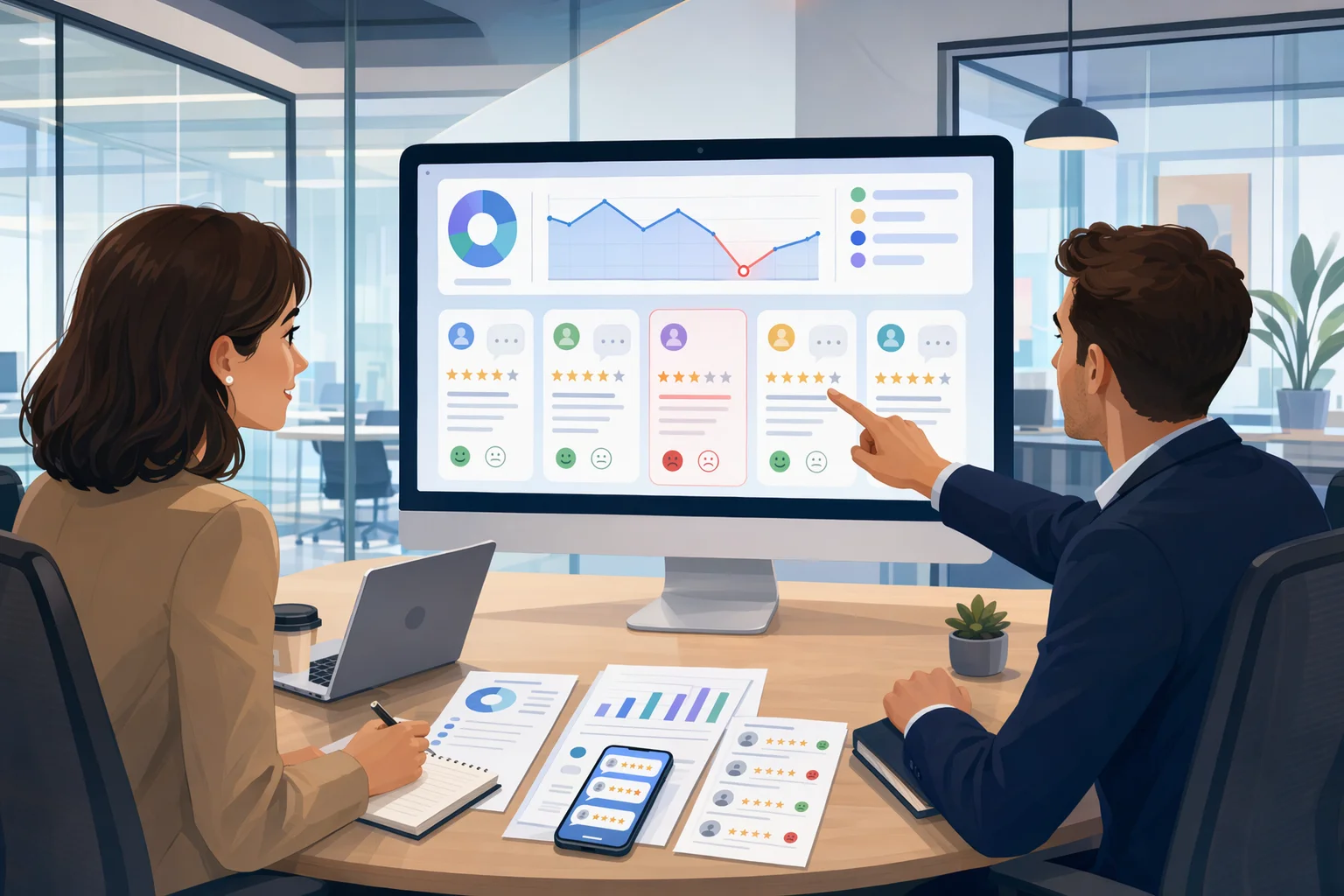
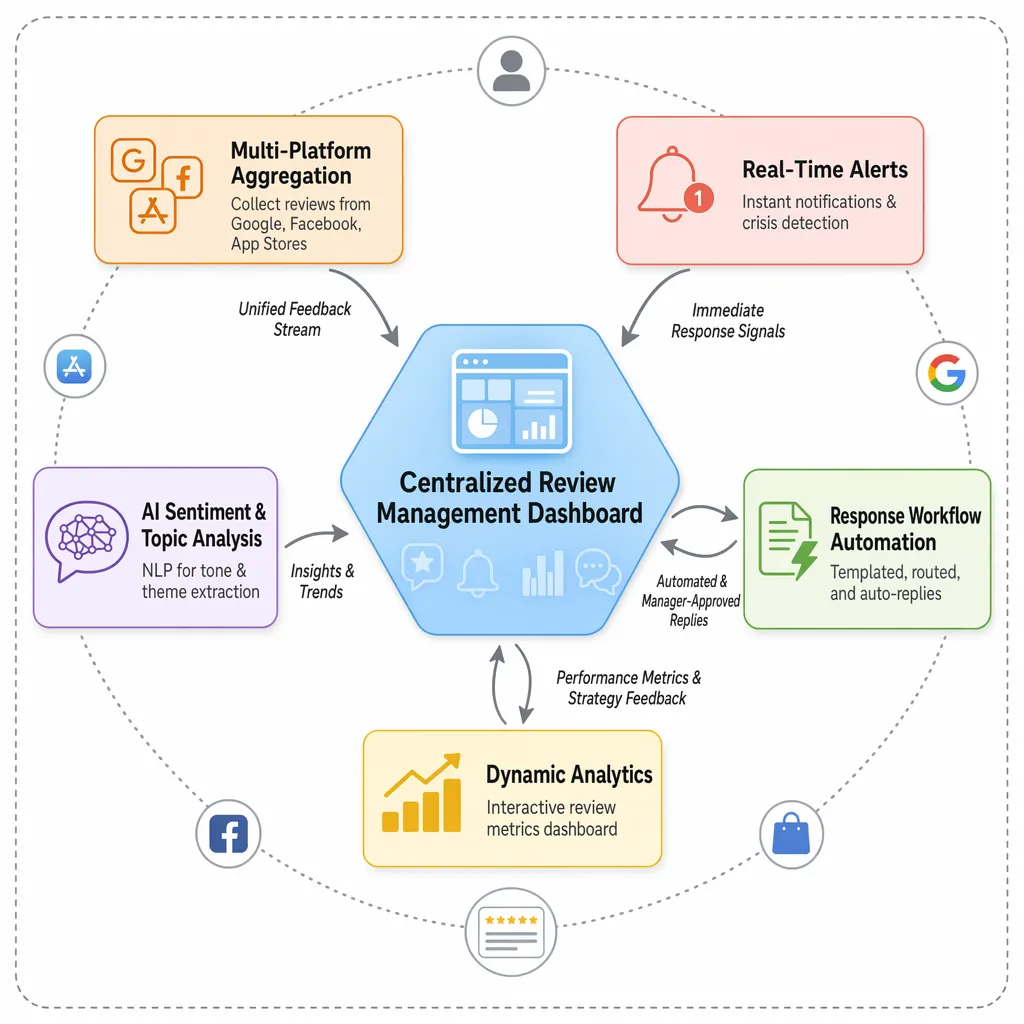
A centralised review dashboard solves this by aggregating every customer review into a single interface. This eliminates chaotic manual tracking, ensures no critical feedback slips through, and transforms raw data into actionable reputation insights.
Managing this manually is hard. ReviewSense automates it.
The Fragmented Feedback Challenge
| Platform | Operational Challenge |
|---|---|
| Google Business | Reviews buried in email clutter, requiring constant manual checks across locations |
| Customer feedback mixed with personal notifications in crowded business page inboxes | |
| Apple App Store | Version-specific bug reports lost without dedicated tracking or alert systems |
| Google Play | Regional variations complicate monitoring across international branches |
For UK businesses, juggling reviews across Google, Facebook, and app stores creates genuine operational headaches. Teams waste hours daily platform-hopping between dashboards, often missing urgent feedback buried in notification noise. Most consumers rely heavily on reviews when choosing suppliers, yet fragmented systems mean critical insights slip through the cracks. When teams can't spot emerging issues quickly, revenue follows the reputation downhill.
The pattern is consistent across sectors. UK home services firms see negative Google reviews snowball when responses lag by more than a few days. Multi-location hospitality brands miss Facebook comments about service inconsistency until they've already shaped weekend trade. Mobile-first SaaS companies discover version-specific bugs through scattered App Store and Play Store complaints rather than a single triage queue. Fragmentation isn't just inefficient — it risks reputation damage and lost revenue.
Without a centralised dashboard to manage all your business reviews, teams struggle with inconsistent response times and missed feedback. Manual processes can't scale across locations or spot sentiment trends early. That's why centralisation isn't optional – it's essential for protecting your brand. For multi-location operations, it's the only practical way to maintain oversight. Explore the Apple App Store review management software guide for platform-specific solutions. Effective customer review management starts with breaking down data silos before they break your business.
Essential Components and Capabilities
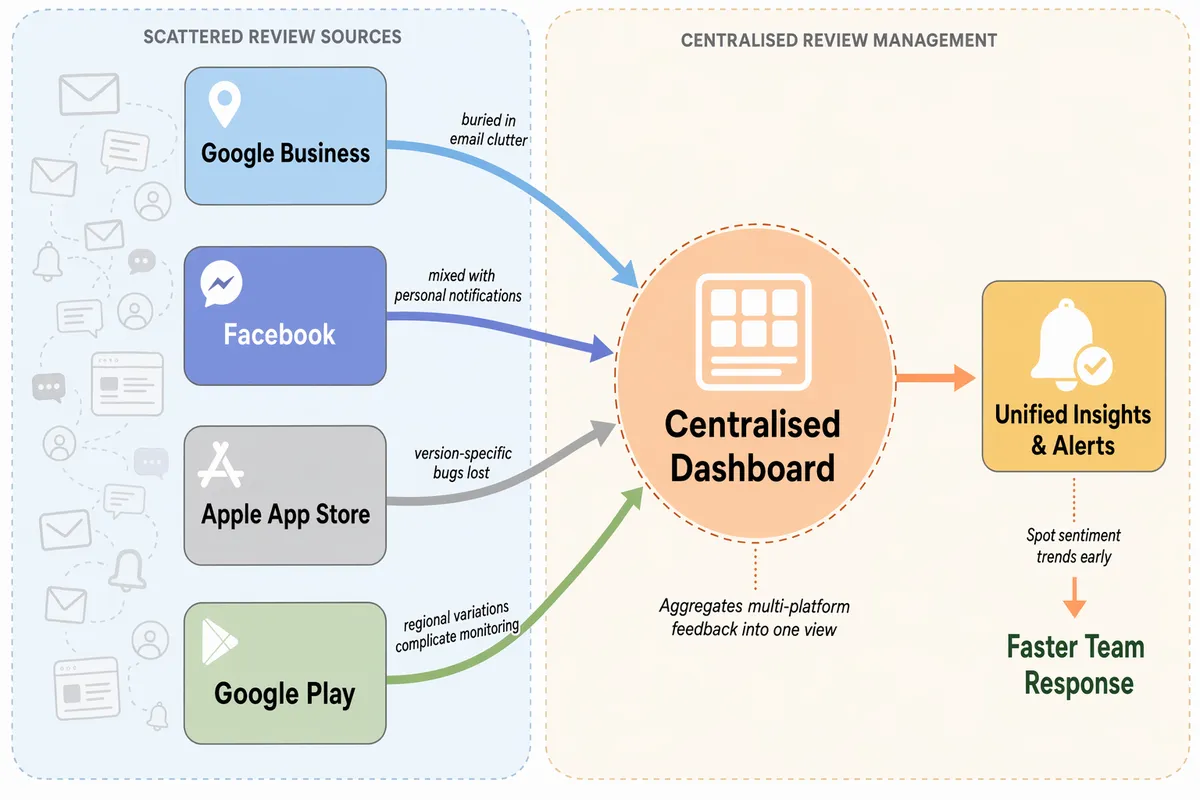
Given these risks, a centralised review dashboard provides the unified interface needed to consolidate multi-source feedback for real-time action. Its core components work in concert to transform scattered data into strategic insights:
| Component | Core Function |
|---|---|
| Multi-Platform Aggregation | Collects reviews from Google, Facebook, Apple App Store, and Google Play |
| Real-Time Alerts | Instant notifications for new reviews with crisis detection for urgent issues |
| AI Sentiment & Topic Analysis | Automatically categorises feedback and detects key themes and emotions |
| Response Workflow Automation | Streamlines drafting, approval, and publishing of replies |
| Dynamic Analytics | Tracks performance metrics and trends across all review sources |
Multi-Platform Aggregation
This foundational element pulls reviews from your Google Business Profile, Facebook pages, and app stores into one location. No more juggling multiple logins or missing platform-specific feedback. Centralisation ensures every voice is captured, whether it's a Play Store complaint about app crashes or Facebook praise for your customer service team.
Real-Time Alerts
Immediate notifications for new reviews let teams respond while feedback is fresh. Crisis detection algorithms flag sudden negative spikes, like multiple one-star Google reviews about a product defect within hours. This enables swift damage control before issues escalate, turning potential reputation fires into manageable incidents.
AI Sentiment & Topic Analysis
Advanced NLP scans review text to identify emotional tone and recurring themes without manual reading. It surfaces patterns like rising complaints about delivery times or frequent praise for staff helpfulness. As industry research confirms, this transforms raw comments into prioritised action points. These insights directly fuel tools like the AI Review Response Generator, which crafts context-aware replies.
Response Workflow Automation
Pre-defined approval chains and templated responses accelerate reply management. Staff can generate personalised responses in seconds, then route them to managers for quick sign-off. Auto-reply rules handle simple five-star reviews instantly, freeing teams to focus on complex or negative feedback needing human nuance.
Dynamic Analytics
Interactive dashboards track metrics like sentiment trends, response rates, and review volume by location or product line. Crucially, they reveal what drives customer satisfaction — and where it slips. Real-time visibility helps refine your customer review management strategy. Internal trends only tell you half the story, though: a 4.2 average reads very differently in a sector averaging 3.8 than in one averaging 4.6, which is the case for pairing your dashboard with review benchmarking tools.
Critical Implementation Pitfalls to Avoid
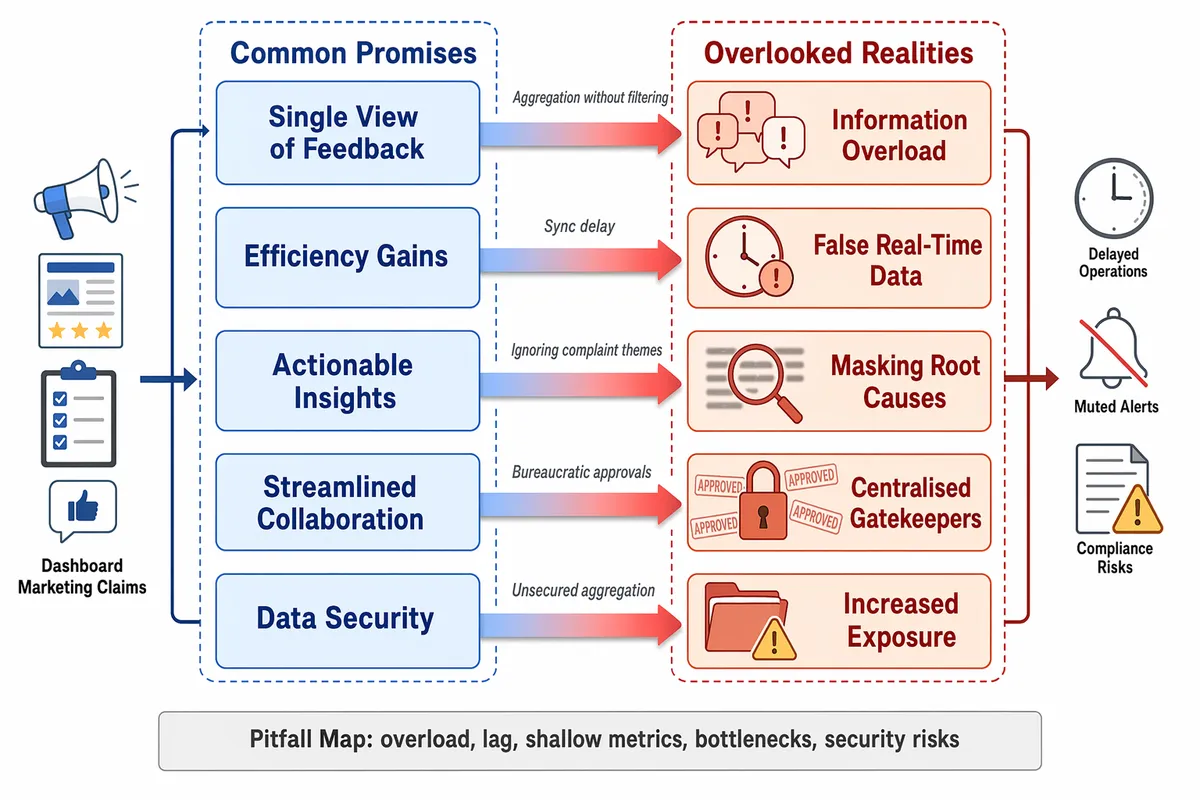
While centralised dashboards promise streamlined review management, implementation missteps can undermine their value. Many businesses discover too late that simply aggregating reviews doesn't automatically yield actionable insights. Consider these common pitfalls versus the often-overlooked realities:
| Common Promises | Overlooked Realities |
|---|---|
| Single View of Feedback | Information overload and decision paralysis when filters are absent |
| Efficiency Gains | False real-time data assumptions delaying critical actions |
| Actionable Insights | Star averages masking root causes hidden in review text |
| Streamlined Collaboration | Centralised gatekeepers slowing response agility |
| Data Security | Increased exposure from unsecured aggregated data |
Information Overload Challenges
Aggregating reviews without intelligent filtering creates noise. Teams given a single feed of every review across every platform tend to skim and miss the urgent items, defeating the point of centralisation. A free mention alert is the extreme case of this, catching a fraction of what is said and sorting none of it, as our piece on why Google Alerts fails for reputation management sets out. Effective systems require customisable alert thresholds and sentiment-based prioritisation to surface what matters.
The Real-Time Myth
Many platforms claim instant data sync, but lags between source platforms and dashboards create false urgency. A negative Google review might appear 'new' in your dashboard hours after publication, risking delayed damage control. This makes understanding Google's review policies essential for timely interventions.
Superficial Metrics Trap
Dashboards displaying only star ratings often miss underlying issues. A 4.2-star average can hide a recurring complaint about delivery delays or staff attitude that's quietly costing repeat business. True insight requires analysing sentiment patterns and topic frequency across platforms, not just averaging scores. The Star Rating Calculator helps contextualise numerical data.
Without addressing these pitfalls, dashboards become vanity metric displays. As the review-management software market grows year on year, the gap widens between systems that just aggregate and systems that genuinely act. Platforms like ReviewSense combat these risks with AI-driven topic clustering and customisable workflows that transform raw data into operational improvements.
Selection Criteria for Modern Solutions
Fragmented customer data costs businesses revenue, so selecting a dashboard that delivers genuine operational improvements requires prioritising these five capabilities for 2026:
| Priority | Selection Criteria for 2026 | Why It Matters |
|---|---|---|
| 1 | AI Depth Beyond Basic Sentiment | Identifies recurring themes and spam, not just positive/negative tone |
| 2 | Customisable Approval Workflows | Ensures brand consistency across multi-location teams and agencies |
| 3 | Real-Time Crisis Alerts | Flags sudden negative spikes for immediate damage control |
| 4 | No-Code Customisation | Empowers non-technical staff to adapt dashboards without IT support |
| 5 | Transparent Pricing with Free Tools | Avoids hidden costs and provides immediate value during evaluation |
AI Depth Beyond Basic Sentiment
Platforms must detect nuanced themes like delivery delays or billing errors across Google, Facebook and app stores. This moves beyond simple sentiment to identify root causes. For example, spotting 15+ mentions of "late delivery" in a week enables proactive process fixes, not just reactive replies.Customisable Approval Workflows
Multi-location businesses need tiered approval chains. A London HQ should review critical responses while local managers handle routine feedback. This scalability makes it essential among the best platforms for centralised feedback and approvals in 2026. Agencies particularly benefit from client-specific workflows.Real-Time Crisis Alerts
Look for platforms monitoring sudden review spikes across all sources. Instant alerts for multiple 1-star Google reviews within an hour enable swift intervention. This prevents issues like product defects escalating, protecting your reputation.No-Code Customisation
Non-technical teams should adapt dashboards without developers. Marketing staff must filter by location or product line via simple dropdowns. This 2026 trend democratises data access, letting frontline staff create custom views.Transparent Pricing with Free Tools
Avoid vendors with complex tiers. Solutions should offer clear GBP pricing (£X/month per location) and free tools like the Google Review QR Code Generator for immediate value. Trial periods let you verify performance before committing.
When evaluating options, prioritise platforms that solve these operational gaps rather than just aggregating data. For multi-location strategies, the guide on choosing review management software offers further considerations.
Tangible Business Outcomes and Risks
Choosing the right platform is just the first step; the real test lies in measurable outcomes and potential pitfalls. Centralised review management delivers tangible wins when executed well, but carries significant risks if mismanaged.
| Successes | Risks |
|---|---|
| B2B teams use aggregated review insights to identify objections and refine sales messaging | Fragmented review data leads to inconsistent reporting and gut-feel decisions |
| Multi-location operators reduce support costs by spotting recurring complaints early | Ignoring negative review threads accelerates brand damage in days, not weeks |
| E-commerce brands lift conversion by displaying verified reviews on product pages | Delayed responses to Google and Facebook reviews directly impact customer retention |
Turning Feedback into Revenue
Centralised dashboards transform scattered opinions into growth levers. Sales teams identify recurring objections by clustering review themes across channels. Multi-location operators pinpoint equipment, staffing, or process issues through cross-platform analysis, enabling preventative fixes that cut support costs. For e-commerce, displaying verified reviews at checkout consistently boosts conversion, and our ecommerce review management platform comparison covers which tools push reviews onto product pages automatically. These outcomes depend on responding promptly — a unified system ensures you miss no critical feedback across Google, Facebook or app stores. Businesses using a centralised dashboard to manage all my business reviews consistently report improved customer experience and revenue growth. To quantify potential gains, try the 5-star review calculator.
The High Cost of Fragmentation
Ignoring consolidation risks reputation and revenue. When teams can't trust their feedback data, decisions drift toward gut-feel rather than evidence. Without real-time alerts, negative Google reviews fester — UK consumers expect responses within hours. This directly impacts retention. For multi-location operations, platforms enabling centralised feedback and approvals prevent revenue leakage. UK-specific guidance on managing Google reviews helps avoid local visibility damage. Start transforming feedback today with a free ReviewSense trial.
Conclusion
In today's fragmented feedback environment, a centralised review dashboard is non-negotiable for reputation management. By consolidating Google Business Profile, Facebook, Apple App Store, and Google Play reviews into one actionable hub, businesses gain real-time crisis alerts to prevent reputation damage, no-code customisation for frontline teams, and analytics that transform scattered feedback into growth opportunities. The cost of fragmentation is steep—delayed responses erode trust, while data silos cripple decision-making. ReviewSense solves this by enabling swift, brand-aligned responses and uncovering insights that directly improve customer experience. Stop letting valuable feedback slip through the cracks and start converting reviews into revenue drivers. Start your 7-day free trial
Related reading: a multi-platform review management strategy, how to monitor reviews across multiple sites, and multi-property hotel review management.