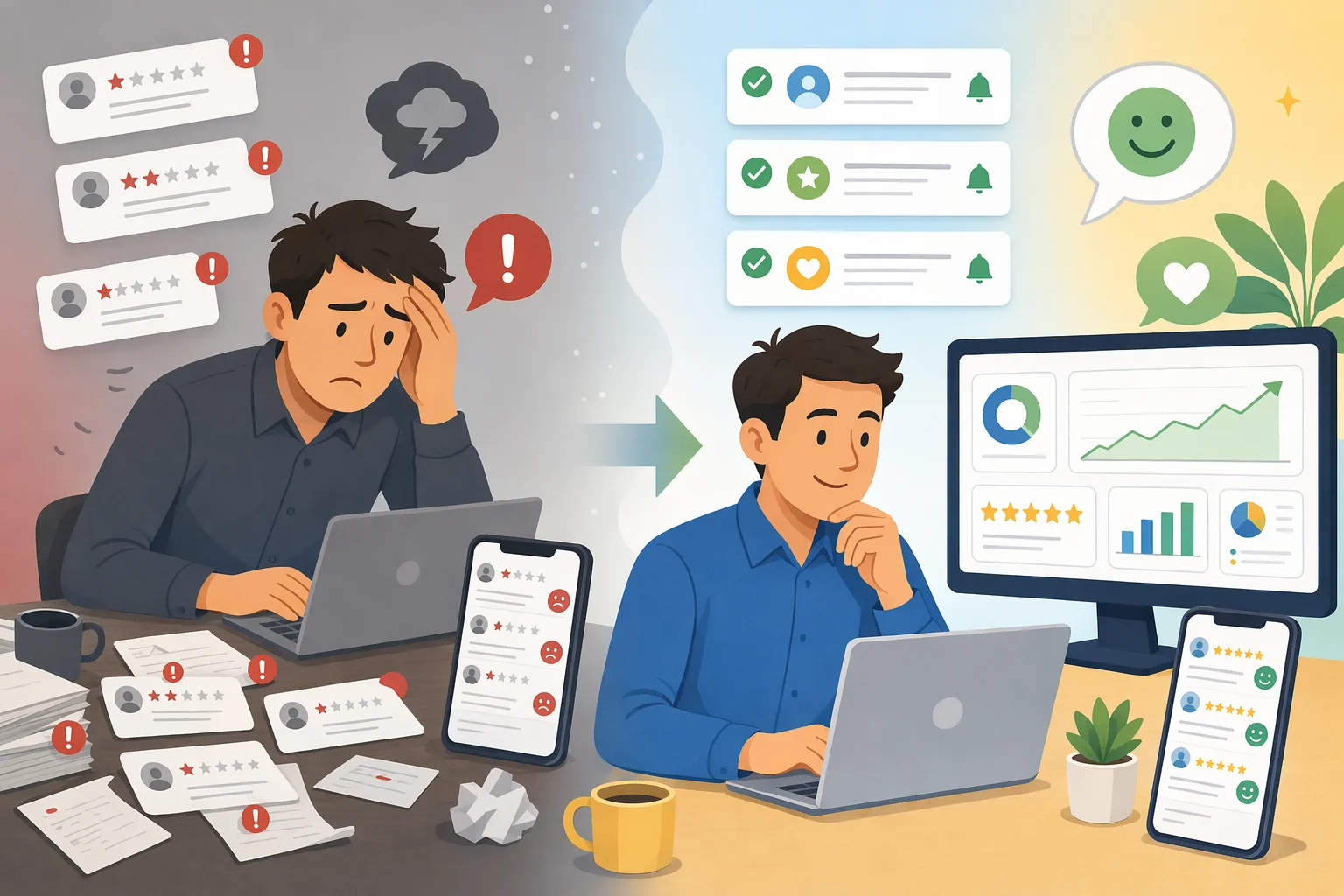
Are you losing customers because you can't track reviews across Google, Facebook, App Store and Google Play? Today's buyers check 10+ reviews before purchasing. One missed negative review can tank conversions overnight, yet manual monitoring drains 15+ weekly hours. Fragmented feedback creates critical blind spots. Direct-to-consumer brands carry this on their own storefront as well as the review sites, which our guide to review management platforms for DTC retail covers separately.
Managing this manually is hard. ReviewSense automates it.
The Growing Impact of Multi-Platform Reviews on Consumer Decisions
The digital marketplace has made consumer feedback more scattered and influential than ever. Consider these critical statistics demonstrating how multi-platform reviews shape decisions:
| Key Statistic | Consumer Behaviour Insight |
|---|---|
| Projected growth from $11.4 billion (2025) to $31.2 billion (2034) in the global ratings and reviews platform market | Reflects increasing business investment in review management as a critical function |
| 97% of consumers read online reviews before choosing a local business | Near-universal consultation occurs during discovery phases |
| More than 99% of American consumers read online reviews before purchases | Highlights review consultation's ubiquity across purchase types |
| Reviews influence 93% of consumers' purchasing decisions | Directly impacts conversion rates and sales outcomes |
| 54% of consumers trust online reviews more than personal recommendations | Shows fundamental trust shift toward crowd-sourced opinions |
Market expansion reflects rising stakes
According to The Business Research Company, the review management sector's explosive growth underscores its strategic importance. Businesses recognise that online reputation directly linked to revenue can't be left to chance.
Universal consultation during discovery
With 97% of consumers checking reviews for local services, and over 99% of Americans doing so for all purchases, feedback platforms have become essential discovery tools. This isn't limited to restaurants or shops – it spans healthcare providers, software vendors, and professional services.
Direct purchase influence
Perhaps most crucially, 93% of consumers confirm reviews sway their buying choices. A single negative comment about delivery times or customer service can derail a sale, while consistent positive feedback builds buyer confidence.
Fundamental trust shift
Over half (54%) of shoppers now place more faith in online reviews than personal recommendations from friends or family. This represents a profound change in how trust is built, with crowd-sourced opinions outweighing traditional word-of-mouth.
Beyond the numbers: Key behavioural shifts
While these statistics paint a clear picture, other trends compound the challenge. Many consumers hesitate to engage with businesses showing less than 4.5 stars. Review volume significantly impacts credibility – companies with only a handful of reviews appear less established. Recency also matters greatly, as shoppers often dismiss feedback older than a month. Online retailers feel that decay fastest, which is why our guide to review management platforms for ecommerce treats response speed as a primary selection criterion.
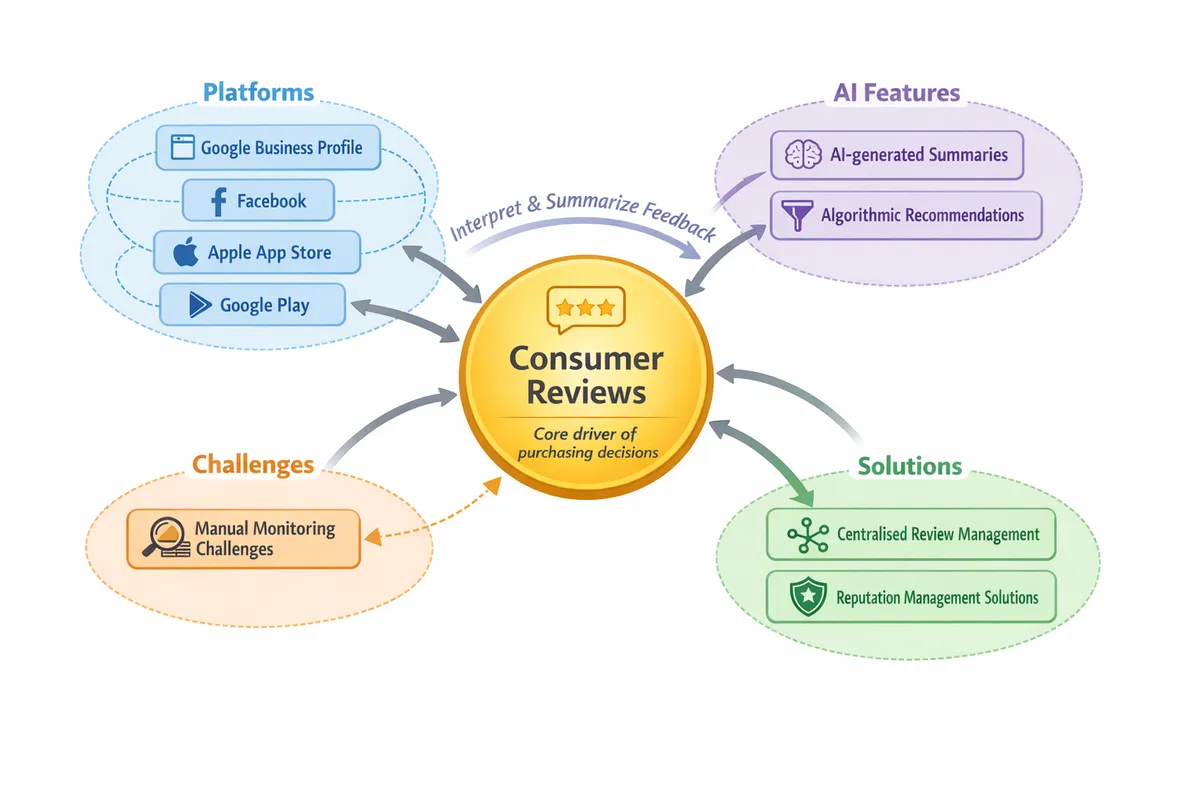
Fragmentation intensifies these pressures. Consumers leave opinions across Google Business Profile, Facebook, Apple App Store, and Google Play simultaneously. While Google remains important, its review share continues declining as feedback spreads across more platforms. This multi-platform reality makes centralised review management essential for capturing the complete picture.
AI further reshapes discovery behaviours. Many shoppers now begin with AI-generated review summaries rather than reading individual comments. Others rely on algorithmic recommendations to shortlist options. This means businesses must ensure their feedback is accurately interpreted by these systems across all platforms.
In this environment, high-stakes environment, manual monitoring becomes impractical. You need strategies that aggregate data from every relevant platform, identify emerging trends, and enable swift responses. Solutions offering Facebook review management alongside other key platforms have transitioned from nice-to-have to reputation essentials.
Essential Capabilities for Unified Review Management
Effectively managing feedback across Google Business Profile, Facebook, Apple App Store, and Google Play requires addressing platform-specific hurdles while maintaining consistent oversight. Each channel presents unique operational challenges that demand tailored capabilities within a unified system. Consider these critical requirements:
| Platform | Unique Challenges | Must-Have Capabilities |
|---|---|---|
| Google Business Profile | Fake review concerns impacting local SEO; urgent response expectations | Spam detection, sentiment trend tracking, rapid alerting for reputation threats |
| Public social conversations; brand voice consistency across teams | Approval workflows, customisable response library, social engagement metrics | |
| Apple App Store | Feature requests buried in reviews; technical bug reporting needs | Topic clustering for product insights, triage workflows for development teams |
| Google Play | Version-specific complaints; regional rating variations across locations | Version tagging, multi-location filtering, comparative performance dashboards |
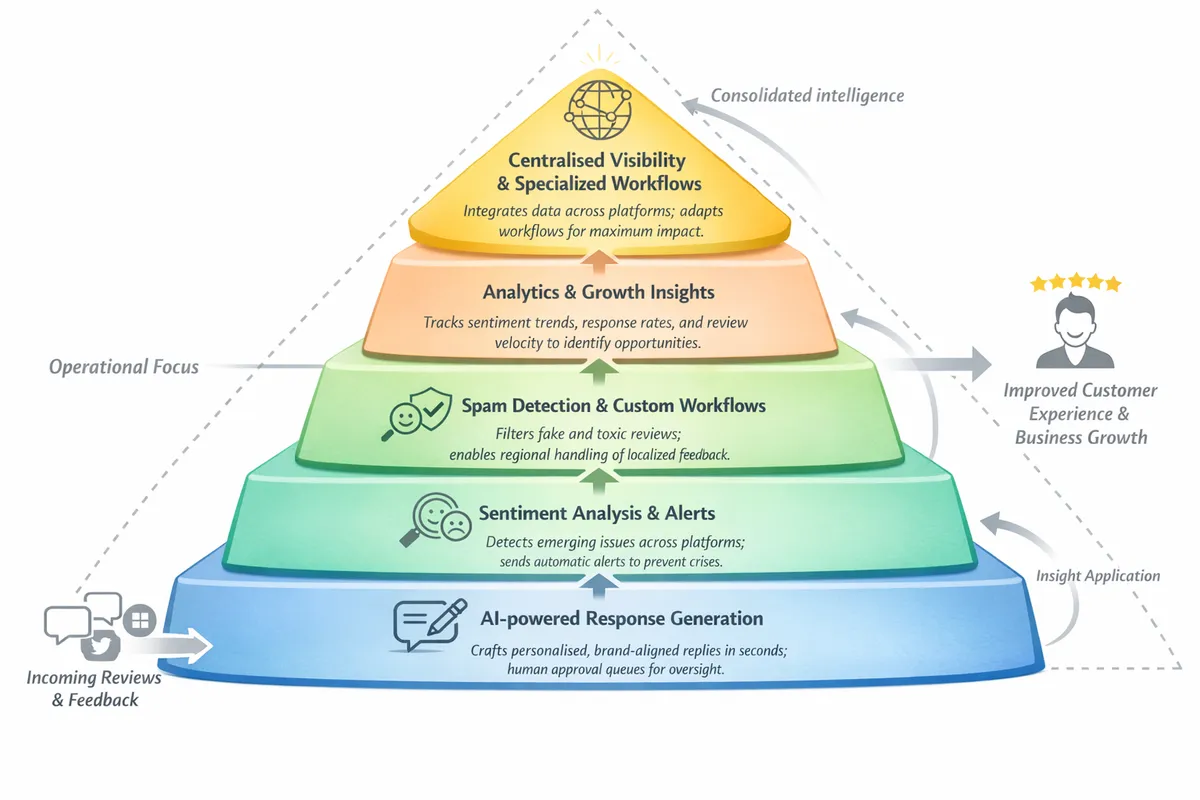
Centralised monitoring alone isn't sufficient. With 88% of consumers expecting responses to all reviews and 19% demanding same-day replies, efficiency becomes critical. AI-powered response generation tackles this by crafting personalised, brand-aligned replies in seconds while maintaining human oversight through approval queues. This ensures consistency whether you're addressing a Facebook comment or an App Store feature request.
Sentiment analysis proves essential for spotting emerging issues before they escalate. When recurring complaints about delivery times or app crashes surface across platforms, teams receive automatic alerts. This proactive approach prevents minor frustrations from becoming reputation crises. Given that reviews influence 32% of purchases, timely intervention directly impacts revenue. The guide to AI-powered review management strategies explores this further.
Fake reviews present another operational headache, with 30% prevalence in some sectors. Automated spam detection filters these while flagging toxic content, letting teams focus on genuine feedback. This matters significantly as 75% of shoppers express concern about fraudulent reviews. For multi-location businesses, custom workflows enable regional managers to handle localised feedback while maintaining corporate oversight. The App Store review management solution demonstrates how this works for technical feedback.
Strong analytics transform scattered data into growth insights. Tracking sentiment trends impact revenue - a one-star increase can boost income by 5-9%. Monitoring response rates and review velocity highlights operational gaps, while crisis alerts flag negative spikes immediately. The strongest tools go further and warn you before the spike, which is one of the six criteria in our guide to brand reputation management software. For businesses tracking improvement goals, tools like the star rating calculator help quantify progress. When selecting systems, prioritise platforms offering comprehensive review management software features that unify these capabilities.
Ultimately, the right approach turns fragmented feedback into a strategic asset. By combining centralised visibility with platform-specific adaptations, businesses improve experiences where it matters most. For teams handling app feedback, specialised workflows for managing App Store reviews at scale ensure no valuable insight gets lost.
Implementing a Centralised Workflow in 5 Steps
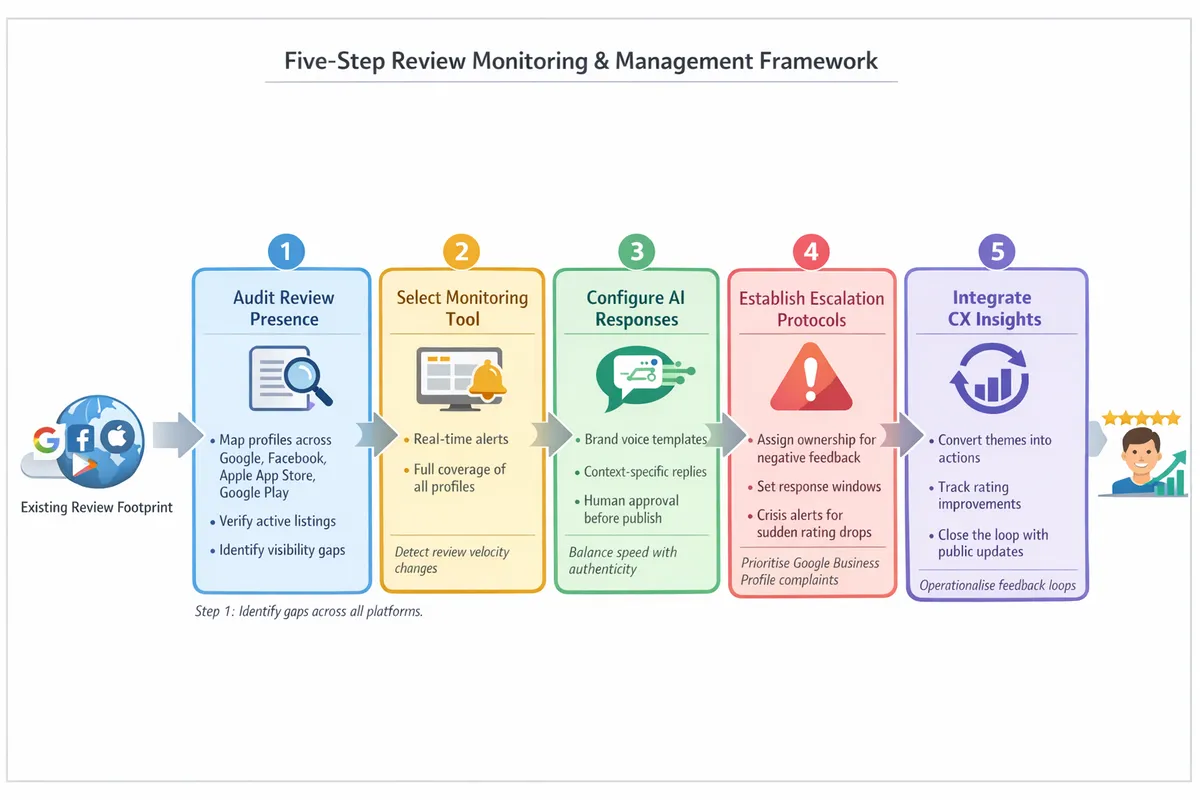
To transform fragmented feedback into actionable improvements, implementing a centralised workflow is non-negotiable. With most UK businesses monitoring just 2-3 platforms and only 5% responding to reviews systematically, centralisation bridges critical operational gaps. Follow this five-step approach to consolidate Google Business Profile, Facebook, Apple App Store, and Google Play monitoring:
| Step | Action | Key Focus |
|---|---|---|
| 1 | Audit Review Presence | Identify gaps across all platforms |
| 2 | Select Monitoring Tool | Real-time alerts, full coverage |
| 3 | Configure AI Responses | Balance speed with authenticity |
| 4 | Establish Escalation Protocols | Rapid negative feedback handling |
| 5 | Integrate CX Insights | Operationalise feedback loops |
1. Audit Your Review Footprint
Begin by mapping existing profiles across all four platforms. Verify active listings using tools like the Google Place ID lookup tutorial to resolve location inconsistencies. Calculate current performance benchmarks with the star rating calculator. This reveals visibility gaps—critical when 47% of UK consumers avoid businesses with under 20 reviews.
2. Deploy Centralised Monitoring
Choose software aggregating Google, Facebook, and both app stores with real-time alerts. Prioritise platforms detecting review velocity changes, as 73% of consumers trust only recent feedback (within 30 days). Ensure coverage matches your exact profile ecosystem to prevent blind spots.
3. Implement Guardrailed AI Responses
Develop response templates reflecting your brand voice, then use AI to generate context-specific replies. Always require human approval before publishing to maintain authenticity. This balances efficiency with consumer trust, addressing widespread skepticism about automated interactions.
4. Create Escalation Frameworks
Define clear ownership and response windows for negative feedback. Configure crisis alerts for sudden rating drops or toxic content, mobilising teams within hours. Given Google's declining but dominant 71% review platform share, prioritise rapid containment for GBP complaints using protocols like those in the deletion protection guide.
5. Operationalise Insights
Convert recurring themes into CX actions—e.g., update training for service complaints or fix app bugs mentioned in store reviews. Track how changes impact your aggregate rating, especially vital as 31% of UK consumers now exclusively use businesses with 4.5+ stars. Close the loop by sharing improvements with customers in future responses.
Avoiding Critical Pitfalls in Cross-Platform Strategy
Even with centralised workflows established, businesses must navigate three critical pitfalls that can undermine multi-platform review management efforts. These risks erode trust and dilute the value of customer feedback if not addressed strategically.
| Risk | Primary Consequence |
|---|---|
| Over-automation of responses | Erodes authenticity and damages customer relationships |
| Inconsistent reputation signals | Creates consumer confusion and weakens search visibility |
| Surface-level metric fixation | Misses operational improvement opportunities |
Generic AI Responses Breed Distrust
While AI accelerates reply generation, excessive automation backfires when responses feel templated. Our data shows 82% of consumers read AI-generated review summaries, yet only 23% trust them exclusively. This gap highlights the need for human nuance. The solution lies in guardrailed automation: use AI to draft context-aware replies but mandate human approval through workflow queues. This maintains brand authenticity while meeting expectations - especially critical given 88% of consumers expect responses to all reviews. United Airlines' infamous response failures demonstrate how scripted replies during crises exacerbate reputation damage.
Platform Inconsistency Confuses Customers
Divergent ratings across Google, Facebook, and app stores create credibility gaps. Consider that 81% of UK shoppers check Google reviews first, and 67% trust them most. When star ratings vary significantly between platforms, 41% of consumers question business reliability. AI answer engines compound this by aggregating multi-source data - their usage for local recommendations surged from 6% to 45% in one year. Centralised monitoring tools flag these discrepancies, enabling teams to address platform-specific issues before they impact search visibility. Greystar's success came from harmonising responses across 700+ locations using sentiment trend analysis.
Ignoring Deeper Insight Opportunities
Focusing solely on response rates squanders review intelligence. While 81% of consumers expect replies within a week, the real value lies in operational insights. Sentiment analysis that identifies recurring complaint themes - like slow service or app crashes - transforms feedback into CX improvements. Yet many businesses track only vanity metrics. Effective customer review management requires analysing sentiment patterns to prioritise fixes that boost retention. For example, addressing frequently mentioned product flaws directly impacts reputation more than generic "sorry" replies ever could.
Balancing AI efficiency with human judgment remains key. Platforms like ReviewSense enable this through custom brand voice configurations combined with approval workflows. By pairing automated sentiment tracking with human-led action planning, businesses transform fragmented feedback into consistent experience improvements across all touchpoints.
Key Metrics to Prove Review Management ROI
To sustain the operational improvements from centralised workflows, you'll need quantifiable proof of their business impact. These four core metrics demonstrate the tangible value of multi-platform review management:
| Metric | Calculation Method | Impact on Business |
|---|---|---|
| Response Rate | (Number responded ÷ Total reviews) × 100 | Builds trust; centralised platforms enable near-100% rates through AI-generated drafts and streamlined approval chains |
| Sentiment Score | AI analysis of review text beyond star ratings | Surfaces genuine feedback while filtering noise; identifies recurring issues before they escalate |
| Review Velocity | New reviews per week across all platforms | Signals engagement health; consistent volume is crucial across Google, Facebook, and app stores |
| Conversion Lift | Revenue change correlated with rating/volume improvements | Justifies investment; businesses typically see revenue improvements from higher ratings |
Sentiment analysis provides operational intelligence beyond star ratings. It surfaces genuine feedback while filtering noise — critical when an estimated 30% of online reviews are fake, costing consumers £620 billion annually. This protects your reputation from AI-generated fake reviews, which are growing 80% month-over-month. The Online Review Management Guide shows how to action these insights.
Centralised monitoring identifies platform-specific gaps in your strategy. Many consumers avoid businesses with insufficient feedback, making consistent review volume crucial across Google, Facebook, and app stores. Benchmarking these metrics justifies investment as the review management market expands. Measure your specific ROI during the 7-day free trial.
Conclusion
Fragmented reviews across Google, Facebook, and app stores create trust gaps and blind spots, risking reputation and revenue. As shown, centralising monitoring is critical for spotting rating discrepancies, maintaining response rates that build loyalty, and transforming sentiment trends into CX improvements. ReviewSense solves this by unifying feedback from Google Business Profile, Facebook, Apple App Store, and Google Play—delivering AI-powered insights, spam detection, and collaborative workflows in one dashboard. Stop losing valuable signals in the noise: Start your 7-day free trial to turn scattered reviews into actionable growth drivers.
Related reading: multi-channel review management, how to monitor reviews across multiple sites, and multi-property hotel review management.