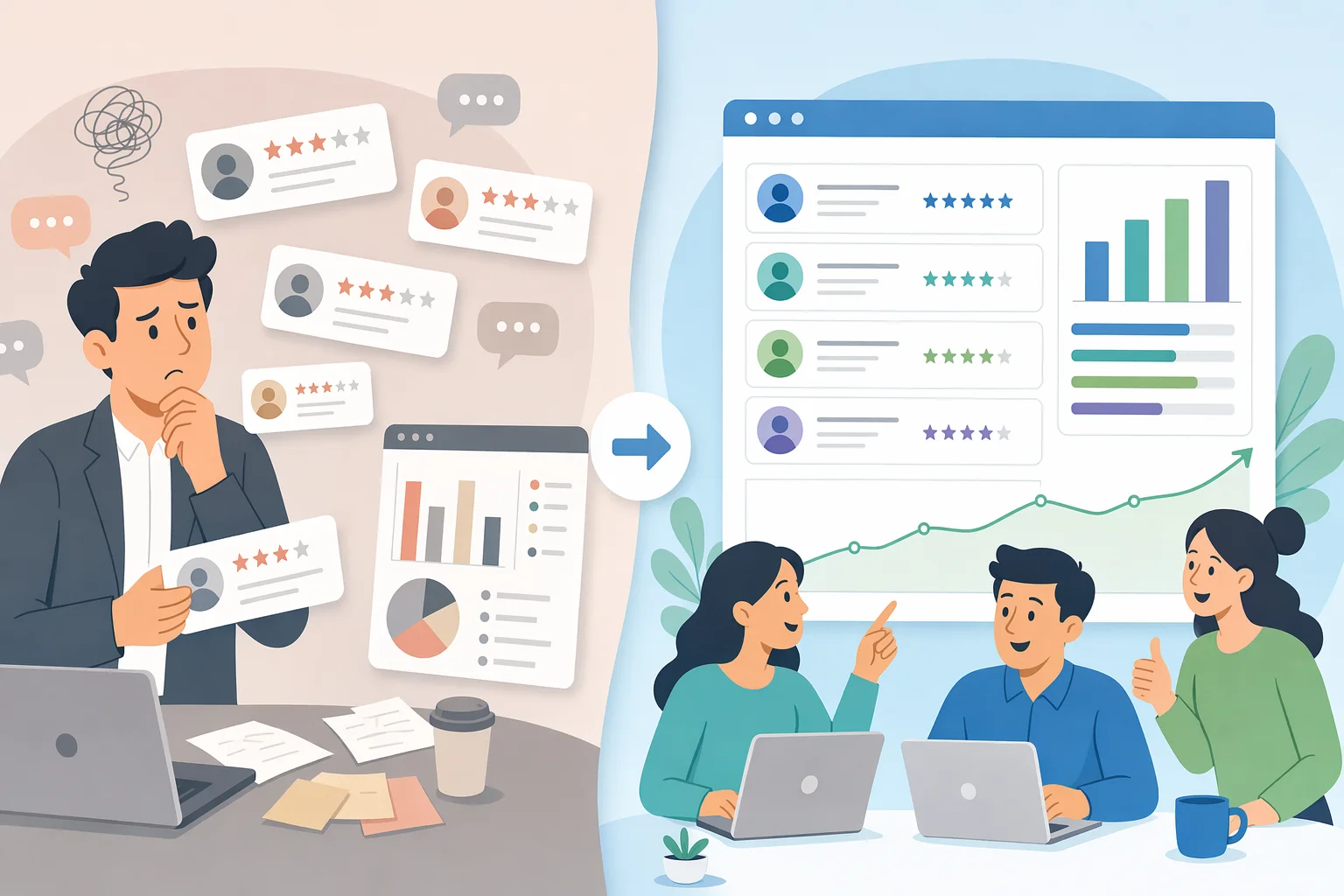
Yet most brands still guess where they stand against competitors. Generic benchmarks won't cut it in 2026—especially as AI reshapes how reviews influence brand perception. You need precise, platform-specific data to spot gaps and act fast.
Managing this manually is hard. ReviewSense automates it.
The Real Cost of Ignoring Your Online Reputation in 2026
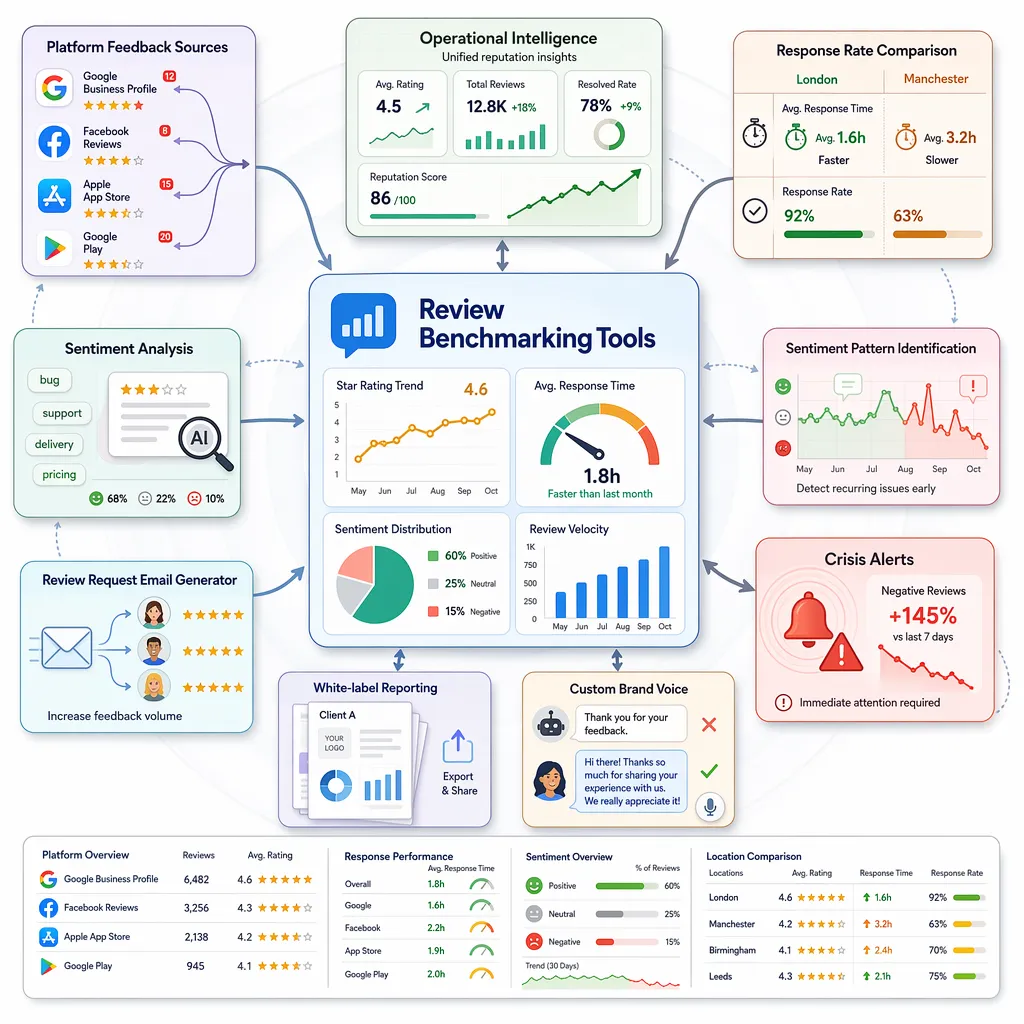
That’s where review benchmarking tools come in. They don’t just track your star rating. They give you operational intelligence. You can see how your response rate compares to competitors. You can spot which platforms drive the most feedback. And you can identify patterns in sentiment before they become crises.
What Review Benchmarking Actually Does
Think of it as a health check for your online reputation. A good benchmarking tool pulls data from Google Business Profile, Facebook, Apple App Store, and Google Play into one view. It then compares your performance against industry averages or direct competitors. You’ll see metrics like review velocity, average rating trends, and response times.
For example, a multi-location retailer might discover their London branch responds to reviews twice as fast as their Manchester one. That insight drives training. Or a SaaS company might find their App Store ratings are dropping due to a recurring bug. Without benchmarking, that signal gets lost in the noise.
What to Look For in a Tool
Not all benchmarking is created equal. You need a platform that offers:
- Sentiment analysis that flags recurring issues, not just positive or negative labels.
- Crisis alerts for sudden negative spikes, so you can act fast.
- Custom brand voice settings, so automated replies don’t sound robotic.
- White-label reporting if you’re an agency managing multiple clients.
ReviewSense delivers all of this. Its built-in sentiment analysis extracts key topics from every review. Crisis alerts notify your team the moment a negative trend emerges. And the Review Request Email Generator helps you proactively gather more feedback, giving you a larger dataset to benchmark against.
Common Pitfalls to Avoid
Many businesses benchmark only their star rating. That’s a mistake. A 4.5-star average can hide a declining response rate or rising complaint volume. Always look at the full picture: response rate, sentiment breakdown, and review velocity. Also, avoid comparing yourself to irrelevant competitors. A local café shouldn’t benchmark against a national chain.
Next, we’ll explore how to benchmark your company reviews against competitors effectively — and why the right tool makes all the difference.
What to Look for in a Review Benchmarking Platform
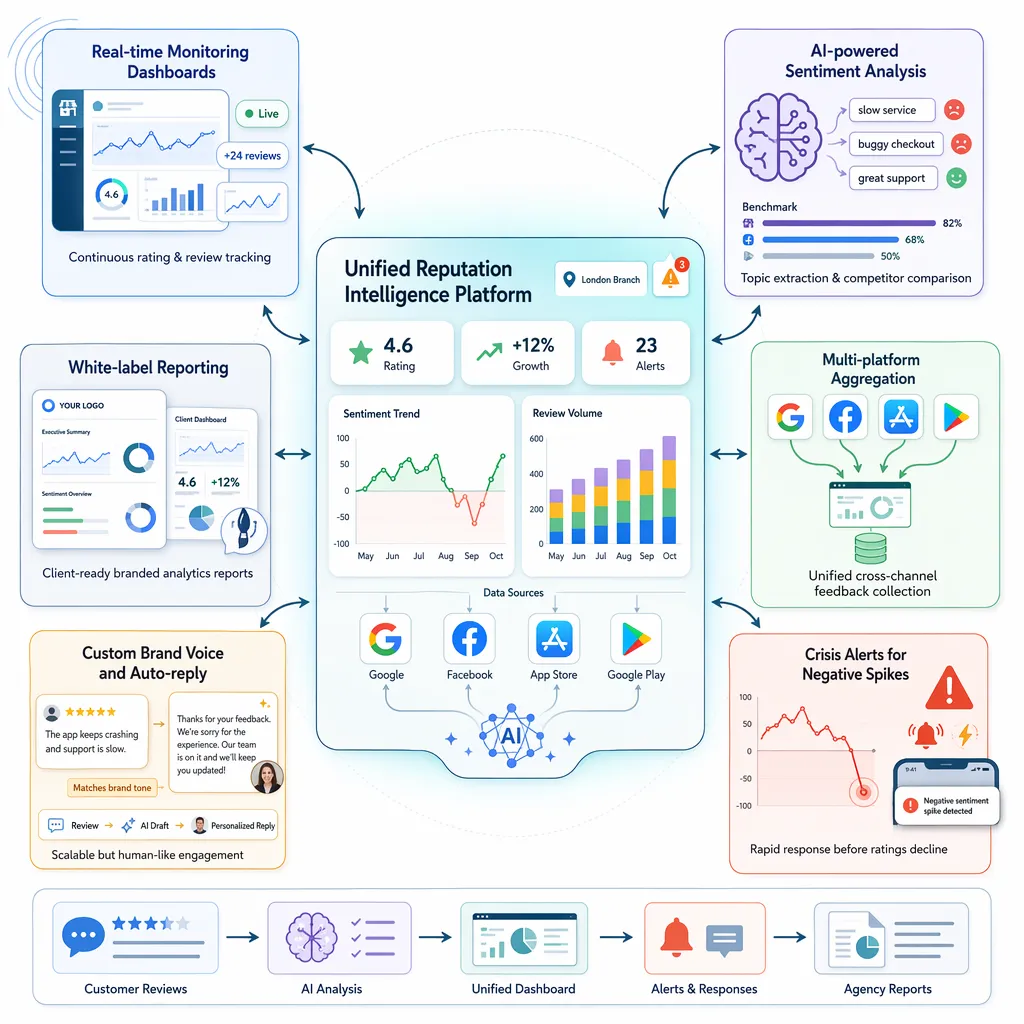
So, you know why benchmarking matters. Now, what should a platform actually do? Here’s a quick checklist to guide your choice.
| Capability | Why It Matters |
|---|---|
| Real-time monitoring dashboards | Catch shifts as they happen, not months later |
| AI-powered sentiment analysis | Spot recurring issues before they escalate |
| Multi-platform aggregation | See the full picture across Google, Facebook, and app stores |
| Crisis alerts for negative spikes | Act fast when sentiment turns south |
| Custom brand voice and auto-reply | Respond at scale without losing your tone |
| White-label reporting | Agencies can deliver branded client reports |
Real-time monitoring dashboards
Annual review cycles are dead. The shift to real-time data means you need a dashboard that updates constantly. Without it, you’re flying blind. A good platform shows review velocity and rating changes as they happen. That lets you spot a dip in your London branch’s performance before it hits your average.
AI-powered sentiment analysis
Many businesses still rely on star ratings alone. That’s not enough. AI-driven tools extract key topics from every review. They flag recurring issues like “slow service” or “buggy checkout.” This turns raw feedback into actionable insights. You can then compare those themes against competitors using review benchmarking tools.
Multi-platform aggregation
Your customers leave feedback everywhere. Google, Facebook, Apple App Store, Google Play. A single dashboard that pulls all four together saves hours of manual checking. It also gives you a complete dataset for how to benchmark your company reviews against competitors. Without it, you’re comparing apples to oranges.
Crisis alerts for negative spikes
One bad week can tank your rating. Crisis alerts notify your team the moment a negative trend emerges. That speed lets you respond before the damage spreads. It’s the difference between a quick fix and a PR problem.
Custom brand voice and auto-reply workflows
Auto-reply workflows help you meet that bar. But they need to sound like you. Custom brand voice settings ensure every reply feels personal, not robotic. This builds trust at scale.
White-label reporting for agencies
If you manage multiple clients, white-label reports are essential. They let you deliver branded insights without revealing your tool stack. That builds your agency’s authority and keeps clients coming back.
How to Benchmark Your Company Reviews Against Competitors (Without Falling Into Traps)
Now that you know what a platform should do, let's get practical. Benchmarking is only useful if you avoid common traps. Here's a step-by-step guide to benchmarking your reviews the right way.
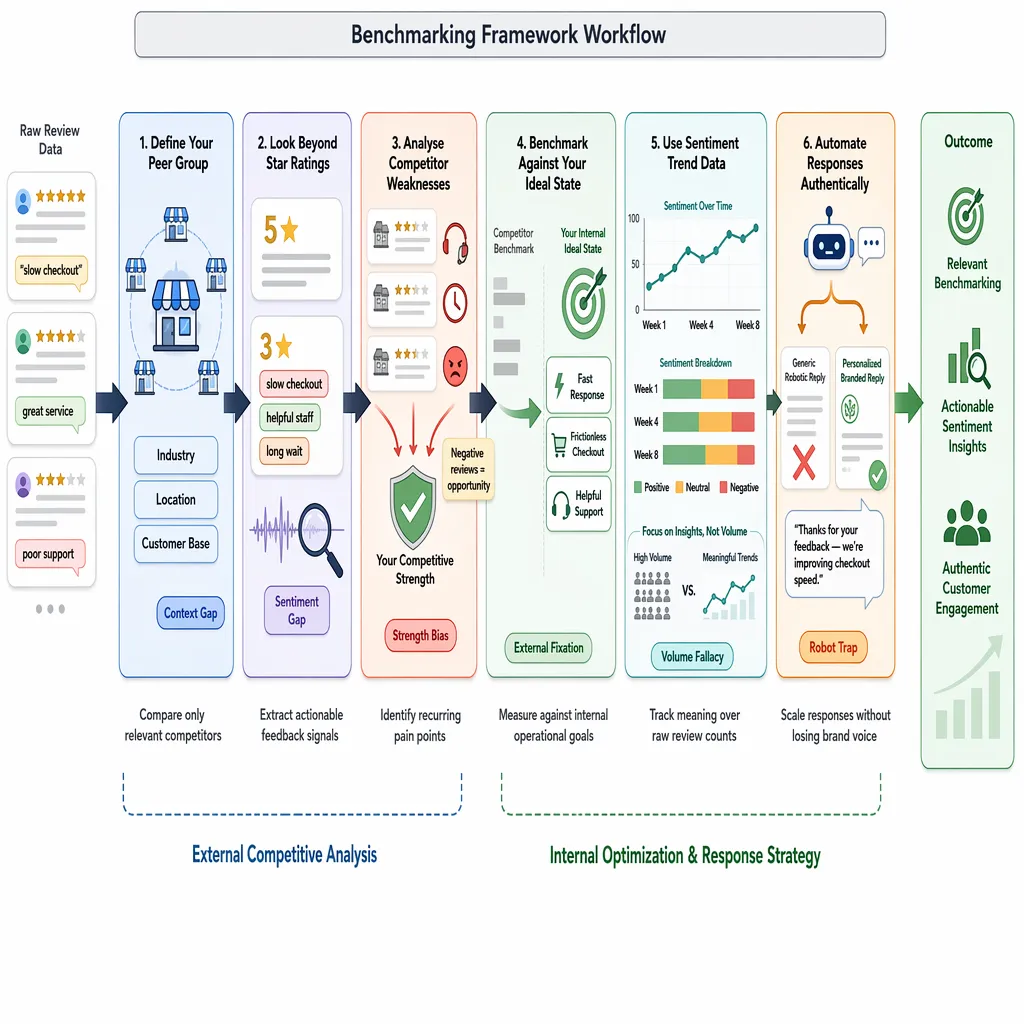
The Benchmarking Framework at a Glance
| Step | Focus | Common Trap |
|---|---|---|
| 1 | Define your peer group | The 'Context Gap' – comparing boutique firms to large providers |
| 2 | Look beyond star ratings | The 'Sentiment Gap' – ignoring actionable feedback |
| 3 | Analyse competitor weaknesses | The 'Strength Bias' – only copying what works |
| 4 | Benchmark against your ideal state | The 'External Fixation' – ignoring internal goals |
| 5 | Use sentiment trend data | The 'Volume Fallacy' – counting reviews, not meaning |
| 6 | Automate responses authentically | The 'Robot Trap' – losing brand voice at scale |
Step 1: Define Your True Peer Group
Many review benchmarking tools compare you against irrelevant businesses. A boutique law firm shouldn't benchmark against a national chain. This 'Context Gap' skews your data. Instead, pick 3-5 direct competitors with similar size, location, and customer base. ReviewSense lets you filter by industry and location, so your benchmarks actually mean something.
Step 2: Look Beyond Star Ratings
A 3-star review with specific feedback is more valuable than a 5-star 'great job'. This is the 'Sentiment Gap'. Star ratings hide nuance. You need sentiment analysis that extracts key topics. That's how you spot patterns like 'slow checkout' or 'helpful staff'. Use a Star Rating Calculator to see how individual reviews shift your average, but don't stop there.
Step 3: Analyse Competitor Weaknesses
Your competitors' negative reviews are a goldmine. Identify recurring complaints they receive. Then solve those problems in your own business. This is the 'Negative Review is a Competitive Moat' strategy. For example, if rivals get slammed for poor customer support, make that your strength. Tools like ReviewSense flag these themes automatically.
Step 4: Benchmark Against Your Own Ideal State
Don't just look outward. Define what 'good' looks like for your business. Maybe it's 'frictionless checkout' mentions or 'fast response times'. Benchmark against those internal operational goals. This keeps your strategy grounded in what you can control.
Step 5: Use Sentiment Trend Data, Not Just Volume
Why Generic Benchmarks Fail in Complex or Specialised Industries
That framework works well for straightforward retail or hospitality businesses. But generic review benchmarking tools break down in complex or specialised industries. Here's why, and how to fix it.
Highly Differentiated Services
Professional services like law, consulting, and specialist healthcare deliver custom outcomes. A solicitor handling a complex property dispute can't be measured by 'speed of delivery'. The value is in expertise, not turnaround time. Yet most benchmarking tools force a one-size-fits-all metric. This creates a 'Context Gap' — you're comparing boutique firms to volume-driven providers. The result? Misleading data that erodes trust in the process. As industry discussions on Reddit highlight, context is everything.
High Operational Complexity
Logistics firms define 'on-time delivery' differently. A courier might measure it in hours; a freight hauler in days. Benchmarks that ignore these definitions are useless. Similarly, financial services often use broad peer groups defined by asset size. But a regional building society faces different pressures than a global investment bank. The data becomes noise. You need a tool that normalises these differences. ReviewSense's sentiment analysis extracts key topics and flags recurring issues, helping you understand the 'why' behind the numbers.
Rapidly Evolving Tech
SaaS and AI companies move fast. Benchmarks that measure legacy processes — like average response time — are already outdated. Worse, they're prone to gaming. Competitors can inflate ratings by incentivising reviews. When they stop, the benchmark shifts. This 'Selection Bias and Data Volatility' pattern makes static comparisons dangerous. A better approach is to track your own sentiment trends over time. Use a Star Rating Calculator to see how individual reviews shift your average, but pair it with topic analysis. That's how you spot real improvements, not just score manipulation.
The solution isn't to abandon benchmarking. It's to use a platform that provides context. ReviewSense normalises data across platforms and surfaces the themes that matter. That turns raw scores into strategic insight. Next, we'll explore how AI is reshaping this entire field.
The Shift From Search Rankings to AI-Synthesized Brand Narratives
This shift in benchmarking logic leads to a bigger strategic question: what are you actually optimising for? The old answer was search rankings. The new answer is far more complex.
The New Battlefield: AI-Generated Brand Narratives
Reputation management has pivoted. It's no longer just about ranking high on Google Search. The real frontier is how your brand appears in AI-generated responses from tools like ChatGPT, Perplexity, and Google AI Overviews. Recent industry research shows this trend is accelerating. Your brand narrative is now being synthesised by large language models. They pull from your reviews, your website, and third-party sources. They don't just show a star rating. They summarise who you are.
This changes everything for review benchmarking tools. They must now track 'AI-visibility'. That means monitoring not just your average score, but how AI models cite and summarise your brand. Are you mentioned positively? Are you mentioned at all? The goal has shifted from 'winning the search algorithm' to 'influencing the AI narrative.'
The UK Regulatory Pressure
There's a new layer of urgency. The Digital Markets, Competition and Consumers Act in the UK is cracking down hard on fake reviews. Transparent, verified collection methods are now essential. If your benchmarking data includes suspicious reviews, your AI narrative is polluted. ReviewSense's built-in spam and toxic content detection helps maintain authenticity. It filters out noise so your data is clean.
The Contrarian Take
Here's the hard truth: review benchmarking is a lagging indicator of a broken culture. If you need a tool to tell you customers are unhappy, you've already failed. The best benchmarking tool treats reviews as an HR and Operations tool, not a marketing task. Use it to identify operational failures that competitors are too lazy to fix. That's your real competitive moat.
Ready to see how your brand narrative is being shaped? Try ReviewSense free for 7 days. No credit card needed. Sign Up and start influencing the AI story about your business.
Conclusion
Review benchmarking is no longer about static scores or search rankings. The accumulated insights reveal three key truths: context matters more than raw data, AI-generated brand narratives are the new battlefield, and authentic reviews are your only reliable signal. Generic benchmarks fail because they ignore operational definitions, platform differences, and the growing risk of polluted data. The smarter approach is to track your own sentiment trends, surface recurring issues, and filter out noise—turning feedback into a strategic operations tool, not a marketing vanity metric. With ReviewSense, you get a platform that normalises data across platforms, detects spam, and surfaces the themes that drive real improvement. Stop chasing lagging indicators and start influencing the AI story about your business. Start your 7-day free trial and turn scattered reviews into actionable insights.