
For dentists, a single bad review or a stagnant 3.8-star rating can quietly kill new patient growth. The old playbook of simply asking for feedback no longer cuts it. Patients now expect seamless digital experiences, and Google weighs your reputation heavily in local pack rankings. This guide outlines a modern framework for reputation management for dentists, moving beyond basic monitoring to a system that actively drives positive reviews and patient trust.
Managing this manually is hard. ReviewSense automates it.
Why Online Reputation Now Defines Dental Practice Growth
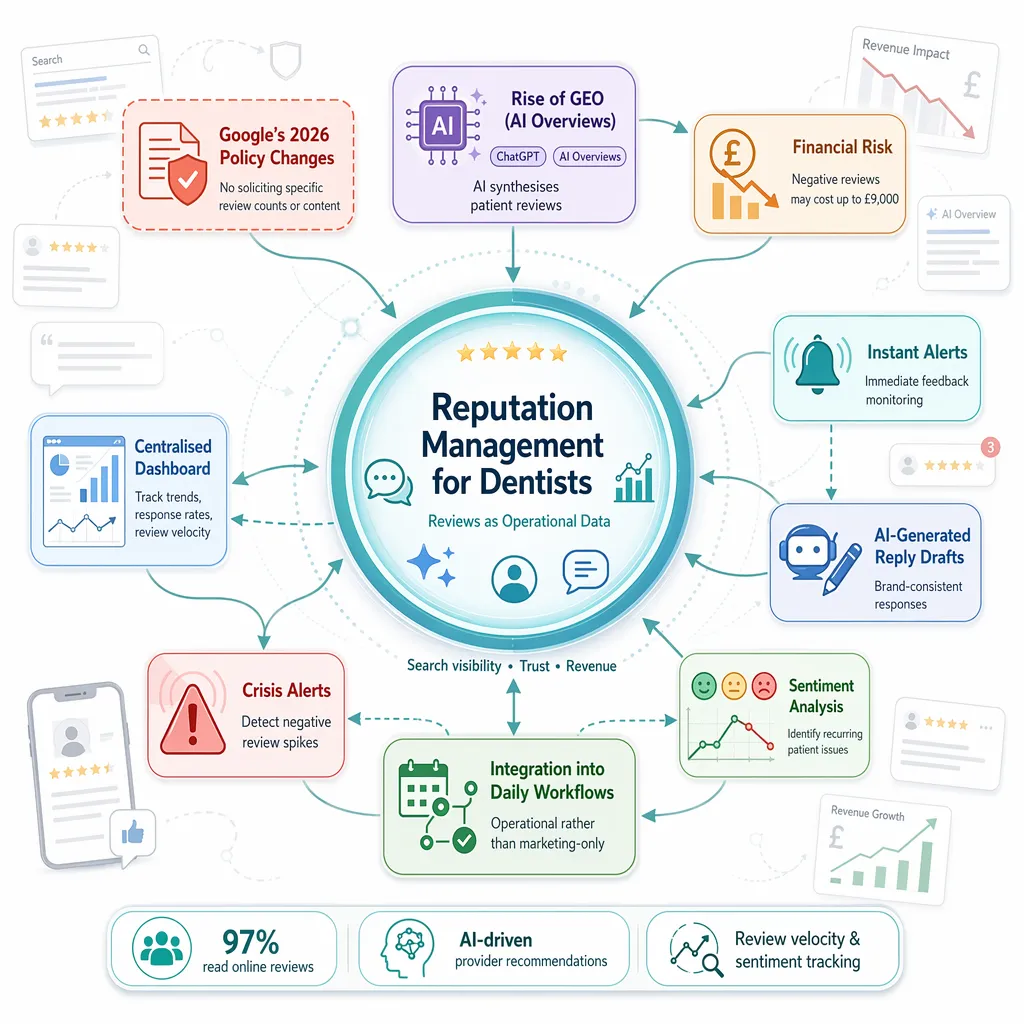
In 2026, a patient's first impression of a dental practice is almost never a phone call—it's a search result and a star rating. With 97% of consumers reading online reviews when researching local businesses, the stakes have never been higher. Reputation management for dentists has evolved from a marketing nice-to-have into a core operational function.
Two forces drive this shift. First, Google's stricter review policies (April 2026) now ban staff from soliciting specific review counts or content. Second, Generative Engine Optimization (GEO) means AI tools like ChatGPT and Google AI Overviews synthesise review data to recommend providers. A single negative review can cost up to £9,000 in high-value treatments like implants or orthodontics. Recent industry research confirms that practices ignoring online reputation lose significant revenue.
| Force | Impact on Dental Practices |
|---|---|
| Google's 2026 policy changes | Bans staff from soliciting specific review counts or content |
| Rise of GEO (AI Overviews) | AI tools synthesise reviews to recommend providers |
| Financial risk | Single negative review can cost up to £9,000 in lost treatments |
To stay competitive, practices need a strategy beyond asking every patient for a 5-star rating. That's where patient review management for dentists becomes essential. The right system acts as an operational backbone, not just a marketing tool.
How to Get More Google Reviews for Dental Practice
Understanding how to get more Google reviews for dental practice requires a systematic approach. You need instant alerts for new feedback, AI-generated reply drafts that match your brand voice, and sentiment analysis to spot recurring issues. A centralised dashboard helps teams collaborate without chaos.
The Operational Shift
Modern reputation management for dentists means treating reviews as data, not vanity metrics. Tools like Google Review Management Software help practices track sentiment trends, response rates, and review velocity. Crisis alerts for negative spikes let teams act quickly before damage spreads.
The practices that thrive will be those that integrate review management into daily workflows. They'll use insights to improve patient experience, not just collect stars. That's the real competitive advantage in 2026.
The New Rules: What Most Reputation Guides Get Wrong
That operational shift matters because most reputation guides still peddle outdated advice. Here are the myths holding dental practices back.
| Myth | Reality |
|---|---|
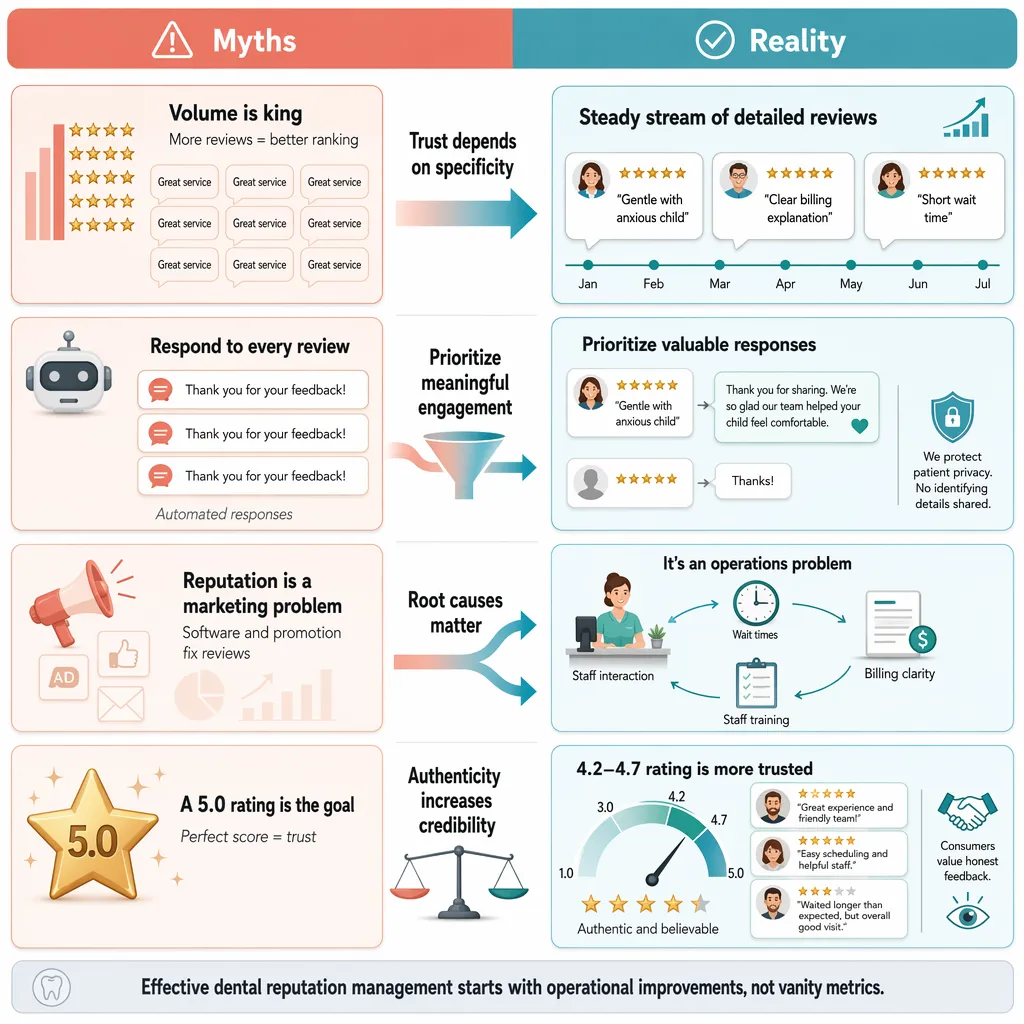
| Volume is king | A steady stream of detailed reviews (velocity + context) beats a flood of generic 5-star ratings. |
| Respond to every review | Robotic replies to generic 5-star feedback hurt trust. Focus on reviews that help future patients. |
| Reputation is a marketing problem | It's an operations problem. Bad reviews often reflect billing or front desk issues. |
| A 5.0 rating is the goal | A 4.2–4.7 rating is more trusted. A perfect score looks curated. |
Myth 1: Volume is king. Many practices chase sheer numbers. But 88% of individuals view online feedback as equivalent to a personal recommendation from a friend. That trust depends on depth, not just stars. A review that mentions "gentle with my anxious child" carries more weight than ten "great service" posts. Google's algorithms now favour recency and specific language. A practice with a steady stream of detailed, recent reviews often outranks one with a larger pool of generic ones.
Myth 2: You must respond to every review. This advice creates robotic, templated replies. Instead, prioritise responses that add value. A patient who mentions dental anxiety deserves a personal note. A generic 5-star review? A simple thank-you suffices. For negative reviews, one professional, HIPAA-compliant response is enough. Over-responding looks defensive.
Myth 3: Reputation management is a marketing problem. This is the costliest myth. If reviews mention long wait times or confusing bills, no software fixes that. The solution is staff training and process change. Effective patient review management for dentists starts in the practice, not the dashboard.
Myth 4: A 5.0 rating is the goal. Consumers trust imperfection. A 4.2–4.7 rating signals authenticity. A perfect score looks curated or filtered. Understanding these nuances helps you evaluate how to get more Google reviews for dental practice authentically.
The real work is understanding what your reviews reveal about your operations. That's where customer review management becomes a strategic advantage, not a vanity project.
Essential Features for a Modern Dental Reputation System
Understanding these myths is the first step. The second is choosing tools that match the new reality. Here are the essential features for a modern dental reputation system.
| Feature | Why It Matters |
|---|---|
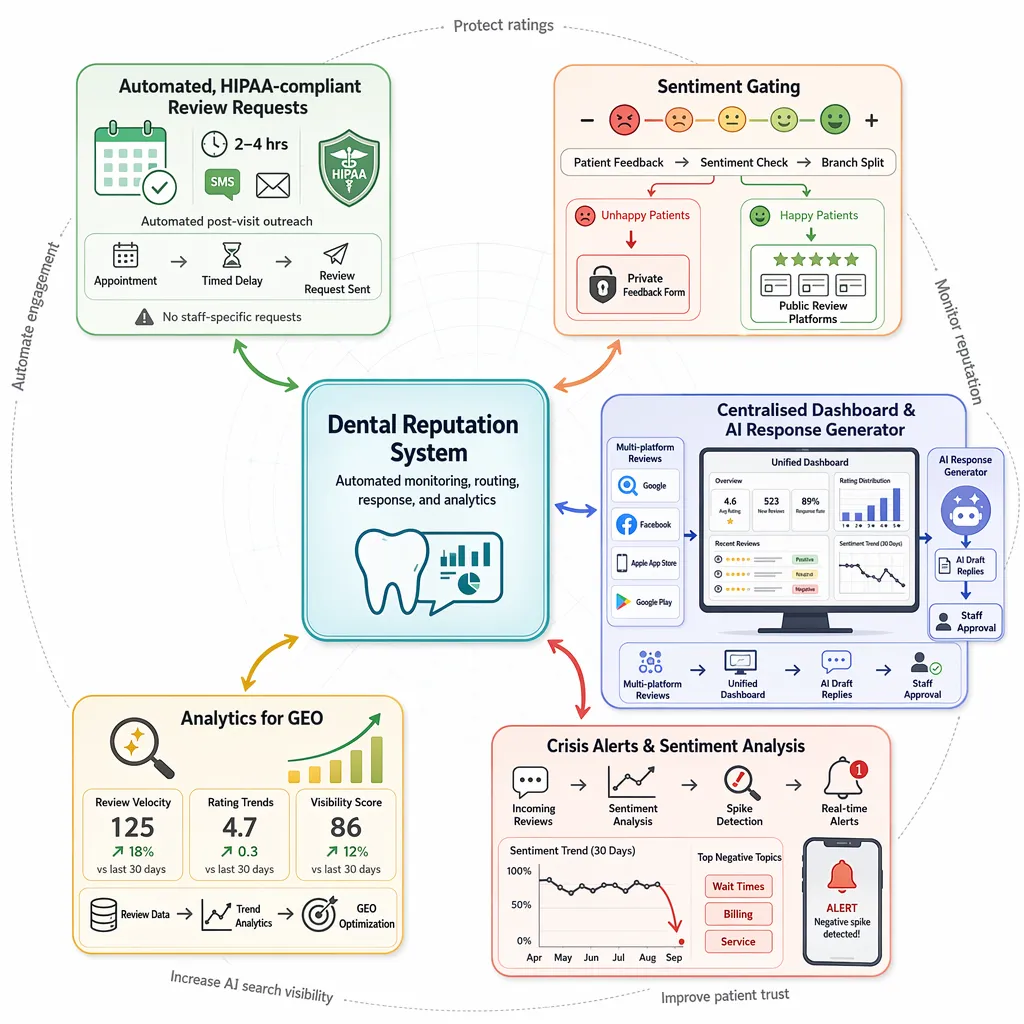
| Automated, HIPAA-compliant review requests | Sends the ask 2-4 hours post-appointment without violating Google's 2026 rules |
| Sentiment gating | Routes unhappy patients to private feedback, happy ones to public platforms |
| Centralised dashboard & AI response generator | Monitors Google, Facebook, Apple App Store, and Google Play in one place |
| Crisis alerts & sentiment analysis | Flags negative spikes so you act before damage spreads |
| Analytics for GEO | Tracks velocity and trends to optimise for AI search visibility |
Automated, HIPAA-Compliant Review Requests
Google's 2026 policy changes ban staff from soliciting specific review counts or content. Your software must automate the ask without requesting staff names. The sweet spot is 2-4 hours after the appointment. This timing captures the experience while it's fresh, but avoids the pressure of in-person requests. A compliant system handles this without manual effort.
Sentiment Gating
Not every patient should be directed to Google. Modern systems use sentiment gating to detect dissatisfaction. Unhappy patients are routed to a private feedback form. Happy ones are sent to public review platforms. This prevents negative public reviews and gives you operational insights from the private channel. It's a simple shift that protects your rating while improving care.
Centralised Dashboard & AI Response Generator
With Google accounting for 81% of all online dental reviews, you'd be forgiven for focusing only there. But patients also leave feedback on Facebook, Apple App Store, and Google Play. A centralised dashboard brings all platforms into one view. An AI response generator drafts personalised, on-brand replies in seconds. Your team can approve or tweak before posting. This saves hours each week and ensures consistency.
Crisis Alerts & Sentiment Analysis
A flood of 1-star reviews can tank your rating overnight. Real-time crisis alerts notify you the moment negative sentiment spikes. Sentiment analysis digs deeper, flagging recurring issues like long wait times or billing confusion. You can act before the damage spreads. This turns review management into a proactive tool, not a reactive chore.
Analytics for GEO
A Practical Framework: From Patient Visit to Positive Review
That operational focus makes the next step clear. You need a repeatable system that turns every patient visit into a potential positive review. Here is a practical framework for reputation management for dentists.
| Step | Action | Outcome |
|---|---|---|
| 1 | Fix the experience first | Reduces negative triggers before automation |
| 2 | Automate the ask (compliantly) | Captures feedback at the right moment |
| 3 | Use sentiment gating | Protects public rating, gathers private insight |
| 4 | Respond strategically | Builds trust without wasting time |
| 5 | Monitor and adjust | Turns data into operational improvement |
Step 1: Fix the Experience First
Before any software, audit your patient journey. Long wait times, confusing billing, or rude front desk staff create negative reviews. Reputation management is operations management. Fix those issues first. A smooth visit makes the ask feel natural.
Step 2: Automate the Ask (Compliantly)
Use a platform that integrates with your practice management system. Trigger a review request via text or email 2-4 hours after the appointment. The message should ask patients to 'share what specifically made you feel comfortable.' This yields detailed, authentic feedback. It's a better approach to how to get more Google reviews for dental practice.
Step 3: Use Sentiment Gating
Ensure the system filters feedback automatically. Negative responses go to a private survey. Positive responses go to a public portal like Google. This prevents unhappy patients from posting publicly. You still get the operational insight privately.
Step 4: Respond Strategically
For positive reviews, respond only to those with specific detail. A generic 'great service' gets a simple thank-you. For negative reviews, use a HIPAA-compliant template. Acknowledge the feedback without confirming patient status. For example: 'We take all feedback seriously. Please contact our office manager to discuss your experience further.' This protects patient privacy and shows professionalism.
Step 5: Monitor and Adjust
Track review velocity. Aim for 15-25 new reviews monthly. Use analytics to spot recurring issues like 'long wait times.' Address them operationally. This framework turns patient review management for dentists into a predictable growth engine. It's not about chasing stars. It's about building a practice that earns them naturally.
Measuring Success: Metrics That Matter Beyond Star Ratings
This operational framework gives you a clear path forward. But how do you know it's working? Star ratings are a lagging indicator. They tell you what happened, not why. To truly master reputation management for dentists, you need to track metrics that predict future performance.
| KPI | Why It Matters | Target |
|---|---|---|
| Review Velocity | Measures new patient acquisition momentum | 15-25 new reviews per month |
| Sentiment Trend | Tracks shifts in patient experience quality | Increasing positive mentions of 'gentle care' |
| Response Rate & Time | Google rewards responsiveness with visibility | 100% response to negative reviews within 24 hours |
| Spam & Toxicity Detection | Protects profile integrity | Flag and remove fake reviews promptly |
| ROI from Reputation | Links reviews to new patient bookings | 320%+ ROI over 12 months |
Review Velocity
A healthy practice generates 15-25 new reviews monthly. This isn't vanity. It signals consistent patient satisfaction and active reputation management. If velocity drops, your patient experience or request process needs attention.
Sentiment Trend Over Time
Star ratings hide nuance. Sentiment analysis reveals it. Are positive mentions of 'gentle care' or 'short wait times' increasing? Track these trends. They show you what's working. A dip in sentiment around 'billing confusion' flags an operational issue before it becomes a 1-star review.
Response Rate & Time
Google rewards practices that respond to reviews. Aim for 100% response to negative reviews within 24 hours. This shows you care. It also limits damage. A quick, professional reply can turn a detractor into a defender.
Spam & Toxicity Detection
Fake reviews erode trust. Track how many are flagged and removed. A clean profile builds credibility. Use tools that detect spam and toxic content automatically. This is a core part of patient review management for dentists.
ROI from Reputation
Tie review improvements to new patient acquisition. Practices with active reputation management see a 320%+ ROI over 12 months. This isn't about vanity numbers. It's about growth. These metrics help you understand how to get more Google reviews for dental practice that actually drive bookings, not just stars. Use a star rating calculator to model the impact of each new review on your average.
Conclusion
Managing your dental practice’s reputation doesn’t have to be a guessing game. By focusing on review velocity, sentiment trends, and strategic responses, you can turn patient feedback into a predictable growth engine. The key is consistency: automate the ask, respond professionally, and track the metrics that matter—not just star ratings. With the right tools, you can spot recurring issues before they escalate, protect your profile from spam, and ensure every positive review drives new patient bookings. Stop chasing stars and start building a practice that earns them naturally. Turn scattered reviews into actionable insights that improve patient experience and drive growth. Start your 7-day free trial