
Are you still treating your Facebook page like a static billboard instead of a live reputation engine? Today, a single negative recommendation on Meta's platform can cost you dozens of potential customers before you even realise it's there. Effective facebook review management is no longer just about saying 'thank you' to happy buyers. It's about proactively shaping public perception, handling disputes swiftly, and proving your brand's reliability in a crowded feed.
Staying on top of every recommendation manually is exhausting, but ReviewSense simplifies the process by integrating AI-powered review management to help you build trust at scale.
The Evolution of Facebook Review Management: From Stars to Recommendations
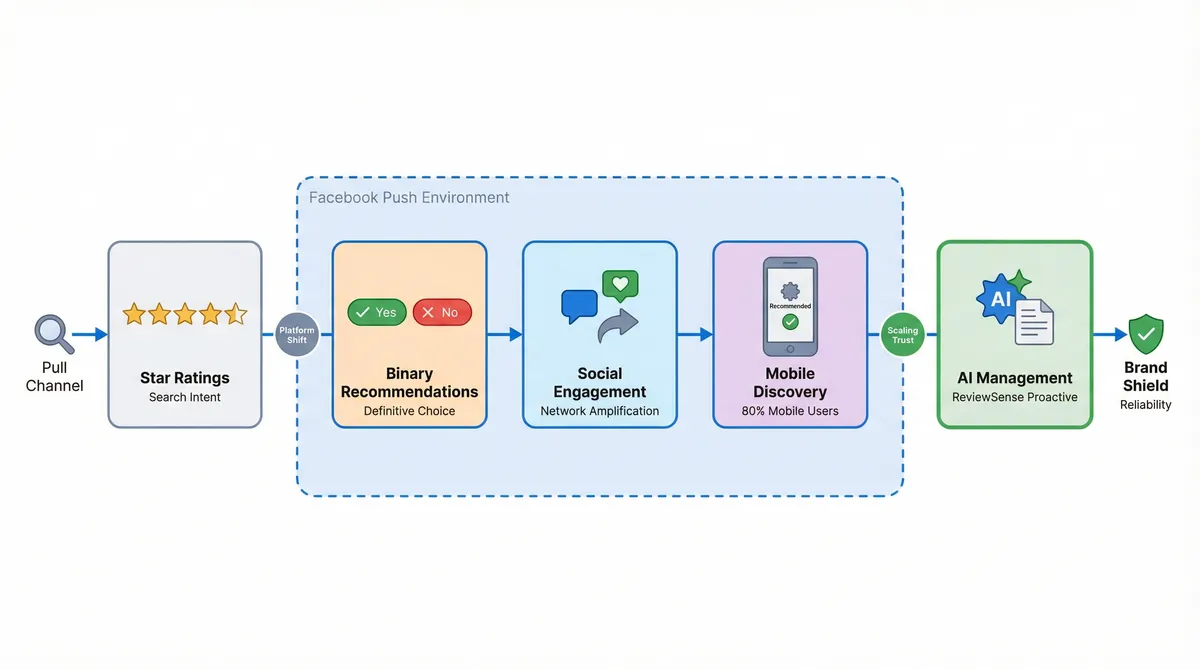
Unlike Google, where users search for specific services, Facebook operates differently. Google is a 'pull' channel driven by search intent. Facebook is a 'push' environment based on passive discovery. Users scroll through their feeds and stumble upon brand interactions. Mastering facebook review management requires understanding this shift. You aren't just answering a query; you are shaping public perception.
The platform altered how feedback works by abandoning the standard rating scale. It introduced a binary 'Yes' or 'No' recommendation model. This forces customers to make a definitive choice about your business. It removes the ambiguity of a middle-ground rating. A simple endorsement now carries significant weight in broader Customer Review Management strategies. When a user recommends a page, that action broadcasts to their network.
Because of this social effect, engagement outweighs a static score. Comments, likes, and shares amplify a positive recommendation across user feeds. This visibility is crucial. In 2025, 40% of consumers use Facebook specifically to read reviews for local businesses. They want to see how you interact with your community. A silent page won't build trust.
This social proof is visible on the go. A massive 80% of customers read reviews on mobile devices. Facebook prominently displays these recommendations in the 'About' and 'Home' tabs. If you want to capture this mobile audience, you need a proactive approach. Using an automated 5-Star Review Response Generator helps maintain active engagement. It ensures your brand voice stays consistent across every mobile interaction.
4 Proven Strategies to Master Facebook Recommendations
To capitalise on this mobile engagement, you must move beyond passive monitoring. Effective facebook review management requires a tactical approach to how you handle feedback. Implementing the right workflows turns simple recommendations into powerful drivers for customer acquisition.
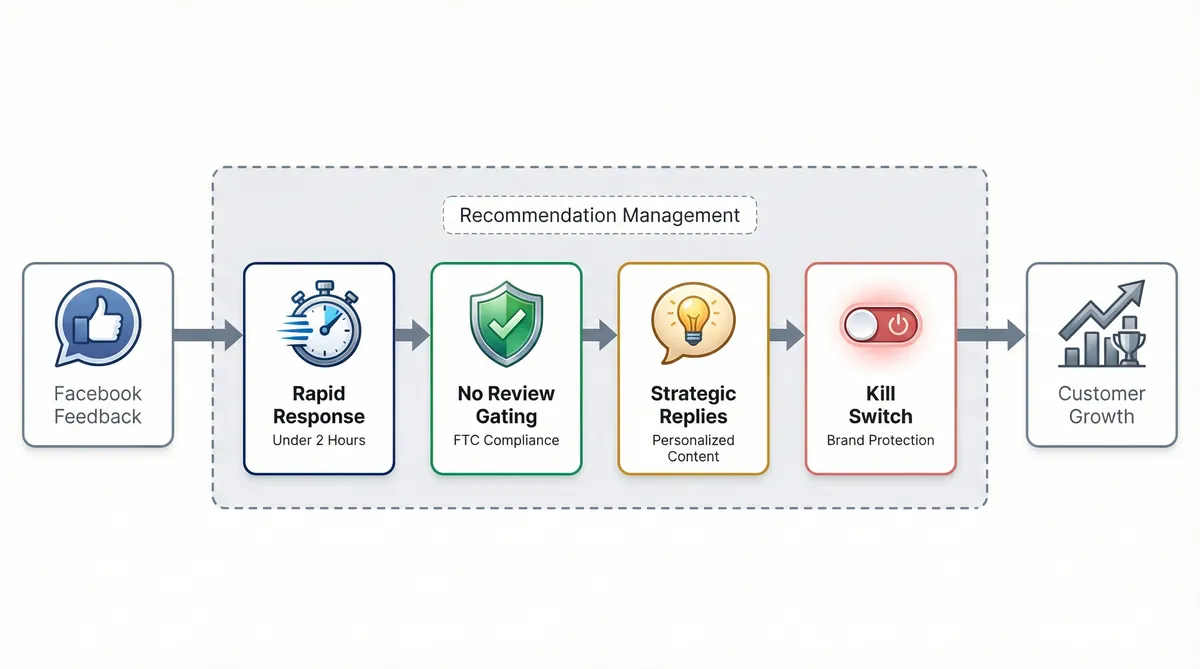
Optimise for the rapid response mandate. Speed acts as a core trust signal for modern buyers. Currently, 30% of consumers expect a same-day response, while 23% expect a response within 1–2 hours. The platform algorithm also rewards fast replies with an organic reach lift.
Eliminate review gating. Filtering out negative feedback before it reaches your page is a dangerous practice. The FTC's 2024 Rule on Consumer Reviews makes gating illegal. Violating this rule carries heavy fines. You must invite honest feedback from every customer, regardless of their initial experience.
Be strategic with your replies. Avoid answering every positive recommendation with a generic thank you. This repetitive behaviour dilutes your reach. Instead, focus on meaningful interactions. Remember that 56% of consumers report they have changed their opinion about a business based on how the business responded to a review. Conversely, only 47% would consider a business that never responds. Using dedicated Review Management Software: Key Features, Use Cases, and Selection Tips helps teams craft personalised responses.
Don't fear the kill switch. Sometimes, businesses face coordinated attacks from online trolls. Turning off recommendations temporarily during a review bomb is a smart strategy. It protects your brand reputation while you assess the situation. You can reactivate the feature once the malicious activity subsides and normal operations resume.
Case Studies: The ROI of Trust vs. The Cost of Defensiveness
Knowing when to pause recommendations is just one part of effective facebook review management. How you handle public criticism ultimately defines your brand's financial trajectory.
| Approach | Business | The Situation | The Outcome |
|---|---|---|---|
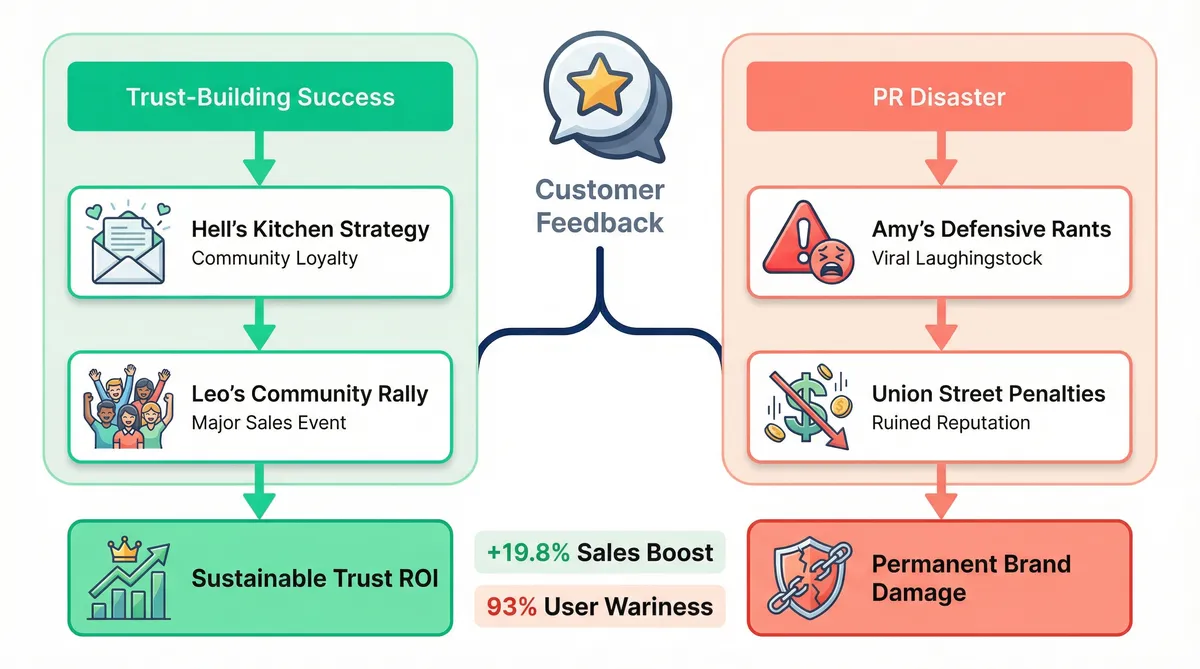
| Trust-Building Success | Hell's Kitchen | Addressed prejudiced comments with a thoughtful open letter. | Won widespread community support and deep customer loyalty. |
| Trust-Building Success | Leo's Pizza | Rallied local followers to counter a fake 1-star review bomb. | Turned a targeted crisis into a major sales event. |
| PR Disaster | Amy's Baking Company | Responded to mild criticism with expletive-laden Facebook rants. | Became a viral laughingstock and suffered permanent brand damage. |
| PR Disaster | Union Street Guest House | Fined wedding guests $500 for posting negative online reviews. | Faced massive media backlash and a ruined public reputation. |
These contrasting approaches highlight the real cost of defensiveness. Public arguments with customers damage your brand. Transparency offers a better path. Displaying authentic customer reviews on your page can boost overall sales by 19.8%.
Consumers watch your reactions under pressure. A full 93% of Facebook users are wary of dishonest feedback. They spot defensive replies with ease. Attacking critics drives potential buyers to competitors. Hostile interactions cost businesses future revenue. You must maintain a calm tone during disputes.
Using a Negative Review Response Generator helps remove emotion from the equation. It keeps replies professional during stressful moments. Smart teams rely on AI-Powered Review Management: Strategies for Streamlining Customer Feedback Oversight to monitor sentiment across platforms. This proactive approach builds trust and prevents a costly disaster. Your response strategy dictates your success.
Navigating Meta's 2026 Trust and AI Platform Updates
While maintaining a calm tone is essential during disputes, the platform itself is changing how users evaluate feedback. Effective facebook review management requires adapting to Meta's recent algorithmic shifts.
- The rollout of Community Notes: Launched in January 2026, this feature crowdsources context on misleading reviews. Brands must monitor notes attached to their content. A false claim creates a permanent warning.
- The rise of AI content labelling: With a massive portion of platform content generated by machines, users crave genuine human connection. There is a trust premium for authenticity over polish. Your replies should sound genuine. Platforms like ReviewSense help teams maintain a consistent brand voice.
- Shifting consumer habits: People consume feedback in new ways. A full 48% of consumers use AI-generated summaries to get a quick overview of a business's reputation rather than reading individual reviews. You need a steady stream of positive sentiment to influence these automated overviews.
- Enhanced Meta Verified features: Businesses gain Advanced Original Content Protection against impersonators leaving fake reviews. This secures your brand identity. It stops malicious actors from confusing your loyal customers.
These updates reflect a broader push for transparency. In fact, 37% of shoppers reported seeing fake reviews on Facebook in 2025, a 7.5% decrease from 2024 due to improved Meta moderation. Marketers are noticing the positive impact. A full 67% of marketers using Meta's social listening and review tools report a strong ROI. They rank it above TikTok and X for business growth.
Understanding these platform changes is vital. It's similar to knowing Why Google Is Deleting Your Reviews in 2026 (And How to Protect Them). You must adapt your strategy to stay visible. Proactive monitoring keeps your reputation safe.
Scaling Your Strategy with the Right Review Management Tools
Adapting to these platform changes requires moving beyond native dashboards. Managing high-volume feedback demands centralised governance. Analysts at IDC and Forrester view dedicated social media tools as essential components of the modern SMB martech stack. Relying on manual checks across multiple apps simply doesn't scale. You need a smarter approach to handle the influx of customer opinions.
Speed is now a critical ranking factor. Industry data from early 2026 suggests the Facebook algorithm gives a 7% lift in organic reach to pages that respond to comments and reviews within the first hour. Hitting this tight window is difficult for busy teams. Yet, answering a complaint on social media can increase customer advocacy by as much as 25%. You can't afford to ignore these interactions.
ReviewSense solves this rapid response challenge. It's a new, cost-effective tool priced between $19 and $149 per month, built for small businesses. The platform centralises feedback from Facebook, Google Business Profile, Apple App Store, and Google Play into one unified dashboard. This eliminates the need to switch tabs. Teams can execute effective Facebook Review Management without the usual administrative headache.
The built-in AI review Response Generator helps teams hit that crucial one-hour window. It drafts personalised replies in seconds while maintaining your specific brand voice. Sentiment analysis flags recurring issues so you can fix operational flaws. If a negative spike occurs, crisis alerts notify your team. This ensures minor complaints never escalate into public relations disasters.
Scaling your reputation strategy requires a helpful partner. ReviewSense provides the automation needed to turn scattered feedback into clear insights. You can test these workflows with a 7-day free trial. It's the easiest way to see how centralised management improves the customer experience and drives local growth.
Conclusion
Mastering Facebook review management requires adapting to Meta's evolving environment, from AI content labeling to the growing demand for rapid, authentic replies. Relying on manual checks makes it nearly impossible to hit the critical one-hour response windows that boost your organic reach. To build lasting trust online, businesses need a centralized approach that prioritizes speed without sacrificing genuine connection.
ReviewSense solves this by bringing your Facebook, Google Business Profile, Apple App Store, and Google Play feedback into a single dashboard. With built-in sentiment analysis and an AI response generator, your team can resolve issues quickly, spot recurring trends, and effortlessly maintain a consistent brand voice.
Turn scattered reviews into actionable insights that improve the customer experience and Start your 7-day free trial.