
By 2026, 78% of businesses use AI for review responses—yet most solutions miss critical sentiment analysis. Manual approaches now risk reputation damage as review volumes explode across platforms. Discover what's changed in AI review management, from hyper-personalised automated response generation to predictive reputation alerts. Learn implementation lessons and essential evaluation criteria to avoid costly mistakes.
Managing this manually is hard. ReviewSense automates it.
The Transformed Review Environment: 2026's AI-Driven Realities
As we navigate 2026's transformed feedback ecosystem, several fundamental shifts demand attention. These changes directly impact how UK businesses manage their online presence across key platforms like Google Business Profile, Facebook, and app stores. Understanding these shifts isn't optional – it's critical for maintaining visibility and trust.
| Shift | Impact on Businesses |
|---|---|
| Over 30% of reviews are fake or AI-generated, with 82% of UK consumers encountering them | Building trust requires authentic engagement and proactive reputation management |
| Review deletion rates are 4-5 times higher than early 2025 | Legitimate feedback may be removed accidentally, demanding vigilant monitoring |
| Rising star rating expectations | Top businesses now average 4.8 stars or higher, making every review critical |
| Reviews increasingly appear in AI search summaries | Customer feedback directly shapes visibility in Google's AI Overviews and tools like ChatGPT |
| Freshness significantly impacts rankings | Prompt responses and recent reviews boost local SEO performance |
Navigating Fake Reviews and Eroding Trust
Nearly one-third of online reviews now lack authenticity according to industry analysis. This surge in synthetic or fraudulent content has tangible consequences: 82% of UK shoppers encountered suspicious reviews last year. Many consumers now frequently suspect AI-generated content, creating scepticism that erodes trust. Businesses must counter this by demonstrating genuine care through personalised responses to every customer. The Online Review Management Guide offers practical strategies for building credibility in this climate.
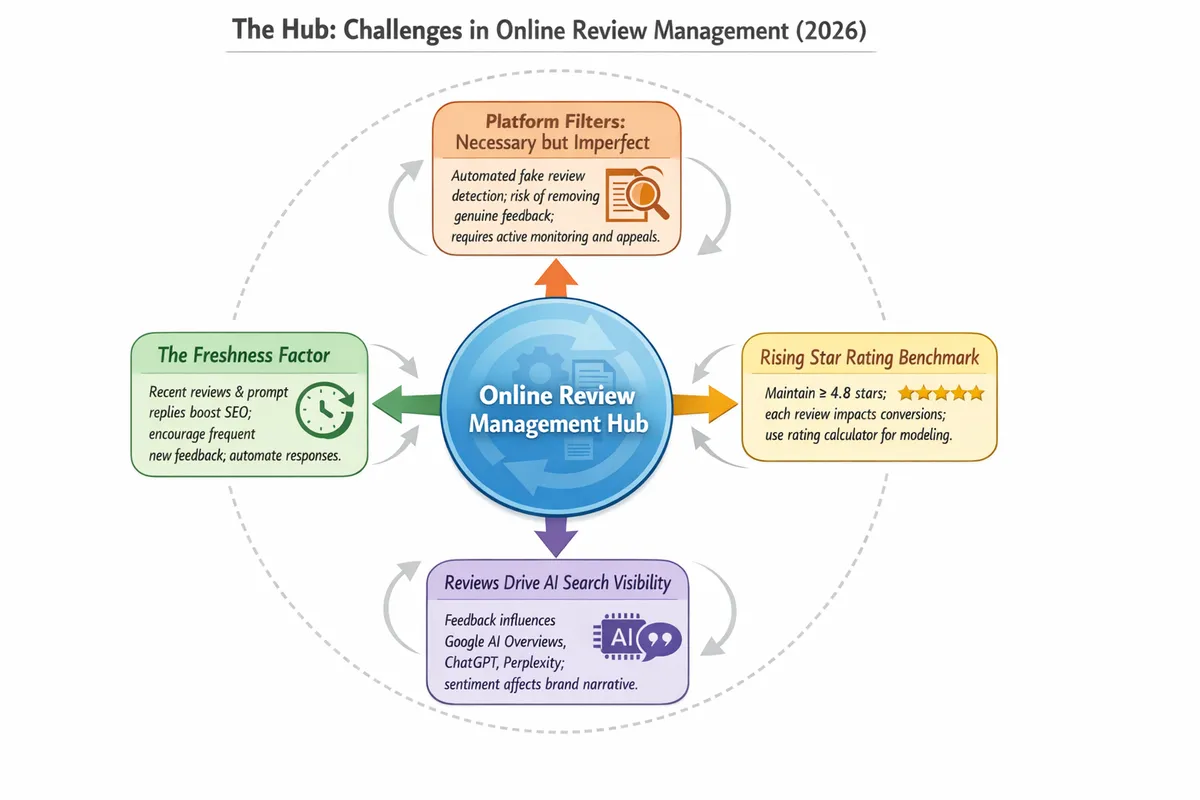
Platform Filters: Necessary but Imperfect
Google's deployment of techniques like Semantic Entropy aims to purge fake reviews. While essential, this has led to deletion rates 4-5 times higher than in early 2025. The unintended consequence? Legitimate feedback often gets caught in these automated sweeps. You'll need active monitoring to spot missing genuine reviews and, where appropriate, appeal wrongful removals. For UK-specific guidance, see our analysis of editing Google reviews. A deeper understanding of platform capabilities is available in the Google review management software investigation.
The Rising Star Rating Benchmark
Customer expectations have soared. Top-performing UK businesses now maintain averages of 4.8 stars or higher across platforms like Google Business Profile and Facebook. Falling below this threshold can directly impact conversions. Each new review carries significant weight, making consistent monitoring vital. Use our free star rating calculator to model how individual ratings affect your overall score.
Reviews Drive AI Search Visibility
Feedback now influences visibility beyond traditional search. Google's AI Overviews frequently incorporate review snippets, while conversational tools like ChatGPT and Perplexity pull from recent customer comments. This amplifies the visibility impact of both praise and criticism. Managing sentiment at scale requires efficient oversight. Explore AI-powered review management strategies to ensure your brand narrative remains prominent, and our roundup of review management software with AI review generation for the platforms that handle that volume.
The Freshness Factor
Search algorithms and AI tools prioritise recent reviews and responses. A prompt reply to feedback signals active engagement, boosting local SEO. Encouraging new reviews consistently is equally vital. Tactics like strategically placed Google review QR codes streamline the process for customers. Automated review management ensures you never miss a new review or delay a reply, maintaining that critical freshness factor.
Why Manual Approaches Fail in the AI Era
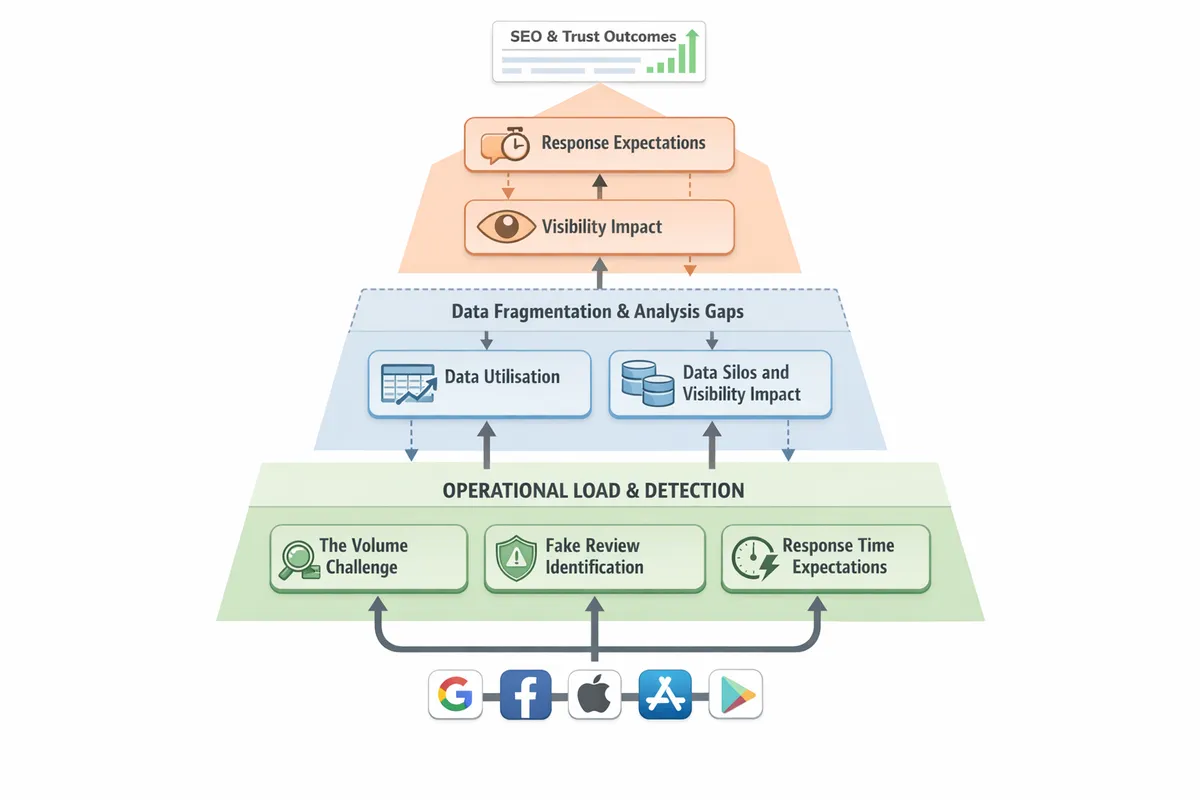
This emphasis on speed and consistency highlights why manual methods struggle in today's environment. Traditional approaches simply can't meet 2026's demands across key review management challenges:
| Challenge | Old Approach | Why It Fails Now |
|---|---|---|
| Review Volume & Speed | Checking platforms individually at set intervals | Real-time monitoring across Google, Facebook and app stores is impossible manually, causing missed feedback and delayed responses |
| Fake Review Detection | Staff spotting suspicious language patterns | Nearly half (48%) of consumers encounter AI-generated reviews often; human spotting can't match AI's pattern recognition at scale |
| Response Expectations | Replying within 24 hours | 72% lose trust if they suspect AI involvement, demanding authentic yet instant replies manual methods can't deliver |
| Data Utilisation | Siloed in spreadsheets or platform dashboards | Isolated data prevents spotting trends; feedback must feed directly into business intelligence systems |
| Visibility Impact | Focused on social proof for customers | Reviews now train AI search tools; slow responses or fake content risk Google penalties and damage rankings |
The Volume Challenge
Manually checking Google Business Profile, Facebook, Apple App Store and Google Play daily is unrealistic for most UK teams. Important feedback gets buried, especially during peak periods. Delayed responses directly impact SEO, as freshness significantly influences local rankings. Without automated alerts, negative reviews linger publicly for hours or days.
Fake Review Identification
With sophisticated AI-generated reviews now common, human moderators face an impossible task. Research shows only 31% of consumers completely trust online reviews, while 42% distrust them. Manual spotting can't consistently identify the patterns that give a fake review away across platforms, or detect coordinated attacks. This leaves themselves vulnerable to reputation damage and potential Google sanctions. Our guide on appealing Google Business Profile suspensions details these risks.
Response Time Expectations
The 24-hour response window is obsolete. Consumers expect acknowledgement within hours, especially for negative feedback. Yet 72% become sceptical if replies feel AI-generated. Manual teams struggle to craft personalised, brand-aligned responses quickly across all platforms. This is particularly challenging for app developers needing platform-specific approaches, as covered in the Google Play review management.
Data Silos and Visibility Impact
Manually collating feedback from four separate sources creates blind spots. Teams miss recurring issues mentioned across Google reviews and Facebook comments. More critically, reviews now directly influence AI search summaries. Slow responses or fake content can demote your visibility beyond traditional SEO, making integrated analysis essential rather than optional.
Essential Components of Modern Review Management
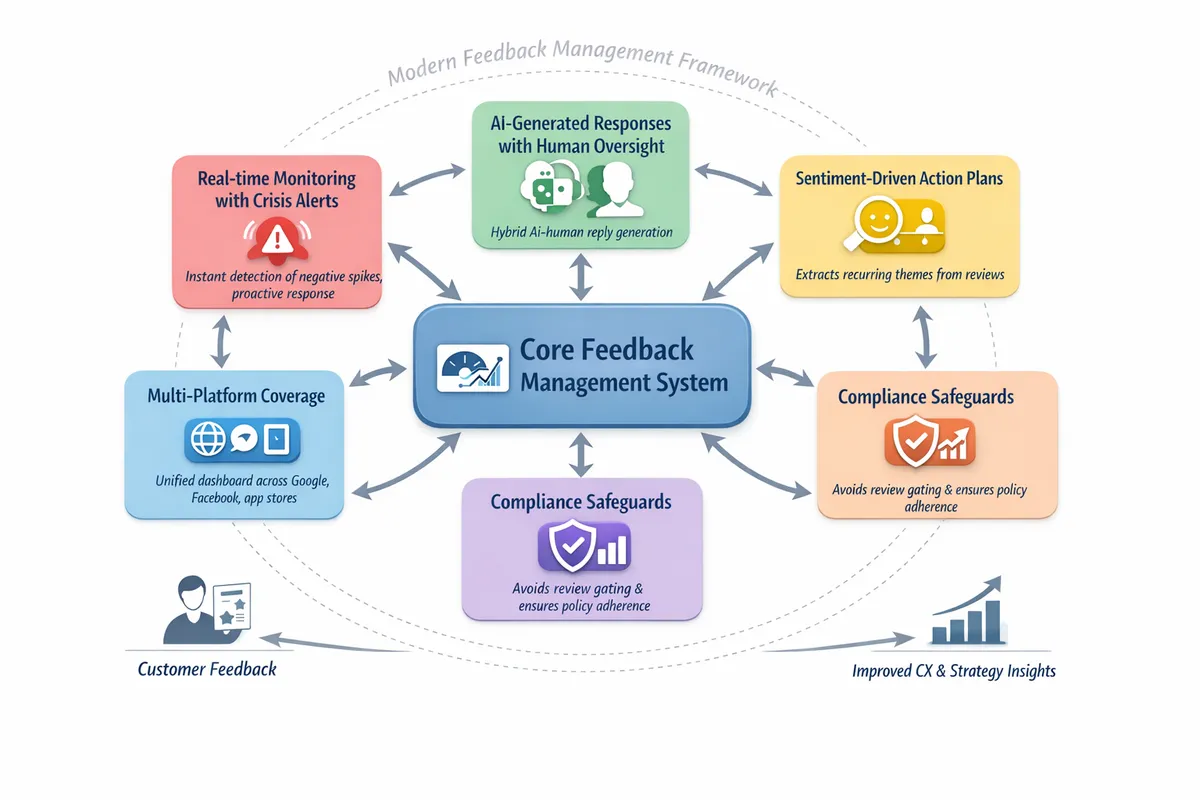
To overcome these hurdles, UK businesses need a modern review management framework built on six core components:
| Component | Why It Matters | Key Capability |
|---|---|---|
| Real-time Monitoring | Google's AI filtering caused a 600% surge in review deletions in 2026. Missing genuine feedback or negative spikes can harm reputation. | Instant alerts for new reviews/deletions with crisis notifications. |
| AI-Generated Responses | ChatGPT references reviews in 58% of responses; Perplexity uses them in 100%. Slow replies damage visibility. | AI drafts with human editing for brand voice. |
| Sentiment Analysis | 41% of UK shoppers skip AI summaries to read individual reviews. Manual issue spotting fails at scale. | Topic extraction for CX improvements. |
| Multi-Platform Coverage | Feedback fragments across four key platforms. Manual checks miss insights. | Unified dashboard for Google, Facebook, App Stores. |
| Compliance Safeguards | Review gating risks platform penalties. Fake content causes suspensions. | Workflows preventing policy breaches. |
| BI Integration | Siloed data hides trends. Feedback must drive decisions. | Export to tools like Power BI. |
Real-time Monitoring with Crisis Alerts
Google's aggressive filtering increased deletions by 600% in local sectors. Instant notifications ensure you never miss critical feedback. Crisis alerts flag sudden negative spikes, letting teams address issues before they escalate. This protects reputation and prevents minor complaints becoming major incidents.AI-Generated Responses with Human Oversight
With conversational AI using reviews in 58-100% of responses, your replies directly influence search visibility. AI drafting accelerates responses, but human oversight maintains authenticity and brand alignment. This hybrid approach prevents robotic replies while scaling efforts. Test this balance using the negative review response generator or explore free AI response methods.Sentiment-Driven Action Plans
Over two-fifths (41%) of shoppers ignore AI summaries to read full reviews. Automated sentiment analysis extracts recurring themes – like delivery delays or product faults – from this detailed feedback. This highlights actionable CX improvements, turning raw data into retention-boosting fixes.Multi-Platform Coverage
Centralising Google Business Profile, Facebook, and both app stores prevents feedback silos. A unified dashboard ensures you catch every review, whether it's a complaint on Google or feature request on the App Store. For platform-specific nuances, the App Store review management guide details best practices.Compliance Safeguards
Automated workflows must avoid review gating and fake content to prevent platform penalties. Human checks on AI-generated responses ensure compliance with evolving policies. This protects your profiles while maintaining ethical standards.Integration with Business Intelligence Tools
Feeding review sentiment and topics into BI tools like Tableau uncovers trends that inform strategy. This closes the feedback loop, ensuring customer voices directly impact product development and service improvements. Discover implementation tactics in the AI-powered management strategies. Solutions like ReviewSense streamline this data flow.
Lessons from Implementation: Successes and Pitfalls
Implementing AI review management requires balancing automation with human judgment, as these real-world cases demonstrate:
| Case | Outcome | Key Lesson |
|---|---|---|
| Vendasta/Xcite Group | 100% retention via AI-human collaboration | Human oversight ensures authenticity |
| Birdeye | 128% review growth with multi-platform agents | Centralisation drives volume |
| Sprinklr/Planet Fitness | 20-point NPS boost via AI alerts | Real-time alerts enable quick action |
| Rytr | FTC action over fake reviews | Compliance is non-negotiable |
| Dental clinic | Ranking suppression from IP clustering | Authentic engagement matters |
Vendasta/Xcite Group maintained perfect client retention by pairing AI-generated responses with human editors. Staff added personal touches to automated drafts, preserving brand voice while scaling responses. This hybrid model reflects how stakeholder trust in AI's helpfulness grew 4.6% recently. Their approach avoided robotic replies that damage credibility.
Birdeye achieved 128% review growth by deploying platform-specific collection strategies. They used customised review requests across Google, Facebook and app stores, centralising feedback in one dashboard. This multi-channel approach directly contributed to visibility gains, with 65% of companies improving AI visibility through active review showcasing. Generating authentic reviews ethically is covered in the review request email generator.
Sprinklr/Planet Fitness lifted NPS by 20 points using instant alerts for negative feedback. Their AI flagged urgent Google and App Store reviews, enabling staff to resolve issues within hours. Speed matters as 34.5% of Google AI Overviews now reference review platforms. Learn platform-specific tactics in the App Store review management guide.
Rytr's FTC penalty for generating fake reviews underscores compliance risks. Automated systems must never create or incentivise inauthentic content. UK businesses should verify all AI outputs and follow guidelines in the fake Google reviews removal guide to avoid sanctions.
A UK dental clinic suffered Google ranking suppression after sending review requests from a single IP address. This clustered activity triggered algorithmic penalties, proving authentic review generation is essential. The Google review QR code guide shows compliant methods to collect genuine feedback. For response quality, test drafts with the 5-star review response generator.
These cases prove AI review management succeeds when combining automation with human ethics. Centralised platforms prevent compliance missteps while accelerating genuine engagement.
Evaluating AI Review Solutions: Critical Criteria
Given the lessons from real-world implementations, selecting the right AI review management platform demands careful scrutiny of specific capabilities (our AI review management tools comparison breaks down the leading options side by side). The market for these tools is growing rapidly, projected to nearly double from $3.77 billion in 2025 to $7.75 billion by 2034. This table outlines critical evaluation criteria for UK businesses:
| Criteria | Must-Have Features | Differentiators (Advanced Value) |
|---|---|---|
| Platform Coverage | Centralised monitoring for Google Business Profile, Facebook, and both app stores. Avoid solutions that omit key UK platforms. | Support for niche industry platforms or custom source integration. |
| Human-AI Workflow | AI-generated draft responses with mandatory human approval queues. Ensures brand alignment and avoids robotic tone. | Customisable brand voice training and multi-level approval chains for enterprises. |
| Sentiment Analytics | Real-time alerts for negative spikes and trend tracking for key topics (e.g., delivery, service). | Predictive analytics identifying emerging issues before they escalate. |
| Compliance | Automated toxicity filters, spam detection, and anti-gating safeguards to prevent platform penalties. | Built-in compliance reporting for regulated industries (e.g., finance, healthcare). |
| Scalability | Role-based permissions and multi-location dashboards. Essential for agencies or chains. | White-label reporting and custom API integrations for enterprise ecosystems. |
| Transparency | Clear pricing without hidden fees. Avoid vendors claiming unverified partnerships or awards. | Independent verification of AI accuracy and data security certifications (e.g., ISO 27001). |
Platform Coverage: Beyond the Basics
Your solution must aggregate reviews from Google, Facebook, Apple App Store, and Google Play – the dominant UK feedback sources. Centralisation prevents critical insights being lost across platforms. For multi-location operations, verify location-specific monitoring capabilities. The Apple App Store review management software guide details platform-specific nuances.
Human Oversight in AI Responses
While AI accelerates reply drafting, human approval queues remain essential. Many consumers distrust purely automated interactions. Mandatory review ensures responses reflect your brand's tone and comply with policies. This hybrid approach maintains authenticity while scaling efforts. Learn workflow best practices in the Online Review Management Guide.
Actionable Analytics Essentials
Basic sentiment analysis isn't enough. Seek tools that convert data into action through crisis alerts for rating drops and trend visualisation. Track whether response improvements actually boost ratings using the Star Rating Calculator. Prioritise platforms that highlight recurring CX issues like delivery problems or staff interactions. If you are drawing up a shortlist against these criteria, our comparison of the best AI-powered reputation management software for 2026 applies them platform by platform.
Compliance Non-Negotiables
Automated workflows must include toxicity filters and anti-gating safeguards. UK businesses face strict Advertising Standards Authority (ASA) regulations around review solicitation. Solutions should automatically flag policy violations before publication. For Google-specific compliance, reference the step-by-step UK business guide.
Scaling Without Friction
Verify role-based access controls for teams and client-facing features if you're an agency. Multi-location businesses need consolidated reporting with location-level filtering. Enterprise users should prioritise API connectivity with existing CRM or BI tools.
Transparency Matters
Demand clear pricing structures without hidden costs. Be wary of vendors exaggerating capabilities or fabricating data partnerships. ReviewSense offers straightforward transparent pricing and avoids unverified claims. Always test platforms through free trials before commitment.
Conclusion
In 2026, modern review management demands centralised control across Google, Facebook, and app stores, human-supervised AI responses to preserve authenticity, and analytics that convert feedback into CX improvements. Compliance safeguards and scalable workflows are non-negotiable for reputation protection. ReviewSense meets these requirements by unifying fragmented reviews from key platforms, enabling teams to detect urgent issues through real-time sentiment alerts while maintaining brand integrity with AI-drafted, human-approved responses. Transform scattered feedback into actionable growth drivers without hidden costs or compliance risks. Start your 7-day free trial