
Nearly a third of all online reviews are estimated to be fake, and 49% of consumers believe there are too many of them. That trust gap is a direct threat to your bottom line, because In 2026, simply collecting reviews isn't enough — you need a platform that proves authenticity and manages the entire lifecycle.
If you're evaluating your options, the guide on choosing the right customer review management software for multi-platform businesses is a great place to start. The platforms that win in this climate are those that help you respond at scale, filter out noise, and surface real customer voices. This list breaks down the best review management platforms for ecommerce 2026 — tools that turn scepticism into sales. If you sell direct rather than through marketplaces, our companion piece on review management platforms for DTC retail applies the same criteria to owned storefronts.
Managing this manually is hard. ReviewSense automates it.
Why Ecommerce Review Management Is Non-Negotiable in 2026
That shift in consumer behaviour makes one thing clear: online reviews are now the backbone of purchase decisions. Recent research shows that between 96% and 98% of shoppers read reviews before buying. For ecommerce brands, this statistic isn't just interesting — it's a direct line to revenue. Yet the environment has grown more complex. A significant portion of online reviews are now suspected to be fake, and nearly half of consumers believe there are too many fabricated ratings to trust what they see. Add to that the fact that 46% of shoppers are suspicious of AI-generated content, and you have a genuine trust crisis.
The operational reality
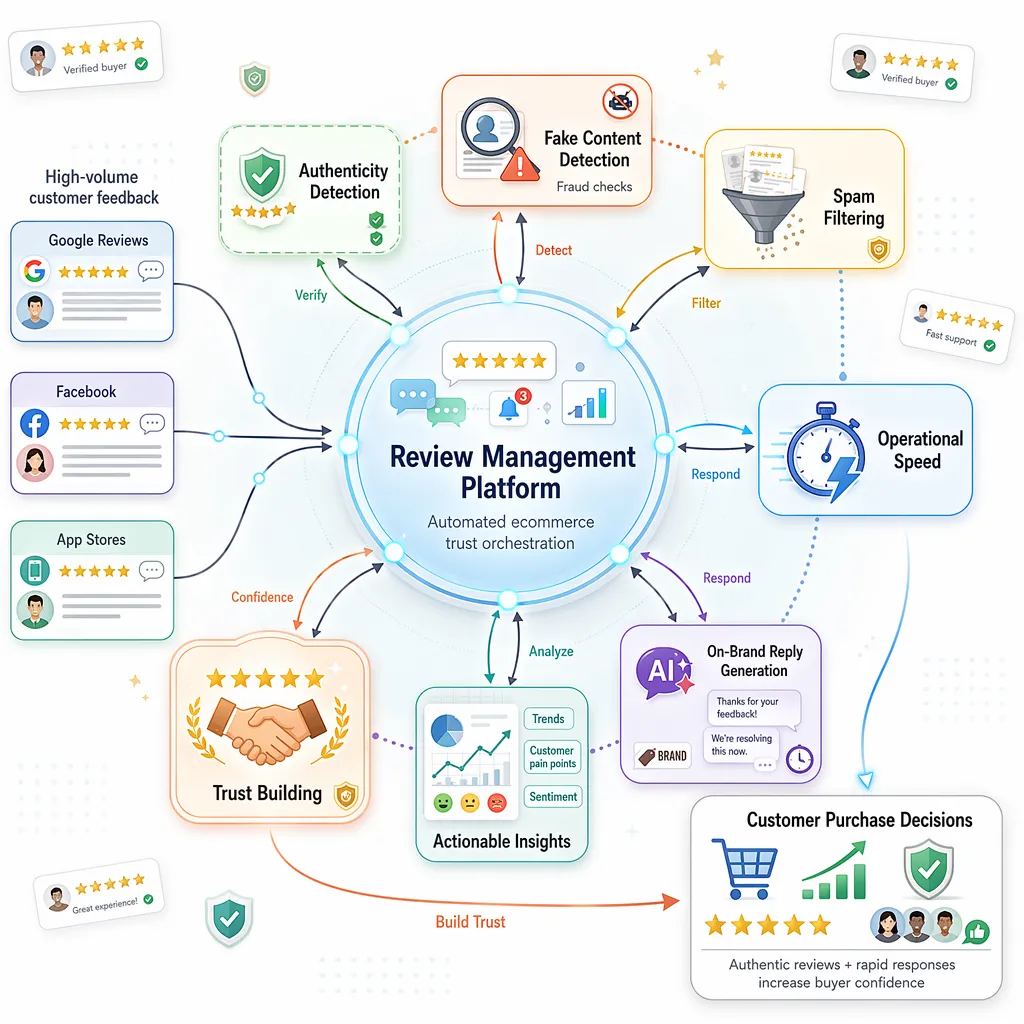
Review management is no longer a nice-to-have. It's a core part of the ecommerce tech stack. Businesses that ignore this risk losing customers to competitors who respond quickly and authentically. The challenge is scale. A single brand can receive hundreds of reviews across Google Business Profile, Facebook, and app stores each month. Manually replying to each one, spotting trends, and filtering spam becomes impossible without the right tools.
What this article covers
This article compares the best review management platforms for ecommerce 2026. We'll focus on how each solution tackles the twin problems of authenticity and operational speed. You'll learn which platforms help you detect fake content, generate on-brand replies in seconds, and surface actionable insights from customer feedback. The goal is to help you choose a system that builds trust, not just manages noise.
For a deeper look at how to measure your current performance, read the guide on understanding 10-star rating calculators. And if you're evaluating software options, the investigation into Google review management software capabilities provides a useful benchmark. The best review management platforms for e-commerce 2026 will need to do more than collect stars — they must restore buyer confidence at scale.
What to Look for in a Modern Review Platform
Building on that need for trust and speed, choosing the right tool requires a clear checklist. Here is what separates a modern review platform from an outdated one.
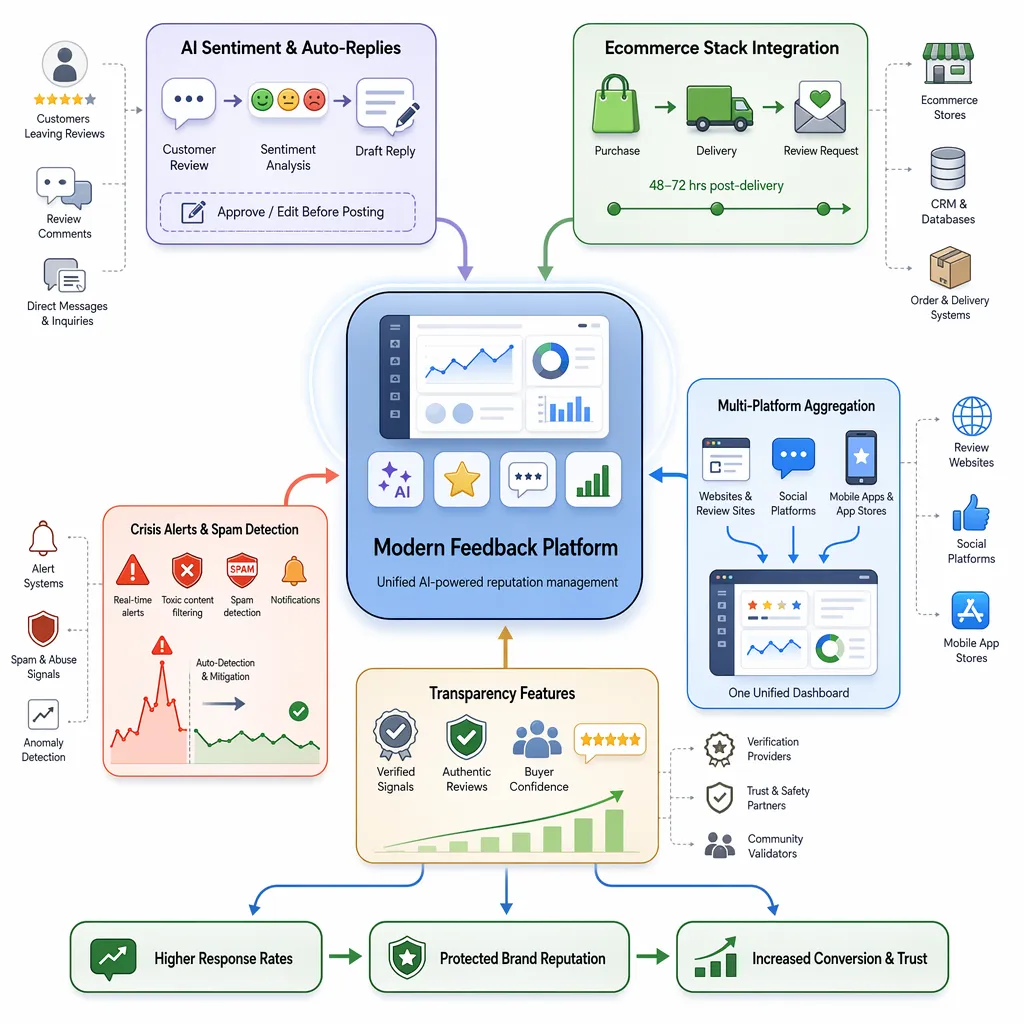
| Criterion | Why It Matters |
|---|---|
| AI sentiment & auto-replies | Saves hours and keeps your brand voice consistent |
| Ecommerce stack integration | Triggers review requests at the right moment |
| Multi-platform aggregation | One dashboard for Google, Facebook, and app stores |
| Crisis alerts & spam detection | Protects reputation before damage spreads |
| Transparency features | Builds buyer confidence with verified signals |
1. AI-driven sentiment analysis and response generation
Most businesses still reply to fewer than 5% of reviews. That is a missed opportunity. A modern platform uses AI to analyse sentiment and generate replies that match your brand voice. You can approve or edit before posting. This turns a manual chore into a scalable process. Recent industry research confirms that displaying reviews can increase conversion rates by up to 270% for products with five or more reviews. Responding well amplifies that effect.
2. Deep integration with your ecommerce stack
A review request sent two weeks after delivery feels irrelevant. The best platforms connect directly to Shopify, BigCommerce, or your CRM. They trigger requests 48 to 72 hours post-delivery, when experience is fresh. Context matters — a nappy brand should not ask for a review the same day a customer buys baby wipes. Smart timing improves response rates and data quality.
3. Multi-platform aggregation from supported sources
Your customers leave feedback on Google Business Profile, Facebook, and app stores. A modern platform pulls all of that into one dashboard. You avoid logging into four different sites. For help with specific channels, see the Facebook Review Management guide and the Google Play review management post.
4. Crisis alerting and spam detection
One negative spike can tank your rating. Good platforms flag unusual activity in real time. They also detect spam and toxic content automatically. This lets your team focus on genuine feedback that impacts reputation and retention.
5. Transparency features that build trust
A "verified buyer" badge is losing its power to reassure. Most platforms define "verified" as someone who placed an order, not someone who actually used the product, and shoppers have caught on. The platforms that build real trust counter this by showcasing context-rich user-generated content — photos, videos, and specific use-case details — rather than generic star ratings, and by letting you display negative reviews openly instead of hiding them behind moderation.
How Top Platforms Address Core Pain Points
Building on that checklist, let's examine how the best platforms tackle the real operational headaches ecommerce teams face daily. The table below maps common pain points to the capabilities that solve them.
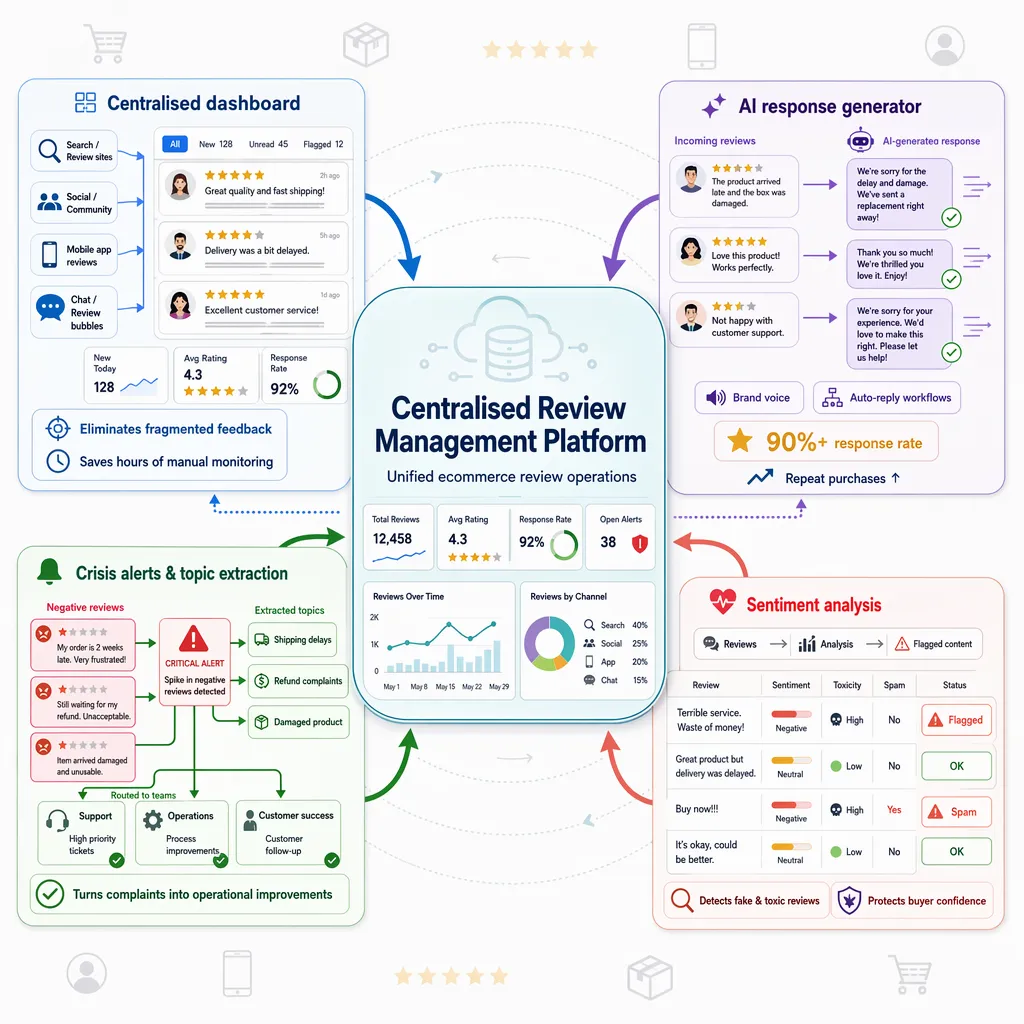
| Pain Point | Platform Approach | Why It Matters |
|---|---|---|
| Fragmented feedback across channels | Centralised dashboard aggregating reviews from Google, Facebook, and app stores | Eliminates data silos and saves hours of manual monitoring |
| Slow response times damaging reputation | AI response generator with brand voice customisation and auto-reply workflows | Enables 90%+ response rates, linked to 18% higher repeat purchases and 35% more organic impressions |
| Fake reviews eroding trust | Built-in sentiment analysis flags toxic content and spam | Protects brand credibility and complies with consumer demand for authenticity |
| Inability to act on negative feedback | Crisis alerts and topic extraction route issues to support teams | Turns complaints into operational improvements |
These capabilities define the best review management platforms for ecommerce 2026. Let's dig into two of the most critical rows.
Tackling the trust gap head-on
Roughly 30% of online reviews are estimated to be fake, and 49% of consumers believe there are too many fake reviews online. That's a direct threat to your conversion rate. A strong platform uses sentiment analysis to detect spam and toxic content automatically. It flags suspicious patterns before they damage your rating. This isn't just about protecting your score — it's about protecting buyer confidence. For a deeper look at managing this across channels, see the Customer Review Management guide.
Speed that drives revenue
Slow responses signal indifference. Modern platforms solve this with AI response generators that match your brand voice. You can set auto-reply rules for common scenarios. This lets you hit response rates above 90%. The payoff is real: faster replies drive repeat purchases and boost organic visibility. If you're new to this, the guide on AI Review Response Generators to Improve Customer Communication is a good starting point. The best review management platforms for e-commerce 2026 make speed a competitive advantage, not a burden.
Comparison Criteria for Selecting Your Solution
Speed and integration matter, but the real test of a platform lies in three less obvious metrics. First, actual response rate. Top tools push response rates above 35%, while the industry average languishes near 2-3%. That gap signals whether a platform truly drives action or just collects dust. Second, depth of integration. Does the platform natively connect to your ecommerce platform and CRM? A shallow link that only pulls order data is useless. You need a system that triggers review requests 48-72 hours after delivery, when the experience is still fresh. Third, send timing logic. The best platforms let you set rules based on delivery status, not just purchase date. This precision maximises conversion rates.
Here is the contrarian take: a 5.0-star rating is a red flag. Consumers are savvy. Consequently, 46% of shoppers are suspicious of reviews that appear to be AI-generated. The most trusted brands lean into the 4.2-4.7 range. That band signals authenticity. It shows you have real customers with real opinions, not a curated facade. A platform that helps you embrace that range, rather than chase perfection, builds deeper trust.
The platform should also operationalise negative feedback. Sentiment data must feed directly into product and logistics teams. When a customer complains about late delivery, that insight should trigger a logistics review, not just a polite reply. This turns complaints into improvements. Tools like ReviewSense offer built-in sentiment analysis that flags recurring issues, helping teams act fast. For a deeper look at managing app store feedback, see the guide on App Store Review Management.
These criteria separate the tools that merely collect reviews from those that drive real business change. They help you identify the best review management platforms for e-commerce 2026.
Making the Right Choice for Your Business
The criteria above separate tools that merely collect reviews from those that drive real change. Now comes the hard part: choosing the right platform for your specific ecommerce operation. The table below distills the decision into five actionable steps.
| Step | Action | Why It Matters |
|---|---|---|
| 1 | Audit your current pain points—is it response speed, trust, or data silos? | Identifies the root problem before you evaluate solutions |
| 2 | Prioritise platforms that integrate with your existing tech stack (e.g., Shopify, BigCommerce, CRM) | Ensures review data flows into workflows you already use |
| 3 | Look for AI that summarizes and categorizes feedback, not just auto-responds | Human empathy still wins; AI should augment, not replace, your team |
| 4 | Demand transparency features: verified buyer signals, ability to display negative reviews, and spam detection | Builds genuine trust with shoppers who can spot a curated facade |
| 5 | Test with a free trial or demo to evaluate actual response rates and ease of use | Reveals whether the platform drives action or just collects dust |
Start with your pain points
Every ecommerce team has a different bottleneck. Maybe you're drowning in manual replies across Google and Facebook. Perhaps fake reviews are eroding buyer confidence. Or your data sits in silos that nobody reads. That gap is your opportunity. A platform like ReviewSense centralises feedback from Google, Facebook, and app stores, then surfaces the insights your team actually needs.
Demand transparency and real integration
Don't settle for a tool that just auto-replies. The best review management platforms for ecommerce 2026 verify buyer signals, display negative reviews openly, and detect spam automatically. They also connect natively to your CRM and ecommerce platform. If you're managing a duplicate Google Business Profile, check the guide on how to merge without losing reviews. For app store feedback, see the Google Play review management resource.
Test before you commit
A free trial reveals the truth. Does the platform actually improve your response rate? Is the AI response generator easy to customise? Does sentiment analysis flag real issues? The best review management platforms for ecommerce 2026 turn scattered feedback into actionable insights that improve customer experience and drive growth.
Conclusion
Choosing the right review management platform for your ecommerce business comes down to three things: bridging the response gap, building authentic trust through transparency, and turning negative feedback into operational improvements. The best platforms don't just collect reviews—they centralise feedback from Google, Facebook, and app stores, surface actionable sentiment, and help you respond with speed and consistency. Tools that verify buyers, display negative reviews openly, and flag recurring issues will earn genuine shopper trust and drive long-term growth. Don't settle for a tool that merely auto-replies. Turn scattered reviews into actionable insights that improve customer experience and drive growth. Start your 7-day free trial