
Can your agency efficiently monitor 500+ client reviews daily across Google, Facebook, and niche platforms? Manual tracking becomes unsustainable as client portfolios grow, risking missed feedback and inconsistent branding. Centralised solutions prevent reputation blind spots while enabling scalable response workflows. For foundational insights, see the comprehensive software selection guide covering core functionalities.
Managing this manually is hard. ReviewSense automates it.
The Growing Imperative of Review Management Solutions
As agencies navigate escalating client demands, the reputation management sector's explosive growth creates both opportunity and operational pressure. Consider these pivotal shifts reshaping agency service delivery:
| Trend | Impact on Agencies |
|---|---|
| Market value surging to $33.45bn by 2030 | Rising client expectations for comprehensive review monitoring across platforms |
| SME sector expansion | Increased demand from smaller businesses needing affordable reputation solutions |
| Consumer reliance on digital reviews | Higher stakes for reputation protection; slow responses damage client revenue |
Recent analysis by Research and Markets confirms the online reputation management market will reach $33.45 billion by 2030, expanding at 14.4% annually. This trajectory stems from fundamental changes in consumer behaviour. People increasingly trust online reviews as much as personal recommendations when choosing service providers. A single negative review visible on Google Business Profile or Facebook can deter potential customers. For agencies managing multiple clients, this creates critical operational challenges. Manual monitoring of Google Play, Apple App Store, Facebook and Google reviews across dozens of locations becomes impractical. Important feedback gets missed in the noise. Response delays frustrate clients and damage their conversion rates.
The SME sector's growing dominance intensifies these pressures. Small businesses now represent the largest segment needing reputation support. They often lack dedicated marketing teams yet face intense local competition. These clients expect agencies to provide cost-effective, real-time review management. Without centralised tools, your team wastes hours jumping between platforms. Valuable insights from sentiment patterns get overlooked. Negative feedback escalates before you can intervene. This inefficiency caps how many clients one account manager can handle effectively.
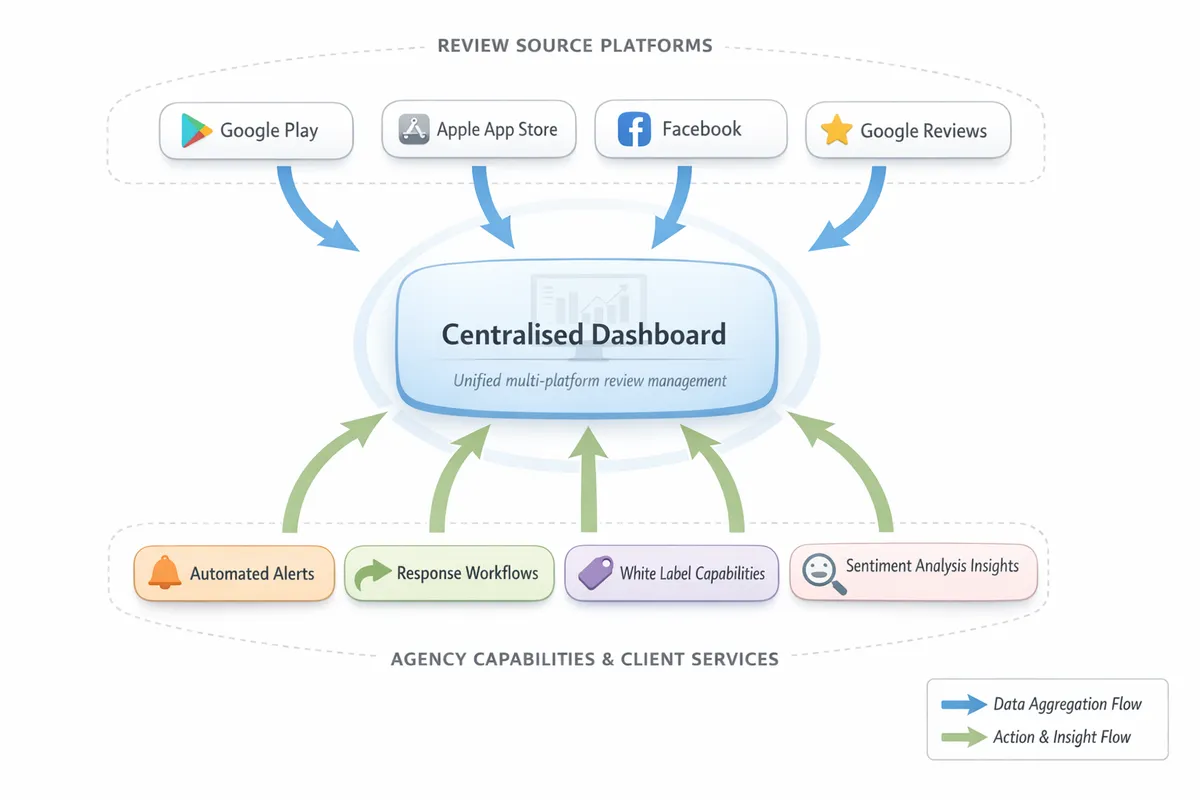
Forward-thinking agencies now treat review management as a core revenue stream, not an add-on. Scalable software solutions allow teams to monitor all supported platforms through one dashboard. Automated alerts for new reviews prevent critical feedback from slipping through. Response workflows ensure timely, brand-consistent replies that mitigate reputation risks. Crucially, platforms with white label review management capabilities let agencies embed these tools within their own service branding. This strengthens client retention while creating efficient operational workflows. Understanding these tools' capabilities helps agencies maximise ROI, as explored in the Google review management software investigation.
Proactive reputation management directly impacts client retention and acquisition. Effective strategies transform reviews into retention tools, as detailed in our guide to building trust through customer review management. Agencies adopting specialised software now position themselves for sustainable growth amid this expanding market.
Critical Scaling Challenges for Marketing Agencies
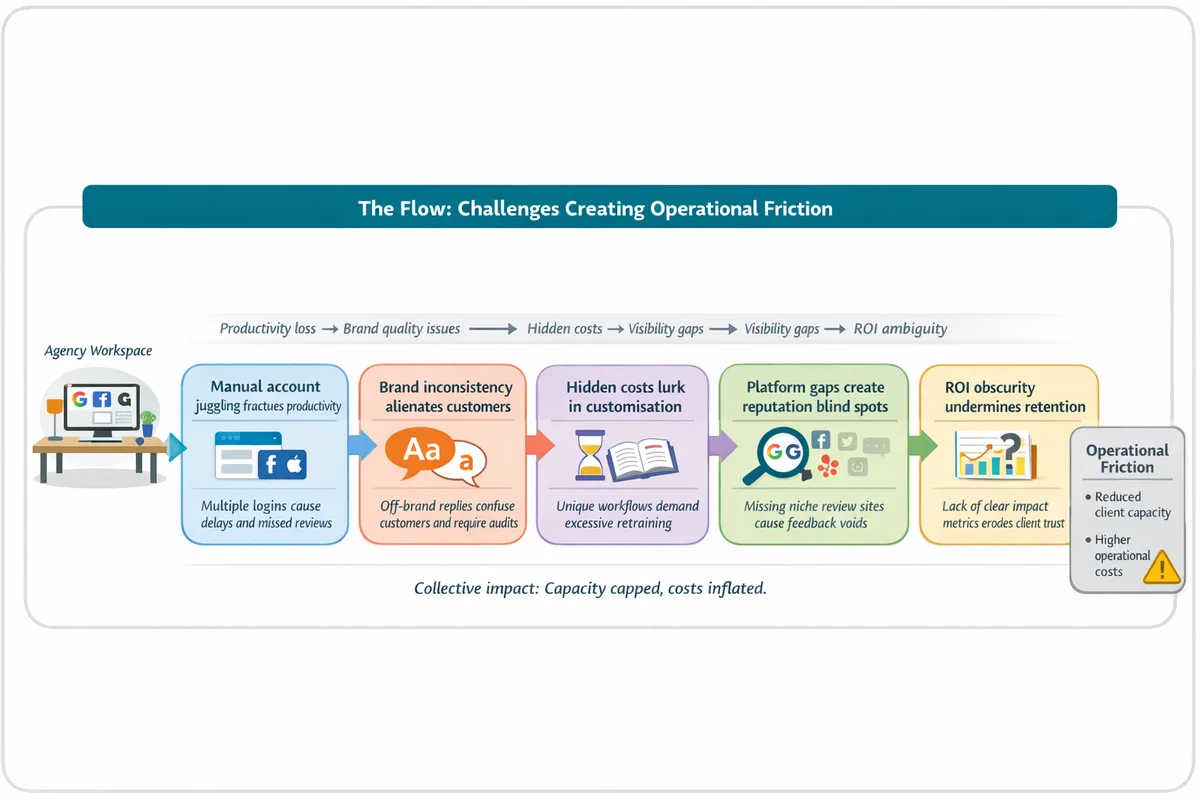
As agencies position themselves to capitalise on reputation management market growth, they face distinct scaling barriers that threaten profitability. Manual processes quickly become unsustainable when handling multiple clients, creating five critical constraints:
| Challenge | Impact on Agency Scalability |
|---|---|
| Manual account switching | Wastes 15+ hours weekly per team member on login chaos |
| Inconsistent brand voice | Damages client reputation and requires costly rework |
| Hidden training costs | Erodes margins through endless customisation requests |
| Platform blind spots | Misses critical feedback on unsupported review sources |
| Unclear ROI reporting | Hinders client retention and service upselling |
These challenges create tangible operational friction:
Manual account juggling fractures productivity Research confirms teams waste hours daily switching between client logins for Google Business Profile, Facebook, and app stores. This fractured workflow causes missed reviews and delayed responses. One study found agencies without centralised dashboards respond 47% slower to negative feedback.
Brand inconsistency alienates customers Without templated response systems, junior staff often send off-brand replies that misrepresent client voice. This inconsistency confuses customers and forces senior staff to audit every interaction. Such rework consumes 30% of project time according to agency efficiency audits.
Hidden costs lurk in customisation While bespoke workflows seem appealing, they demand unsustainable training hours. Each client's unique approval chains and reporting formats require constant retraining. This hidden drain prevents account managers from handling more than 8-10 clients effectively.
Platform gaps create reputation blind spots Solutions limited to only four platforms (Google, Facebook, Apple App Store, Google Play) miss niche industry sites. For example, hospitality clients need Tripadvisor monitoring while trades rely on Checkatrade – creating dangerous feedback voids. Our guide on choosing multi-platform review software explores this limitation.
ROI obscurity undermines retention Without clear metrics showing how review management boosts bookings or ratings, clients question service value. This is critical since reviews directly influence nearly all purchase decisions. Platforms lacking white-label analytics dashboards struggle to demonstrate impact during quarterly reviews.
Collectively, these barriers cap client capacity while inflating operational costs. Agencies overcoming them through integrated solutions unlock true scalability – transforming review management from a time sink into a profit centre. For strategies addressing these pain points, see our analysis of AI-powered review management efficiencies.
Essential Capabilities for Multi-Client Operations
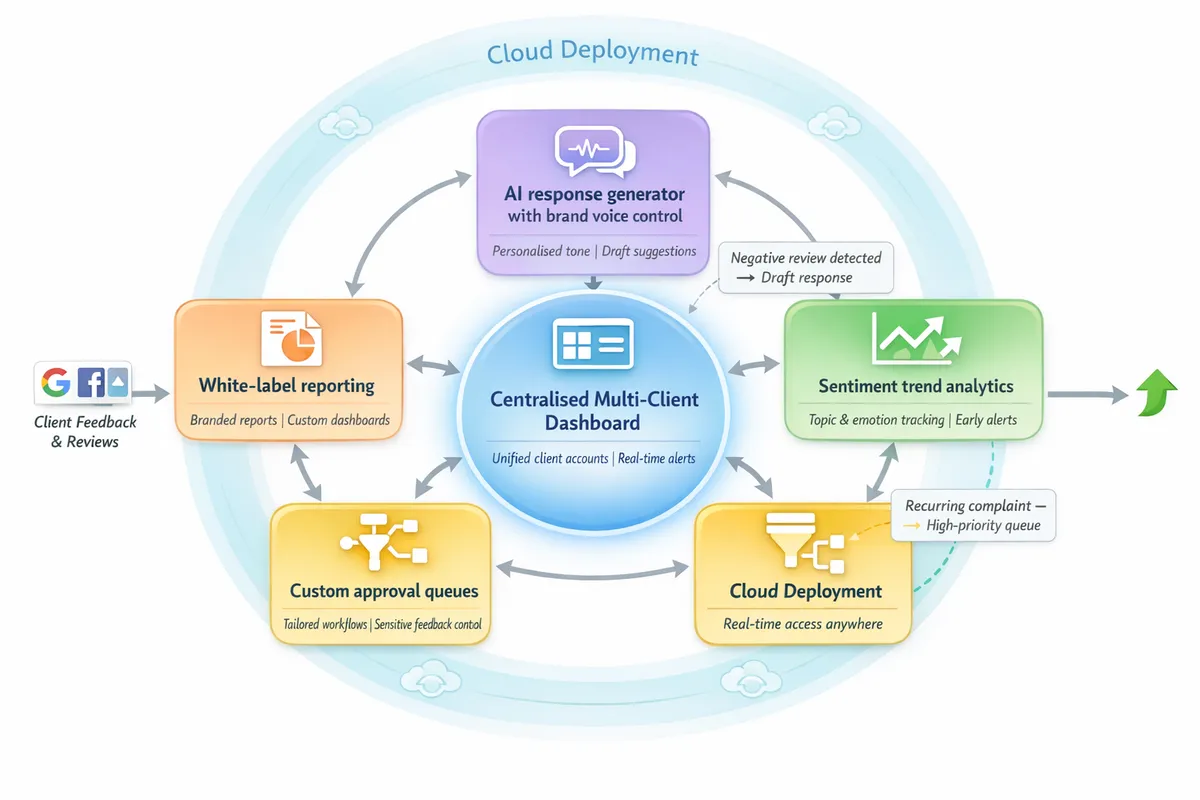
To overcome these scaling barriers, agencies need specific capabilities within their review management software. The right features transform operational chaos into streamlined efficiency while protecting client reputations. Consider these essential functions:
| Feature | Agency Impact | Problem Solved |
|---|---|---|
| Centralised multi-client dashboard | Eliminates manual login switching across platforms | Solves account juggling chaos and missed alerts |
| White-label reporting | Enables branded deliverables that reinforce agency value | Removes generic vendor branding from client analytics |
| AI response generator with brand voice control | Maintains authentic client tone at scale | Prevents robotic replies that damage customer trust |
| Sentiment trend analytics | Identifies recurring issues before escalation | Uncovers hidden patterns across review platforms |
| Custom approval queues | Adapts to unique client sign-off requirements | Removes workflow bottlenecks for urgent responses |
Centralised multi-client dashboard
A single view of all client accounts across Google, Facebook, and app stores prevents critical feedback from slipping through. Your team avoids wasting hours daily on login gymnastics. Real-time alerts ensure urgent issues like negative reviews trigger immediate action. This is vital when 67% of consumers abandon businesses after one poor review.
White-label reporting
Professional reports free of software vendor branding demonstrate tangible value during client reviews. Custom dashboards show response rates, sentiment improvements, and review volume trends without third-party logos. This white label review management approach strengthens client retention by positioning your agency as the solution owner.
AI response generator with brand voice control
Generative AI now powers 45% of local business interactions, but generic replies damage authenticity. Effective systems learn each client's unique voice - whether formal, conversational, or technical - then apply it to draft personalised responses. Staff simply refine suggestions rather than writing from scratch.
Sentiment trend analytics
Spotting recurring complaints early prevents reputation crises. Automated analysis categorises feedback by topic and emotion across all platforms. Agencies quickly alert clients about emerging issues, like consistent service complaints flagged across a client's Google Business Profile and Facebook reviews. This proactive approach is essential when 93% of buyers consult reviews.
Custom approval queues
Tailored workflows match each client's internal processes. Configure separate queues for different review types, locations, or urgency levels. For example, route all 1-3 star Google reviews to a client's marketing director while auto-approving positive responses. This prevents delays when handling sensitive feedback. Agencies managing app-based clients should explore specialised workflows for Google Play Store reviews.
Together, these capabilities enable agencies to scale efficiently while maintaining service quality. Cloud deployment ensures teams access real-time data anywhere - crucial for managing multiple accounts. The right platform becomes a force multiplier, turning review management from a chore into a profit centre.
Implementing Efficient Client Workflows
With SME subscriptions in the online reputation management market rising at 16.68% annually according to industry analysis, agencies need efficient workflows to scale profitably. Those implementing automation typically handle three times more clients without increasing overhead. This six-step framework delivers consistent results across diverse portfolios:
| Step | Action | Key Benefit |
|---|---|---|
| 1 | Standardise onboarding with platform connections | Reduces setup time by 70% through bulk configuration |
| 2 | Configure sentiment-based alert thresholds | Flags critical issues within minutes of publication |
| 3 | Develop brand voice guidelines for AI responses | Ensures authentic communication across all interactions |
| 4 | Establish tiered approval chains | Accelerates response times for urgent feedback |
| 5 | Schedule automated white-label reports | Provides client-ready insights without manual effort |
| 6 | Conduct quarterly reputation audits | Uncovers improvement opportunities for retention |
Step 1: Standardise onboarding with platform connections
Create a templated process for connecting client accounts across Google Business Profile, Facebook, and app stores. Bulk-configure settings to eliminate repetitive setup. Include tools like the Google review QR code generator to streamline review collection for physical locations. This reduces onboarding from hours to minutes per client.
Step 2: Configure sentiment-based alert thresholds
Set custom triggers for 1-2 star reviews, specific complaint keywords, or rating drops. Immediate notifications ensure teams address reputation threats within the critical first hour. Route high-priority alerts to senior staff while filtering routine feedback to junior team members.
Step 3: Develop brand voice guidelines for AI responses
Document each client's communication style in a brief. Specify tone, formality, and prohibited phrases. Train your AI response generator using these parameters to draft on-brand replies. Refine outputs using resources like the 5-star review response templates for consistency.
Step 4: Establish tiered approval chains
Implement custom workflows based on review severity and client preferences. Automatically route negative app store reviews to technical leads using methods from the app review management guide, while approving positive responses instantly. This prevents bottlenecks in time-sensitive situations.
Step 5: Schedule automated white-label reports
Configure branded dashboards showing response rates, sentiment trends, and platform comparisons. Set weekly or monthly delivery to clients. This white label review management approach demonstrates value without manual compilation, freeing 15+ hours monthly per account manager.
Step 6: Conduct quarterly reputation audits
Analyse three months of aggregated feedback across all platforms. Identify recurring complaints, response gaps, and competitive benchmarks. A client's rating means little in isolation, so score it against the sector median using review benchmarking tools before you present it. Present findings with actionable recommendations during client reviews to showcase ROI and renew contracts.
By embedding these steps, agencies transform chaotic processes into scalable systems. The result? Higher client retention, predictable workloads, and capacity to manage expanding portfolios effectively.
Strategic Evaluation Beyond Feature Checklists
Yet even with optimised workflows, agencies often evaluate platforms through a narrow technical lens. Truly strategic selection requires looking beyond feature checklists to address operational realities. Consider these critical evaluation factors:
| Common Oversight | Strategic Imperative |
|---|---|
| Assuming automation requires no oversight | Maintain human refinement of AI responses |
| Focusing solely on response speed | Transform data into client strategy |
| Ignoring setup complexity | Account for integration and training time |
| Treating all clients identically | Customise for diverse business models |
| Overlooking global scalability | Prioritise platforms with international capabilities |
Avoiding the set-and-forget trap
Many agencies underutilise analytics despite having access, missing crucial insights. Automation shouldn't replace human judgment - especially since consumers value authentic communication. While AI generates draft responses rapidly, staff must refine them to maintain brand voice. Our guide on proactive reputation monitoring tools shows how blending technology with human oversight prevents reputation risks.
Accounting for hidden implementation costs
Factor in onboarding time across multiple client accounts. Complex setups like location mapping require tools such as the Google Place ID Finder. Unexpected challenges like suspended profiles also demand attention - the GBP suspension appeal guide helps mitigate these disruptions. Training teams on new workflows adds further time investment before seeing returns.
Transforming data into client strategy
The reputation management market is growing at 16.9% annually, projected to reach £19.56 billion in 2026. Differentiation comes from converting raw feedback into strategic recommendations. Identify recurring complaints across a client's Google reviews and Facebook feedback to propose service improvements. Use the 5-star review calculator to set measurable reputation goals during client consultations.
Ensuring business model alignment
Agencies serving international clients need platforms that handle regional variations. With Asia-Pacific's significant growth, ensure your solution accommodates different review platforms and languages. Custom workflows are essential too - restaurant chains need different escalation paths than app developers receiving Play Store feedback. ReviewSense's white-label reporting adapts to various client types without reconfiguration.
Ultimately, the right platform should enhance your agency's unique value proposition, not just automate tasks. Sign up for our free tier to test how strategic customisation drives client retention beyond basic functionality.
Conclusion
In summary, scaling review management for agencies demands more than basic automation—it requires transforming fragmented feedback into strategic client value. By centralising Google Business Profile, Facebook, Apple App Store, and Google Play reviews, implementing AI-assisted workflows, and converting data into actionable insights, agencies boost retention and operational efficiency. Avoid common pitfalls like "set-and-forget" approaches by choosing a platform that combines automation with human oversight, customises for diverse clients, and turns raw data into growth opportunities. ReviewSense empowers agencies to elevate client outcomes by transforming scattered reviews into actionable insights. Start your 7-day free trial