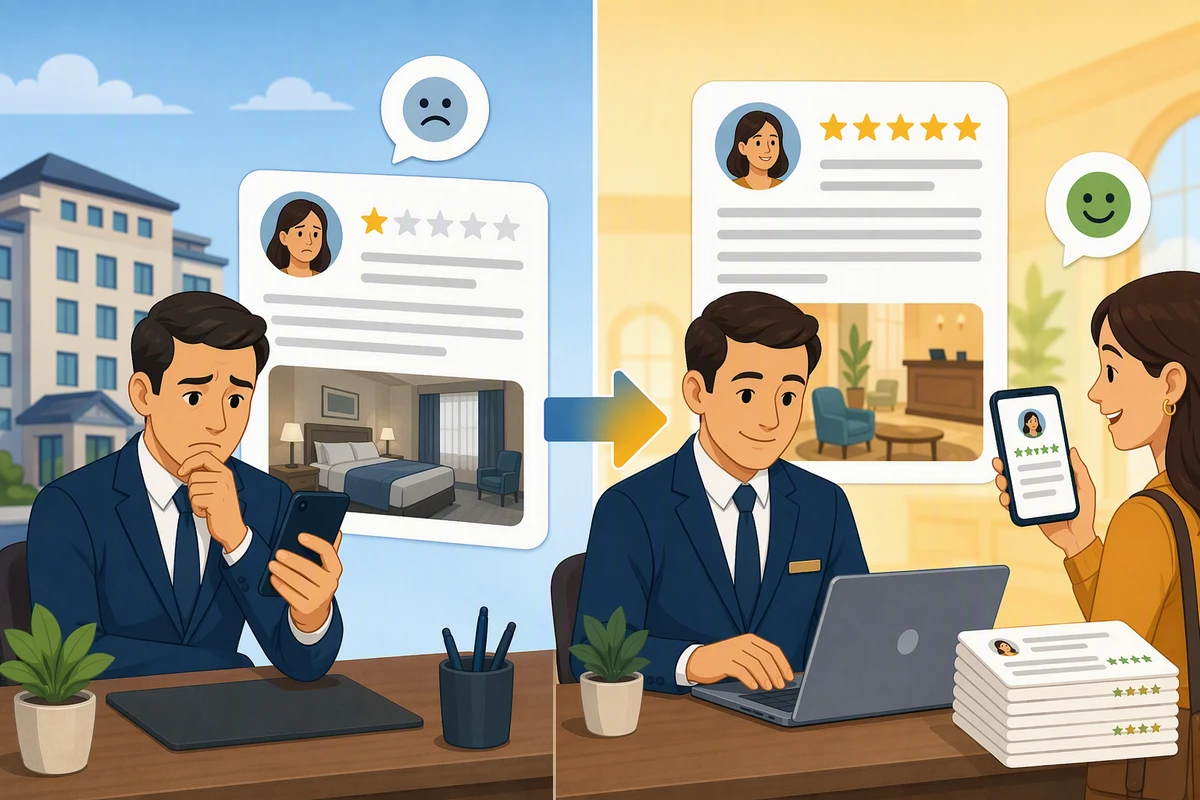
97% of consumers read reviews when evaluating a local business, yet most replies still sound like they were written by a template. The problem isn't your gratitude — it's that every "thank you for your kind words" blends into the noise. A robotic reply signals you don't care, even when you do.
Managing this manually is hard. ReviewSense automates it.
Why Your 5-Star Reply Matters More Than You Think
That personal touch matters because the reply itself is public marketing content, not a private thank-you. com/research/local-consumer-review-survey/), 97% of consumers read reviews when evaluating a local business. Nearly 89% expect businesses to respond. Every reply you write becomes part of your public profile.
| Statistic | What It Means for Your Reply |
|---|---|
| 80% more likely to use a business that responds to every review | A consistent reply builds trust and drives choice. |
| 42% won’t buy from a business that ignores reviews | Silence signals inattentiveness and costs you revenue. |
| 31% now require at least a 4.5-star rating | A high average matters, but replies reinforce that rating. |
The cost of silence
Ignoring a five-star review feels harmless. Yet 42% of consumers say they won’t purchase from a business that fails to respond to any reviews. That’s nearly half your potential customers. Silence looks inattentive. It suggests you don’t value feedback. A simple reply reverses that impression.
Why a 4.5-star floor matters
The 2026 data shows 31% of consumers now require at least a 4.5-star rating before they’ll consider a business. That bar keeps rising. A strong average rating helps you clear it. But a thoughtful reply to positive review reinforces that you care about the experience behind the score. It turns a number into a story.
The reply as a conversion tool
When you reply to a positive review, you’re not just thanking one person. You’re speaking to every future customer who reads that page. An 80% majority say they’re more likely to use a business that responds to every review. That’s a direct link between a few seconds of typing and a new booking.
Practical next steps
Start by auditing your current response rate. If you’re replying to fewer than half your reviews, you’re leaving money on the table. Use a 5-star review response generator to maintain consistency without sounding robotic. For negative feedback, a negative review response generator helps you address issues professionally. Track your progress with a customer review management strategy that ties replies to real business outcomes.

The 2026 Data-Backed Formula That Sounds Human
That reply strategy works best when it follows a repeatable structure. Research from Harvard Business Review found that shorter, less promotional replies to positive reviews actually perform better. Customers want acknowledgement, not a sales pitch.
The formula below breaks down the four elements that make a reply feel human. Use it as your template for how to respond to a 5 star review.
| Element | Purpose | Example |
|---|---|---|
| Thank | Acknowledge the reviewer by name | "Thanks, Sarah!" |
| Mention specific detail | Reference something they said | "Glad you loved the espresso martini." |
| Reinforce value | Restate what you do well | "We work hard to source fresh beans." |
| Low-pressure invitation | Invite them back without a hard sell | "Hope to see you again soon. Half of consumers reject copy-and-paste responses entirely, according to PinMeTo. A generic "thank you for your review" signals you didn't read it. That erodes trust. |
The 24-hour window
Speed matters. 19% of consumers expect a reply the same day. Another 32% expect it the next day. That means half your audience wants a response within 24 hours. A fast reply shows you're attentive.
A real example
Here's a reply that follows the formula for a coffee shop: "Thanks, Sarah! Glad you loved the espresso martini. We work hard to source fresh beans. Hope to see you again soon." It thanks her, names the drink, reinforces quality, and invites her back. No fluff.
This structure is your foundation. But AI changes the game. A tool like ReviewSense can generate these replies in seconds while keeping your brand voice consistent. It turns a manual chore into a scalable habit.

How AI Is Changing Review Replies in 2026
That formula works because it feels human. But in 2026, the line between human and machine replies is blurring fast. Four developments are reshaping how businesses approach the question of how to respond to a 5 star review.
First, Google is actively testing AI-generated review replies inside Business Profile. Early reports show the tool suggests short, polite responses. The problem? They often sound identical across businesses. A generic "thank you for your review" from Google's AI might save time, but it erodes the trust you just built.
Second, Gemini's direct GBP integration, announced June 2026, takes this further. It lets business owners generate a reply with one click. Speed improves dramatically. Authenticity suffers. The tension between speed and genuine connection has never been sharper.
Third, AI agents from platforms like Birdeye now auto-publish replies without human review. That's risky. A machine can't catch when a phrase feels off or when a customer's name is misspelled. One wrong tone can undo years of reputation work.
Fourth, there's a direct link between review language and AI-generated business recommendations (GEO). Search engines now analyse reply content to determine local rankings. A thoughtful reply to positive review signals engagement. A robotic one does not.
The practical rule is simple: use AI for a first draft, then add one human detail. That could be a specific menu item, a staff name, or a reference to the weather that day. One sentence changes everything.
The human-review checklist for editing AI drafts:
- Remove generic phrases like "we appreciate your feedback." Replace them with something specific.
- Vary sentence structure. AI tends to repeat the same pattern. Break it up.
- Don't repeat your business name unnaturally. If you said "at Joe's Diner" once, you don't need it again.
- Check for tone. Does it match your brand voice? If not, rewrite the middle sentence.
Tools like ReviewSense let you generate a draft and then edit it before posting. That hybrid approach keeps you fast without sounding like a bot. For more on spotting fake or low-effort reviews, see the Fake Review Checker.

Industry-Specific Challenges That Break Generic Advice
That hybrid approach works for most businesses, but regulated industries face a harder problem. A generic "thank you for your review" can violate privacy laws. The risk isn't just a bad tone — it's a fine.
The table below shows why standard advice breaks down in eight sectors.
| Industry | Why It's Hard | Safe Response Pattern |
|---|---|---|
| Healthcare | HIPAA prohibits confirming a patient relationship. | "We're glad you had a positive experience with our team." |
| Legal | ABA rules require client confidentiality. | "Thank you for recognising our dedication." |
| Finance | FINRA and SEC restrict endorsements and testimonials. | "We appreciate your feedback on our service." |
| Education | FERPA protects student records from disclosure. | "We're proud our staff made a difference." |
| Real Estate | Fair Housing Act bans discriminatory language. | "Thank you for your kind words about our service." |
| Hospitality | No specific law, but repeating guest details can breach privacy. | "We're thrilled you enjoyed your stay." |
| Home Services | Low regulation, but naming a specific address can create liability. | "Thanks for letting us help with your project." |
| Funeral Services | HIPAA applies if health details are mentioned. | "We're grateful for the opportunity to serve your family." |
The core principle is safe specificity. Thank the reviewer for recognising a team member or a quality, but never confirm they were a patient, client, or student. The HHS Office for Civil Rights settled a case in 2023 where a dental practice posted a patient's full name and treatment detail in a reply. The fine was $50,000.
The FTC's Reviews and Testimonials rule, updated in 2024, also applies. It bans businesses from posting replies that imply a fake or incentivised relationship. Stick to thanking for the feedback, not the person.
The broader pattern is simple: the reviewer may reveal more than the business should repeat. A customer writes "Dr. Smith fixed my broken tooth." You reply "Thanks for choosing us!" — not "Glad Dr. Smith fixed your tooth." That one shift keeps you compliant.
For more on protecting your reputation across multiple sites, see the guide on how to monitor reviews on multiple sites. And if you're evaluating alternatives, our comparison of Birdeye alternatives for small business reviews covers compliant options.
When Automation Helps and When It Hurts
That compliance environment makes one thing clear: not every review needs the same treatment. The trick is knowing when to automate and when to slow down.
| Scenario | Automate? | Why |
|---|---|---|
| Short positive review, no complaints | Yes | Low risk, high volume. Speed matters more than nuance. |
| Review mentions an employee by name | No | Personal recognition needs a human touch. |
| Medical, legal, or financial service | No | Privacy laws forbid confirming the relationship. |
| Emotional feedback (angry or very happy) | No | Tone calibration requires human judgment. |
| Generic "great service" with no details | Yes | A polite thank-you is sufficient. |
The rule is simple: automate the routine, escalate the sensitive. A tool like ReviewSense centralises feedback from Google, Facebook, Apple App Store, and Google Play into one dashboard. Instant alerts notify your team the moment a review drops. The AI response generator drafts a reply in seconds. That solves the speed problem.
But speed without authenticity backfires. Research from the 2026 Journal of the Academy of Marketing Science shows that responding to positive reviews improves ratings and revenue — but repetitive responses lose effectiveness. Customers notice when every reply reads the same.
ReviewSense solves the authenticity problem with brand voice customisation and approval workflows. You set the tone once. The AI follows it. A human reviews the draft before it goes live. That hybrid approach keeps you fast without sounding like a bot.
For short positive reviews with no complaints, let the AI auto-reply. For any mention of an employee, a medical condition, or emotional language, route that review to a human. The FAQ section covers how to configure those rules.
A response is a public demonstration of what the business notices, values, and repeats. Reply to a 5 star review with a generic "thank you for your review" and you signal that you don't pay attention. Reply with a specific detail and you show future customers what matters.
Free tools like the Google review link generator and negative review response templates give you immediate value while you evaluate the full platform. The principle is contrarian but true: the best reply to a positive review is not a thank-you — it's a signal.
Conclusion
A generic "thank you" wastes a five-star review. Specificity builds trust, but only within legal boundaries. Automate the routine replies. Escalate anything that mentions an employee, a medical detail, or strong emotion. ReviewSense centralises feedback from Google, Facebook, Apple App Store, and Google Play into one dashboard. Its AI drafts replies in seconds while brand voice controls and approval workflows prevent robotic repetition. The result is speed without sacrificing authenticity. Turn scattered reviews into actionable insights that protect your reputation and drive growth. Start your 7-day free trial.