
Automated email flows, including review requests, generate 320% more revenue than non-automated campaigns despite accounting for only 2% of total email volume. That’s a massive return — but only if your emails actually get opened and clicked. Most review request emails fail because they’re generic, poorly timed, or feel like spam. The fix isn’t just sending more emails; it’s sending smarter ones built on timing, personalisation, and a clear value exchange. This playbook covers the three pillars of a high-performing review request, how to balance automation with authenticity, and what to look for in a review generation solution — including how a review request template generator can save hours of manual work.
Managing this manually is hard. ReviewSense automates it.
Why Most Review Request Emails Fail (And How to Fix It)
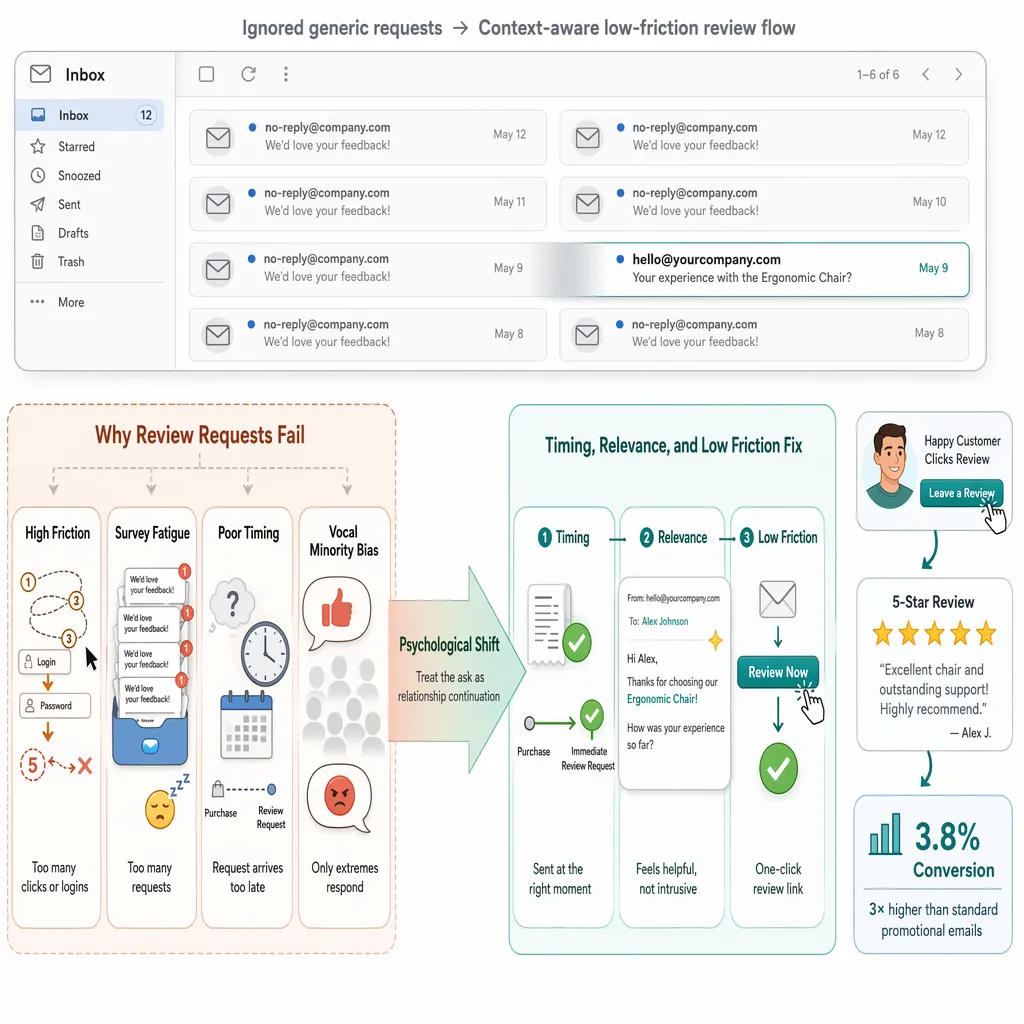
This is where most review generation email strategies unravel. The core problem isn't the channel itself — it's the approach. Businesses send generic requests at the wrong moment, and customers have learned to ignore them.
| Barrier | Why It Fails |
|---|---|
| High Friction | Asking for a review requires too many clicks or logins. Customers abandon the process. |
| Survey Fatigue | Customers receive too many requests. They tune out all of them. |
| Poor Timing | Requests arrive days after the experience, when memory has faded. |
| Vocal Minority Bias | Only the very happy or very angry respond. You miss the middle. |
The psychology of the ignored inbox
Customers are protective of their time. A review request that lands a week after a purchase feels like spam. It asks them to recall details they've forgotten. That friction kills participation.
Data consistently shows that brands typically hear from less than 1% of their customer base. That's not a channel problem. It's a timing and relevance problem.
Template blindness is real
When every email looks the same, customers stop reading. They scan the subject line, recognise the pattern, and delete. This is 'template blindness' — the brain's way of filtering out predictable noise.
The fix: timing, relevance, and low friction
Well-executed post-purchase flows achieve a conversion rate of 3.8%. That is three times higher than standard promotional emails. The difference is simple: they ask at the right moment, with a clear ask, and minimal steps.
A good review request template generator helps you vary language and timing. But the real shift is psychological. Treat the ask as a continuation of the customer relationship, not a transaction.
For practical tools to lower friction, try a Google Review Link Generator that creates a direct, one-click link. And if you're worried about losing profile access, read the Google Business Profile Suspended? How to Appeal and Get Reinstated (2026 Guide) to protect your reputation.
Understanding Customer Review Management: Building Trust and Improving Ratings helps you frame the request as helpful, not intrusive. The goal is to make saying yes feel effortless.
The Three Pillars of a High-Performing Review Request
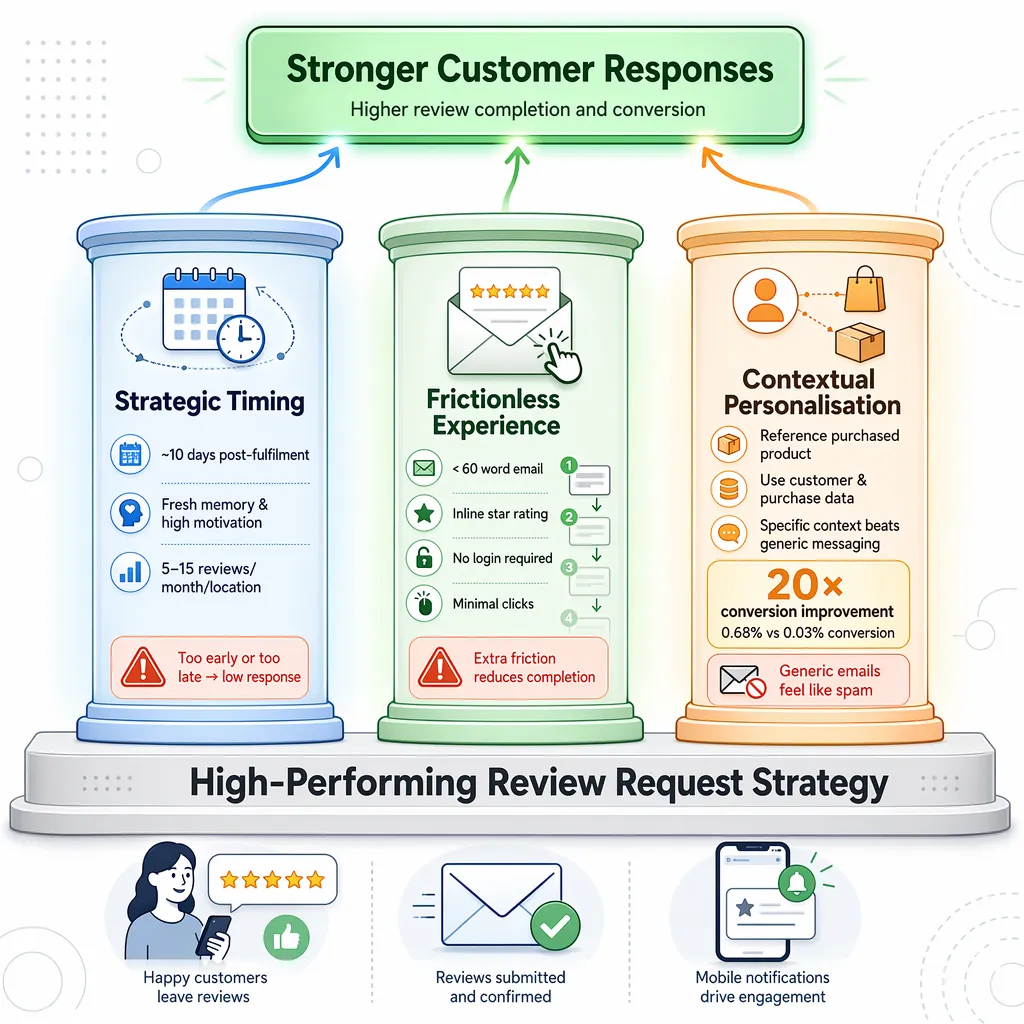
Building on that foundation, a high-performing review generation email rests on three distinct pillars. Get these right, and you'll see response rates climb. Miss any one, and your efforts stall.
| Pillar | Core Principle | Common Failure |
|---|---|---|
| Strategic Timing | Ask when memory is fresh and motivation is high | Sending too early or too late |
| Frictionless Experience | Remove every unnecessary click or login | Requiring account creation to leave a review |
| Contextual Personalisation | Reference the specific purchase or interaction | Using generic templates with just a name |
Strategic Timing
Timing is everything. Research suggests the sweet spot for a review request is around 10 days post-fulfilment. That's when the product has been used, but the experience isn't cold. Aim to generate 5 to 15 reviews per month per location. This cadence keeps your profile active without overwhelming customers. When timing is off, you get silence or low-quality responses.
Frictionless Experience
The best review request is the one the customer actually completes. Keep your email under 60 words. Include a star rating directly in the email body — don't send people to a landing page. Never require a login. Every extra click drops completion rates. A good review request template generator can help you build these short, direct emails that auto-populate customer details.
Contextual Personalisation
Using the customer's first name is table stakes. Real personalisation references what they bought. "How are you finding the cordless drill?" beats "How was your experience?" every time. Automated email flows that use purchase data achieve a click rate of 3.15% and a conversion rate of 0.68%, compared to 0.54% and 0.03% for standard campaigns. That's a 20x improvement in conversion. Without this context, your email feels like spam.
These three pillars turn a generic ask into a natural next step. Use the Customer Review Monitoring: Tools and Techniques for Proactive Reputation Management guide to track which pillar needs work. And if you're calculating your current rating, the Star Rating Calculator gives you a clear benchmark.
Automation Vs. Authenticity: Finding the Right Balance
Those three pillars — timing, friction, and personalisation — create a strong foundation. But they raise a deeper question. How much of this process should you automate?
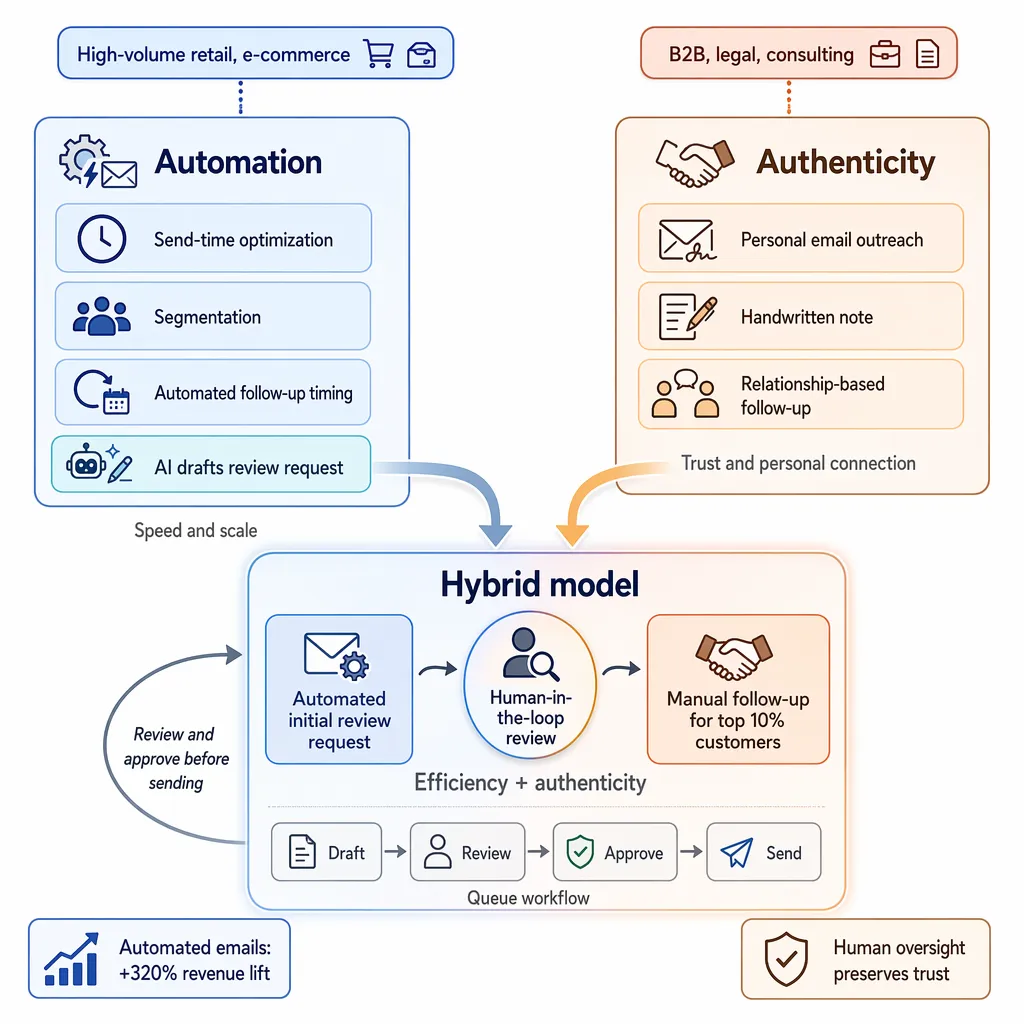
The tension between automation and authenticity is real. Automated flows can generate significant revenue. The DMA Email Automation Report 2026 found that automated emails deliver a 320% revenue lift. That is hard to ignore. Yet a purely automated approach can feel impersonal, especially for high-value clients.
The right balance depends on your customer type.
| Scenario | Best Approach | Why It Works |
|---|---|---|
| High-volume retail, e-commerce | Automated review generation email | Speed and scale matter. Customers expect quick, frictionless requests. |
| B2B, legal, consulting | Manual outreach (personal email or handwritten note) | Relationships are high-stakes. A personal touch builds trust. |
Automation excels at the heavy lifting. It handles send-time optimisation, segmentation, and follow-up timing. By 2026, 61% of enterprise email programs will use AI for campaign elements. That shift is already here.
But the final output must feel human. The 'human-in-the-loop' trend is gaining traction. AI drafts the message; a person reviews it. This hybrid model works well for a review request template generator. The tool creates the structure; you add the nuance.
For most businesses, a hybrid model is the answer. Use automation for the initial request. Then have a team member follow up manually with the top 10% of customers. This approach combines efficiency with authenticity.
ReviewSense supports this balance. Its AI response generator creates on-brand replies, but you control the final output. The platform's queue workflows let you review and approve before sending. You get the speed of automation without losing the human touch.
For practical tips on scaling your approach, read the guide on How to Manage App Store Reviews at Scale. And if you're evaluating tools, the Review Management Software: Key Features, Use Cases, and Selection Tips can help you find the right fit.
What to Look for in a Review Generation Solution
That hybrid approach — automation with a human touch — only works if the tool you choose can handle both sides well. When you evaluate a review generation email solution, you need to look beyond basic send-and-forget features. Here is what matters.
| Criteria | What It Solves | Why It Matters |
|---|---|---|
| Multi-Platform Centralisation | Logging into four different sites to check replies | Saves hours per week and prevents missed reviews |
| Smart Response Tools | Drafting replies that match your brand voice | Speeds up response time without sounding robotic |
| Sentiment & Spot Detection | Wading through fake or toxic feedback | Lets your team focus on genuine customer insights |
| Actionable Analytics | Guessing whether your strategy is working | Gives you data to improve response rates and ratings |
Multi-Platform Centralisation
Without centralisation, teams waste hours logging into Google Business Profile, Facebook, and two app stores every day. That login fatigue leads to missed reviews and slower response times. A proper solution aggregates every new review into one dashboard. You see everything at a glance. No tab-switching. No forgotten credentials. For multi-location businesses, this is non-negotiable.
Smart Response Tools
Responding to every review manually is unsustainable at scale. Look for AI response generation that drafts on-brand replies based on your existing tone. But don't accept black-box automation. You need a queue system for approval workflows. That way, a human reviews each draft before it goes live. A built-in review request template generator should also be part of the package — not an upsell. It helps you create consistent email templates that auto-populate customer details.
Sentiment & Spam Detection
Data shows that brands typically hear from less than 1% of their customer base. That means the feedback you do get carries disproportionate weight. You cannot afford to waste time on spam or toxic content. Built-in analysis flags fake reviews and recurring issues automatically. Your team focuses on genuine feedback that impacts reputation and retention.
Actionable Analytics
A dashboard full of star badges isn't a strategy — it's a scoreboard with no way to see how you're doing. Look for a solution that tracks response rates and rating trends over time, so you can tell whether a change to your timing or templates is actually working, rather than guessing. It should also surface sentiment trends across every platform you're monitoring and flag a sudden spike in negative feedback early, before it turns into a pattern your customers notice before you do. Without this visibility, you're reacting to reviews one at a time. With it, you can adjust your approach based on data and catch problems while they're still small.
The Contrarian Playbook: Turning Reviews Into Relationships
That hybrid model — automation with a human touch — works best when you flip conventional wisdom on its head. Most businesses treat review generation as a numbers game. More requests equal more ratings. But the data tells a different story. Only about 10% of consumers leave reviews organically, according to Bazaarvoice. Proactive email strategies are required to increase this. The real opportunity lies in building relationships, not collecting stars.
Here is a four-step playbook that turns the standard approach upside down.
| Step | Conventional Approach | Contrarian Approach |
|---|---|---|
| 1 | Ask for a review immediately | Ask for feedback first, then invite a public review |
| 2 | Aim for only 5-star ratings | Embrace a mix of 4- and 5-star reviews for authenticity |
| 3 | Use corporate subject lines | Write human-sounding subject lines |
| 4 | Automate everything | Send personal notes to your top 10% of customers |
Step 1: Ask for Feedback, Not a Review
Start your email by asking "How can we improve?" This builds trust. If the feedback is positive, follow up with an invitation to post publicly. If it's negative, you have a chance to fix the issue privately. This approach turns your review generation email into a relationship builder, not a transaction.
Step 2: Embrace the Negative
A mix of 4- and 5-star reviews signals authenticity. Consumers spot perfect ratings and question them. A professional public response to a negative review can be more valuable than ten generic 5-star ratings. It shows you care about customer experience.
Step 3: Go Anti-Template
Write subject lines that sound human. "Quick question about your [product]" outperforms "We value your feedback" every time. A review request template generator can help you structure the message, but the tone must feel personal.
Step 4: Manual Touches for VIPs
For your top 10% of customers, skip the automated sequence. Send a personal email or handwritten note. This investment pays dividends in loyalty and word-of-mouth referrals.
Relationships, not hacks, bridge the trust gap. Ethical, transparent requests are non-negotiable. Use the Google Review Link Generator to make the process frictionless. And if you're managing app store feedback, the Google Play Review Management guide covers the specifics.
Conclusion
The contrarian playbook proves that review generation isn’t about collecting stars—it’s about building trust through authentic feedback, human-sounding outreach, and proactive issue resolution. By asking for feedback before public reviews, embracing a mix of ratings, and adding personal touches for VIPs, you transform a transactional process into a relationship engine. Centralising this effort across Google, Facebook, and app stores with smart response tools and sentiment analysis ensures no insight is missed. ReviewSense gives you the platform to execute this strategy at scale—from automated workflows to actionable analytics that improve customer experience and drive growth. Turn scattered reviews into actionable insights that build lasting relationships. Start your 7-day free trial