
The global reputation management software market hit $7.75 billion in 2026, driven by a brutal truth: your brand is now defined by what AI search engines say about you. With ChatGPT processing 2.5 billion queries daily and 60% of consumers planning to use AI agents for purchases, managing reviews is no longer about star ratings — it's about controlling your data footprint across generative engine outputs.
Modern platforms must tackle fake review regulation (with fines up to 10% of global turnover), sentiment analysis, and GEO strategies that can boost AI visibility by 40%. Whether you're an SMB or enterprise, the right tool turns reputation from a reactive chore into a growth engine.
Managing this manually is hard. ReviewSense automates it with AI-driven response generation and multi-platform monitoring.
Why Reputation Management Now Means Managing AI Search
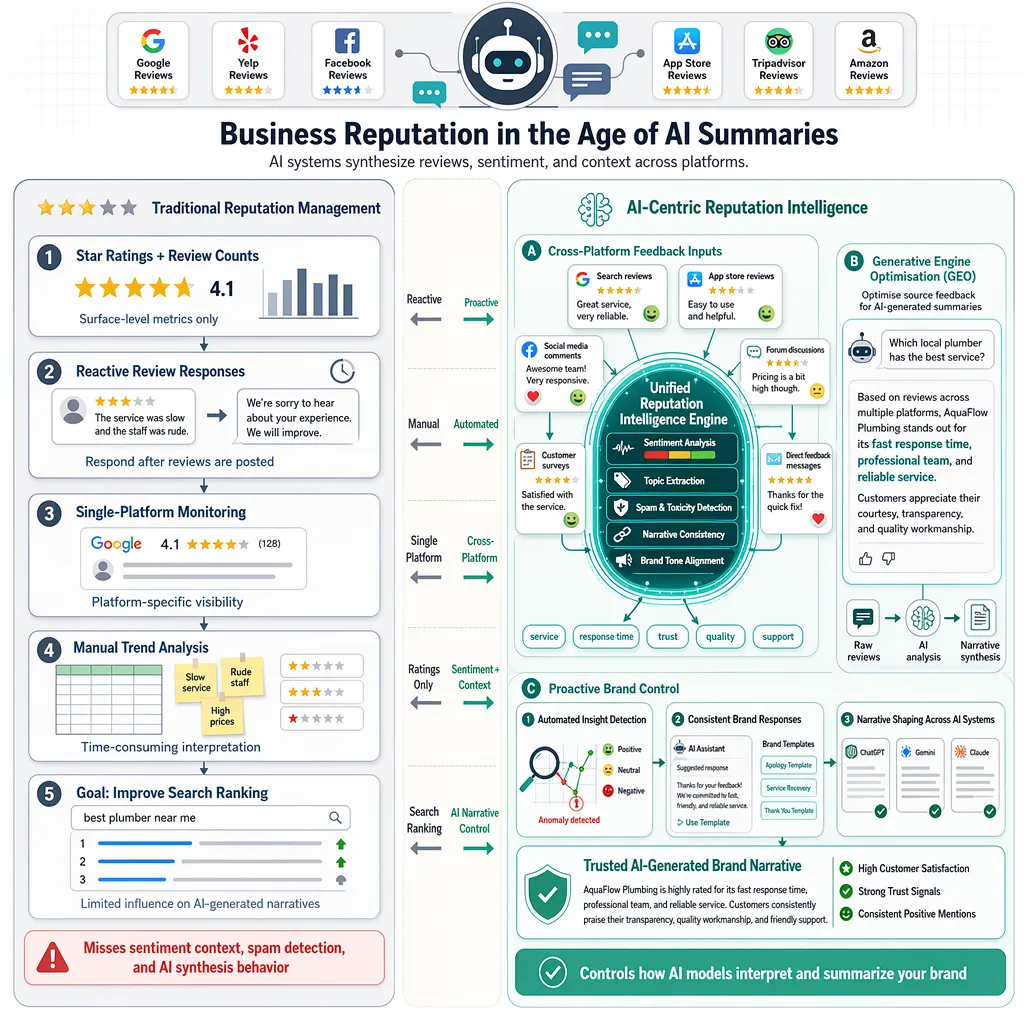
This shift is not just about monitoring star ratings, and it is well past what a free mention alert can see, as our piece on why Google Alerts fails for reputation management sets out. It is about understanding how AI models perceive your brand. The first impression a customer now gets is often an AI-generated summary, not a search result page. This changes everything.
| Traditional Reputation Management | AI-Centric Reputation Intelligence |
|---|---|
| Focus on star rating and review count | Focus on sentiment, context, and AI model perception |
| Reactive: respond to reviews after they post | Proactive: optimise content for AI synthesis |
| Platform-specific (e.g., Google only) | Cross-platform data aggregation for AI training |
| Manual analysis of feedback trends | Automated sentiment analysis and topic extraction |
| Goal: improve search ranking | Goal: control the narrative in AI-generated summaries |
The Rise of Generative Engine Optimisation
ChatGPT processes billions of queries daily. A growing share of consumers now expect to use AI agents for purchasing decisions. When a potential customer asks an AI model "Which local plumber has the best service?", the answer is not a list of links. It is a synthesised paragraph drawn from reviews across multiple platforms.
Your business narrative is now written by an algorithm. If you do not manage the source data, you lose control of the story. This is where Generative Engine Optimisation (GEO) becomes critical. GEO is the practice of structuring your online feedback so AI models extract accurate, positive summaries.
Why Most Software Fails Here
Many review tools only scrape star ratings. They ignore the text that feeds AI models. They cannot detect spam or toxic content that pollutes the data. They offer no sentiment analysis to surface recurring issues. Without these capabilities, you cannot influence what an AI model says about you.
The best AI-powered reputation management software 2026 must solve this. It needs to centralise feedback from all supported platforms, analyse sentiment, and flag problematic content. It must help you respond consistently and on-brand. Only then can you shape the AI-generated narrative that defines your first impression. For the enterprise end of that market specifically, our roundup of review management software with AI review generation compares sentiment depth, spam control and reply volume.
For a deeper look at platform-specific challenges, read the guide on Google Play review management. You can also explore the Review Management Software: Key Features, Use Cases, and Selection Tips to understand what to look for.
What to Look for in an AI Reputation Platform Today
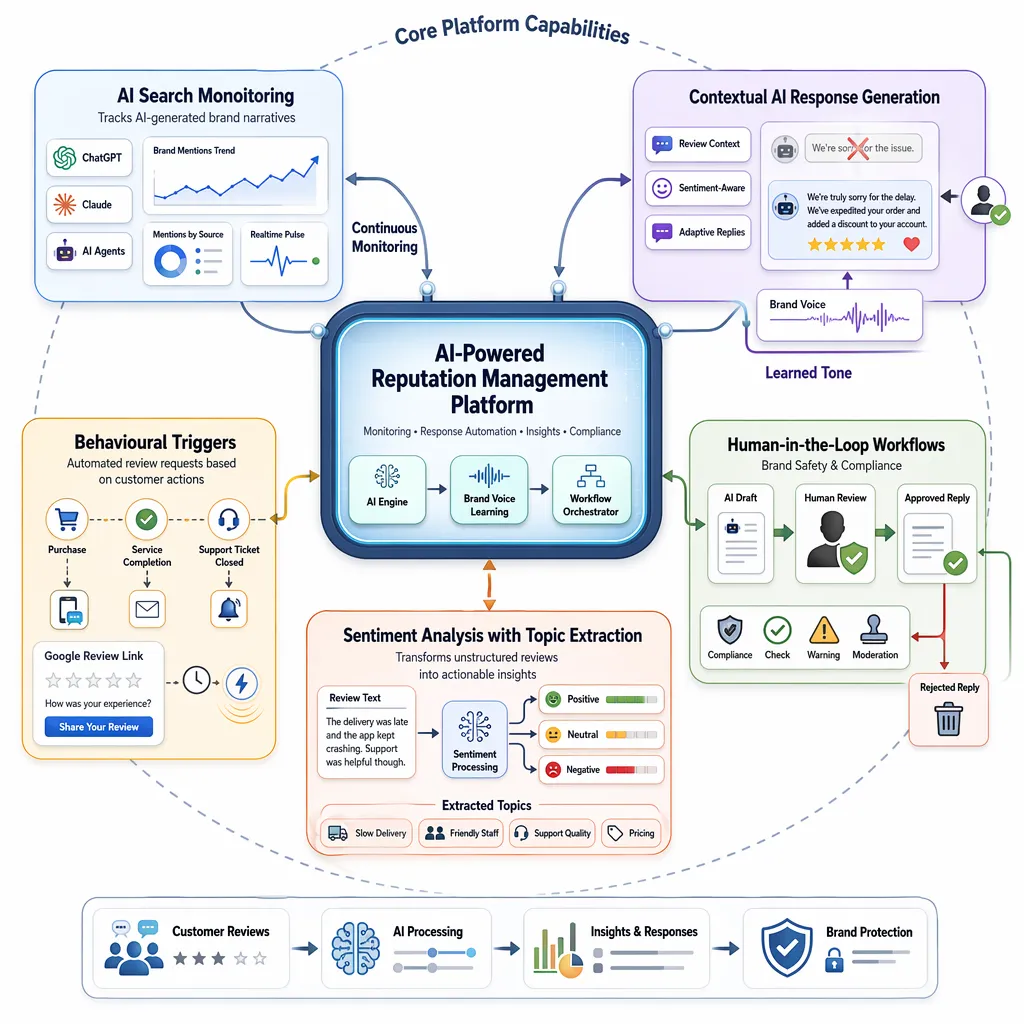
Building on that understanding, here are the five capabilities your next platform must deliver.
| Capability | Why It Matters |
|---|---|
| AI Search Monitoring | Tracks brand mentions in ChatGPT, Claude, and other AI agents |
| Contextual AI Response Generation | Moves beyond rigid templates to match brand voice and review context |
| Behavioural Triggers | Sends review requests based on customer actions, not guesswork |
| Sentiment Analysis with Topic Extraction | Surfaces recurring issues and positive themes from unstructured text |
| Human-in-the-Loop Workflows | Ensures compliance and brand safety before any reply goes live |
1. AI Search Monitoring
ChatGPT processes 2.5 billion queries daily. A growing share of consumers now expect to use AI agents for purchasing decisions. Your platform must track what these models say about your business. Without this, you cannot correct inaccuracies or reinforce positive narratives. Recent industry research confirms that AI-generated summaries now shape first impressions.
2. Contextual AI Response Generation
Templates feel robotic. A modern tool uses the review's specific language and sentiment to craft replies. It learns your brand voice over time. This is the 'bionic approach' — human oversight paired with AI speed. It saves hours each week while keeping replies personal.
3. Behavioural Triggers for Review Requests
Timing matters. A platform that triggers requests after a purchase, service completion, or support ticket closure captures feedback when experience is fresh. This boosts response rates and review volume. You can use the Google Review Link Generator to create custom links for each trigger.
4. Sentiment Analysis with Topic Extraction
About 51% of companies have integrated sentiment analysis into their workflows. The best tools go further. They extract topics — 'slow delivery', 'friendly staff' — so you see patterns, not just scores. This turns scattered feedback into actionable insight.
5. Human-in-the-Loop Workflows
Compliance is non-negotiable. A platform should generate a draft, then route it for approval before posting. This prevents brand-damaging replies. It also gives teams control over tone and accuracy.
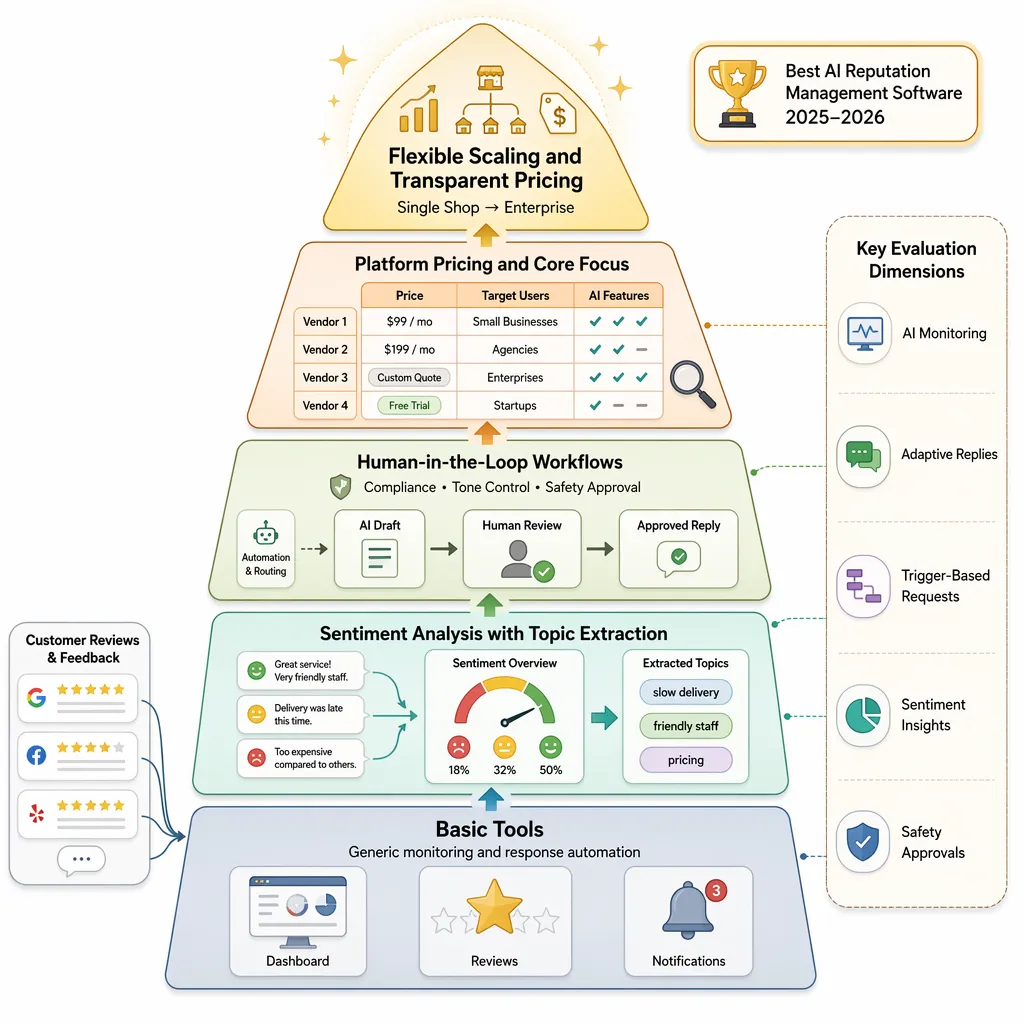
These five features separate basic tools from the best AI-powered reputation management software 2026. Next, we compare the leading platforms against this checklist.
Comparing the Leading Platforms: Pricing and Core Focus
These five capabilities set a high bar. How do the leading platforms measure up? The table below compares entry pricing and core focus for the best AI-powered reputation management software 2026.
| Vendor | Entry Price | Best For | Key AI Feature |
|---|---|---|---|
| Birdeye | ~$299/month (annual) | Enterprise, multi-location brands | AI reply drafts, sentiment reporting, competitive benchmarking |
| BrightLocal | $41/month | Single-location review tracking | Review monitoring and rank tracking |
| Podium | ~$399/month | SMS-first communication | AI-generated text message replies, lead routing |
| SOCi | Custom quote | Enterprise | Not published |
| ReviewSense | 7-day free trial, transparent pricing | SMBs to multi-location enterprises | AI response generation, sentiment analysis, crisis alerts |
SOCi requires a custom quote. That often means a long sales cycle and hidden costs. For many UK businesses, that friction alone kills momentum. You don't need a six-figure contract to get AI depth.
ReviewSense offers clarity without compromise
ReviewSense gives you transparent pricing from day one. You get a 7-day free trial to test the AI response generator, sentiment analysis, and crisis alerts. No sales call required. That's rare in this space. As recent analysis from wiserreview.com notes, many platforms bury AI features behind premium tiers. ReviewSense doesn't. It scales from a single shop to a multi-location enterprise without changing the core AI engine. That's the kind of flexibility you'll want when evaluating the best AI reputation management software 2026.
For a deeper look at platform-specific tools, explore the guide on Apple App Store Review Management Software: Features and Selection Tips. You can also see how AI-Powered Review Management: Strategies for Streamlining Customer Feedback Oversight fits into your workflow.
How It Addresses Core Pain Points for SMBs and Enterprises
These pricing differences matter, but the real test is how a platform handles three emerging pain points. The table below maps each problem to a specific solution.
| Pain Point | The Risk | How a Modern Platform Solves It |
|---|---|---|
| The Persistence Problem | Old negative data lives on in AI models | Real-time alerts and sentiment tracking catch issues early |
| Loss of First Impression Control | AI summaries disintermediate brands | AI response generator that learns your brand voice |
| The AI Slop Trust Gap | Generic automated replies erode trust | Human-approval workflows ensure authenticity |
The Persistence Problem
AI models don't forget. A bad review from 2022 can still shape what ChatGPT says about your business today. That's the persistence problem. You need to catch new issues fast. ReviewSense sends instant alerts when a review drops. Its sentiment analysis flags recurring themes. You spot a problem before it becomes a pattern. This is where the best ai-powered reputation management software 2026 earns its keep.
Loss of Control Over First Impressions
AI-generated summaries now appear in search results. They often pull from outdated or irrelevant reviews. Your brand loses control of that first impression. The fix is a response generator that uses your brand voice. ReviewSense learns your tone over time. Every reply reinforces your identity. It's not generic. It's yours.
The AI Slop Trust Gap
Customers spot a robotic reply in seconds. That erodes trust fast. The solution is a human-in-the-loop workflow, the same one our guide to auto-responding on Trustpilot without sounding robotic recommends. ReviewSense drafts a reply. A team member reviews it. They approve or tweak it before it goes live. The platform also detects spam and toxic content. You focus on genuine feedback. This approach builds trust, not noise.
For a deeper look at response strategies, read the guide on Using AI Review Response Generators to Improve Online Reputation. You can also explore Customer Review Management to see how these workflows scale.
The Contrarian Take: Reputation Is Infrastructure, Not Marketing
This shifts the conversation from feature lists to a deeper question. What if the real value of reputation software isn't marketing at all? The contrarian view is that your brand's online presence is infrastructure, not a campaign. You're building a knowledge graph that AI systems use to describe your business. Every review, every response, every piece of structured data feeds that graph. The best AI-powered reputation management software 2026 helps you manage those signals, not just monitor star ratings.
| Old Mindset | New Reality |
|---|---|
| Reputation is a marketing KPI | Reputation is operational data |
| Focus on average star rating | Focus on data consistency and signal accuracy |
| Respond to reviews for goodwill | Respond to reviews to train AI models |
| Monitor sentiment manually | Audit source authenticity automatically |
The 'Bot Storm' insight changes everything. Negative sentiment is often synthetic. Competitors or bad actors can flood your profile with fake reviews. A tool that only tracks sentiment misses the real threat. You need a platform that verifies source authenticity. ReviewSense detects spam and toxic content, so you focus on genuine feedback. This isn't about polishing a score. It's about protecting your brand's data integrity.
Winning brands in 2026 will be predictable, consistent, and easy for AI to understand. That means standardising your Google Business Profile data, responding with a consistent brand voice, and flagging anomalies fast. ReviewSense gives you crisis alerts for negative spikes and custom brand voice controls. You don't just react. You audit your entire reputation infrastructure.
The question isn't whether your reviews look good. It's whether your brand's data holds up to AI scrutiny. Use the 7-day free trial to find out. No sales call required.
Conclusion
The best AI-powered reputation management software for 2026 isn't about chasing star ratings. It's about treating your online presence as critical infrastructure: catching issues before they persist in AI models, controlling first impressions with a consistent brand voice, and closing the trust gap with human-approved responses. ReviewSense delivers real-time alerts, sentiment analysis, spam detection, and crisis alerts to protect your data integrity. Don't just monitor your reputation—build a knowledge graph that AI systems trust. Start your 7-day free trial and turn scattered reviews into actionable insights that drive growth.