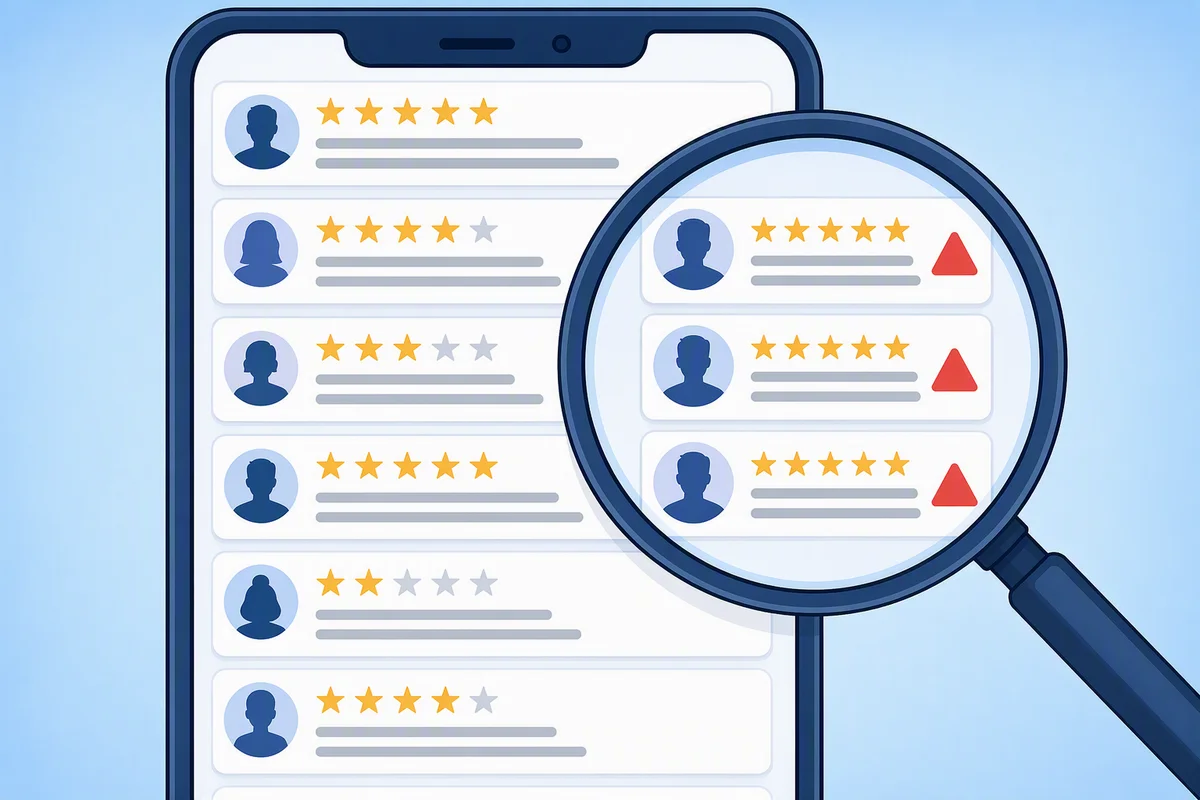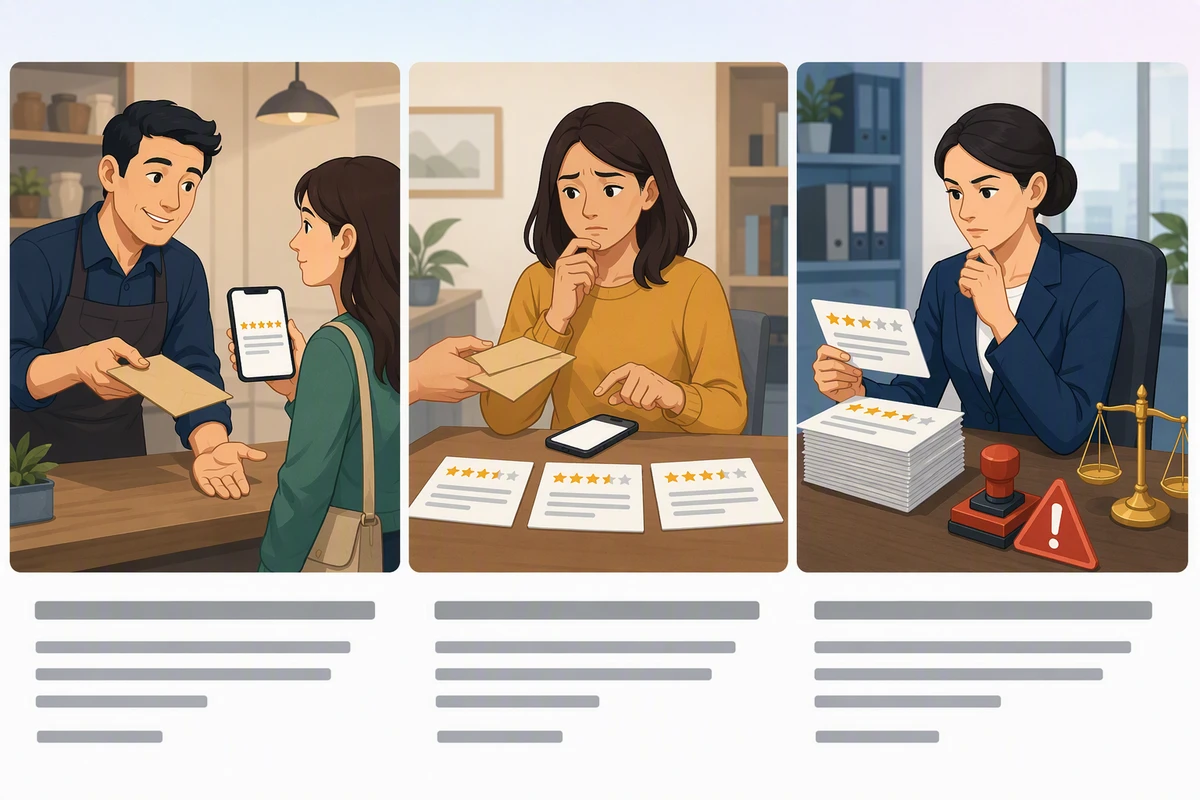
The FTC recently finalised a $750,000 settlement against TruHeight for incentivised and insider reviews — and its latest warning states that each violation can cost up to $53,088. So is buying reviews illegal? The short answer: yes, if you pay for a specific sentiment or fail to disclose material connections. But the grey areas — like review swaps or free-product requests — trip up most businesses.
Managing this manually is hard. ReviewSense automates compliant review generation and monitoring.
When you dig into the buying reviews law, the real risk isn't just fines — it's reputational damage and platform bans. The FTC's updated rule prohibits conditioning payments on positive reviews, but many companies still cross the line by using third-party sellers or undisclosed incentives. We'll break down what's banned, where the grey zones lie, and how to build a review strategy that keeps you safe — whether you're using a Google Review Link Generator or a Trustpilot Review Link Generator.
Understanding the difference between illegal purchasing and legitimate solicitation is critical. For example, offering a discount in exchange for any honest review is generally acceptable — but paying only for five-star reviews is not. The best approach is to centralise your efforts with Review Management Software: Key Features & Selection Tips and use Review Request Email Templates that are transparent and compliant.
If you're running an ecommerce operation, you'll also want to explore the Best Review Management Platforms for Ecommerce 2026 to compare tools that handle compliance natively. And for app-specific needs, check out Apple App Store Review Management Software: Features & Tips to avoid solicitation pitfalls on that platform.
Is Buying Reviews Illegal? the Short Answer Depends on the Details
That depends on the details. Buying fake reviews or paying for a specific sentiment — positive or negative — is illegal under the FTC's Consumer Reviews and Testimonials Rule, effective October 21, 2024. Each violation carries a maximum civil penalty of $53,088, as outlined in the FTC's 2025 warning to 10 companies. The rule bans businesses from writing or buying fake reviews and from suppressing honest negative feedback.
| Scenario | Legal? | Key Condition |
|---|---|---|
| Paying a stranger for a fake 5-star review | No | Violates FTC rule; misrepresents consumer experience |
| Paying a real customer for an honest review | Grey area | Must be disclosed; cannot condition payment on sentiment |
| Offering a discount in exchange for a review | Grey area | Lawful if disclosure is clear and review is unbiased |
| Buying reviews conditioned on positive sentiment | No | Explicitly prohibited; TruHeight case (2026) is example |
The TruHeight case shows what happens when a company crosses the line. In July 2026, the FTC approved a final order against TruHeight for deceptive advertising. The order imposed a $4 million judgment, partially suspended when the company paid $750,000, and prohibited buying reviews conditioned on a particular sentiment. The FTC found TruHeight paid for positive reviews without disclosing the relationship. That's a concrete example of illegal behaviour.
The Grey Area: Paying Real Customers
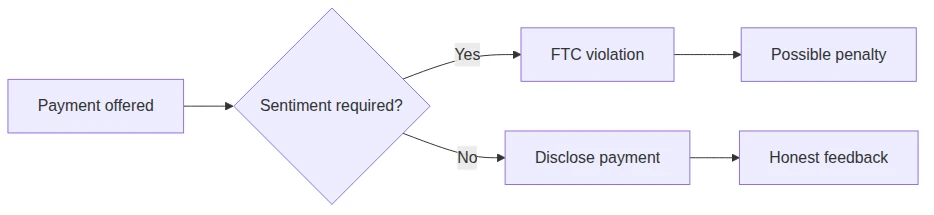
Paying a real customer for an honest, unbiased review sits in a grey zone. It may be lawful if you clearly disclose the payment and do not condition it on a specific sentiment. The FTC's Consumer Reviews and Testimonials Rule requires that any material connection — payment, free product, discount — be disclosed. Without disclosure, even a genuine review can trigger penalties.
What This Means for Your Business
You need a clear policy. Many businesses now use a platform like ReviewSense to centralise feedback and monitor for suspicious activity. The built-in spam detection flags reviews that look purchased or fake. That helps you stay compliant while focusing on genuine customer insights. For deeper guidance on managing reviews across locations, see the Top 2026 Review Management Tools for Hotels & Restaurants and Best Review Management Software 2026: 10 Platforms Compared.
What the FTC Fake Reviews Rule Actually Prohibits (And What It Doesn't)
That table shows the line between legal and illegal is thin. The FTC Fake Reviews Rule makes some practices clear-cut violations. Others depend on disclosure and intent. Here's what the rule actually prohibits — and what it doesn't.
| Prohibited Practice | Why It's Illegal | Case Example |
|---|---|---|
| Buying fake reviews from non-customers | Misrepresents consumer experience; violates FTC rule | Premium Home Service: 15,000 fake profiles |
| Paying for positive or negative sentiment | Conditions payment on specific rating; deceptive | TruHeight: paid for five-star reviews |
| Using undisclosed employee or vendor reviews | Conceals material connection; misleads consumers | Premium Home Service: employee reviews without disclosure |
| Suppressing legitimate negative reviews | Violates consumer review rule; FTC bans review gag clauses | FTC rule text: prohibits contract terms that restrict honest reviews |
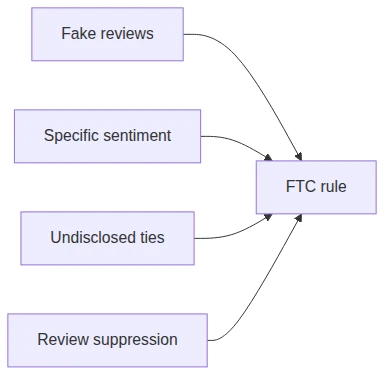
Buying fake reviews from non-customers. This is the clearest violation. The FTC rule bans writing or procuring a review that misrepresents the reviewer's experience. In the Premium Home Service case, the company created 15,000 fake profiles to post fabricated five-star reviews. The FTC fined them and required a compliance programme.
Paying for a specific sentiment. You cannot pay someone to leave a positive review — or a negative one on a competitor. The TruHeight case made this explicit. The company paid for five-star reviews without disclosing the relationship. The FTC's final order prohibited that practice and imposed a $4 million judgment.
Undisclosed employee or vendor reviews. Employees and vendors have a material connection to your business. If they leave a review without disclosing that relationship, it's deceptive. The Premium Home Service case included employee-written reviews presented as genuine customer feedback.
Suppressing legitimate negative reviews. The rule prohibits using contract terms or threats to stop customers from posting honest negative reviews. The FTC's final rule on consumer reviews explicitly bans review gag clauses.
What is potentially permissible. Offering a disclosed, non-sentiment-based incentive for an honest review from a real customer sits in a grey zone. You can offer a discount or entry into a draw — but you must clearly disclose the incentive, and you cannot condition it on a specific rating. The FTC allows this if the review reflects the customer's genuine experience.
Real Penalties and Enforcement: What Happens When You Get Caught
The rules are clear, but what happens when you break them? The consequences escalate fast. Here's the enforcement ladder, from platform action to criminal liability.
| Severity | Consequence | Example |
|---|---|---|
| 1 | Platform penalties | Review removal, account suspension |
| 2 | FTC civil penalties | Up to $53,088 per violation |
| 3 | Monetary judgments | TruHeight: $750K paid, $4M judgment |
| 4 | Broader legal liability | DOJ involvement, criminal charges |
| 5 | UK CMA investigations | £4.7M in fines, 14 investigations |
Step 1: Platform Penalties
Google acts first. In 2026, the company blocked 292 million policy-violating reviews. It also paused profiles during suspicious spikes. You lose visibility on Google Maps. Your account gets suspended. That kills local traffic overnight.
Step 2: FTC Civil Penalties
The FTC issued warning letters to 10 companies in 2025. Each violation of the Consumer Reviews Rule carries a penalty of up to $53,088. That adds up fast if you run a multi-location campaign. The FTC's enforcement actions show they target repeat offenders.
Step 3: Monetary Judgments
The TruHeight case set a precedent. The company paid $750,000 and faced a $4 million judgment. That's real money. The FTC required a compliance programme to prevent future violations.
Step 4: Broader Legal Liability
The Premium Home Service case went further. The company created 15,000 fake profiles, and the DOJ filed a civil complaint alleging violations of the FTC Act and Illinois consumer-protection law. Separately, a Washington state enforcement action against a plastic-surgery practice for review manipulation produced a $5 million settlement — the AG's office pursued that case as consumer fraud. The DOJ can get involved when fake profiles cross into identity theft.
Step 5: UK CMA Investigations
The UK's Competition and Markets Authority fined businesses £4.7 million. It investigated 14 companies for fake reviews. The CMA targets the entire supply chain, not just the review writer.
Regulators now pursue everyone involved: the business, the agency, and the platform. You need a system that flags suspicious activity. ReviewSense's spam detection catches fake reviews before regulators do. That keeps your reputation clean and your compliance simple.
For more on staying compliant, see the Review Response Templates and Review Request Email Templates.

Why Most Articles Get the Legality of Buying Reviews Wrong
That enforcement ladder makes the rules look clear-cut. Yet most articles still get the legality of buying reviews wrong. They blur five critical distinctions, leaving businesses exposed.
| Common Mistake | What It Misses | The Real Distinction |
|---|---|---|
| Equating all paid reviews | Ignores payment to real customers for honest feedback | Deception, not payment, defines illegality |
| Assuming payment = illegal | Overlooks disclosed, non-conditioned incentives | Sentiment-conditioning triggers FTC action |
| Ignoring review gating | Only asking happy customers is deceptive | Suppressing negative voices violates policy |
| Confusing federal law with platform terms | A practice can be legal but breach Google's rules | Both carry consequences |
| Missing agency liability | Business owners pay for third-party violations | The FTC holds advertisers responsible |
Blurring different practices. Paying a non-customer to write a fake review is fraud. Paying a real customer for an honest review, with clear disclosure, sits in a grey zone. The FTC's guidance on online reviews makes this distinction central. Most articles collapse both into one bucket.
'Paid' does not mean 'illegal'. The critical factor is deception and sentiment-conditioning, not payment itself. You can offer a discount for an honest review. You cannot pay for a five-star rating. The TruHeight case proved that.
Review gating gets ignored. Only asking happy customers to leave a review skews your average. Google's policy bans this practice. It's deceptive even without purchasing fake reviews. Many businesses do this daily without realising it's a violation.
Confusing federal illegality with platform-policy violations. A practice can be legal under the FTC rule but still violate Google's terms. Google blocks 292 million policy-violating reviews annually. You lose visibility either way.
Overlooking advertiser liability. The Premium Home Service case implicated relatives and an SEO agency. The business owner paid the price. The FTC holds advertisers responsible for third-party vendors.
The contrarian take: the real problem is information integrity, not compensation for honest labour. The buying reviews law targets deception, not payment. Focus on transparency. Use tools like ReviewSense to monitor for suspicious activity and maintain genuine feedback loops. For a deeper comparison, see the guide on comparing top AI review management tools.
How to Build a Compliant Review Strategy That Avoids Legal Risk
That enforcement ladder makes the rules clear, but knowing the penalties is only half the battle. You need a practical strategy that keeps your business compliant day-to-day. The table below maps common risky practices to safer alternatives.
| Practice | Risk Level | Why It's Risky | Safe Alternative |
|---|---|---|---|
| Paying for fake reviews from non-customers | High | FTC violation, platform ban | Use ReviewSense to monitor and respond to organic reviews |
| Offering incentives only for positive reviews | High | Conditioned on sentiment, violates FTC rule | Offer a disclosed, non-sentiment-based incentive for any honest review |
| Suppressing negative reviews | High | FTC violation | Use ReviewSense's sentiment analysis to address issues publicly and privately |
| Using employees as undisclosed reviewers | High | FTC violation | Never do this; use ReviewSense's AI response generator to craft on-brand replies instead |
| Failing to respond to reviews | Low risk legally, but high reputational risk | Customers expect engagement | Use ReviewSense's instant alerts and auto-reply workflows to maintain high response rates |
Start with a clear policy on incentives
The buying reviews law targets deception, not payment. You can offer a small discount for any honest review. Disclose the offer clearly. Never condition the incentive on a positive rating. The FTC's final rule on consumer reviews makes this distinction explicit.
Monitor your review velocity
A sudden spike in five-star reviews triggers platform algorithms. Google pauses profiles for suspicious activity. ReviewSense's spam detection flags these anomalies before regulators do. You catch problems early.
Respond to every review
Ignoring reviews carries low legal risk but high reputational damage. Customers expect a reply within 48 hours. ReviewSense's instant alerts and auto-reply workflows keep your response rate high. You show prospects you care.
Audit your current practices
Many businesses violate the ftc fake reviews rules without knowing it. Review gating is common. Only asking happy customers to leave feedback skews your average. Stop that practice today. Use ReviewSense's sentiment analysis to understand what customers actually say.
The safest strategy is simple: earn genuine reviews through excellent service and manage them transparently. For agencies managing multiple clients, see the guide on scaling multi-client ops. Local service businesses can find tailored advice in the best local business tools post.
Conclusion
The rules are clear: paying for reviews is illegal, and even well-intentioned practices like review gating violate platform policies. Focus on earning genuine feedback and managing it transparently. Use ReviewSense's sentiment analysis and spam detection to catch suspicious activity before regulators do. Monitor your review velocity with instant alerts. Respond to every review using AI-powered reply workflows. Audit your current practices today. Turn scattered reviews into actionable insights that drive real growth. Start your 7-day free trial.