
87% of patients read online reviews before choosing a healthcare provider, and 40% have cancelled or changed appointments based on what they found. For doctors, reputation directly impacts patient acquisition and practice viability. Managing it means protecting patient confidentiality — under UK GDPR and the Data Protection Act 2018 — while transforming feedback into actionable insights.
ReviewSense automates secure reputation management for healthcare providers.
Why Online Reputation Directly Impacts Patient Acquisition
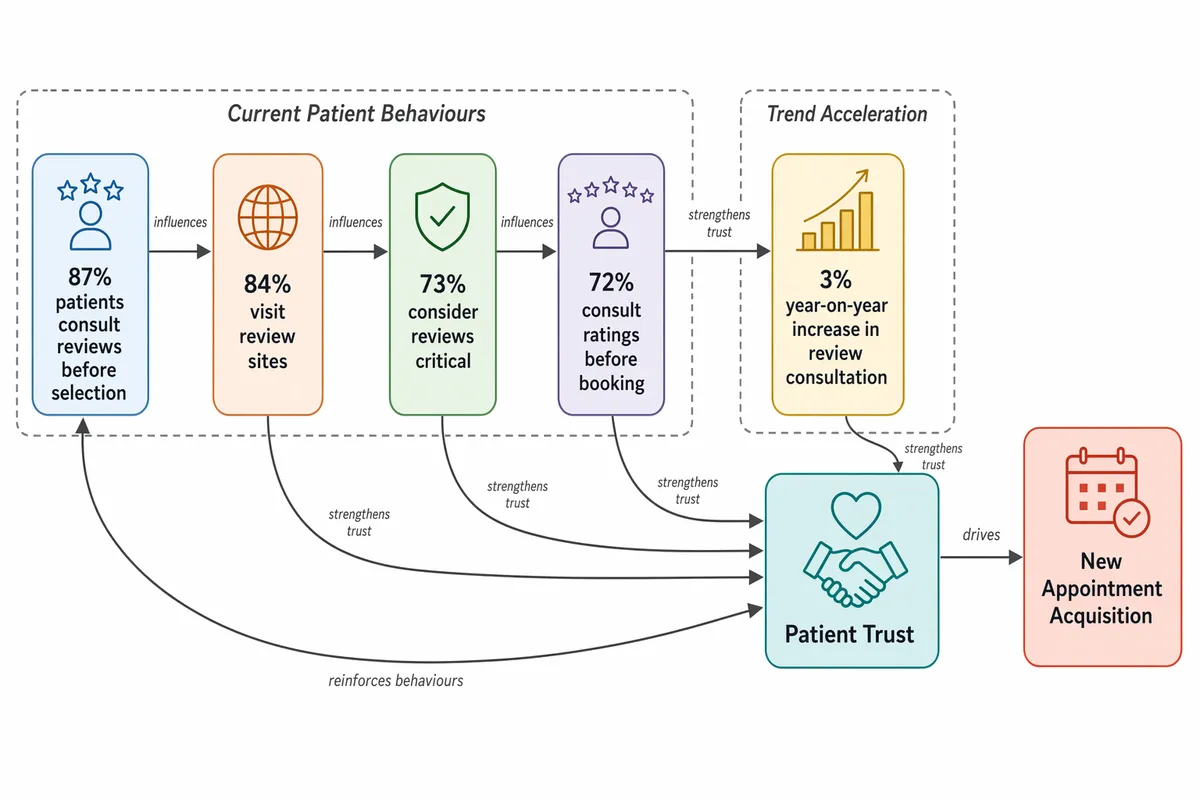
Patient decision-making now hinges on digital reputation, with 87% of patients consulting online reviews before selecting healthcare providers as of March 2026. This reliance on peer feedback creates a non-negotiable baseline for medical practices seeking new patients. Consider how these behaviours shape choices:
| Patient Behaviour | Statistic | Year |
|---|---|---|
| Read reviews pre-selection | 87% | 2026 |
| Visit review sites for evaluation | 84% | 2025 |
| Consider reviews critical for choice | 73% | 2025 |
| Consult ratings before booking | 72% | 2025 |
These figures reveal a clear trajectory: practices without visible, recent feedback become invisible to prospective patients. The 3% year-on-year increase in review consultation demonstrates accelerating dependence on digital validation. When patients encounter sparse or outdated reviews, they question practice relevance and quality assurance.
Effective reputation management for doctors requires continuous monitoring across key platforms like Google Business Profile and Facebook. Neglected reviews signal disengagement, directly impacting patient trust. This is where proactive monitoring tools prove invaluable, helping identify emerging issues before they deter potential patients.
For healthcare providers, selecting the best review management software for health wellness brands 2025 onwards demands data-protection-compliant solutions. Platforms like ReviewSense centralise feedback from Google, Facebook, and app stores while ensuring data security. Their AI response generator crafts personalised replies that maintain brand voice without compromising efficiency – crucial for time-constrained medical teams. Discover how AI-generated responses can enhance your practice's digital dialogue.
With patient acquisition directly tied to review perception, establishing systematic reputation management isn't optional – it's foundational. ReviewSense's free trial offers immediate access to sentiment analysis, response workflows, and crisis alerts. Begin transforming feedback into patient growth with no initial commitment.
Overcoming Unique Healthcare Reputation Challenges
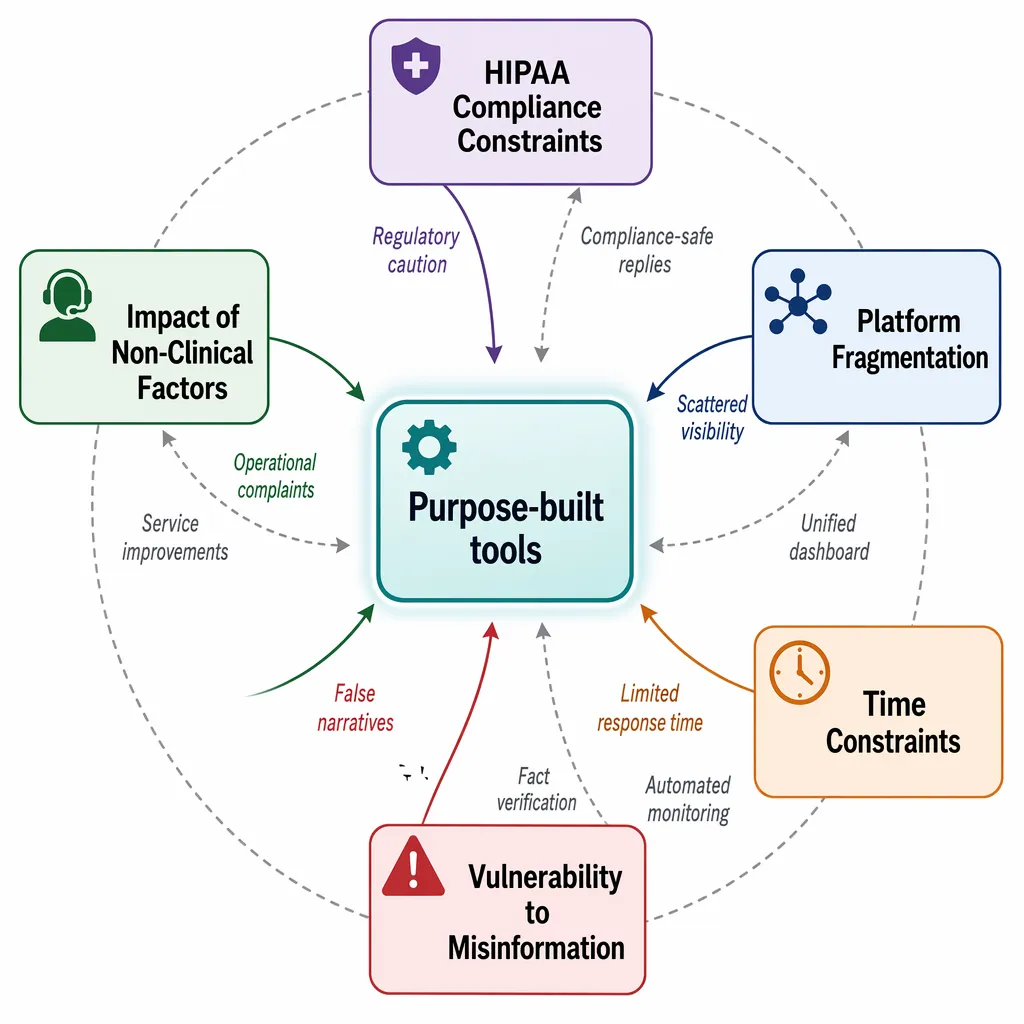
Building on the critical need for systematic reputation management, healthcare providers face distinct hurdles that demand specialised solutions. Consider how patient expectations intensify these challenges:
| Patient Expectation | Statistic | Year |
|---|---|---|
| Trust online reviews over personal recommendations | 61% | mid-2025 |
| Always read reviews when browsing | 41% | 2026 |
| Choose providers with high ratings | 90% | 2025 |
| Require 4+ stars to consider a business | 68% | 2026 |
1. Navigating patient-confidentiality constraints
While US providers operate under HIPAA, UK practices must comply with UK GDPR and the Data Protection Act 2018 (overseen by the ICO), alongside GMC confidentiality guidance. Crafting public responses requires extreme care to avoid disclosing confidential patient information. Generic replies undermine trust, yet personalised responses risk breaching confidentiality. Most patients consider timely, thoughtful replies essential for building confidence. This creates a unique balancing act for medical practices managing digital conversations.
2. Platform fragmentation across review sources
Feedback scatters across Google Business Profile, Facebook recommendations, and app store reviews. Tracking this manually wastes hours better spent with patients. Critical feedback on one platform often goes unnoticed when teams lack centralised visibility. The investigation of Google review management capabilities highlights this operational headache.
3. Time constraints for medical professionals
Doctors work within tightly packed clinics, leaving minimal bandwidth for review monitoring. Delayed responses signal indifference - 68% of patients now demand four-star minimum ratings (see how a dental practice climbs from 3.8 to 4.5 stars). Practices need efficient workflows that fit within packed clinical routines without compromising care quality.
4. Vulnerability to misinformation and fake reviews
Unverified claims about treatments or staff behaviour spread rapidly. Malicious competitors sometimes post false reviews, while well-meaning patients might misrepresent clinical outcomes. These require immediate identification to prevent reputational damage and patient confusion.
5. Impact of non-clinical factors
Wait times, billing processes, and front-desk interactions dominate negative feedback. Such operational issues frequently drive negative reviews yet often go unnoticed by clinical staff. Identifying these patterns allows practices to improve real patient experiences. Discover actionable strategies in the comprehensive review management guide.
Addressing these hurdles requires purpose-built tools that respect healthcare's regulatory environment while streamlining oversight. Centralised platforms with confidentiality-conscious workflows turn fragmented feedback into operational improvements.
Essential Capabilities in Modern Management Solutions
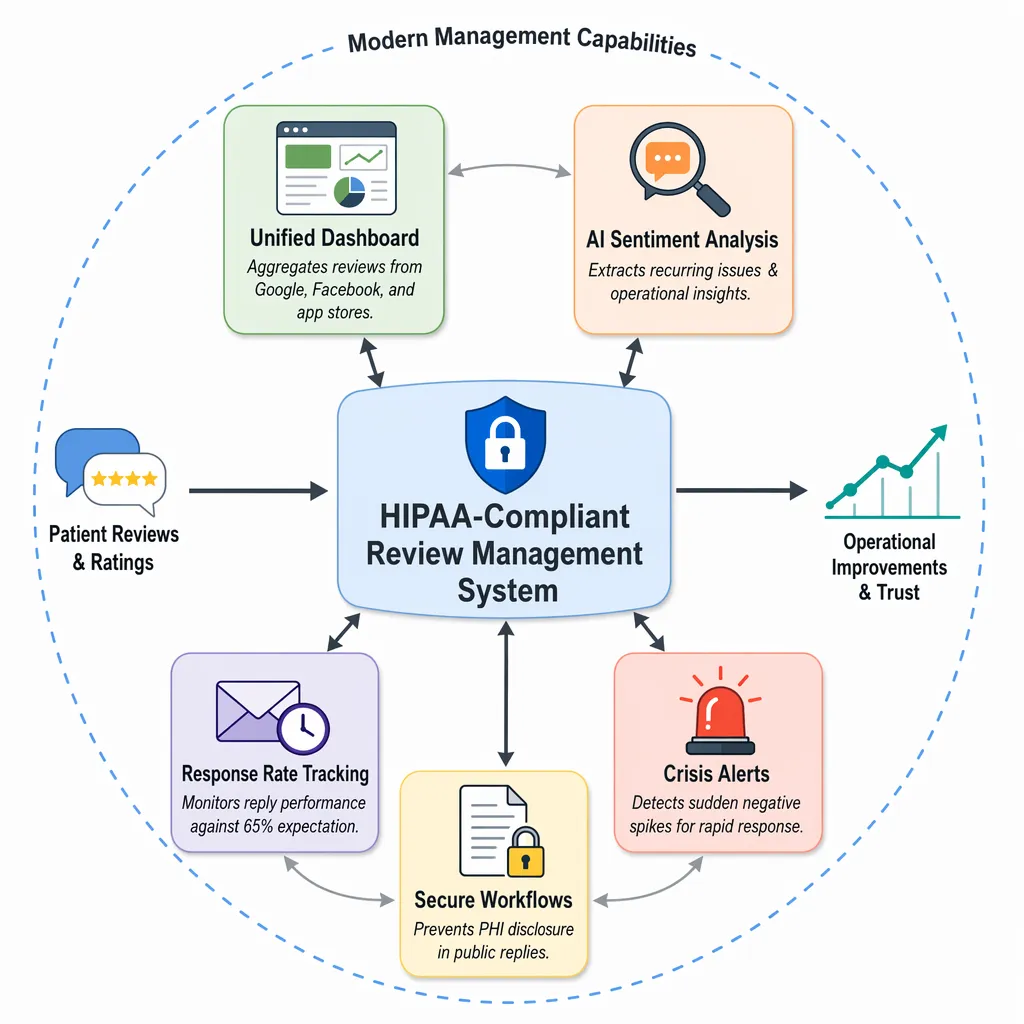
Purpose-built tools must therefore offer specific capabilities to navigate healthcare's unique reputation environment effectively. The table below compares essential features for modern solutions:
| Feature | Purpose | Healthcare-Specific Value |
|---|---|---|
| Data-protection-compliant workflows | Ensure data security | Avoids breaches when handling patient feedback |
| Unified dashboard | Centralise multi-platform reviews | Prevents missed feedback across sources |
| AI sentiment analysis | Identify recurring issues | Flags non-clinical pain points for improvement |
| Response rate tracking | Monitor reply performance | Meets 65% patient expectation for responses |
| Crisis alerts | Detect sudden negative spikes | Enables rapid damage control |
Data-protection-compliant workflows form the foundation of trustworthy review management. They prevent accidental disclosure of confidential patient information when responding publicly. This compliance isn't optional - it's fundamental to maintaining patient confidentiality.
A unified dashboard solves fragmentation by bringing Google, Facebook, and app store reviews into one secure view. This prevents critical feedback from being missed across platforms. For multi-location practices, tools like the Google Place ID lookup simplify data aggregation.
AI sentiment analysis extracts operational insights from unstructured feedback. It automatically surfaces recurring complaints about wait times or billing issues that often drive negative sentiment. This allows practices to address root causes rather than symptoms. Practices weighing up vendors on this capability can start from our comparison of the best AI-powered reputation management software for 2026, then apply the data-protection filters set out below.
Response rate tracking matters because 65% of patients consider provider replies essential. Falling short signals disengagement. Tools that automate and track responses help meet this expectation efficiently. The AI review response generator ensures timely, personalised replies without compromising compliance.
Crisis alerts provide early warnings for sudden review spikes. A surge in one-star reviews could indicate serious operational issues or misinformation spreading. Immediate notification lets teams contain reputational damage before it escalates.
These capabilities define full-cycle platforms in 2026, turning scattered feedback into operational improvements. For practices, choosing data-protection-compliant review management isn't just about security - it's about building trust at scale. Maintaining high ratings remains critical, with nearly a third of patients refusing to consider practices below 4.5 stars. Use the star rating calculator to track your progress against this benchmark. Explore transparent pricing to find the right solution for your practice size.
How AI Transforms Feedback Into Patient Experience Insights
Moving beyond basic monitoring, AI-powered analysis transforms raw feedback into actionable patient experience intelligence. This elevates reputation management from reactive damage control to proactive improvement. Consider how these three AI applications drive meaningful change:
| AI Application | Core Functionality | Healthcare Impact |
|---|---|---|
| Real-time topic detection | Identifies recurring non-clinical issues | Pinpoints operational fixes that boost satisfaction |
| Personalised response generation | Creates consistent, on-brand replies | Builds trust: 42% more trust in responding providers |
| Sentiment dashboards | Visualises trends and detects negative spikes | Allows proactive intervention to retain 64% of dissatisfied patients |
Pinpointing Operational Weaknesses Through Topic Analysis
AI scans reviews across Google, Facebook, and app stores to surface recurring themes like appointment delays or billing frustrations. Unlike manual monitoring, it detects patterns in hundreds of reviews instantly. This reveals systemic issues clinical staff might miss, such as persistent front-desk problems affecting multiple patients. Practices then implement targeted improvements rather than treating symptoms. Effective customer review management uses these insights to enhance real-world experiences.
Building Trust Through Authentic Engagement
Timely, thoughtful responses demonstrate care - 42% of prospective patients report increased trust when seeing replies. AI generates personalised responses reflecting your practice's voice while maintaining patient confidentiality. Crucially, it doesn't replace human oversight. Clinicians review each AI-suggested reply, ensuring medical accuracy before sending. This balances efficiency with responsibility. The AI review response generator helps maintain this delicate equilibrium without compromising standards.
Preventing Escalation With Proactive Monitoring
Sentiment dashboards track satisfaction trends across locations, flagging emerging issues before they become crises. When negative feedback spikes, instant alerts enable swift action. This matters profoundly: 64% of patients would return to practices that professionally address concerns. By spotting early warning signs - like sudden complaints about new billing software - teams resolve problems while demonstrating responsiveness.
Unlike superficial review management, AI-driven systems create feedback loops that improve actual patient experiences. They address time constraints by automating tedious tasks, not clinical judgment. As recent industry research confirms, this approach turns feedback into a strategic asset for any practice prioritising both efficiency and patient care.
Evaluating Software for Practices and Health Systems
Building on AI's role in transforming feedback, practices need a structured approach to select software that meets healthcare's unique demands. Use this five-point framework to evaluate solutions:
| Evaluation Criteria | Key Considerations for Healthcare |
|---|---|
| 1. Data Protection & EHR Integration | Must meet UK GDPR / DPA 2018 standards and integrate with major EHR systems without manual data entry |
| 2. Multi-Location Scalability | Centralised oversight with location-level permissions and reporting for health systems |
| 3. AI Customisation for Brand Voice | Ability to reflect clinical tone and avoid overly promotional language |
| 4. Response Workflow Efficiency | Tools to ensure timely, compliant replies that build patient confidence |
| 5. Free Tools Value Assessment | How trial features and calculators support immediate reputation goals |
1. Verify Data-Protection Compliance and EHR Integration
Prioritise platforms with audited data-protection compliance (UK GDPR / DPA 2018), especially as 2026 regulations tighten data handling requirements. Native EHR integration is non-negotiable – manual data exports create compliance risks and operational delays. Verify if the software connects natively with systems like EMIS or SystmOne to protect patient confidentiality.
2. Assess Multi-Location Scalability
For health systems managing multiple sites, ensure the platform offers granular permission controls and consolidated reporting. Staff at each location should respond to local reviews while leadership monitors system-wide trends. This prevents critical feedback from being overlooked across branches.
3. Test AI Customisation for Brand Voice
Generic AI responses undermine trust. Confirm the tool adapts to your practice's communication style – whether empathetic or clinically precise – while avoiding sales language. As recent data shows, 26% of patients report that AI tools have influenced their choice of provider, making authentic engagement essential.
4. Analyse Response Workflow Efficiency
Timely responses impact patient retention: Seek tools with automated alerts, approval queues, and templated responses for common scenarios. Efficient workflows help practices address concerns before they escalate.
5. Compare Value of Free Tools vs. Paid Features
While free tools like the How Many 5-Star Reviews Calculator help set rating goals, evaluate if paid features justify investment through time savings or improved outcomes. Trials should demonstrate tangible efficiency gains in daily operations. For broader context, see the analysis of the best review management software for health wellness brands 2026.
Conclusion
In today's healthcare environment, patient reviews on Google, Facebook, and app stores directly impact trust and retention. As we've explored, effective reputation management requires more than monitoring—it demands data-protection-compliant workflows, scalable multi-location oversight, and AI that preserves your practice's clinical tone. ReviewSense delivers precisely this: automating review responses while surfacing critical feedback trends through sentiment analysis, ensuring no concern goes unaddressed. By centralising fragmented feedback from key platforms into actionable insights, practices prevent operational blind spots and demonstrate proactive patient care. Ready to transform scattered reviews into your practice's growth engine? Start your 7-day free trial.