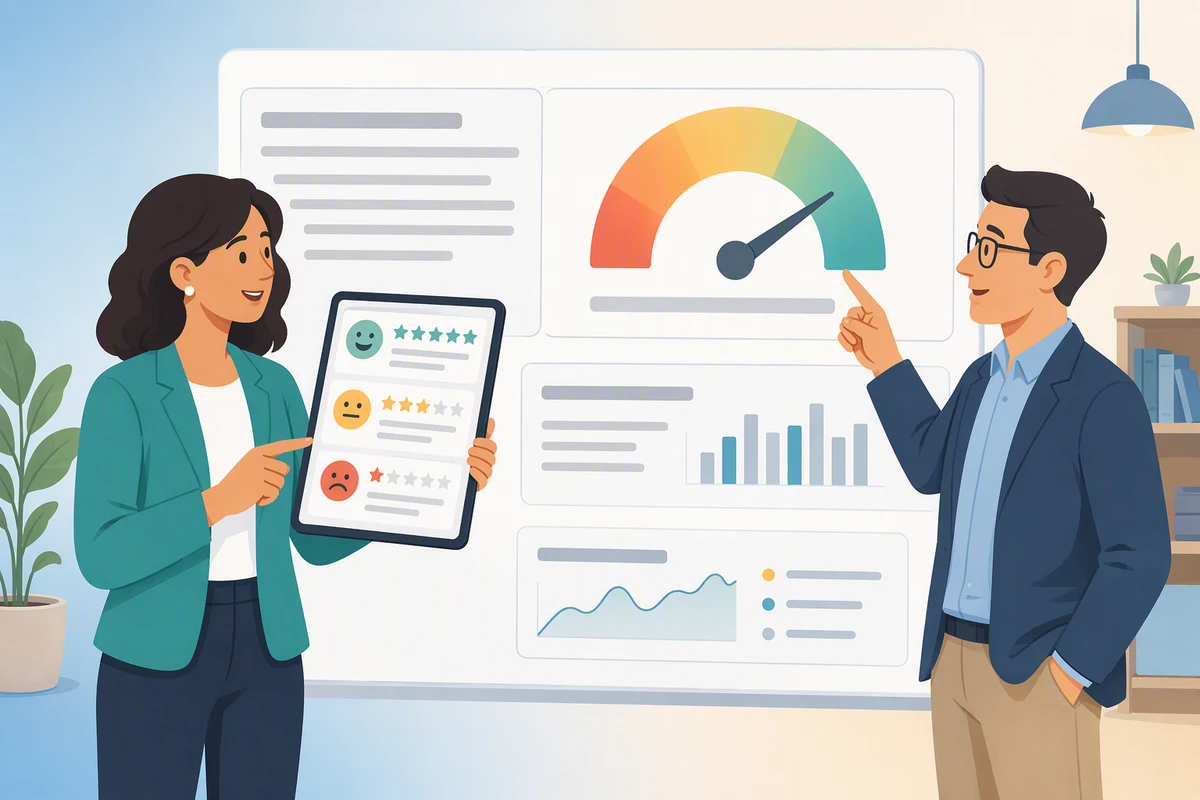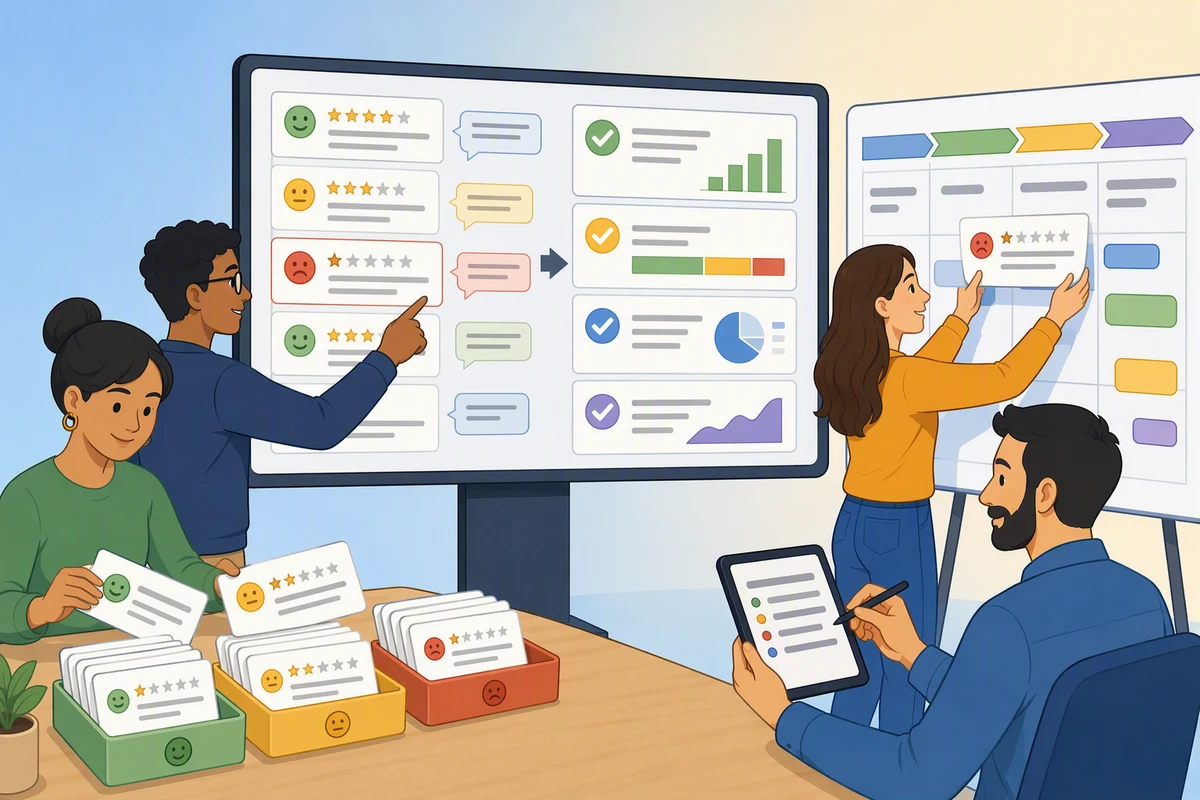
The median feedback-to-action linkage across 28 high-feedback organisations was effectively 0%. That is not a rounding error — it means the vast majority of customer insights are collected, categorised, and then abandoned. A 2026 benchmark of 5.13 million feedback records revealed that while taxonomy and sentiment coverage reach 64% and 71% respectively, the critical step — actually changing something based on that data — barely registers. Closing the customer feedback loop isn't just about gathering more reviews; it is about building a feedback loop process that connects each piece of feedback to a specific operational intervention.
Managing this manually is hard. ReviewSense automates it.
Why Most Feedback Loops Fail to Drive Change
That gap between collecting feedback and acting on it has a name: the execution gap. Most organisations confuse gathering data with closing the loop. They treat a full inbox of reviews as proof of progress.
| Common pitfall | What it looks like | Why it fails |
|---|---|---|
| Treating frequency as importance | Prioritising the most common complaint | Misses low-volume, high-severity issues |
| Over-indexing on complaints | Ignoring neutral or positive feedback | Skews resource allocation toward vocal minorities |
| Failing to weight by segment | Treating a one-star review from a new user like one from a loyal customer | Distorts true impact on retention |
Consider the numbers. A benchmark of 28 high-feedback organisations, analysing 5.13 million records, found the median feedback-to-action linkage was effectively 0%. Thirty to forty percent of departments take no action after receiving CX data, according to Medallia’s 2026 report. That’s not a data problem. It’s a process problem.
One root cause is mistaking feedback for truth. A customer’s literal request is a hypothesis about an underlying job. Ask for a faster checkout, but the real need might be less friction in payment. Close the feedback loop by testing the hypothesis, not just implementing the ask.
Another trap: treating all feedback equally. A single angry review from a one-time visitor gets the same weight as a pattern from repeat buyers. That distorts priorities. A proper feedback loop process weights input by severity, segment, and business impact.
The result? Teams drown in data but starve for insight. They close tickets without closing the loop. The promise of this article is a system that produces measurable change, not just more spreadsheets. Start by extracting themes from customer reviews to separate signal from noise.

The New Standard: From Collection to Operational Intervention
The execution gap described above demands a structured response. A modern customer feedback loop turns passive collection into active intervention. Here is the process.
| Step | Action | Outcome |
|---|---|---|
| 1 | Capture multimodal signals | Fill the direct-feedback gap |
| 2 | Classify and diagnose | Extract topics and sentiment |
| 3 | Trigger action | Initiate service recovery |
| 4 | Respond visibly | Build trust through speed |
| 5 | Measure the outcome | Track real business impact |
1. Capture multimodal signals
Only 31–32% of consumers give direct feedback after an experience, according to Qualtrics research. That leaves a massive blind spot. Reviews on Google, Facebook, Apple App Store, and Google Play fill that gap. ReviewSense centralises these signals into one dashboard. You see the full picture, not just the vocal few.
2. Classify and diagnose
Raw feedback is noise. A 2026 study of 17 companies found median taxonomy coverage was only 64% and sentiment coverage 71%. Customer-context and feedback-to-action linkage were effectively zero. That’s where AI-powered analysis steps in. ReviewSense’s sentiment analysis extracts key topics and flags recurring issues. You diagnose the root cause, not just the symptom.
3. Trigger action
Data without action is decoration. In one cited case, Qualtrics’ AI agents helped TruGreen reduce escalations by more than 30% through automated service recovery. ReviewSense sends crisis alerts for negative spikes. Your team acts before a bad review becomes a trend.
4. Respond visibly
Customers now judge brands by response speed. One in three would switch brands rather than remain on hold, per a Parloa study. To close the feedback loop, you must reply fast and on-brand. ReviewSense’s AI response generator creates personalised replies in seconds. You maintain your voice without the delay.
5. Measure the outcome
Track feedback-to-action linkage, time to decision, issue resolution rate, and repeat-contact rate. These metrics reveal whether your feedback loop process actually drives change. Without them, you’re guessing. ReviewSense’s analytics make the outcome visible.

What the 2026 Research Reveals About Priorities
Those five steps demand a clear-eyed look at what the data actually says. The 2026 research reveals a hard truth: most organisations still fail to close the feedback loop.
| Statistic | Source | What It Means for Your Feedback Loop |
|---|---|---|
| Feedback-to-action linkage effectively 0% | Enterpret | Collecting feedback without action is wasted effort. |
| 66% of CX practitioners believe experience improved, but only 17% of consumers agree | Medallia | Perception gap means companies must close the loop with customers, not just internally. |
| 78% of practitioners plan new measurement approaches | Medallia | The industry is shifting to action-oriented metrics. |
| Direct feedback declining 6.5-7.7 points vs 2021 | Qualtrics | Reliance on surveys is risky; reviews and unsolicited feedback are more critical. |
| 49% of negative feedback comes via email, 40% via website | Qualtrics | Centralised review management captures what surveys miss. |
| 70% of executives say expectations change faster than adaptation | PwC | Real-time alerts and AI responses are essential. |
The most important 2026 metric is feedback-to-action linkage. It exposes the gap between hearing customers and changing behaviour. ReviewSense’s analytics directly address this. Sentiment trends show you what matters. Response rates reveal who acts. Review velocity flags shifts before they become crises. Crisis alerts for negative spikes let your team intervene fast. That’s how you close the feedback loop with evidence, not guesses. The centralised review dashboard captures the unsolicited feedback that surveys miss. You stop measuring activity and start measuring change.

How to Build a Feedback System That Actually Changes Behavior
The previous section showed that feedback-to-action linkage often sits at zero. Building a system that actually changes behaviour requires a different approach. It starts with understanding what you're collecting.
Distinguish Signal, Diagnosis, Prescription, and Demand
Not all feedback holds equal weight. A contrarian taxonomy separates four types. Signal is evidence of a problem: "Your app crashed three times." Diagnosis offers an explanation: "It crashes when I upload photos." Both are high-value because they reveal truth. Prescription proposes a solution: "Add a progress bar." Demand is a roadmap request: "Build an Android version." Prescriptions and demands require judgment. A customer's proposed fix may mask a deeper issue. Treat signal and diagnosis as facts. Treat prescription and demand as hypotheses to test. This distinction prevents wasted effort on the wrong fixes.
Route Feedback to the Right Decision-Makers
To close the feedback loop, you must separate response from resolution. Bain & Company describes two loops. The inner loop is frontline response: a manager replies to a review within hours. The outer loop is systemic: a product team fixes the root cause over weeks. ReviewSense's collaboration tools and queue workflows assign feedback to the right owner. A local manager handles the inner loop. A product lead owns the outer loop. This feedback loop process ensures no signal gets lost between departments.
Measure the Outcome, Not Just the Output
Response rate is a vanity metric. It measures activity, not change. Instead, track whether the original problem frequency decreased. Did crash reports drop after the fix? Did retention improve for the affected segment? Did the fix create new issues? Apply the counterfactual principle: what would have happened without the intervention? Recent industry research shows most organisations still measure output, not outcome. That keeps the feedback loop broken.
Communicate Changes Back to Customers
Closing the loop means telling customers what changed. Not "we heard you." A specific statement: "We fixed the upload crash you reported." ReviewSense's personalised AI replies and auto-reply workflows make this scalable. You reply fast and cite the fix. Customers see their input caused action. That builds trust and encourages future feedback. Use the Google Review Management Software: Capabilities, Limits & ROI guide to see how structured responses improve retention. The Small Business Review Management page offers practical steps for teams with limited resources. Without this final step, the loop stays open.
Comparison Criteria: Choosing a Platform That Bridges the Action Gap
That gap between hearing customers and changing behaviour is exactly where most platforms fall short. The 2026 research confirms it: 70% of executives say customer expectations change faster than their company can adapt. Choosing a review management platform means evaluating it against that action gap. Here is how to judge each option.
1. Does it centralise feedback from the platforms your customers actually use?
Most negative feedback arrives through email (49%) or a company website (40%). Yet many tools only pull from one or two public review sites. ReviewSense centralises Google Business Profile, Facebook, Apple App Store, and Google Play into a single dashboard. You capture the private complaints and the public reviews in one place.
2. Does it classify feedback automatically?
Raw feedback is noise without structure. The platform must extract key topics and flag recurring issues. ReviewSense's built-in sentiment analysis detects spam and toxic content automatically. Your team focuses on genuine signals, not manual sorting.
3. Can it trigger immediate response?
Speed matters. A slow reply signals indifference. ReviewSense sends instant alerts for new reviews. Its AI response generator creates on-brand replies in seconds. You close the feedback loop before the customer moves on.
4. Does it support both inner and outer loops?
Frontline staff need queue workflows for quick replies. Product teams need analytics for systemic fixes. ReviewSense provides both. Queue workflows handle the inner loop. Sentiment trends and review velocity data feed the outer loop. This feedback loop process connects daily actions to long-term change.
5. Does it detect crises before they escalate?
A single negative spike can damage reputation fast. ReviewSense sends crisis alerts for negative spikes. Your team intervenes before the problem compounds.
6. Can it scale across locations?
Multi-location enterprises need collaboration tools and white-label reporting. ReviewSense offers custom integrations and brand voice controls. One dashboard serves a single shop or a national chain.
7. Is it easy to evaluate?
Transparent pricing and a 7-day free trial remove risk. Free tools like a Google review link generator and negative review templates provide immediate value. You test before you commit.
Conclusion
Closing the feedback loop requires more than replying to reviews. It demands a system that captures signals, assigns ownership, measures outcomes, and communicates change back to customers. ReviewSense delivers that system. It centralises feedback from Google Business Profile, Facebook, Apple App Store, and Google Play. Sentiment analysis flags recurring issues. Crisis alerts catch negative spikes early. Queue workflows route inner-loop fixes to frontline staff. Outer-loop analytics inform product improvements. Teams measure whether problems decline, not just response rates. Customers see their input caused action. That builds trust. That closes the loop. Start your 7-day free trial and turn scattered reviews into actionable insights that drive real change.