Only 31% of consumers provide direct feedback after a very good experience—and just 32% do after a poor one. That means your customer sentiment analysis tool is working with a fraction of the full picture. A single "72% positive" score hides more than it reveals, especially when 77% of service leaders face pressure to deploy AI. If you're relying on a dashboard number alone, you're making decisions on incomplete data.
Managing this manually is hard. ReviewSense automates it by centralising multi-platform feedback and linking sentiment to specific journey stages, so you know exactly what to fix.
Why a Sentiment Score Alone Is a Weak Signal
Most articles treat a sentiment score as a reliable read on how customers feel. That assumption is misleading. A polarity label — positive, neutral, negative — is a lossy summary, not a direct measurement of satisfaction, loyalty, or commercial risk.
| What a Sentiment Score Hides | Why It Matters |
|---|---|
| Self-selection bias | Only 31% of consumers gave direct feedback after a very good experience. After a very poor one, only 32% did. |
| Reporting bias | Among those who complained directly, 49% used email and 40% used the company website. The silent majority never speaks. |
| Channel distortion | A Facebook review differs from a Google Play rating. The score collapses them into one number. |
| Topic blindness | A 4-star review might praise the product but bury a complaint about shipping. The score ignores that. |
The score reflects who chose to speak, not the entire customer base. Self-selected reviewers often do not represent the broader population, as MIT Sloan research confirms. That means a 4.2 average could mask a recurring defect that only 5% of customers bothered to report.
Why Context Changes Everything
A customer sentiment analysis tool must contextualise the score with channel, topic, and journey stage. A negative rating on the Apple App Store during checkout tells a different story than a negative rating about product durability. Without that context, you are acting on noise.
The Real Value: Aspect-Level Scoring
The next step is aspect-level scoring. Instead of asking "Is this review positive?", ask "What does the customer feel about delivery speed, product quality, or support?" That shift turns a weak signal into a specific action. You can then fix the checkout flow, not the entire experience.
What the Score Triggers
The real value lies in what the score triggers, not the number itself. A drop in sentiment should prompt a review of recent changes, a spike in negative feedback should alert the team, and a pattern across locations should update training. Without that trigger logic, even the best sentiment analysis software is just a dashboard with a pretty colour.
For a deeper look at how to manage feedback across channels, see the Google Review Management Software guide. And if you are dealing with fake reviews, our step-by-step guide on how to report and remove fake Google reviews can help clean your data.

What the Score Actually Means in Practice
A sentiment score without context is a number looking for a story. The industry has moved past simple polarity labels toward scores that trigger real action. Sprinklr's Summer '26 release exemplifies this shift, enabling brands to move from insights to real-time customer action. That changes what a score means in practice.
What a Meaningful Score Includes
| Component | Why It Matters |
|---|---|
| Aspect-level scoring | One score per review hides the real problem. A customer might love the product but hate the delivery. |
| Whole-interaction context | Mixed emotions are normal. CallMiner's whole-contact classifiers handle domain-specific language and emotional shifts across a single conversation. |
| Outcome linkage | The score must connect to resolution and churn risk. A negative score that gets resolved tells a different story than one that doesn't. |
The Stakes of Getting It Wrong
A single misinterpreted score can cost you a customer. Research shows that 79% of respondents would switch after one bad experience. That makes accurate interpretation critical. A customer sentiment analysis tool must explain its output. It should show the contributing topic, a text excerpt, and a confidence level. Without that, you're guessing.
Why Automation Matters Now
Seventy-seven percent of customer-service leaders report pressure from senior executives to deploy AI. Many have seen their AI budgets rise. That pressure makes sense. A good sentiment analysis software automates the hard part: turning feedback into action. It flags a recurring issue about checkout errors, not just a negative score.
What the Score Should Trigger
A score should trigger a workflow. A spike in negative feedback alerts the team. A pattern across locations updates training. A resolved complaint closes the loop. That's the difference between a dashboard and a tool that drives growth. Different industries face unique challenges in applying these scores, which we'll cover next.

Industries Where Sentiment Scores Mislead Most
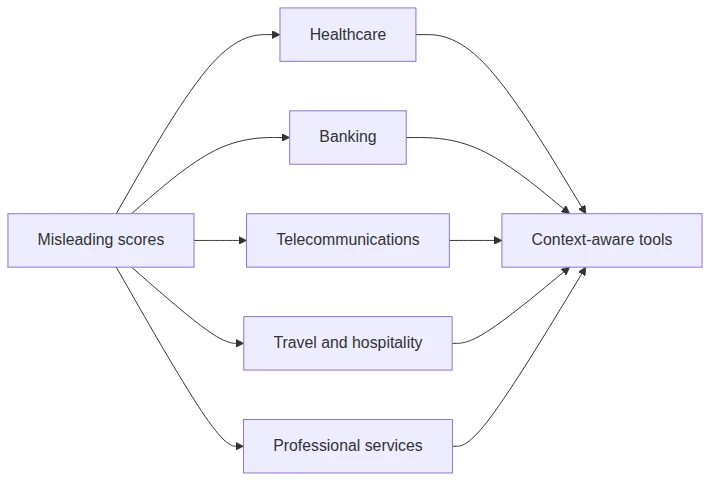
Different industries warp sentiment scores in predictable ways. A customer sentiment analysis tool that ignores these distortions produces misleading signals. The table below shows where scores fail most.
| Industry | Why the Score Misleads | What a Better Tool Does |
|---|---|---|
| Healthcare | HIPAA rules strip patient identifiers, removing context. Clinical terminology like "stable" or "managed" reads as neutral, not positive. Emotional complexity — gratitude mixed with anxiety — flattens to a single label. | Detects topic clusters (wait times, billing, bedside manner) without exposing PHI. Flags emotionally complex reviews for human review rather than auto-scoring. |
| Banking | Compliance rules (SEC recordkeeping, Reg Z) force generic language. A customer who says "I'm managing" may be hiding financial distress. Sarcasm about fees reads as positive. | Spam and toxicity detection filters fake complaints. Sentiment analysis on Google Business Profile and Facebook catches account-level feedback patterns. |
| Telecommunications | High-volume, event-driven complaints (outages, billing errors) spike scores temporarily. A single outage can tank a 4.5 average, masking stable service quality. | Tracks review velocity and crisis alerts. Separates event-driven noise from chronic issues using sentiment trends over time. |
| Travel/Hospitality | Sarcasm is rampant. "Great, another delayed flight" scores positive. Fake reviews from competitors or bots inflate ratings. FTC rules on deceptive reviews require verification. | Fake review checker identifies suspicious patterns. Sentiment analysis software on supported platforms only (Google, Facebook, Apple, Google Play) avoids unsupported channels. |
| Professional Services | Clients use indirect language: "We expected more" instead of "This was poor." Feedback is account-level, not transaction-level. A single partner relationship skews the score. | Collaboration tools let teams add context to reviews. Queue workflows route account-level feedback to the right person. |
Specialised vocabulary, privacy constraints, and sampling bias are the common threads. Research from PMC confirms that domain adaptation — training models on industry-specific language — remains a central challenge. A generic sentiment score cannot handle clinical terms, regulatory language, or indirect complaints.
These challenges inform what to look for in a customer sentiment tool. The next section covers the specific features that separate useful tools from misleading ones.
How to Evaluate a Tool Beyond the Dashboard
Those industry distortions make one thing clear: a dashboard alone won't save you. You need a customer sentiment analysis tool that passes real-world tests. Here are nine criteria to evaluate any tool beyond the surface.
| Criterion | Why It Matters |
|---|---|
| 1. Omnichannel ingestion | Consumers expect 24/7 service, but feedback lives across Google, Facebook, Apple, and Google Play. A tool that misses one channel misses the full picture. |
| 2. Aspect-level sentiment | A single score hides mixed feelings. A customer might praise the product but hate the delivery. Aspect detection surfaces that split. |
| 3. Emotion and urgency detection | 85% of CX leaders say customers may abandon brands over unresolved issues. Detecting frustration early prevents churn. |
| 4. Multilingual support | Global brands need analysis across languages. A tool that only handles English creates blind spots. |
| 5. Human review and correction | AI makes mistakes. A tool must let teams override scores and add context. |
| 6. Sampling bias controls | Reviews skew toward extremes. A good tool flags when data is unrepresentative. |
| 7. Integrations with CRM/help desk | Sentiment data must flow into existing workflows, not sit in a silo. |
| 8. Closed-loop workflows | Alerts, escalations, and case creation turn insight into action. |
| 9. Outcome measurement | Did the intervention improve retention? A tool must link scores to business results. |
Why Each Criterion Matters
Omnichannel ingestion is non-negotiable. 74% of consumers expect 24/7 availability, yet feedback arrives at all hours across different platforms. A customer sentiment analysis tool that only ingests one channel creates a distorted view. You need a tool that centralises reviews from Google Business Profile, Facebook, Apple App Store, and Google Play.
Aspect-level sentiment separates vague scores from actionable insight. A negative score on a restaurant review could mean slow service or cold food. Aspect detection pinpoints the issue. Recent Gartner research confirms that sentiment analysis works best when integrated into a broader Voice of Customer platform that connects collection, analysis, and action.
Emotion and urgency detection catches what polarity misses. A customer who writes "I'm furious" needs a faster response than one who says "It was okay." 85% of CX leaders say customers may abandon brands after an unresolved first contact. A tool that flags urgency helps teams prioritise.
Turning Sentiment Into a Decision, Not a Number
Those nine criteria separate a useful tool from a misleading one. But even a tool that passes every test can fail if you treat the sentiment score as the final answer. The score is an intermediate signal, not an endpoint.
You do not need a tool to tell you that an angry customer is angry. You need a system that tells you which recurring, fixable problems are economically important. That distinction changes everything.
From Score to Structure
The Harvard Business Review has long argued that text analytics turns raw language into structured business insight. The best systems classify feedback by sentiment, subject, customer segment, product feature, urgency, and business impact. A single score cannot do that.
| Layer | Question It Answers | Example |
|---|---|---|
| Expression | What emotion is present? | Negative sentiment |
| Cause | What triggered it? | Confusion during SSO setup |
| Context | Who is affected and when? | Enterprise administrators, first week |
| Consequence | What is the business cost? | Two extra support contacts, delayed activation |
The strongest architecture links all four layers. 'Negative sentiment' becomes 'Enterprise administrators report confusion during SSO setup.' That becomes 'SSO confusion causes two additional support contacts and delays activation.' The final link: 'Simplifying the setup flow reduces time-to-value.'
Why This Architecture Wins
Recent Zendesk research found that 82% of CX leaders say promptable analytics unlock insights in seconds. The same study shows 88% of customers expect faster response times than they did one year earlier. A tool that only surfaces a score cannot meet that expectation.
ReviewSense uses sentiment analysis that extracts key topics, flags recurring issues, and provides crisis alerts for negative spikes. It connects expression to consequence without forcing your team to guess.
The Market Is Moving
The global market for sentiment-analysis software and the broader sentiment-analytics systems category sits at roughly $3.4–$5.6 billion in 2026. Analysts project sentiment-analysis software alone will reach $10.1 billion by 2033. The winners will be tools that prioritise decision quality over dashboard quantity.
Choose a customer sentiment tool that turns language into action, not just a number. Your reputation depends on it.
Conclusion
A sentiment score alone tells you little. The real value lies in connecting that score to a cause, a context, and a consequence. You need a tool that surfaces recurring issues, flags urgent spikes, and links feedback to business outcomes—not one that simply paints a dashboard red or green. ReviewSense delivers exactly that architecture. It extracts key topics from every review across your supported platforms, detects spam, and alerts your team the moment sentiment shifts. Stop guessing what your customers mean. Turn scattered reviews into actionable insights that protect your reputation and drive retention. Start your 7-day free trial