
With 80% of customer feedback collected by DTC brands still sitting unanalysed, the gap between data and action is costing you revenue. Reviews influence over 90% of purchase decisions, yet most brands lack the tools to respond, aggregate, and learn from that feedback at scale. In 2026, the right platform isn't a nice-to-have — it's the difference between a loyal customer and a lost one.
Managing this manually is hard. ReviewSense automates it.
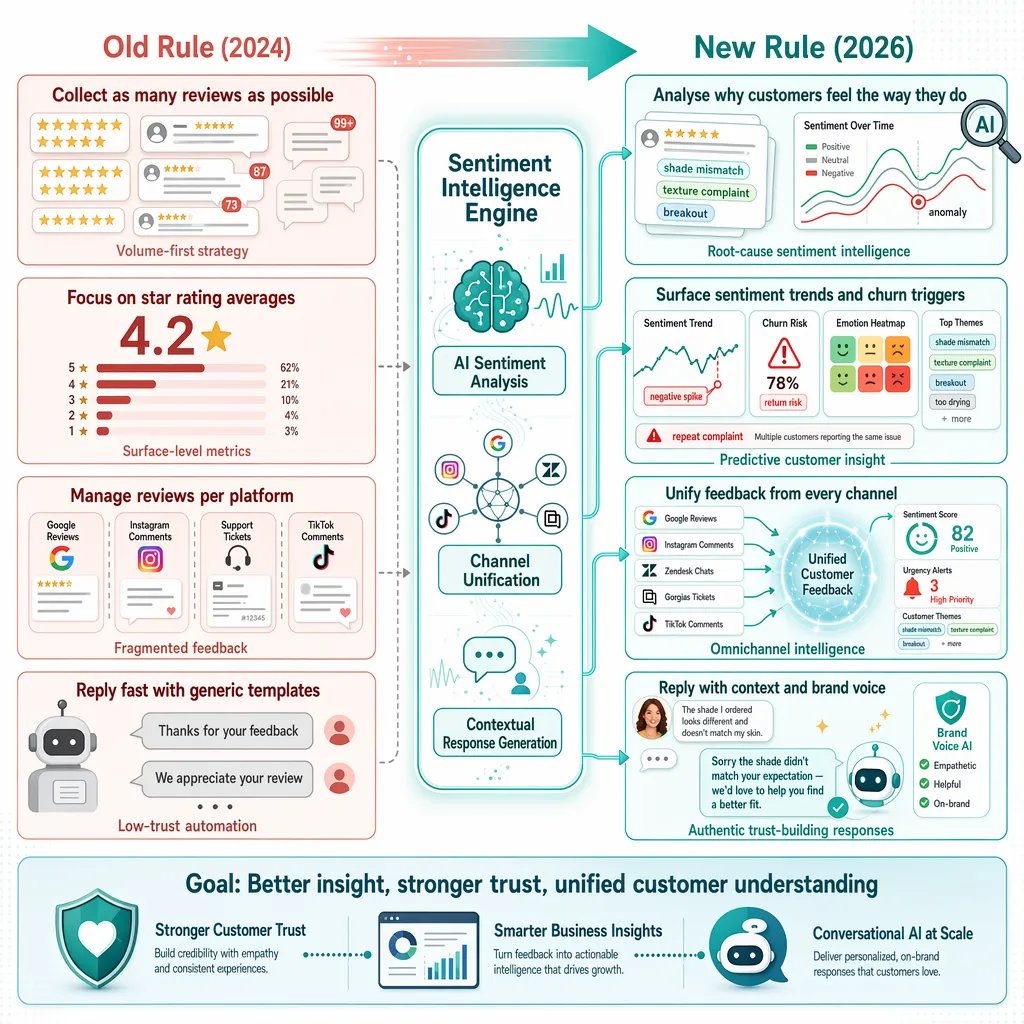
The New Rules of Review Management in 2026
This shift matters most for high-consideration categories like cosmetics, where trust and authenticity are everything. The old volume game is dead. 2026 is about intelligence, not just collection.
Here’s how the rules have changed:
| Old Rule (2024) | New Rule (2026) |
|---|---|
| Collect as many reviews as possible | Analyse why customers feel the way they do |
| Focus on star rating averages | Surface sentiment trends and churn triggers |
| Manage reviews per platform | Unify feedback from every channel |
| Reply fast with generic templates | Reply with context and brand voice |
AI Sentiment Analysis Goes Deeper
Star ratings tell you what happened, not why. The customer feedback software market reached $2.26 billion in 2026, growing at 13.2% annually, driven by tools that decode the story behind the score. Recent industry research shows AI now surfaces specific churn triggers, like “shade mismatch” or “texture complaint,” from raw text. For DTC retail, that’s gold. You’ll spot a returning issue before it hits your return rate.
Omnichannel Unification Is Non-Negotiable
Customers don’t care about your platform silos. They leave feedback on Google, Instagram, and your support tickets. Top review management platforms for DTC retail 2026 must pull everything into one view. That includes Zendesk chats, Gorgias tickets, and TikTok comments. A star rating calculator helps, but the real win is seeing the full picture. For cosmetics brands, a complaint about “breakout” on a support ticket is as urgent as a one-star Google review.
Automated Responses That Sound Human
Generic “thanks for your feedback” replies damage trust. Modern tools like an AI review response generator craft replies that match your brand voice and reference the specific issue. For review management for cosmetics brands, that means acknowledging a shade issue without sounding robotic. You can also explore Apple App Store review management software and Google Play review management for app-based DTC brands.
The goal isn’t more reviews. It’s better insight. Using AI review response generators to improve online reputation is just one piece of a broader strategy. Sign up to see how ReviewSense centralises your feedback into one dashboard.
What to Look for in a 2026 Platform
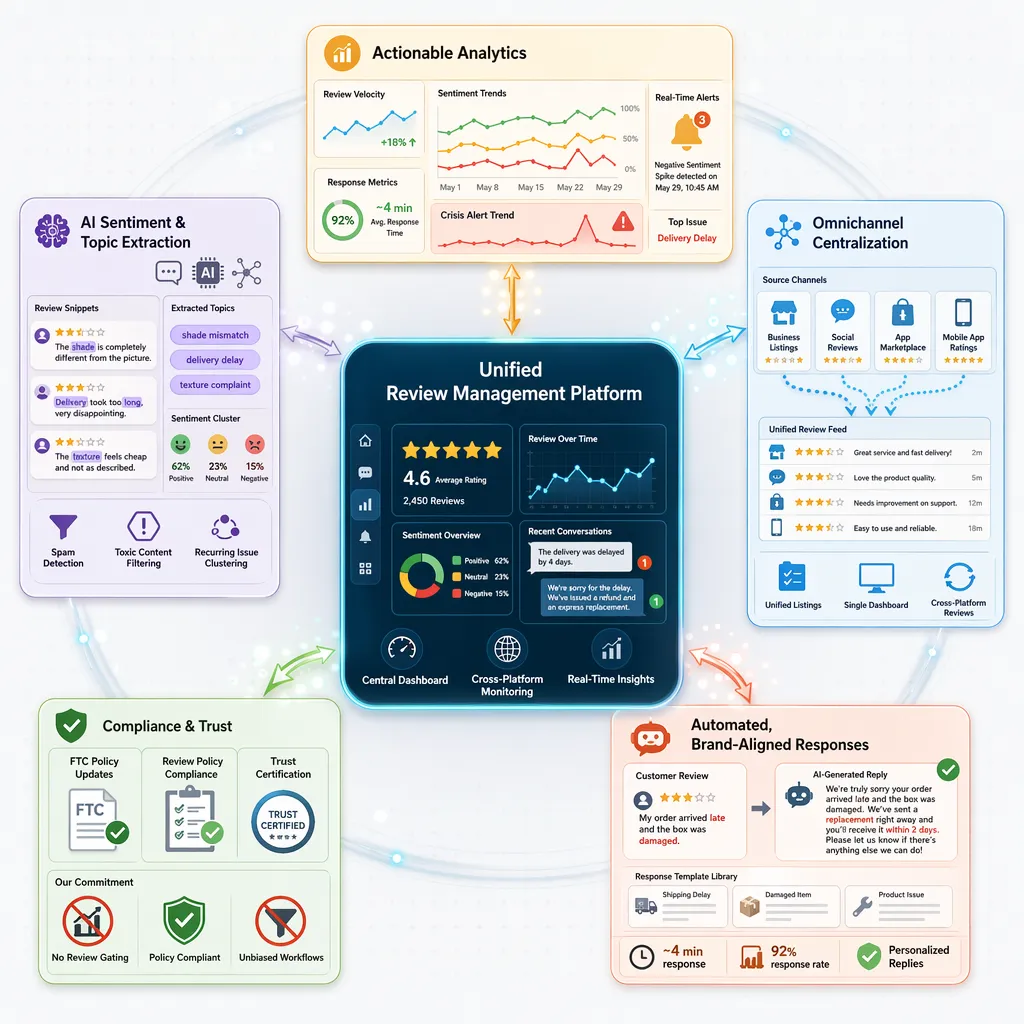
Building on those new rules, choosing the right platform in 2026 means knowing which capabilities actually move the needle for DTC retail. The table below breaks down what to prioritise and what to avoid.
| Capability | Why It Matters in 2026 | Red Flags to Avoid |
|---|---|---|
| AI Sentiment & Topic Extraction | Machine learning surfaces recurring issues like 'shade mismatch' or 'delivery delay' from raw text. It flags spam and toxic content automatically. | Platforms that only show star averages. No topic clustering or spam detection means you miss churn triggers. |
| Omnichannel Centralization | Unifies Google Business Profile, Facebook, Apple App Store, and Google Play into one dashboard. No more manual cross-referencing. | Siloed tools that force you to log into each platform separately. That wastes time and hides patterns. |
| Automated, Brand-Aligned Responses | Top platforms achieve auto-response times as low as 4 minutes and response rates up to 92%. Replies reference the specific issue, not a template. | Generic 'thanks for your feedback' replies. Customers spot templated responses instantly, and it damages trust. |
| Compliance & Trust | New FTC rules and Google's 2026 policy updates outlaw 'review gating'. Compliant, unbiased request workflows are non-negotiable. | Any tool that asks you to filter reviews before posting. That practice is now illegal and can get your business suspended. |
| Actionable Analytics | Beyond star ratings, look for sentiment trends, response rates, review velocity, and crisis alerts for negative spikes. | Dashboards that only show historical data. Real-time alerts for sudden negative shifts are essential for fast action. |
AI Sentiment and Topic Extraction
Consumers are wary of fake reviews. Recent research shows A platform that uses machine learning to surface specific topics — like 'texture complaint' or 'shade mismatch' — helps you act before issues escalate. For review management for cosmetics brands, ingredient-related feedback and product quality concerns must be surfaced automatically. Without this, you're guessing at what drives returns.
Omnichannel Centralisation
Your customers leave feedback across Google, Facebook, and app stores. The ideal platform pulls everything into one view. Tools like a Google Place ID Finder help you locate your listings, but centralisation is the real win. Avoid platforms that only cover one channel. Siloed data hides the full picture.
Automated, Brand-Aligned Responses
Reply speed used to be the whole game — get back to a customer fast, and you won. That calculus has changed. Third-party benchmarking shows top-tier platforms now manage auto-response times as low as 4 minutes while sustaining response rates up to 92%, so speed alone is no longer a differentiator — most competent platforms can hit those numbers.
What separates the leaders is what happens after the reply is drafted. Templated, generic responses are easy to spot, and both customers and search algorithms increasingly notice. Automating the first draft of a response is table stakes; automating the final response for anything beyond a routine five-star acknowledgement is a mistake. For a one-star review flagging a shade mismatch or a damaged shipment, a human-reviewed reply that references the specific complaint does more for trust than a faster, more generic one ever will.
The platforms worth paying for treat automation as a starting point, not an endpoint — surfacing a brand-aligned draft in seconds, then routing anything sensitive to a person before it goes live. For DTC brands managing volume across Shopify, Instagram, and support tickets simultaneously, that hybrid model is what keeps response times low without sacrificing the authenticity that increasingly sceptical shoppers are looking for.
Compliance & Trust
Regulatory risk used to be a footnote in review management. In 2026, it's a selection criterion. New FTC rules and Google's own 2026 policy updates have effectively outlawed "review gating" — the once-common practice of only inviting happy customers to leave a review while quietly excluding unhappy ones. The Digital Markets, Competition and Consumers Act (DMCCA) tightens the net further, and both frameworks target incentivised or filtered feedback as a form of consumer deception.
For DTC brands, this changes what to look for in a platform. A tool that lets you filter who gets asked for a review, or that offers a discount in exchange for a five-star rating, is now a liability rather than a growth hack — those tactics can trigger fines under either regime. The platforms worth trusting build compliant, unbiased request workflows in by default: every customer who completes a purchase gets the same invitation, on the same terms, regardless of how the interaction went.
That default matters especially for cosmetics and other categories where ingredient-related feedback needs to reach the brand rather than being filtered out — genuine complaints about a formulation issue are exactly the reviews that must stay visible, not the ones you'd be tempted to suppress. Choose a platform that treats compliant collection as the baseline, not an add-on.
Actionable Analytics
Star ratings tell you where you stand today. Actionable analytics tell you where you're headed. Beyond the average score, the platforms worth evaluating surface sentiment trends over time, response rates, review velocity, and — critically — crisis alerts that fire the moment negative sentiment spikes.
That last capability matters more than it sounds. A dashboard that only shows historical data is a rear-view mirror: useful for reporting, useless for prevention. The market is moving toward predictive, "agentic" analytics instead — tools that don't just log that returns are rising, but flag the pattern early enough for a DTC team to intervene before it turns into a wave of low-star reviews.
For a cosmetics brand, this might mean catching a cluster of "texture complaint" or "shade mismatch" mentions across three channels in the same week, before it becomes a visible trend on your product page. Avoid platforms that stop at a monthly summary report. The tools that earn their subscription fee turn analytics into an early-warning system, not a scorecard you check after the damage is already done.
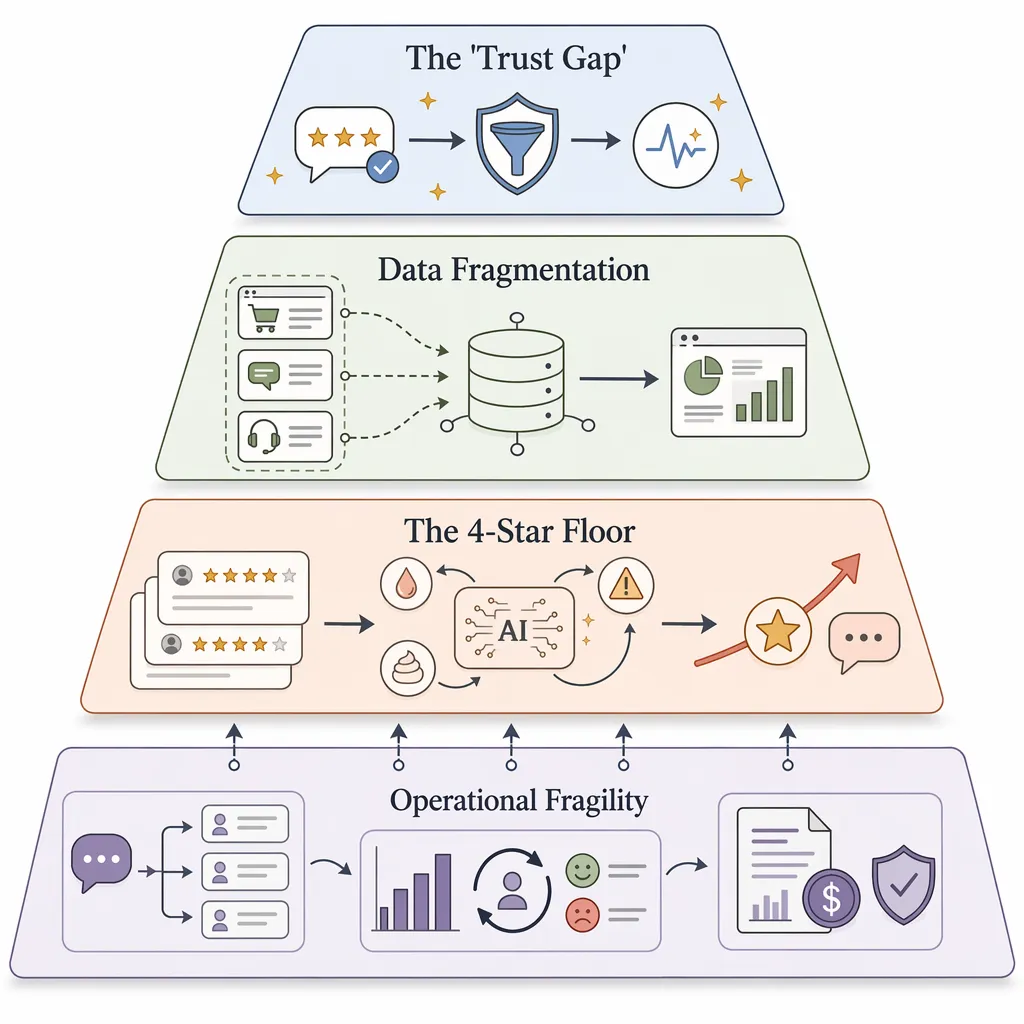
How the Best Platforms Solve Core Pain Points
That table sets the benchmark. Now let's look at how the best platforms tackle the specific pain points that trip up DTC retailers.
| Pain Point | What It Costs You | How Top Platforms Fix It |
|---|---|---|
| The 'Trust Gap' | Brand-controlled feedback looks suspicious. | Verified purchase data and AI spam detection build genuine trust. |
| Data Fragmentation | Review data sits in silos, disconnected from CRM and product teams. | Direct integrations with Shopify, Klaviyo, and Gorgias feed insights into product pipelines. |
| The 4-Star Floor | Consumers ignore businesses rated below 4 stars. One bad patch can tank visibility. | Automated collection workflows maintain high averages. AI surfaces root causes from 3- and 4-star reviews. |
| Operational Fragility | Non-revenue tools get cut. Review management must prove its worth. | Clear ROI through improved response rates, higher conversion, and retention insights. |
1. The 'Trust Gap' — Verified Feedback Wins
Consumers are sceptical. Recent research shows Top platforms solve this by verifying reviews against actual purchase history. They also use AI to detect fake or spam content automatically. For DTC brands, that means every review on your product page carries weight. A Google Review Link Generator helps you collect more genuine feedback, but verification is what builds trust.
2. Data Fragmentation — Connect the Dots
Your review data shouldn't live in a silo. The most successful DTC brands in 2026 are building first-party feedback loops. They connect review insights directly to CRM and product development. Platforms that integrate with Shopify, Klaviyo, and Gorgias turn scattered comments into actionable product data. For review management for cosmetics brands, that means spotting a texture complaint and feeding it straight to your formulation team.
3. The 4-Star Floor — Proactive Rating Management
Consumers now refuse to engage with businesses rated below 4 stars. One bad week can hurt visibility. Top platforms use automated review collection workflows to maintain high averages. They also use AI to identify root causes from 3- and 4-star reviews. You fix the issue before it drags your rating down. For cosmetics brands, ingredient sensitivity and product texture feedback are common pain points. Granular topic extraction helps teams pinpoint formulation issues fast.
4. Operational Fragility — Prove the ROI
Any tool that isn't visibly driving revenue is a target when budgets tighten, and review management software is often first in line. The fix isn't better marketing for the tool — it's picking a platform that can point to a number a finance team actually cares about.
Response rate is the clearest lever available. BrightLocal's research puts it starkly: 88% of consumers will use a business that replies to all its reviews, while only 47% will use one that doesn't bother. That's not a vanity metric — it's a direct line from "we reply to reviews" to "more people choose us," and it's the kind of statistic that survives a budget review because it maps straight to conversion.
The platforms that prove their worth do it on three fronts at once: they lift response rates, they show up in higher on-site conversion once shoppers see an actively managed review section, and they surface retention signals — the sentiment and topic data that flags why customers churn, not just that they did. Put together, that's a case a DTC operator can defend in a budget meeting: not "reviews look nice," but "this tool measurably keeps and converts more customers than not having it."
For any DTC brand facing the structural fragility of thin margins, where a single supply chain delay or ad-account issue can threaten the whole operation, that ROI case is the difference between a platform that survives the next cost review and one that gets cut alongside every other tool nobody can defend on a spreadsheet.
Comparison Criteria for DTC Brands
Operational fragility means review tools often get cut first. To avoid that, your choice must align with growth stage and integration needs. Here is how to evaluate the top review management platforms for dtc retail 2026.
Comparison Criteria for DTC Brands
| Decision Axis | What to Look For | What to Avoid |
|---|---|---|
| Depth of AI Insight | Platforms that explain why customers behave a certain way, not just star counts. | Tools that only collect ratings without surfacing root causes. |
| Integration Breadth | Centralisation of Google Business Profile, Facebook, Apple App Store, and Google Play. | Platforms supporting only one or two channels. |
| Response Automation vs. Personalisation | Human-centric, non-templated replies for critical reviews. | Generic auto-responses that consumers and algorithms spot instantly. |
| Pricing Transparency | Clear pricing and free trials for evaluation. | Feature-bloated tools where reviews are an afterthought. |
Depth of AI Insight
Traditional CX tools fail because they record a score without explaining behaviour. You need a platform that uses AI to surface specific topics. For review management for cosmetics brands, that means flagging 'texture complaint' or 'shade mismatch' automatically. This turns feedback into actionable product data. Without this depth, you're guessing at what drives returns.
Integration Breadth
Your customers leave feedback across multiple channels. The ideal platform pulls everything into one dashboard. It must support Google Business Profile, Facebook, Apple App Store, and Google Play. Avoid platforms that only cover one channel. Siloed data hides the full picture. A Google Play review management guide can help you evaluate options.
Response Automation vs. Personalisation
Most brands use AI to auto-respond, but consumers and algorithms are adept at spotting templated replies. Prioritise platforms that facilitate human-centric responses for critical reviews. The goal is speed without sacrificing authenticity. A 5-Star Review Response Generator can help, but use it as a starting point, not a final draft.
Pricing Transparency
Analysts warn against feature-bloated tools where reviews are an afterthought. Look for transparent pricing and free trials that allow evaluation without commitment. For cosmetics brands, ensure the platform supports product-level categorisation and attribute-rich feedback collection. This helps you manage reviews across multiple SKUs and formulations effectively. A Customer Review Monitoring: Tools and Techniques for Proactive Reputation Management article offers further guidance on selecting the right tool.
Common Pitfalls to Avoid When Choosing a Platform
Most guides treat reviews as a volume game. Collect more stars, display them on product pages, and watch conversions climb. That logic is breaking. In 2026, consumers often skip product pages entirely. They ask ChatGPT, Perplexity, or Google's AI Overviews for purchase advice. If your reviews are generic, AI models can't understand your brand's value proposition. You lose visibility in AI-driven search. Here are three pitfalls to avoid when choosing a platform.
| Pitfall | The Old Thinking | The 2026 Reality |
|---|---|---|
| Treating reviews as a destination | Display reviews on product pages | AI summaries pull review data; generic text hurts visibility |
| Ignoring the training signal shift | Focus on star count | Descriptive reviews train AI search models better |
| Downplaying regulatory risk | Incentivise 5-star reviews | Aggressive tactics are high-risk under DMCCA and FTC guidelines |
Treating Reviews as a Destination
Many platforms optimise for the product page carousel. That's no longer enough. AI search tools now synthesise review content into concise summaries. A 4.5-star product with specific, descriptive reviews will outperform a 5-star product with generic praise in those AI summaries. Choose a platform that prompts customers for attribute-rich feedback. For review management for cosmetics brands, that means capturing ingredient-level detail and texture notes. Without that depth, your brand becomes invisible in AI-generated answers.
Ignoring the Training Signal Shift
Reviews are now training data for AI search models. Every descriptive sentence helps an AI understand what your product does well. Generic phrases like "great product" add zero signal. Platforms that encourage structured, attribute-based reviews give you a competitive edge. They help your brand appear in more AI search results. This is especially critical for DTC brands with complex product lines.
Downplaying Regulatory Risk
Aggressive incentivisation tactics are now high-risk liabilities. The DMCCA and stricter FTC guidelines target fake or biased reviews. Offering discounts for 5-star ratings can lead to fines. Prioritise platforms that support compliant, unbiased collection. They should also detect toxic or spam content automatically. For cosmetics brands, this protects against damaging ingredient-level misinformation.
Choose a platform that helps you engineer for AI interpretability and brand trust. Don't just collect stars. Collect data that makes your brand discoverable in the next search era. ReviewSense offers AI-Powered Review Management: Strategies for Streamlining Customer Feedback Oversight to help you stay compliant and visible.
Conclusion
Choosing a review management platform in 2026 means moving beyond star counts. Your DTC brand needs a tool that captures descriptive, attribute-rich feedback to feed AI search models, ensures regulatory compliance, and surfaces actionable insights—not just noise. The right platform helps you engineer for AI interpretability while building genuine trust.
ReviewSense delivers exactly this. It centralises reviews from Google, Facebook, and app stores into one dashboard, uses sentiment analysis to flag recurring issues and spam, and helps you respond with authentic, on-brand replies—at scale. Turn scattered reviews into actionable insights that improve customer experience and drive growth. Start your 7-day free trial