
Businesses that respond to 75% or more of their reviews rank 2.3 positions higher in the local pack according to Flen AI's 2026 study of 5,000 businesses. But does this translate to broader SEO benefits? We examine how review responses impact rankings, why 53% of customers expect replies, and what signals actually move the needle. Using a dedicated review management platform simplifies achieving high response rates consistently.
To put a number on the gap between your current rating and your target, our Google review calculator works out how many 5-star reviews close it. Managing this manually is hard. ReviewSense automates it.
The Direct SEO Impact of Review Responses
| Review Response Factor | SEO Impact |
|---|---|
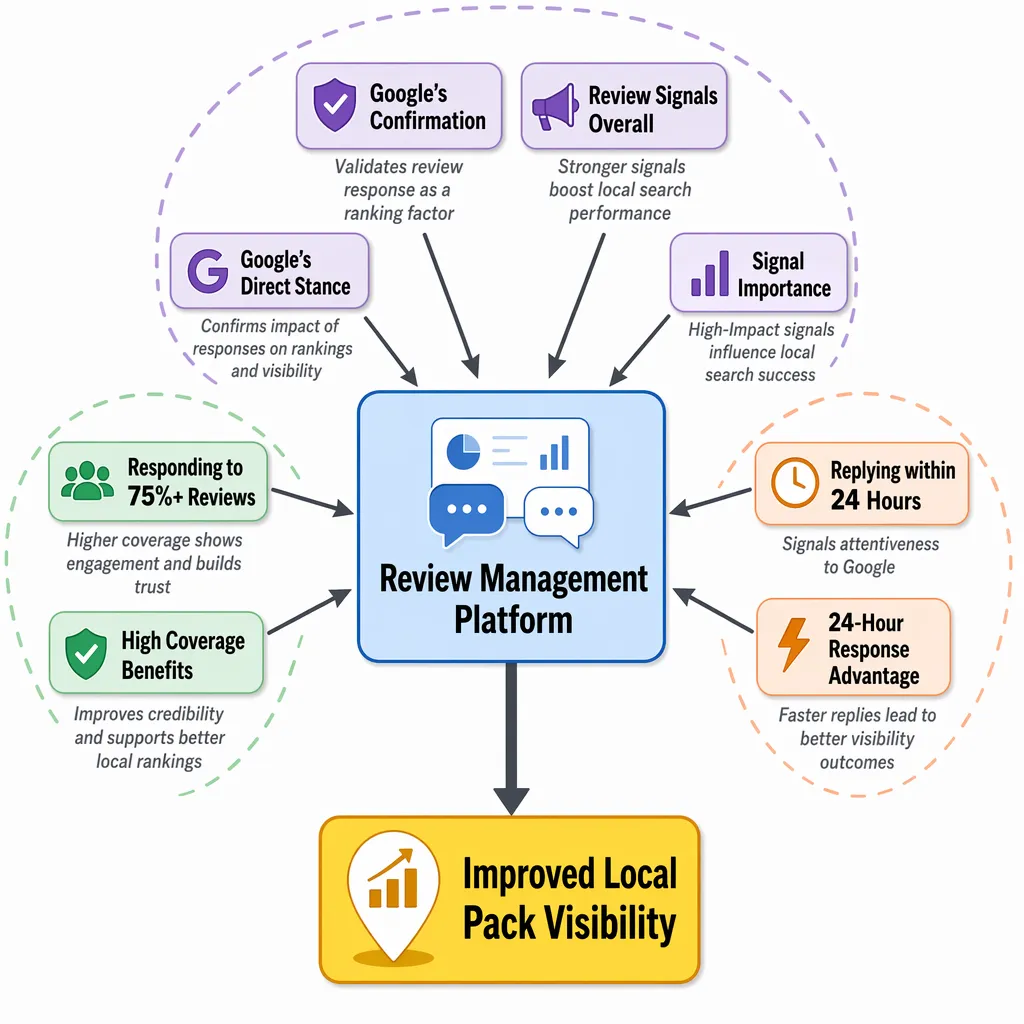
| Responding to 75%+ reviews | Higher local pack rankings |
| Replying within 24 hours | Improved ranking positions vs. slower replies |
| Google's confirmation | Responses factor into local search visibility |
| Review signals overall | Major portion of Map Pack ranking factors |
The Power of High Coverage
Businesses responding to over three-quarters of their reviews typically achieve stronger local pack visibility. This consistency signals engagement to Google's algorithm, demonstrating you value customer feedback. The analysis shows this approach correlates with improved search prominence.
The 24-Hour Advantage
Speed transforms review management from reactive to strategic. When you reply within a day, you're not just satisfying customers - you're satisfying search algorithms. Quick responses show your business is attentive and active, qualities Google rewards with better visibility. Tools like the AI Review Response Generator help maintain this cadence without sacrificing quality.
Google's Direct Stance
Google explicitly states that review responses influence local search rankings. Their guidance confirms that businesses engaging with feedback gain visibility advantages. This isn't speculation - it's documented search behaviour that shapes how potential customers find you.
Why Signals Matter
Review-related factors constitute a substantial portion of local ranking algorithms. Each response adds fresh, relevant content that search engines index. More importantly, consistent engagement improves your overall rating over time. Businesses addressing negative reviews see 12% greater rating improvement than those ignoring them, creating a compounding SEO benefit. For practical implementation, see the UK-specific Google review management guide.
Trust and Conversion Benefits Beyond Rankings
Beyond the direct ranking improvements, consistently replying to reviews builds trust that converts browsers into buyers and fuels indirect SEO advantages. Consider these measurable impacts:
| Trust & Conversion Factor | Business Impact | SEO Connection |
|---|---|---|
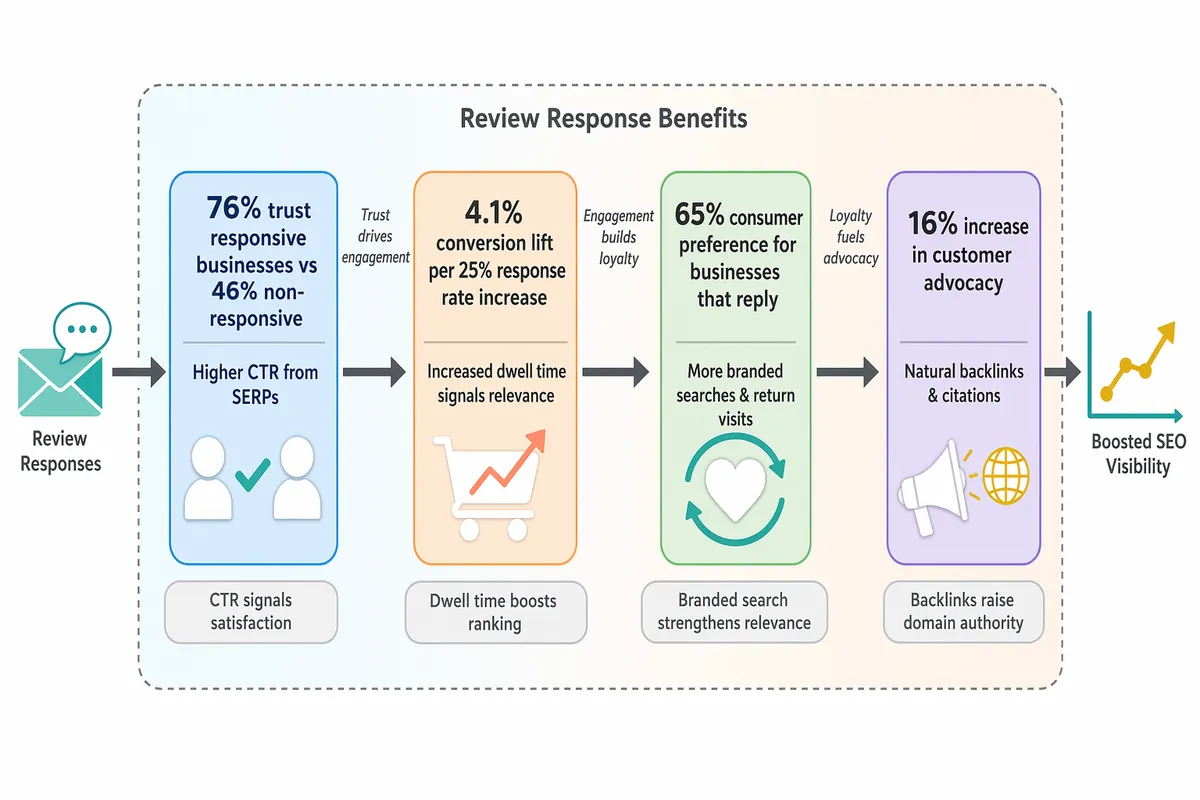
| Trust Perception | 76% trust responsive businesses vs 46% non-responsive | Higher CTR from SERPs |
| Conversion Rate | 4.1% lift per 25% response rate increase | Increased dwell time signals relevance |
| Consumer Preference | 65% choose businesses that reply to reviews | More branded searches & return visits |
| Advocacy Boost | 16% increase in customer advocacy | More natural backlinks & citations |
Trust: The Click-Through Catalyst
When consumers see you actively respond to reviews, their trust nearly doubles - 76% versus 46% for silent businesses. This perception directly impacts click-through rates from search results. With 53% of UK customers expecting replies, meeting this demand makes your listing more compelling. Higher CTR signals to Google that your business satisfies user intent.
Conversions: From Consideration to Commitment
Each 25% increase in review response rate delivers a 4.1% conversion lift. Why? Responses demonstrate you value feedback, reducing purchase hesitation. More conversions mean longer dwell times as users explore your site. Search engines interpret this engagement as quality content, further boosting visibility. For businesses managing multiple platforms, the customer review management guide shows how consistency drives results.
Loyalty: The Retention Engine
65% of consumers actively prefer businesses that reply, creating a self-reinforcing cycle. This preference drives repeat visits and branded searches - strong relevance signals. It also builds advocates who generate authentic content about your brand. Research confirms resolving negative feedback well increases customer advocacy by 16%. These advocates naturally create backlinks and citations, strengthening domain authority. Scaling this across locations? See strategies in the multi-platform software guide.
Ultimately, review responses don't just satisfy algorithms - they satisfy humans. That human satisfaction translates into search behaviours that algorithms reward. It's a virtuous cycle where reputation management fuels discoverability.
Content Signals Search Engines Actually Value
Building on these trust factors, let's explore how review responses create content signals that search engines actively interpret. Your replies generate valuable text that algorithms analyse alongside customer feedback, forming a richer understanding of your business.
| Mechanism | SEO Benefit | Implementation Tip |
|---|---|---|
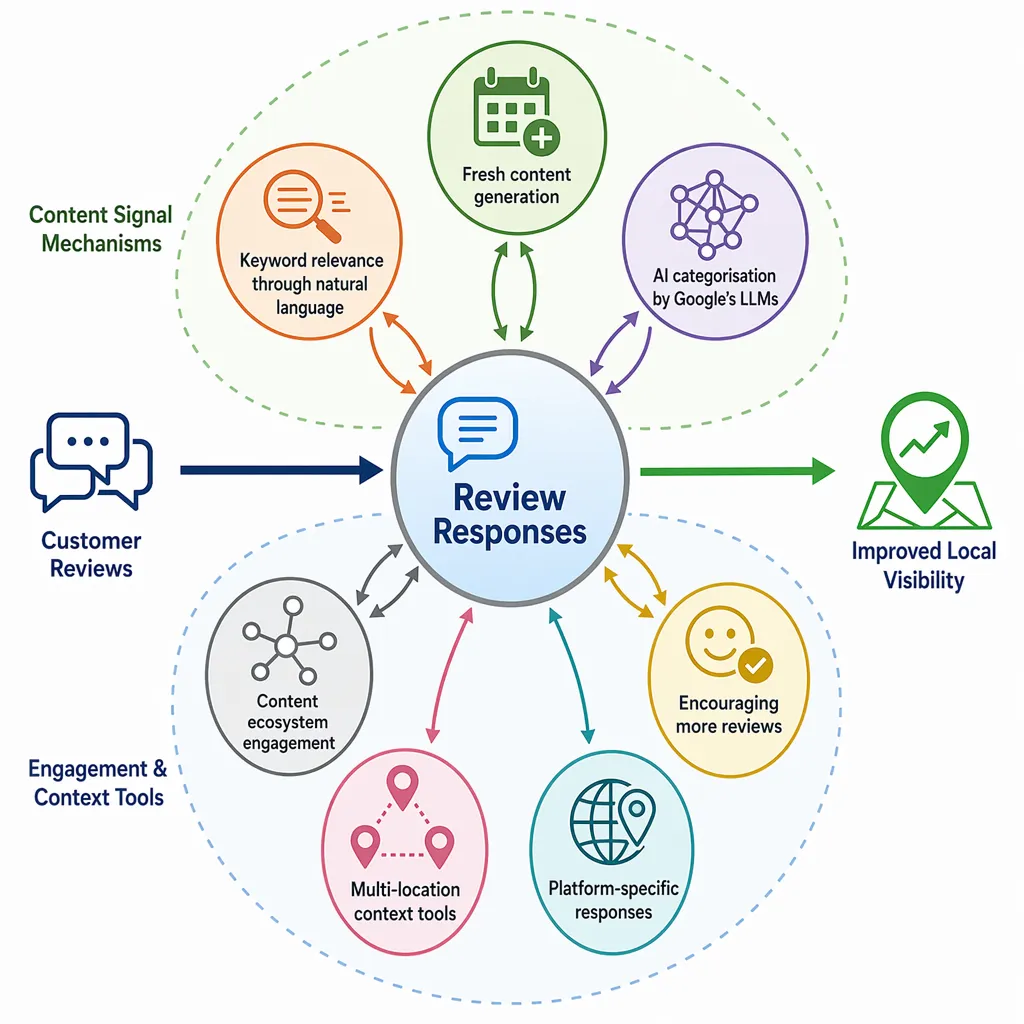
| Fresh content generation | Regular updates signal business activity, improving crawl frequency and local relevance | Respond to every review within 24 hours using tools like the AI response generator |
| Keyword relevance through natural language | Responses incorporate customer phrasing that matches real search queries, enhancing semantic understanding | Mirror terms like "emergency plumber" or "vegan cafe" that customers use naturally in reviews |
| AI interpretation by Google's LLMs | Google's systems analyse sentiment and context to categorise businesses and assess service quality | Be specific about resolutions (e.g. "We replaced your boiler pump within 2 hours") to demonstrate expertise |
Some argue that keyword density in responses has limited direct impact. While responses aren't a primary ranking factor, they create indirect benefits. Google's AI systems like BERT analyse conversational context across reviews and replies. This helps categorise your business accurately for local searches.
Well-crafted responses also encourage more reviews. Since 53% of customers expect replies, meeting this expectation builds goodwill. Satisfied customers often leave additional feedback when acknowledged. More genuine reviews mean more content for search engines to index and more positive signals.
Platform-specific responses matter too. App store replies should reference recent updates, while Google Business responses might mention local landmarks. The Apple App Store review management software guide details these nuances. For multi-location businesses, tools like the Place ID lookup ensure location-specific context.
Ultimately, responses contribute to a content ecosystem that search engines value. They demonstrate engagement, clarify your offerings, and fuel the review cycle that influences visibility.
Industry-Specific Response Challenges and Solutions
While review response strategies share universal SEO benefits, sector-specific challenges demand tailored approaches. Different industries face unique hurdles in managing feedback across Google Business Profile, Facebook, Apple App Store, and Google Play. Here's how to address common obstacles:
| Industry | Primary Challenge | Core Solution Focus |
|---|---|---|
| B2B | Long sales cycles, fewer reviews | Milestone-triggered requests |
| Niche Markets | Vulnerability to negative feedback | Community advocacy |
| Low-Volume Industries | Maintaining visibility with few reviews | Quarterly volume targets |
| Multi-Location Brands | Inconsistent response quality | Centralised workflows |
| SMBs | Limited resources and time | Efficiency tools |
B2B: Strategic Review Requests After Milestones
- Request feedback after key project deliveries or contract renewals when client satisfaction peaks.
- Personalise responses to reference specific deliverables, reinforcing expertise for industry-specific search queries.
- Convert positive feedback into case studies for your website, boosting SEO content depth.
Niche Markets: Community-Driven Reputation Defence
- Mobilise loyal customers to leave authentic reviews countering isolated negative feedback.
- Respond to all reviews with detailed, technical language demonstrating specialised knowledge.
- Address inaccuracies in negative reviews factually to maintain credibility within specialised communities.
Low-Volume Industries: Quarterly Review Volume Targets
- Set achievable quarterly review targets to maintain steady feedback flow for SEO freshness.
- Prioritise responding to every review to maximise individual impact on visibility.
- Showcase positive reviews prominently on service pages to build social proof.
Multi-Location Brands: Centralised Response Workflows
- Implement approval chains ensuring consistent brand voice across all platforms.
- Use location-specific keywords in responses to strengthen local SEO for each branch.
- Monitor regional sentiment trends to address location-specific issues promptly. Centralised platforms like the review management software guide streamline this process.
SMBs: Efficiency Tools for Resource Constraints
- Use AI-generated response suggestions to draft replies in seconds while maintaining quality.
- Set instant alerts for new reviews across all platforms to enable timely engagement.
- Focus responses on converting readers by addressing common objections preemptively. Free tools like the star rating calculator help track progress.
Future-Proofing Your Response Strategy
Building on industry-specific approaches, future-proofing your review response strategy requires adapting to evolving search algorithms and consumer expectations. Consider these emerging priorities:
| Strategy | Why It Matters | Implementation Tip |
|---|---|---|
| Authentic personalisation | Google now surfaces review snippets in AI Overviews, rewarding genuine interactions | Customise AI-generated drafts with specific customer details before sending |
| Issue resolution focus | Search algorithms increasingly track whether businesses address recurring complaints | Use sentiment analysis to identify root causes and implement operational fixes |
| Timely but thoughtful replies | 24-48hr responses remain important, but rushed generic answers now harm credibility | Set alerts for new reviews, then craft meaningful replies using our response generator |
| 'Open now' integration | Google combines real-time status with review sentiment for local rankings | Monitor and respond to reviews mentioning accessibility alongside profile updates |
Adapting to Algorithm Shifts
Google's systems now prioritise authentic engagement patterns, with AI Overviews directly surfacing review content. Generic five-star reviews and templated responses carry less weight as algorithms detect low-effort engagement. This shift rewards businesses that resolve underlying issues mentioned in feedback. When customers mention specific problems like delivery delays or staff rudeness, operational improvements matter more than reply quantity.
Some question whether replying to reviews helps SEO directly, given these changes. While the immediate ranking boost may be less pronounced, responses build crucial trust signals. For every 25% increase in review response rate, conversion rates improve by approximately 4.1%, and 65% of consumers are more likely to choose a business that responds to its reviews. This behavioural shift impacts SEO indirectly through dwell time and reduced bounce rates.
Balancing Speed and Substance
Timeliness remains valuable - the guide on managing Google reviews details UK response windows. But authenticity now trumps speed. A thoughtful reply addressing specific concerns three days post-review outperforms a same-day generic response. Crucially, ensure your 'open now' status stays current, as Google combines this real-time signal with review sentiment. When negative feedback mentions accessibility issues, immediate profile updates plus personalised responses create the strongest trust signals algorithms favour.
Ultimately, future-proof strategies treat reviews as diagnostic tools rather than reputation bandages. By resolving the root causes behind feedback while maintaining authentic engagement, you'll satisfy both algorithms and customers.
Conclusion
Replying to reviews directly impacts SEO by building trust signals that boost conversions and user behaviour metrics, while authentic engagement aligns with evolving algorithms favouring genuine issue resolution. To maximise this advantage:
- Respond thoughtfully to all reviews across Google Business Profile, Facebook, Apple App Store, and Google Play
- Use sentiment analysis to identify operational improvements
- Balance speed with personalised replies using AI efficiency tools ReviewSense transforms scattered feedback into actionable insights with centralised response workflows and real-time alerts. Start your 7-day free trial