
Are you still relying on spreadsheets to track customer feedback across half a dozen platforms? It's a losing battle. As AI search engines increasingly synthesise customer sentiment into direct answers, your online reputation is no longer just about star ratings—it's about context and volume. If you can't monitor, analyse, and respond to feedback at scale, your competitors will gladly take your market share.
Scaling this manually is impossible, but ReviewSense automates the heavy lifting for you.
Before you commit to a platform, you need to understand the core features that actually drive growth and how to choose the right customer review management software for multi-platform businesses.
The State of Customer Feedback: Why Review Management Software is a Necessity
Customer feedback is no longer about mere optics. It is a vital infrastructure for growing businesses. 99% of consumers read reviews before making a purchase. 81% check Google before other platforms. It takes an average of 10 reviews to build initial trust. Managing this volume by hand across multiple platforms is impossible. Teams need dedicated Google review management software to keep pace.
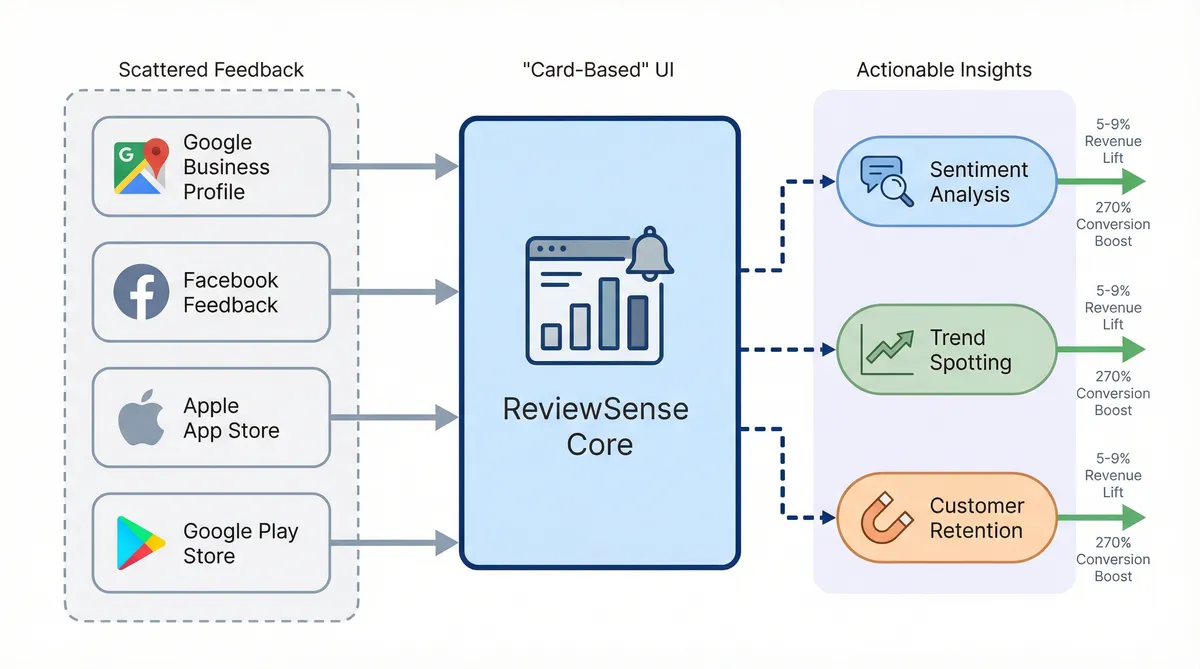
The financial stakes are high. A one-star rating increase can drive a 5-9% revenue lift. Displaying five reviews can boost conversions by 270%. This explains why the broader feedback market is expanding. It will jump from $16.73 billion in 2025 to $19.56 billion in 2026. That represents a 16.9% compound annual growth rate.
Large enterprises hold 56.1% of this market share. SME adoption is the fastest-growing segment with a 16.7% CAGR. Smaller teams realise they can't afford to ignore customer sentiment. They need review management software to centralise their efforts. ReviewSense solves this exact problem. It pulls feedback from Google Business Profile, Facebook, Apple App Store, and Google Play into one dashboard.
Logging into separate accounts is unnecessary. ReviewSense turns scattered feedback into actionable revenue drivers. Built-in sentiment analysis flags recurring issues. You can spot trends before they damage your reputation. By understanding customer review management: building trust and improving ratings, your team can focus on genuine feedback. You'll respond with speed, resolve complaints, and drive better customer retention.
A major event in late 2025 saw Qualtrics acquire Press Ganey Forsta for $6.75 billion. This signals a massive shift toward deep experience analytics. Businesses must adapt to this new standard. Centralising your data ensures you never miss a critical customer interaction.
Core Features to Look for in Modern Review Management Platforms
As experience analytics evolve, selecting the right review management software requires looking beyond basic aggregators. You need intelligent tools that actively protect your reputation. Modern platforms must offer specific capabilities to handle increasing feedback volumes.
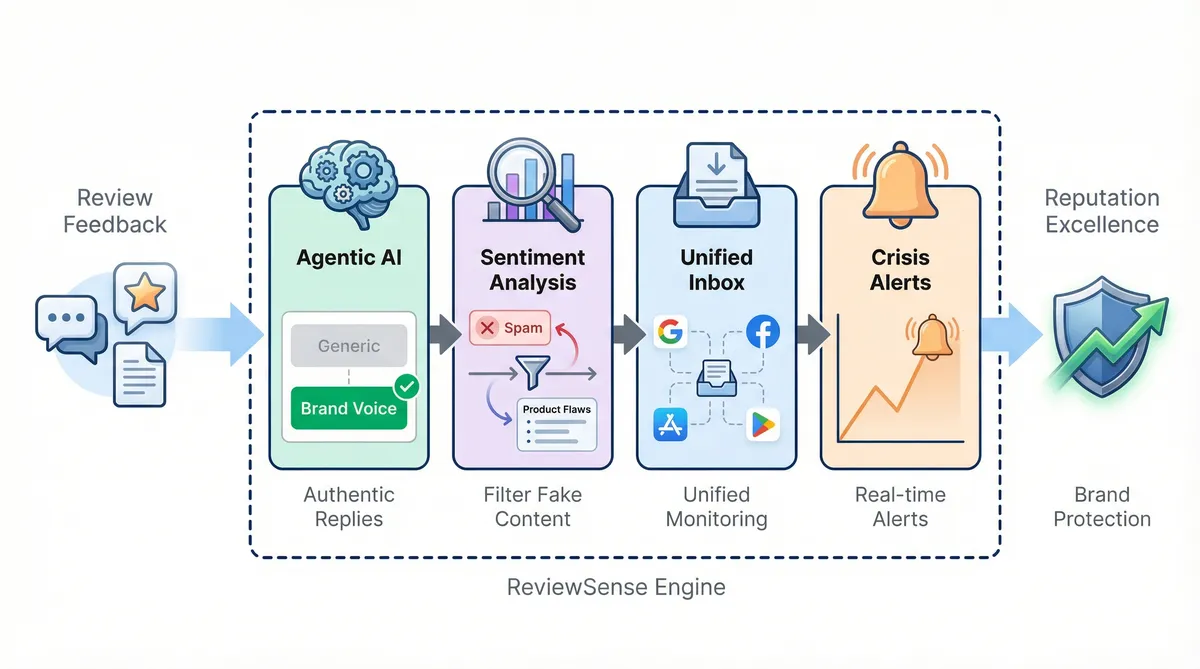
Agentic AI vs. Generative AI: Standard generative tools spit out generic templates. Modern platforms use agentic AI to draft personalised replies. ReviewSense features an AI response generator that learns your custom brand voice. It drafts authentic replies in seconds. This speed matters.2. Sentiment Analysis 2.0: Older tools just count stars. Advanced sentiment analysis extracts recurring product flaws from unstructured text. ReviewSense includes built-in sentiment analysis that detects spam and toxic content. Roughly 30% of all online reviews are estimated to be fake. Filtering out this noise helps teams focus on genuine feedback that impacts retention.
Unified Inboxes: Logging into separate portals wastes valuable time. A unified inbox centralises specific channels into one dashboard. ReviewSense pulls feedback directly from Google Business Profile, Facebook, Apple App Store, and Google Play. This targeted approach streamlines customer review monitoring: tools and techniques for proactive reputation management. Your team can manage approvals with auto-reply workflows.
Crisis Alerts: Negative spikes require immediate action. Real-time crisis alerts notify your team before a minor issue escalates. ReviewSense provides instant alerts for new reviews and negative trends. You can implement AI-powered review management: strategies for streamlining customer feedback oversight to resolve complaints quickly. This proactive stance protects your brand image and prevents customer churn.
Real-World Use Cases: Successes and Strategic Failures
Understanding these core features is just the start; applying them correctly determines your market survival. Proper review management software transforms chaotic feedback into operational advantages.
| Approach | The Action | The Result |
|---|---|---|
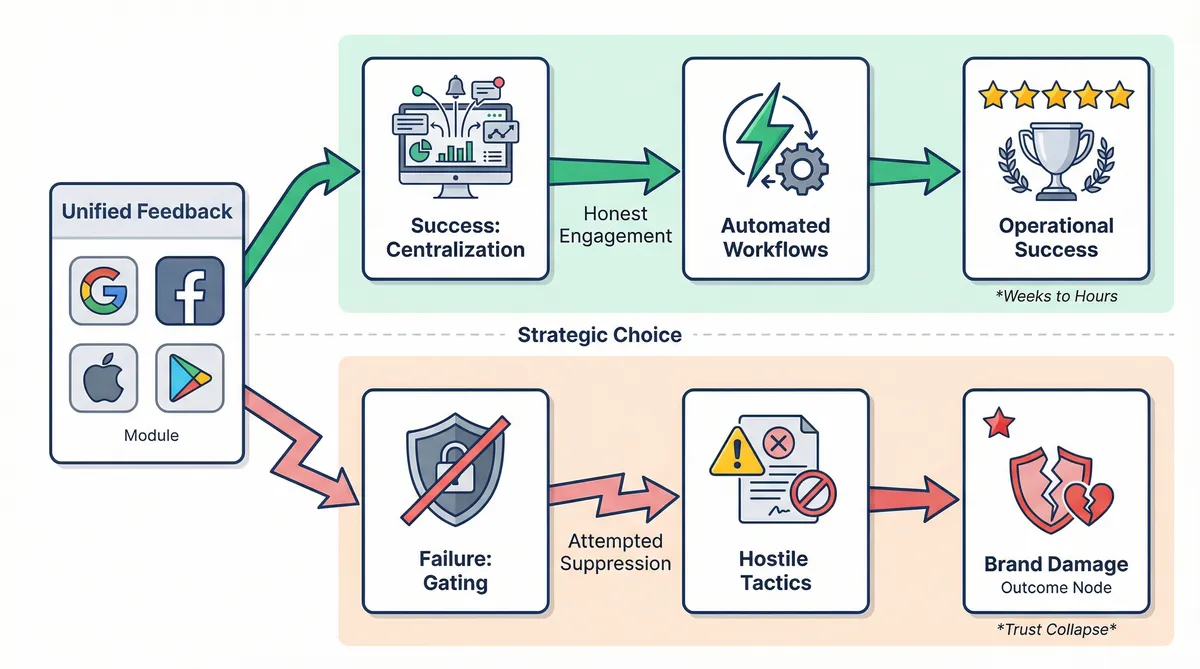
| Success: Centralisation | Lakeside Hospitality used review management software to unify Google and Facebook feedback across 40 locations. | Ratings jumped from 3.2 to 4.7 stars. Response times dropped from weeks to mere hours. |
| Failure: Review Gating | Union Street Guest House threatened guests with a $500 fine for leaving negative feedback. | Public backlash drove their rating down to 1.5 stars. Brand trust was broken. |
It's clear that attempting to suppress negative feedback always backfires. 54% of consumers will refuse to purchase a product if they suspect fraudulent feedback. Honest engagement builds lasting trust.
ReviewSense prevents these defensive failures entirely. It provides a central dashboard for your Google Business Profile, Apple App Store, Google Play, and Facebook review management. Teams can monitor genuine feedback without resorting to unethical tactics.
Managing multi-location approvals by hand creates severe bottlenecks. ReviewSense solves this with auto-reply and queue workflows. Managers can review drafted responses before they go live. You can route specific complaints to the right department without delay. This keeps your business responsive and engaged.
This speed is vital for high-value purchases. For luxury or high-priced items, this lift can reach as high as 380%. Learning how to manage App Store reviews at scale ensures you capture this revenue. ReviewSense makes this process effortless. Your team can focus on better customer experiences instead of chasing scattered data.
Navigating 2026 Regulations and the AI search Shift
Chasing scattered data leaves you vulnerable to regulatory changes. As AI transforms search and governments crack down on fake feedback, your review management software must adapt. Future-proofing your strategy requires navigating three major shifts to protect your brand.
Comply with the FTC Consumer Review Rule. Regulators are targeting deceptive practices across all platforms. Suppressing negative feedback or using fake indicators carries severe penalties, including fines of $53,088 per violation. ReviewSense protects you by focusing on genuine feedback. Its built-in sentiment analysis flags toxic content without hiding valid complaints.
Optimise for Answer Engine Optimisation (AEO). Traditional search is evolving quickly. AI search engines like ChatGPT and Gemini now summarise customer feedback in their results. Review signals are projected to account for 20% of the local search ranking algorithm in 2026. You need structured data. By learning how to manage Google reviews effectively: a step-by-step UK business guide, you ensure your Google Business Profile feeds these AI summaries with accurate information.
Adhere to EU AI Act transparency. Using AI to draft replies is standard, but transparency is mandatory. By the end of 2026, 40% of enterprise review applications will include task-specific AI agents. The EU AI Act requires businesses to disclose when responses are AI-assisted. ReviewSense offers a compliant response generator. It drafts on-brand replies for the Apple App Store and Google Play while keeping human oversight active.
You can review and approve every drafted response before publishing. This workflow keeps your business safe from regulatory fines. It also ensures your digital presence is primed for AI search summaries. Exploring how to use free AI review response generators to improve customer communication builds trust while maintaining strict compliance.
The Contrarian Guide to Selecting Review Management Software
Navigating these strict AI regulations requires a shift in how you evaluate software platforms. Most buyers fall for flashy features that ultimately harm their brand trust.
The 'Response Speed' Myth. Vendors push instant replies as the ultimate goal. This is a critical mistake. A thoughtful human-in-the-loop response after 24 hours performs better than a robotic canned reply. Customers spot generic templates easily. They want genuine engagement, not a chatbot dismissing their concerns.
The '5-Star Trap'. Many businesses obsess over achieving a perfect score. Consumers trust a 4.5-star rating with real complaints over a flawless 5.0. A perfect score signals fake reviews. Effective customer review management: building trust and improving ratings means embracing negative feedback. It proves your business is authentic and responsive.
Software as a 'UI Tax'. Do not overpay for a pretty dashboard that lacks deep insights. Many enterprise tools charge exorbitant fees simply to display your Google Business Profile and Facebook data. You need a platform that extracts actionable insights instead of repackaging public information.
ReviewSense champions this quality-first philosophy. It offers a low-cost ($19/mo) alternative to bloated enterprise tools. The platform focuses on intelligent reply generation that mimics your unique brand voice. It extracts real insights to improve daily operations rather than artificially inflating scores.
Choosing the right review management software: key features, use cases, and selection tips shouldn't require a blind leap. ReviewSense provides transparent pricing and a 7-day free trial. You can test free tools like a Google review link generator to prove real ROI before committing.
Conclusion
Managing customer feedback is no longer just about collecting stars. As AI search evolves and regulations tighten, success requires authentic engagement over robotic speed and a focus on genuine customer sentiment. The right software shouldn't just act as an expensive dashboard; it must extract meaningful data from your Google Business Profile, Facebook, Apple App Store, and Google Play accounts while keeping your business compliant.
By prioritizing intelligent, human-in-the-loop workflows, you can protect your brand reputation and respond to feedback with a consistent, personalized voice. You don't need a bloated enterprise tool to achieve this—you need a platform built for actionable intelligence.
Transform scattered reviews into actionable insights that improve customer experience and drive growth when you Start your 7-day free trial.