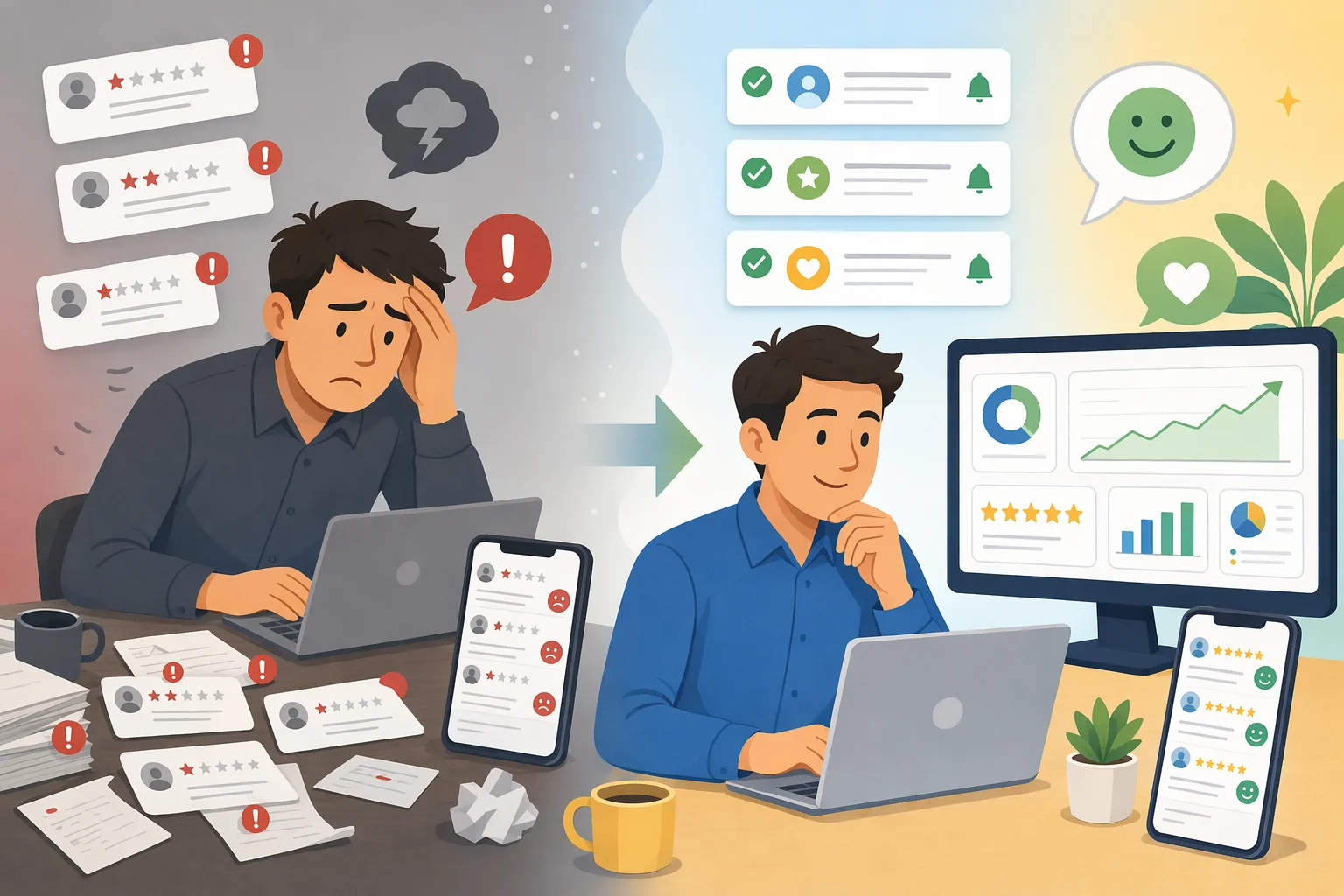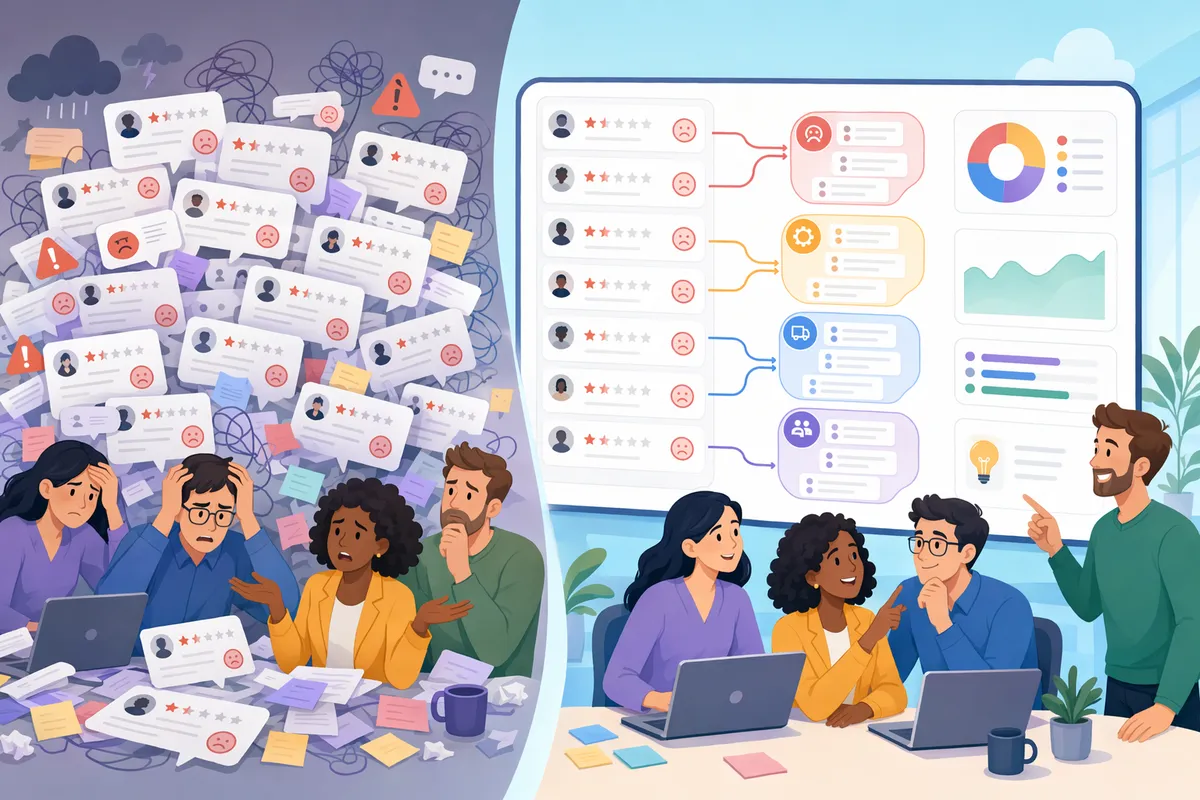
What if most of your negative feedback traces back to the same handful of unresolved issues? Manually analysing 10,000 product reviews takes 200+ hours yet misses critical patterns. Without advanced review management tools, teams drown in data while churn drivers go unchecked. AI now detects hidden themes at scale.
Managing this manually is hard. ReviewSense automates it.
The Hidden Costs of Manual Review Analysis
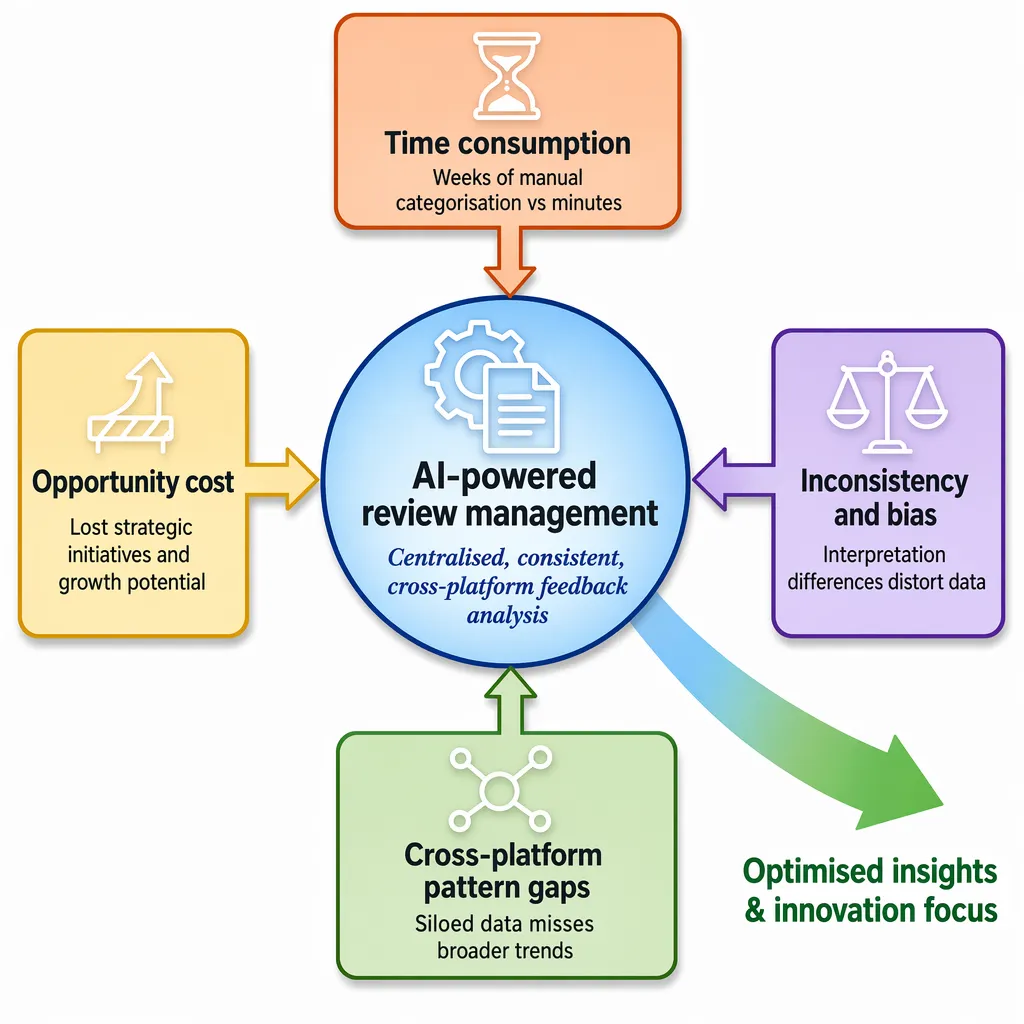
But extracting meaningful themes from 10,000 reviews manually is a practical impossibility for most teams. The sheer volume creates hidden operational drains that undermine customer experience improvements. Consider these critical pain points:
| Pain Point | Impact on Business |
|---|---|
| Time consumption | Weeks of manual effort vs minutes with AI, delaying critical insights |
| Inconsistency and bias | Subjective interpretation leads to unreliable data and missed patterns |
| Cross-platform pattern gaps | Inability to connect feedback dots across Google, Facebook, App Stores |
| Opportunity cost | Product teams diverted from strategic work, slowing innovation |
Time drains that stall action
Manually categorising 10,000 reviews takes weeks of focused effort. Your team must read, interpret and tag each entry while juggling core responsibilities. This creates dangerous delays - negative trends escalate while you're still sorting data. AI-powered solutions process the same volume in minutes, letting you act on urgent issues immediately.
Human inconsistency creates blind spots
Individual analysts interpret feedback differently. One might classify 'late delivery' as a logistics issue while another tags it under 'customer service'. This inconsistency distorts your data. Modern AI theme discovery achieves over 80% accuracy in identifying themes, matching trained human consistency according to industry benchmarks. Without this objectivity, critical patterns remain hidden - like a hospitality case where significant service complaints were lost in noise.
The multi-platform challenge
When feedback lives across Google Business Profile, Facebook, and app stores, manual comparison becomes guesswork. A delivery problem mentioned in Google reviews might connect to App Store complaints about tracking, but teams rarely spot these links. This fragmentation prevents holistic understanding. Centralised analysis through customer review management platforms solves this by mapping connections across all sources.
The real cost: Stalled innovation
The greatest expense isn't just hours spent - it's what your team isn't doing. Product experts stuck reading reviews aren't improving your offering. Experts confirm manual analysis at this scale demands impractical budgets, diverting talent from innovation that drives growth. When resource drain outweighs insights gained, you need smarter approaches.
How Modern AI Transforms Feedback Into Insights
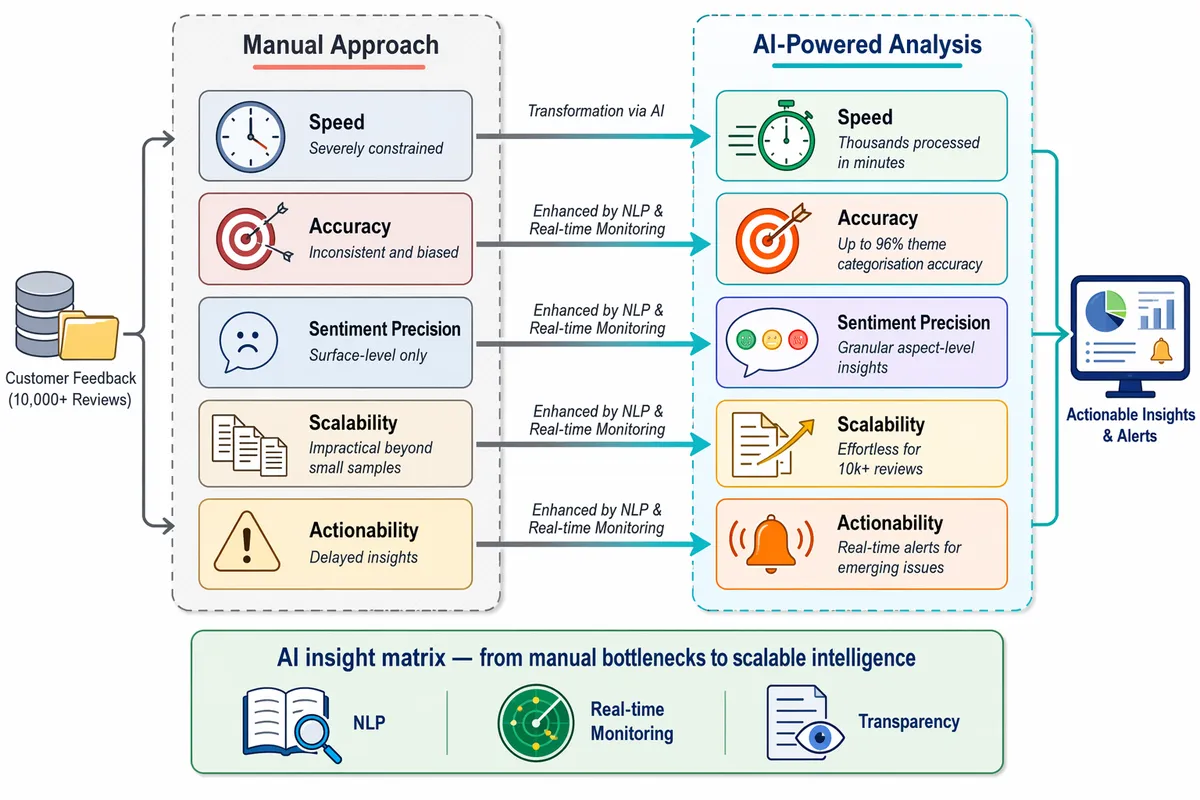
These smarter approaches use artificial intelligence to overcome the limitations of manual methods, turning feedback into actionable intelligence at scale. The transformative power of AI becomes clear when comparing core capabilities:
| Analysis Metric | Manual Approach | AI-Powered Analysis |
|---|---|---|
| Speed | Severely constrained | Thousands processed in minutes |
| Accuracy | Inconsistent and biased | Up to 96% theme categorisation accuracy |
| Sentiment Precision | Surface-level only | Granular aspect-level insights |
| Scalability | Impractical beyond small samples | Effortless for 10k+ reviews |
| Actionability | Delayed insights | Real-time alerts for emerging issues |
Decoding Language Variations
Natural language processing (NLP) understands semantic nuances – recognising that 'laggy', 'slow', and 'unresponsive' all describe performance issues. This eliminates the inconsistency of human interpretation across platforms, whether feedback comes from Google Business Profile or the Apple App Store. By grouping these variations, AI reveals the true frequency of specific problems.
Transparent, Trustworthy Theme Assignment
Modern solutions provide clear visibility into how themes are assigned, showing which keywords and phrases triggered a specific category. ReviewSense exemplifies this by allowing teams to see the evidence behind each theme, building confidence in the analysis. This transparency is vital for root cause investigation. Teams can verify conclusions to ensure they address genuine issues.
Proactive Issue Detection
AI doesn't just analyse the past; it monitors in real-time. Sudden spikes in negative sentiment around specific features trigger alerts, letting teams address problems before they escalate. Research confirms that real-time monitoring reduces customer churn by enabling faster interventions. For example, a hotel chain could quickly spot recurring cleanliness issues across platforms.
By automating the extraction of negative feedback themes from 10,000 product reviews, AI eliminates manual bottlenecks. Platforms like ReviewSense deliver consistent, accurate insights to improve products and retain customers. If you are choosing that platform for an online store specifically, start with our best review management platforms for ecommerce, or the DTC retail platform comparison if you sell direct.
Step-by-Step: Extracting High-Impact Themes
Building on AI's capacity to process feedback at scale, extracting high-impact themes from 10,000 reviews requires a structured approach. Compare core differences in theme extraction:
| Theme Extraction Factor | Manual Process | AI-Powered Approach |
|---|---|---|
| Platform Consolidation | Fragmented, error-prone | Unified across GBP, Facebook, App Stores |
| Spam/Duplicate Removal | Inconsistent filtering | Automated detection with high accuracy |
| Theme Identification | Keyword-only, misses context | Aspect-based sentiment for precise themes |
| Theme Prioritisation | Based on volume alone | Impact-weighted (NPS/retention risk) |
| Actionable Insights | Delayed and subjective | Real-time, with root cause analysis |
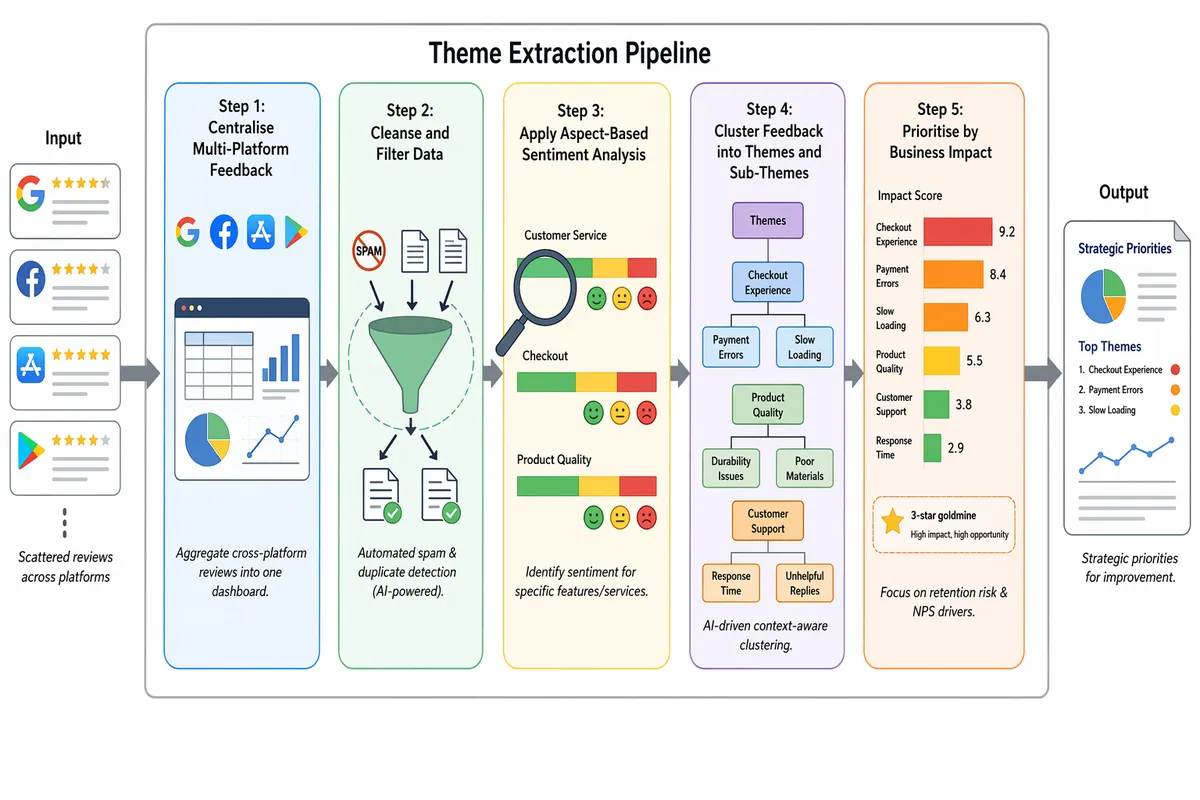
Follow this five-step methodology for reliable theme extraction:
Centralise Multi-Platform Feedback: Aggregate reviews from Google Business Profile, Facebook, Apple App Store, and Google Play into one dashboard. Fragmented data hides patterns; centralisation reveals cross-platform issues. For platform-specific nuances, the Google Play review management offers deeper insights.
Cleanse and Filter Data: Remove duplicates and spam automatically. AI tools like ReviewSense detect toxic content and irrelevant entries, ensuring analysis focuses on genuine feedback. This step prevents skewed results from fake or duplicate entries.
Apply Aspect-Based Sentiment Analysis: Go beyond overall sentiment to pinpoint specific feature or service failures. In hospitality and retail, customer service issues account for about 40% of complaints. This precision identifies exact pain points, like checkout delays or product defects.
Cluster Feedback into Themes and Sub-Themes: Group related issues hierarchically (e.g., 'payment errors' under 'checkout experience'). Avoid simplistic keyword matching – it misclassifies phrases like 'slow service' versus 'slow loading'. AI understands context, clustering accurately.
Prioritise by Business Impact: Focus on themes affecting customer retention and NPS. The '3-star goldmine' strategy targets balanced feedback in mid-range reviews, which often contain actionable improvement ideas. These insights then inform targeted actions, such as using an AI review response generator to address common concerns consistently. Root cause analysis shows how recurring themes drive customer decisions, letting you fix systemic problems.
This method transforms raw data into strategic priorities, ensuring resources tackle issues that matter most to customers and your bottom line.
Avoiding Common Analysis Pitfalls
Even with strong theme extraction, businesses often stumble during interpretation. Three common pitfalls derail actionable insights from your 10,000 reviews:
| Pitfall | Solution |
|---|---|
| Prioritising high-volume complaints over severe issues | Impact-based scoring (payment failures > cosmetic flaws) |
| Misclassifying sarcastic/mixed-tone feedback | Context-aware AI + human validation loops |
| Using vague theme labels (e.g., 'bad service') | Granular sub-themes + toxic content filtering |
Over-Indexing on Volume vs Severity
Focusing solely on complaint frequency distorts priorities. Cosmetic flaws might dominate volume yet barely affect retention, while rare payment failures cause immediate churn. Impact-based scoring weights themes by their proven effect on metrics like NPS and customer lifetime value. This ensures critical issues like checkout errors trigger urgent action, not just high-frequency nitpicks.
Misinterpreting Sarcasm and Mixed Tones
Phrases like 'Brilliant, my delivery's only a week late' often fool basic sentiment tools. Modern AI achieves up to 87% accuracy in detecting such nuances, but human validation remains essential. Platforms flag ambiguous cases for team review, creating a feedback loop that refines AI learning. This prevents misclassifications that could bury genuine complaints under false positives.
Vague Theme Grouping
Broad labels like 'poor service' offer little operational value. Granular sub-themes—'delayed refunds', 'unresponsive support', 'incorrect sizing'—pinpoint exact failure points. Automated toxic content filtering simultaneously removes abusive or spam reviews that distort analysis. Combined, these steps ensure themes drive specific improvements, whether refining your App Store review management or optimising service workflows. For UK businesses, mastering this balance is covered in the guide to managing Google reviews.
From Insights to Action: Strategic Response Frameworks
Turning analysis into operational improvements requires structured response strategies. This framework contrasts common approaches with effective methods:
| Reactive Approach | Strategic Framework |
|---|---|
| Generic responses | Tailored templates for recurring issues |
| Delayed manual routing | Automated triage to departments |
| Ignoring sentiment trends | Real-time alerts for negative spikes |
| Siloed feedback analysis | Integrated with product roadmaps |
| No impact measurement | Track resolution via CSAT/NPS |
Route themes to relevant teams
Automatically channel specific feedback themes to responsible departments. Bug reports go directly to development teams, shipping complaints to logistics managers, and service issues to customer support leads. This eliminates internal bottlenecks. For app-based businesses, specialised workflows like those in our App Store review management guide ensure technical feedback reaches product teams immediately.
Develop response templates
Create customised templates for frequent issues identified through theme analysis. A restaurant might craft responses for common complaints about delivery times, while a SaaS company templates replies for feature requests. These maintain brand voice while ensuring consistency. Our negative review response generator helps craft these quickly while allowing personalisation.
Monitor and act on sentiment shifts
Configure real-time alerts for sudden drops in sentiment scores. When negative mentions spike around a specific feature update or service change, teams receive instant notifications. This enables swift damage control before issues escalate. Voice of the customer tools unify these signals across all review platforms.
Feed insights into development
Integrate recurring complaint themes into product planning cycles. If payment errors consistently emerge as a top issue across Google Play and App Store reviews, prioritise this in your development roadmap. Demonstrating you've acted on feedback builds trust and loyalty.
Measure resolution impact
Track how addressing key themes affects customer satisfaction metrics. Monitor NPS or CSAT scores before and after implementing changes based on review analysis. This quantifies ROI and justifies further investment in feedback management. Proactive issue resolution significantly reduces churn, as shown in customer experience research. Watch the sector line as well as your own, since a rising score in a rising market is not the win it looks like. Review benchmarking tools supply that comparison.
Conclusion
Effectively analysing large volumes of negative feedback requires moving beyond surface level. Prioritise issues by their proven impact on retention and loyalty, not just frequency. Employ AI capable of detecting nuanced sentiment like sarcasm, validated by human oversight for accuracy. Break broad complaints into granular sub-themes to identify exact operational failures, while filtering out toxic or spam content that distorts insights. Crucially, transform these insights into action: route themes to relevant teams, deploy tailored response templates, monitor real-time sentiment shifts, integrate findings into development cycles, and measure resolution impact on key metrics like CSAT. ReviewSense centralises this entire process, turning scattered reviews from Google, Facebook, Apple App Store, and Google Play into a strategic engine for customer experience improvement. Start your 7-day free trial to transform feedback into growth.