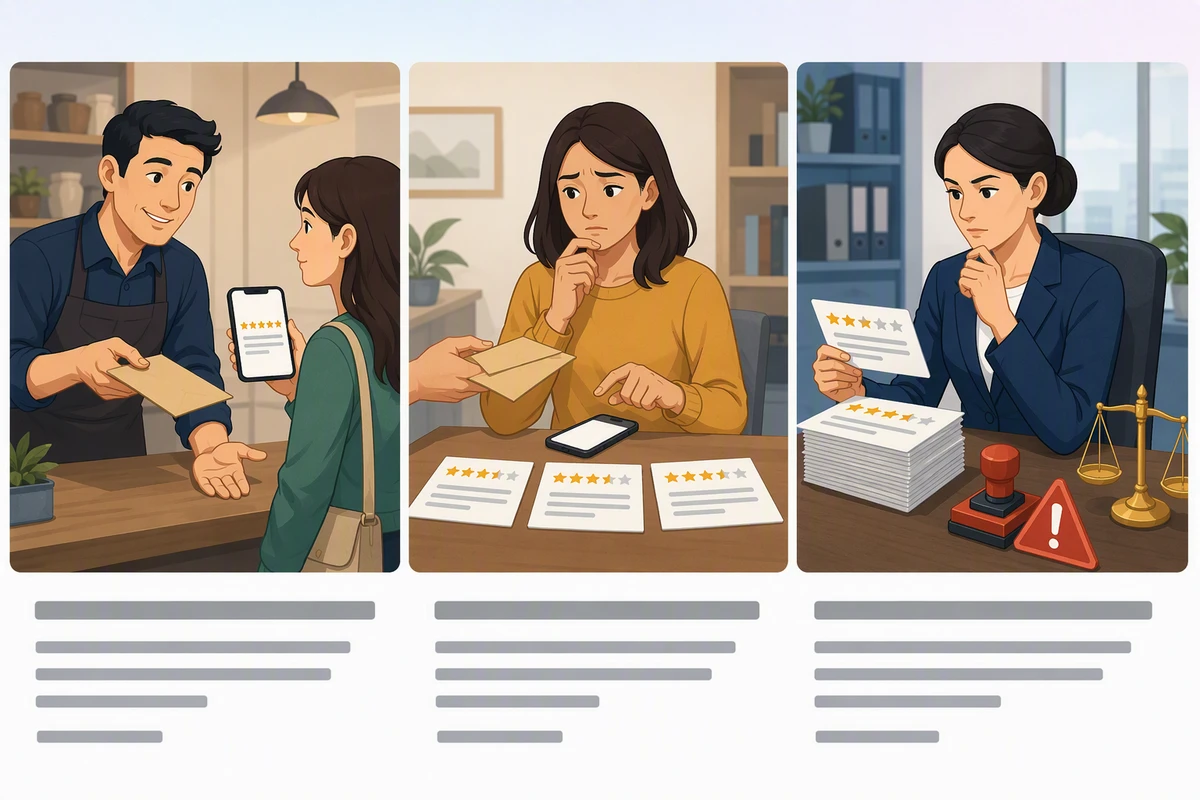
97% of U.S. consumers read reviews before choosing a business — but a single reputation score can hide more than it reveals. With 41% now saying they always read reviews (up from 29% in 2025), and 73% paying attention only to reviews written in the last month, relying on a static number is risky. Your online reputation score might be misleading you. This guide explains what these scores actually measure, where they fall short, and how to measure reputation beyond the score — so you can make smarter decisions about your brand.
Managing this manually is hard. ReviewSense automates it.
What an Online Reputation Score Actually Measures in 2026
That single-digit number next to your brand isn't a universal truth. It’s a snapshot from one specific lens. In 2026, three distinct types of scores dominate the conversation, and they measure fundamentally different things.
| Score Type | What It Measures | Example |
|---|---|---|
| Consumer brand-trust score | Emotional trust and purchase intent among a surveyed population | Morning Consult’s Most Trusted Brands 2026 report ranks Dawn Dish Soap at 60.4 out of 100 |
| Review-based star average | Arithmetic mean of customer ratings on a single platform | A 4.2-star average on Google Business Profile |
| Proprietary ORM platform score | Weighted composite of rating, volume, recency, response rate, and sentiment | Reputation.com’s 0–1,000 scale, used in their automotive industry report |
These scores are not interchangeable. A high trust score doesn’t guarantee a high star average, and vice versa. Each answers a different question.
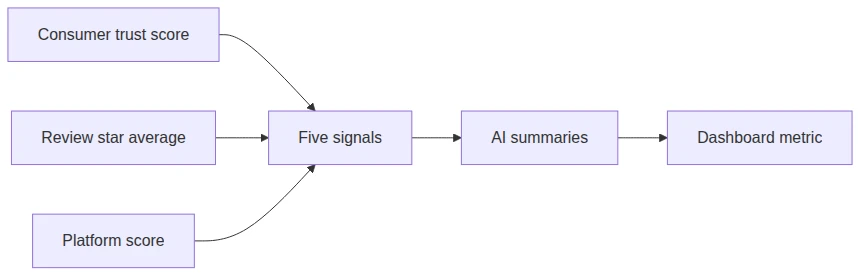
The multi-signal reality. A credible reputation score now blends five signals: average rating, total review count, recency of feedback, response rate, and sentiment. S. consumers read reviews. 73% focus on recent reviews. 40 reviews serves as a reliability threshold. A score that ignores recency or volume is misleading.
AI visibility changes the game. Google’s Gemini integration now surfaces AI-summarised review snippets in search results. Reputation.com’s AI tools analyse sentiment at scale. How to measure reputation in 2026 means accounting for machine-generated summaries, not just human-written stars.
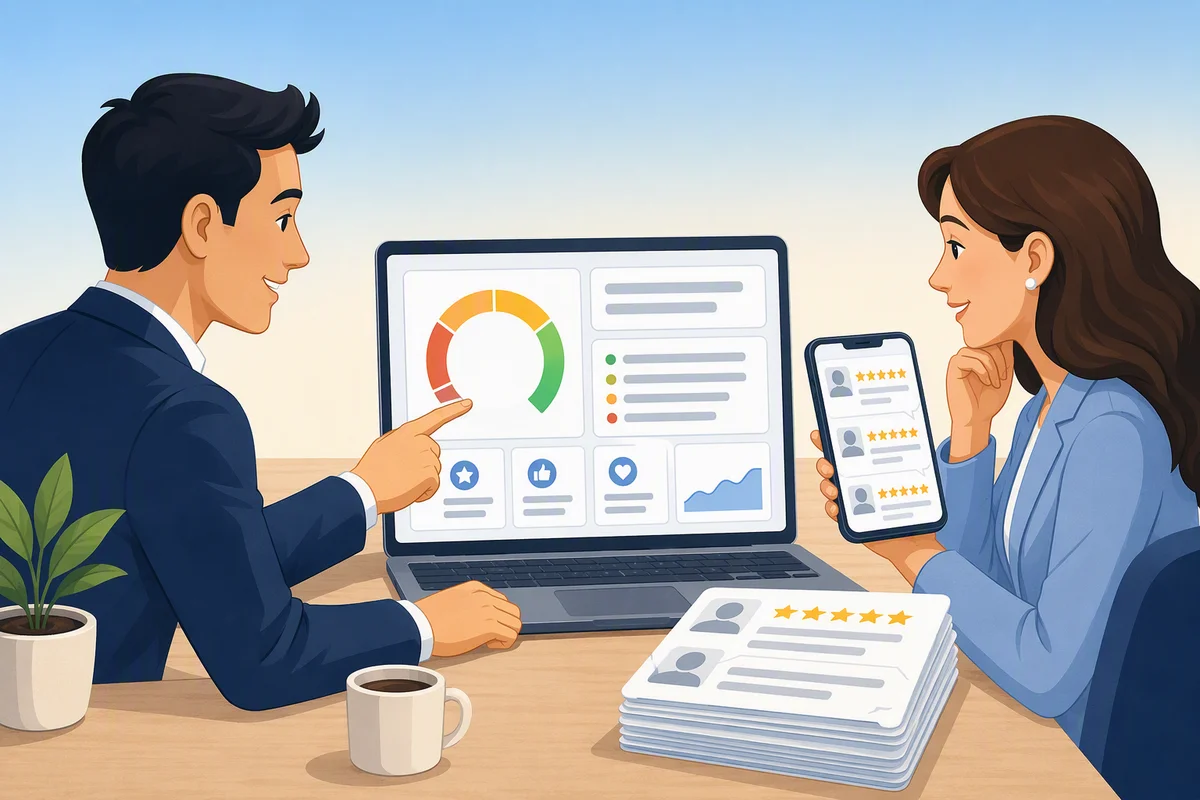
The score is a dashboard metric, not a universal truth. It signals trends, not absolute quality. Use it to spot a dip in response rates or a spike in negative sentiment. Treat it as a directional guide, not a final verdict. For a deeper look at how to measure reputation effectively, read the guide on customer review monitoring tools. You can also use the Google Place ID Finder to centralise your location data.
Why a Single Number Can Be Misleading
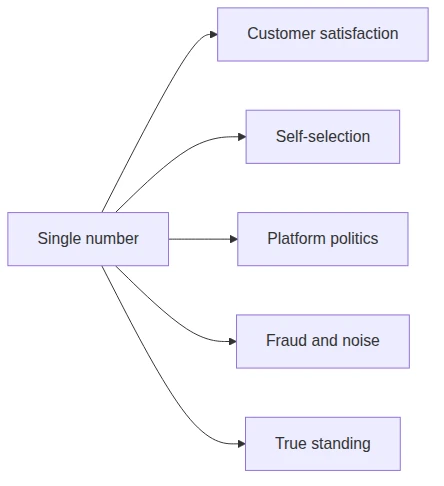
That dashboard metric, however, can mask a messier reality. A single number simplifies, but it also distorts. Here is what a reputation score claims to represent versus what it often hides.
| What the Score Claims | What It Often Misses |
|---|---|
| Reflects overall customer satisfaction | Only captures a self-selected subset; may miss the silent majority. Research in Electronic Commerce Research (2026) found that self-selection bias distorts trust signals significantly. |
| Represents genuine feedback | Fraud and manipulation are real. MIT’s Dellarocas showed that fake reviews can skew averages, making a score unreliable without detection. |
| Measures your brand’s true standing | Platform dependence skews results. Google’s review policies differ from Facebook’s, so a 4.5 on one site may not translate to another. |
| Predicts future behaviour | Silence bias is rampant. Chen and Li’s IEEE paper found that non-reviewers hold different opinions, meaning the score reflects only the vocal few. |
| Equates to search visibility | Confuses appearance with reputation. A high score does not guarantee top search placement; Google’s algorithm weighs recency and volume too. |
The Self-Selection Trap
Not every customer leaves a review. Most don’t. A 2026 study in Electronic Commerce Research confirmed that self-selection bias distorts how we interpret trust. Angry customers shout. Happy ones often stay quiet. That 4.2-star average may represent only 10% of your actual client base.
Platform Politics
A score on Google Business Profile is not the same as one on the Apple App Store. Each platform uses its own algorithm. Google’s review policies filter differently than Facebook’s. The FTC’s recent rule on fake reviews adds pressure, but enforcement remains uneven. Your online reputation score is a product of its environment, not a pure measure of quality.
Fraud and Noise
Fake reviews are a persistent problem. MIT research by Dellarocas demonstrated that even a small percentage of fraudulent ratings can shift a score. Without spam detection, you’re trusting a polluted number.
How to Measure Reputation Beyond the Score
That single score hides more than it reveals. To understand your real standing, you need a broader audit. Here is a practical framework for how to measure reputation beyond the dashboard number.
| Step | What to Do | Why It Matters |
|---|---|---|
| 1 | Audit search visibility | AI tools now drive 45% of local discovery, up from 6% in 2025 |
| 2 | Analyse review content | Star averages miss recurring themes and sentiment shifts |
| 3 | Measure response rate and quality | 97% of readers check how you reply |
| 4 | Check for fake review signals | FTC rules require active monitoring |
| 5 | Connect data to outcomes | A 150-point score lift can drive 10% sales growth |
Step 1: Audit Visibility Across Key Searches
Your reputation score means little if customers can't find you. Check where your brand appears for branded and non-branded queries on Google and Facebook. AI-generated summaries now shape first impressions. If you're missing from those snippets, your score won't help.
Step 2: Analyse Review Content for Themes
A 4.5 average can mask a pattern of complaints about slow service. Use sentiment analysis to spot recurring issues. Dedicated platforms can centralise this data and flag topics like "wait time" or "quality."
Step 3: Measure Response Rate and Quality
Recent industry research shows that response quality matters as much as speed. A generic "thank you" doesn't build trust. Track how many reviews you reply to and whether those replies address the specific feedback.
Step 4: Check for Fake Review Signals
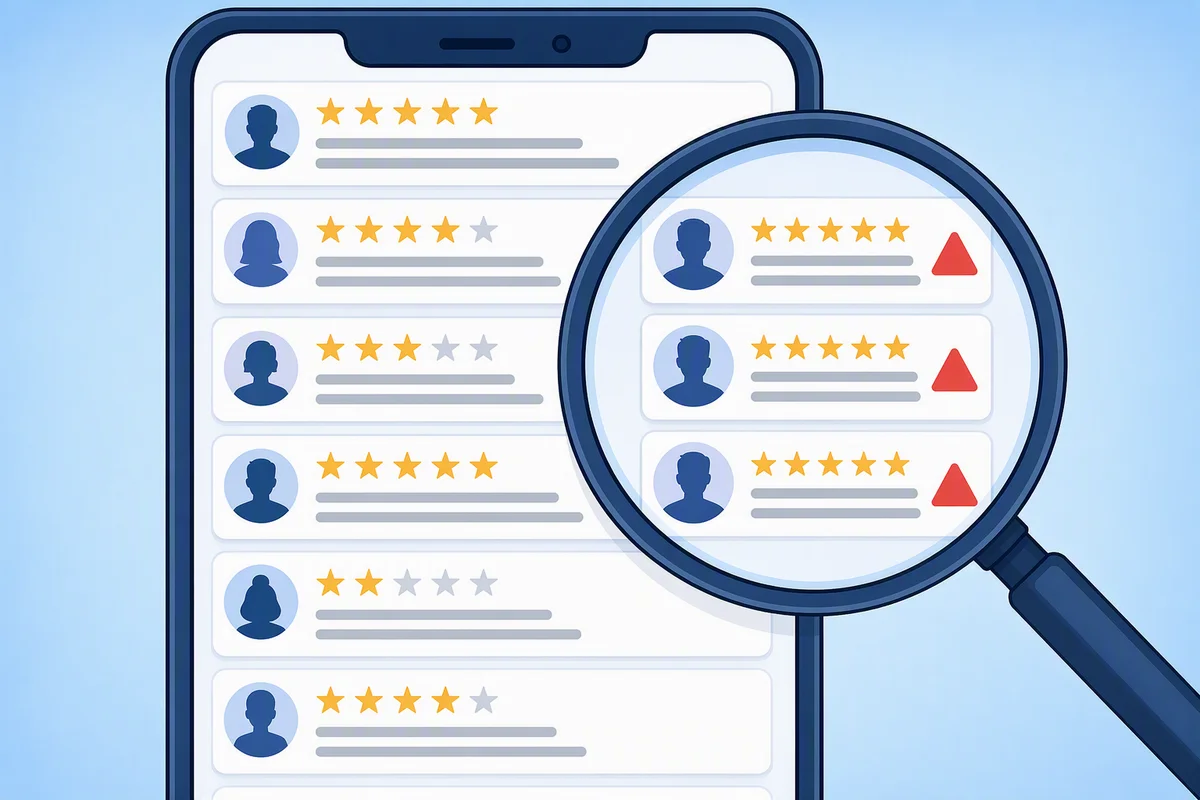
FTC guidance on consumer reviews and testimonials requires businesses to monitor for fraud. Look for suspicious patterns: multiple 5-star reviews from new accounts or identical phrasing. Spam detection tools can automate this check.
Step 5: Connect Reputation Data to Business Outcomes
A higher reputation score correlates with real revenue. Track your score against sales data over time. If you see a dip, investigate the root cause. For a deeper look at how to measure reputation effectively, read the guide on merging duplicate profiles. You can also compare pricing and features for 2026 to find the right tool.

Industries Where Reputation Risk Is Highest
That framework works for most businesses, but some industries face unique volatility. A single online reputation score becomes especially unreliable when the underlying data is sparse, emotional, or regulated. Here is where the risk is highest.
| Industry | Key Vulnerability | Why the Score Misleads |
|---|---|---|
| Restaurants | High volume, subjective experiences | One bad night can tank a weekly average |
| Healthcare | Privacy constraints on responses | You can't reply to specifics, so silence looks like neglect |
| Home Services | Low review volume | A single 1-star review can drop a score by a full point |
| Automotive | Complex transactions, high stakes | Recency bias distorts long-term quality |
| Financial Services | Regulatory spillover from CFPB complaints | Formal complaints never appear on review platforms |
Restaurants and Food Service
Dining is deeply subjective. Taste, service speed, and ambiance vary by visit. A 73% of consumers paid attention only to reviews written within the previous month. That means a single slow Saturday can crater your score for weeks. The hospitality sector consistently struggles with review volatility, as InMoment's 2025 benchmark data shows.
Healthcare
Medical practices face strict privacy rules. You cannot reply to a review with specifics about a patient's case. A generic "thank you for your feedback" reads as dismissive. The score then reflects not care quality, but your inability to defend yourself.
Home Services
Plumbers, electricians, and landscapers often operate on thin review counts. A single negative review can shift the average by a full star. The online reputation score becomes a fragile number, not a reliable measure of skill.
Automotive
Car sales and repairs involve high stakes and complex transactions. InMoment's data shows the automotive sector had the largest year-over-year improvement in 2025. But that progress is fragile. A single dispute over a repair bill can trigger a flurry of negative reviews, distorting the score.
Financial Services
Banks and lenders face a hidden problem. Formal complaints filed with the CFPB never appear on Google or Facebook. Your reputation score looks fine while regulatory risk builds underneath.
What to Look for in a Reputation Management Tool
Because a single score hides signal in noise, your tool must do more than display a number. Here is what to look for when evaluating a reputation management platform.
| Criterion | Why It Matters |
|---|---|
| Multi-platform support | Customers review on Google, Facebook, and app stores. A tool that misses one creates blind spots. |
| Sentiment analysis | Star averages bury recurring complaints. Topic extraction surfaces patterns. |
| AI response generation | Consistent, on-brand replies improve reader trust and response rates. |
| Crisis alerts | A sudden negative spike demands immediate action, not a weekly report. |
| Analytics on response rate and sentiment | You cannot improve what you do not measure. |
Multi-platform support. Most businesses receive reviews across Google Business Profile, Facebook, Apple App Store, and Google Play. A tool that only covers one platform leaves you blind. Google’s own guidance on managing your Business Profile stresses the importance of monitoring all channels. Look for a centralised dashboard that pulls feedback from every supported site into one view.
Sentiment analysis and spam detection. The FTC’s final rule banning fake reviews, announced in August 2024, puts the onus on businesses to monitor for fraud. A tool that flags suspicious patterns — identical phrasing, bot-like timing — protects your reputation score from pollution. Sentiment analysis then extracts recurring themes like “wait time” or “quality,” turning raw text into actionable data.
AI response generation. Replying to every review at scale is impractical without automation. An AI generator that adapts to your brand voice ensures consistency. It helps overcome silence bias by prompting for reviews after a positive interaction.
Crisis alerts and analytics. A sudden drop in your online reputation score needs an instant response. Real-time alerts for negative spikes let your team act before damage spreads. Analytics that track response rates and sentiment trends show whether your strategy works. For a deeper look at benchmarks, see the CSAT Benchmarks 2026 guide.
Low-risk evaluation. You can test these features with a 7-day free trial. Free tools like a Google Review Calculator and negative review response templates provide immediate value without commitment.
Conclusion
An online reputation score offers a quick snapshot, but it rarely tells the full story. Star averages bury recurring complaints, hide regulatory risks, and distort easily with thin review counts. Smart teams look past the number. They monitor sentiment across every supported platform, detect spam before it pollutes their data, and respond at scale with consistent brand voice. Crisis alerts catch negative spikes before damage spreads. Analytics then confirm whether your strategy actually works. The goal is not a higher score—it is a clearer understanding of what drives customer experience. Turn scattered reviews into actionable insights that improve retention and growth. Start your 7-day free trial.