
Nearly 78% of businesses now use AI tools to assist with or automate review responses, yet over 30% of reviews are estimated to be fake or AI-generated. This paradox defines 2026: you need AI to keep up with volume, but blind automation risks eroding trust. The top review management software with AI review generation balances speed with authenticity, helping you maintain a human touch at scale.
Managing this manually is hard. ReviewSense automates it.
Why AI Review Management Is No Longer Optional in 2026
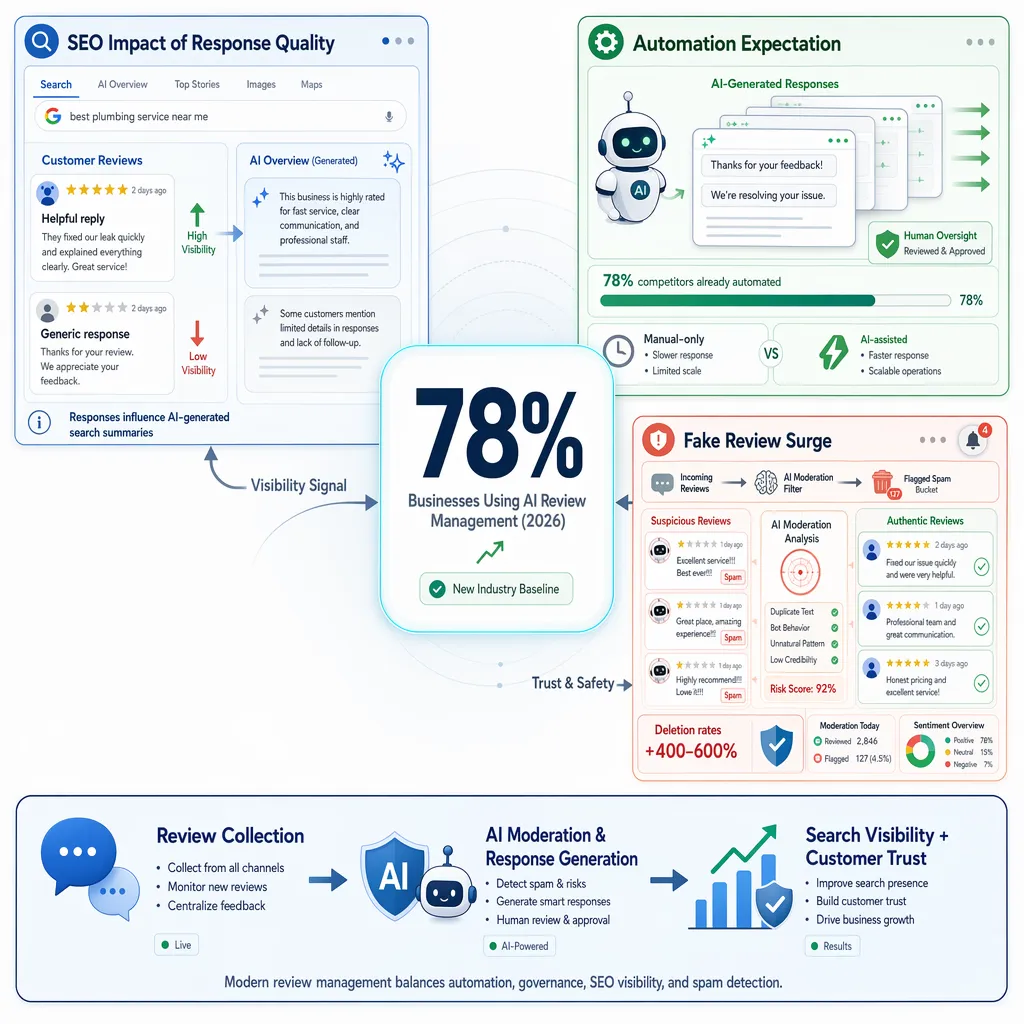
By 2026, the debate around AI in review management is settled. Approximately 78% of businesses now use AI tools to assist with or automate review responses, according to recent industry research. That's not a trend — it's the new baseline. For anyone searching for the top review management software with AI review response or generation 2026, the question has shifted from 'should we use AI?' to 'how do we use it safely and effectively?'
| Key Shift | What It Means for Your Business |
|---|---|
| Reviews feed AI search summaries | Google AI Overviews and ChatGPT now pull review data directly. Poor responses hurt your visibility. |
| Fake review surge | Deletion rates have jumped 400-600%. Real-time detection is now essential, not optional. |
| Automation is expected | 78% of competitors already use AI. Manual responses signal a lack of investment. |
Why Response Quality Is Now an SEO Signal
Reviews don't just influence customers — they influence search engines. Google's AI Overviews and similar tools pull from public review data. A generic or unhelpful reply can damage your brand's standing in AI-generated summaries. This makes choosing the best AI review management tools for businesses 2026 a strategic decision, not just an operational one.
The Fake Review Problem Won't Fix Itself
Industry data shows that roughly 30% of online reviews are fake. Deletion rates have surged 400-600% as platforms crack down. But manual monitoring is impossible at scale. A platform that flags spam and toxic content in real time lets your team focus on genuine feedback. That's why many businesses now prioritise detection features when evaluating a top-rated review management platform for enterprises 2026.
What This Guide Covers
This article helps you choose a platform that balances automation with governance. You'll learn how to evaluate response generators, sentiment analysis, and spam detection. For a deeper look at building trust through reviews, see the guide on customer review management. And if you're managing feedback on Apple devices, the Apple App Store review management software page covers platform-specific features. The goal is simple: find a tool that saves time without sacrificing quality.
How the Top Platforms Handle Sentiment, Spam, and Scale
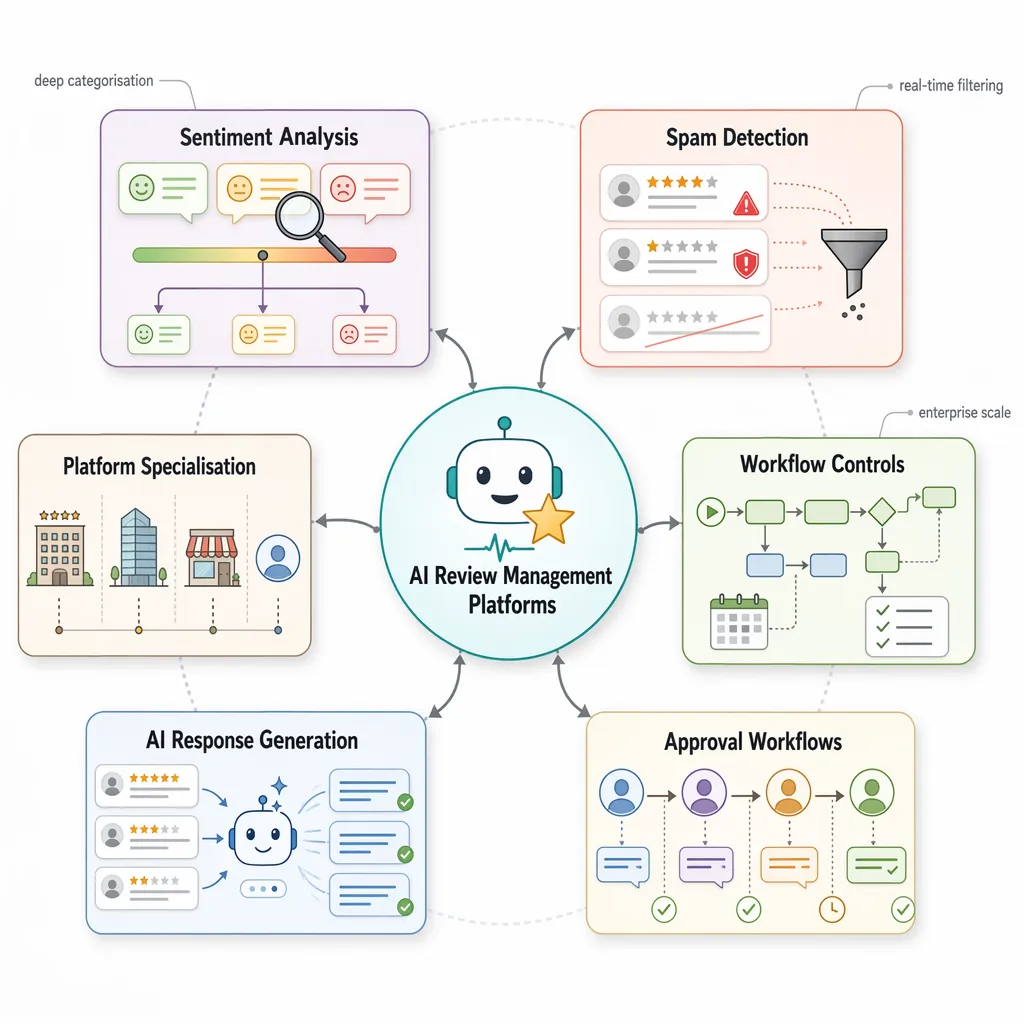
Not all AI review tools are built the same. As you evaluate the top review management software with AI review response or generation 2026, the differences in sentiment analysis, spam detection, and workflow controls become critical. Here’s how six platforms compare.
| Platform | Best For | Key AI Features |
|---|---|---|
| MARA | Hospitality industry | High-quality, industry-trained AI responses |
| Birdeye | Mid-market and enterprise | Sentiment categorisation and experience trend analysis |
| Podium | Multi-tool/SMS integration | Sentiment classification from customer messages |
| Reputation.com | Large enterprises | Advanced NLP for reputation scoring and competitive intelligence |
| ReviewScout AI | Small businesses | Cost-effective AI response generation and sentiment analysis |
| RepliFast | Solo and small teams | Automated review replies with approval workflows |
The table shows a clear pattern. Many tools generate replies, but few offer actionable sentiment analysis. Recent industry research confirms that AI marketing use cases—including visibility monitoring, analytics, and content generation—are adopted by 72–84% of organisations that have implemented AI. Yet most platforms still miss the mark on spam detection.
Why Sentiment Gaps Matter
Surface-level sentiment (positive, negative, neutral) isn't enough. You need to know why a customer is unhappy. Is it a delivery delay, a product defect, or poor service? Without deep sentiment analysis, you're guessing. For enterprise buyers searching for a top-rated review management platform for enterprises 2026, Reputation.com stands out with its advanced NLP and competitive intelligence. But for most teams, the gap between basic and deep sentiment is where real value lives.
Spam Detection Is the New Baseline
With over 30% of reviews now estimated to be fake or AI-generated, spam and policy-violation detection has stopped being a differentiator and become table stakes. Platforms have responded by increasing review deletion rates by 400–600%, which cuts both ways: real-time monitoring is now essential, but it also means legitimate feedback can get swept up if a tool's detection isn't precise. The platforms worth shortlisting for 2026 pair fast, automated flagging with enough accuracy that your team spends time on genuine feedback, not re-checking what an overzealous filter removed.
The Hidden Risks of Full Automation and How to Avoid Them
Spam detection is only half the battle. The real challenge is using AI without damaging your brand. Here's how to avoid the hidden risks of full automation.
The Hidden Risks of Full Automation and How to Avoid Them
| Risk | Consequence | How to Avoid |
|---|---|---|
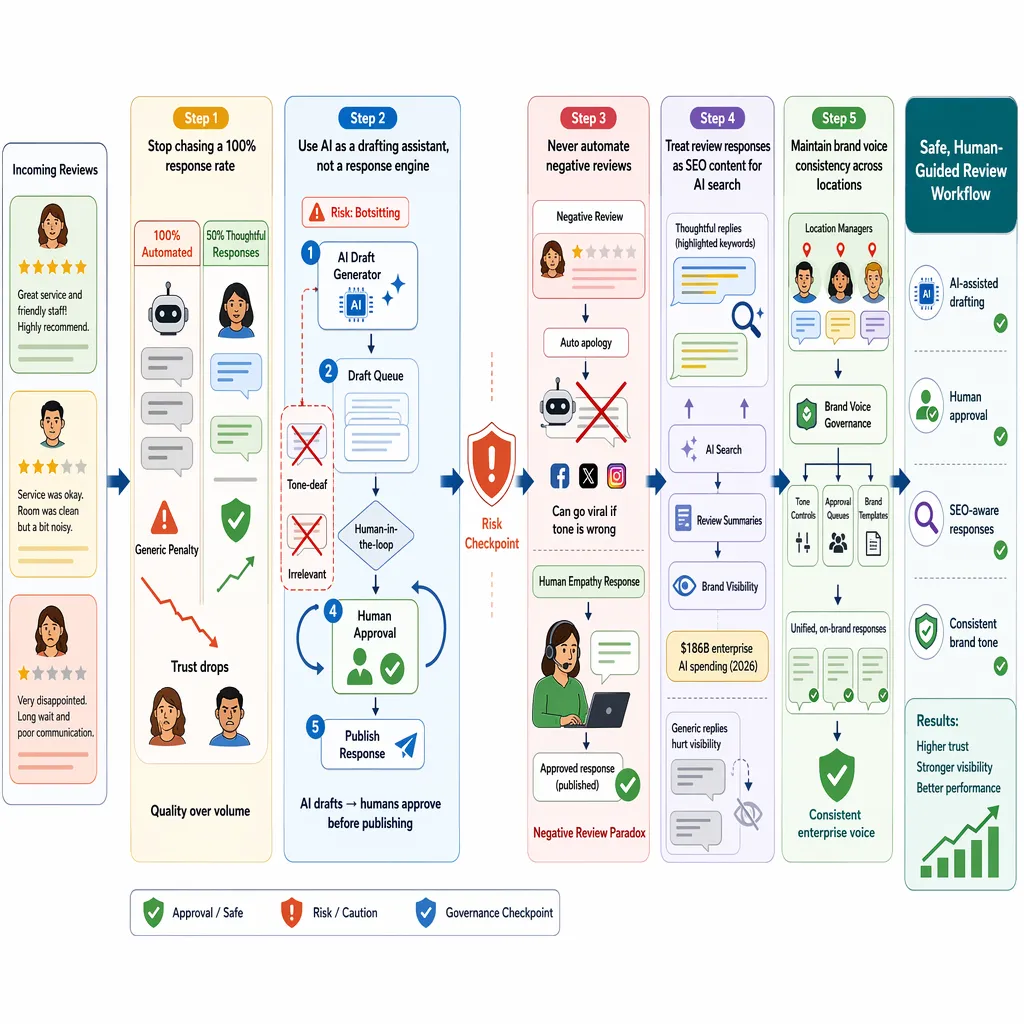
| Generic penalty | Customers spot bot-written replies; trust drops | Aim for 50% thoughtful responses, not 100% robotic ones |
| Botsitting | Staff spend more time editing AI replies than writing from scratch | Use AI as a drafting assistant, not a response engine |
| Negative review paradox | AI-generated apologies can go viral if tone is wrong | Never automate negative reviews |
| SEO content loss | Generic replies miss chances to improve AI search visibility | Treat responses as SEO content for AI search |
| Brand voice drift | Multi-location teams produce inconsistent replies | Maintain brand voice consistency with governance tools |
Step 1: Stop chasing a 100% response rate. Research shows customers can spot bot-written replies. A 50% thoughtful rate beats 100% robotic. The 'generic penalty' is real. Your team should prioritise quality over volume.
Step 2: Use AI as a drafting assistant, not a response engine. Full automation creates a 'human-in-the-loop bottleneck'. Staff end up 'botsitting' — spending more time editing bad AI drafts than writing themselves. Worse, unchecked AI can produce 'botshitting': irrelevant or tone-deaf replies. The best approach is a queue workflow where humans approve before publishing.
Step 3: Never automate negative reviews. The 'Negative Review Paradox' is simple: AI-generated apologies that miss the mark can go viral for all the wrong reasons. Negative feedback needs human empathy, not template logic.
Step 4: Treat review responses as SEO content for AI search. Global enterprise AI spending reached $186 billion in 2026, a 47% increase from 2025. AI search tools now pull review data directly. Thoughtful replies improve your visibility in these summaries. Generic ones hurt it.
Step 5: Maintain brand voice consistency across locations. Enterprise teams face a governance challenge. Without custom brand voice settings, each location manager writes differently. The top-rated review management platform for enterprises 2026 must offer tone controls and approval queues.
What to Look for in a Modern Review Management Platform
Building on those risks, let's focus on what separates capable platforms from the rest. When you evaluate the top review management software with AI review response or generation 2026, look for these six criteria.
| Criterion | Why It Matters in 2026 |
|---|---|
| Workflow integration | Saves hours by connecting Slack, Teams, or CRM |
| Deep sentiment analysis | Reveals the 'why' behind feedback, not just star ratings |
| Spam and fake review detection | Over 30% of reviews are now estimated to be fake or AI-generated |
| Human-in-the-loop approvals | Prevents tone-deaf replies on sensitive reviews |
| Multi-location governance | Keeps brand voice consistent across dozens of sites |
| Transparent pricing | Avoids hidden fees; look for plans from ~£10/month |
1. Integration with existing workflows. Your team already uses Slack, Microsoft Teams, or a CRM. A platform that pushes review alerts there reduces context switching. The 'integration over innovation' advice holds: a tool that fits your flow beats one with flashy features you never use. Check if it connects to your helpdesk or project management software.
2. Sentiment analysis that goes deeper. Star ratings tell you what happened. Good sentiment analysis tells you why. It should extract topics like 'late delivery' or 'rude staff' from text. This turns reviews into structured data your product and operations teams can act on. Without it, you're flying blind.
3. Spam and fake review detection. With over 30% of reviews now estimated to be fake or AI-generated, manual filtering is impossible. A modern platform must flag policy violations automatically. This protects your reputation and saves hours of manual review. Industry research confirms that fake reviews erode consumer trust fast.
4. Approval workflows with human oversight. Never automate negative reviews. A queue system where a human reviews and approves each response before publishing is essential. This 'human-in-the-loop' approach prevents PR disasters. It's a core feature for any best AI review management tools for businesses 2026.
5. Multi-location governance and brand voice. Enterprises with multiple branches need consistency. A platform should let you set a global brand voice, then allow local edits within guardrails. This stops one rogue store manager from damaging the whole chain's reputation.
Comparing Approaches: Which Business Type Needs What
That framework of governance and human oversight applies differently depending on your sector. The right approach to the top review management software with AI review response or generation 2026 depends heavily on your business type. Here's how the needs diverge.
| Business Type | Core Challenge | What Matters Most |
|---|---|---|
| Highly Regulated (Healthcare, Legal, Finance) | Compliance risk and audit trails | Verifiable response history, no 'decision debt' |
| High-Touch Service & Hospitality | Empathy and avoiding robotic tone | Context-aware AI that feels human |
| Multi-Location Enterprises | Governance fragmentation | Centralised dashboards and brand voice controls |
Highly Regulated Industries: Compliance First
For healthcare, legal, and finance firms, every review response is a potential liability. The risk isn't just a bad reply — it's a regulatory breach. AI that drafts responses without an audit trail creates 'decision debt': you can't prove who approved what or why. Industry analysis from getperspective.ai shows that platforms have increased review deletion rates by 400–600% to manage risk. Your software must log every action and allow full approval queues. The best AI review management tools for businesses 2026 in this space offer immutable response histories.
High-Touch Service & Hospitality: Empathy Over Efficiency
Hotels, restaurants, and clinics live and die by personal touch. A robotic reply to a complaint about a cold meal or a rushed appointment feels insulting. The contrarian take holds here: human-written, slightly imperfect responses stand out more than polished AI ones. You need AI that drafts with context — knowing the guest's room number or the specific dish mentioned — not generic templates. A guide on managing Google reviews effectively can help teams set the right tone.
Multi-Location Enterprises: Governance at Scale
Franchises and chains face a different beast: consistency across dozens of locations. Without centralised controls, one branch's reply can undermine the whole brand. The top-rated review management platform for enterprises 2026 must offer a single dashboard with global brand voice settings and local editing guardrails. It's about empowering local managers without losing control.
The ideal platform adapts to your context. It doesn't force one-size-fits-all automation. It gives regulated firms audit trails, hospitality teams empathy tools, and enterprises governance — all from the same core system.
Conclusion
Choosing the right review management software in 2026 isn't about chasing the flashiest AI—it's about finding a platform that balances automation with the human oversight your business type demands. Whether you need compliance audit trails, empathetic response context, or multi-location governance, the core requirement remains the same: a system that flags risks, enforces brand voice, and turns scattered feedback into a strategic asset. ReviewSense delivers this by centralising reviews from Google, Facebook, and app stores, providing instant alerts, sentiment analysis, and customisable approval workflows—all without the marketing fluff. Stop letting reviews manage you. Turn scattered reviews into actionable insights that drive growth. Start your 7-day free trial