
Are generic, delayed responses to Google reviews damaging your local SEO and customer trust? Manual review management consumes 15+ hours weekly for most businesses, and 72% of consumers say merely suspecting a review is AI-generated already lowers their trust. With review volumes doubling since 2023, scaling quality responses is impossible without AI assistance. Discover how automation solves this in the Online Review Management Guide.
Managing this manually is hard. ReviewSense automates it.
The AI Revolution in Google Review Management
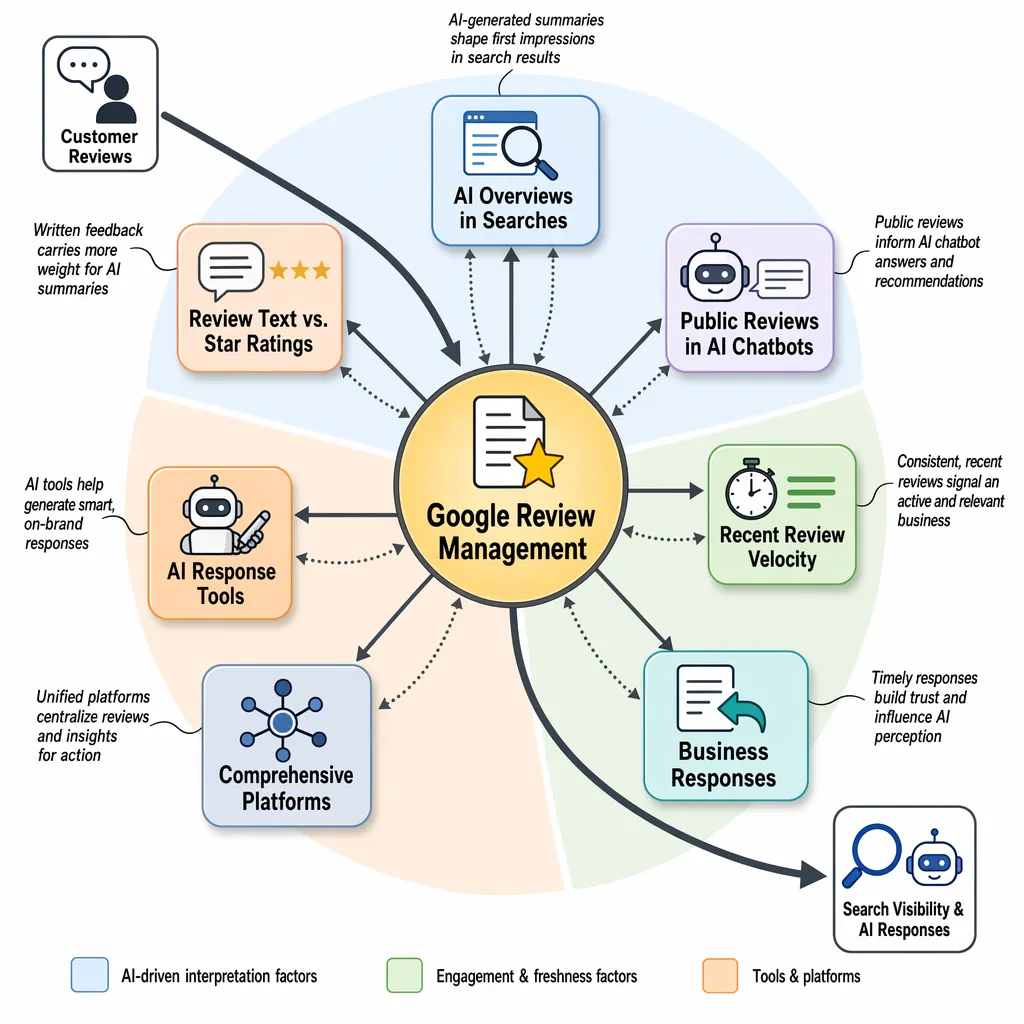
Beyond their immediate visibility, Google reviews now directly fuel the AI systems that shape how businesses appear in search results. In 2026, understanding this relationship is non-negotiable for reputation management.
| Aspect | Impact on Business Visibility |
|---|---|
| AI Overviews in 55% of searches | Synthesised review snippets shape first impressions |
| Review Text vs. Star Ratings | Written feedback carries more weight than ratings alone |
| Recent Review Velocity | Fresh feedback signals active engagement |
| Public Reviews in AI Chatbots | ChatGPT/Perplexity use reviews for business Q&A |
Google's AI doesn't just count stars; it reads. Written feedback provides context that star ratings lack, making it the primary driver for AI-generated summaries. These appear in over half of searches, fundamentally altering how customers discover businesses. A sudden influx of reviews, whether positive or negative, also triggers alerts within Google's systems. This 'velocity' factor can push your business into featured snippets or bury it under warnings.
The reach extends beyond Google. AI assistants like ChatGPT and Perplexity scrape public reviews to answer user queries. A negative review excerpt in an AI chatbot response can deter potential customers instantly.
Your responses actively shape this AI interpretation. Thoughtful replies demonstrate engagement, while unanswered criticism signals neglect. Yet only 54% of Google reviews receive a business reply, and 68% of negative ones go entirely unanswered according to ReplyOnTheFly's 2026 analysis. This gap leaves businesses vulnerable to AI systems amplifying unresolved complaints.
Closing this gap transforms visibility. Businesses using AI response tools achieve near-perfect response rates of 95-100% compared to 41% for manual efforts. This consistent engagement signals to both customers and algorithms that you're attentive. For teams needing efficient solutions, the 5-Star Review Response Generator helps craft quality replies quickly. Comprehensive platforms like ReviewSense enable complete AI-powered review management, turning scattered feedback into reputation fuel.
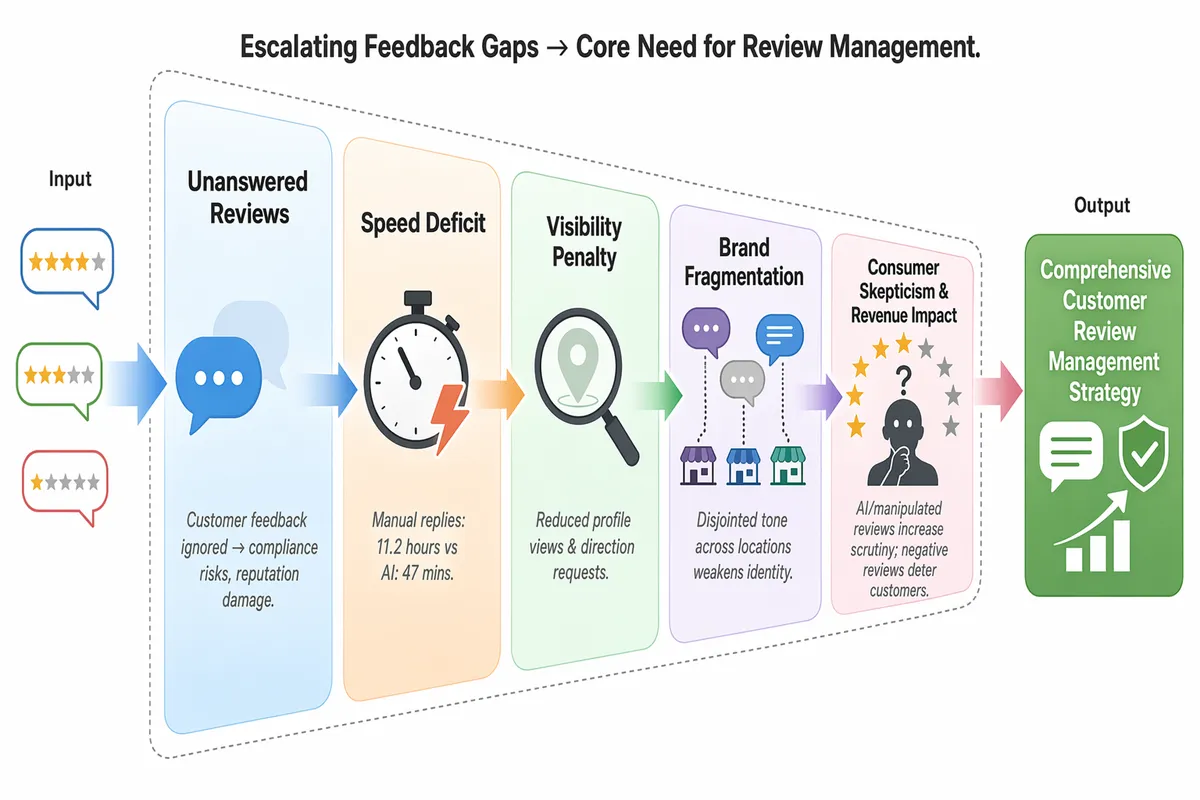
Critical Gaps in Manual Review Response
| Gap | Operational Impact |
|---|---|
| Slow Response Times | 11.2-hour median delay for manual replies vs 47 minutes with AI assistance |
| Low Response Rates | Businesses answering >90% of reviews see 23% more Google profile views than those under 50% |
| Brand Inconsistency | Fragmented messaging damages customer trust and recognition |
Response Rate Crisis: A substantial portion of Google reviews never receive acknowledgement, with negative feedback particularly neglected. This leaves customers feeling unheard, escalating minor issues into reputation crises. For healthcare providers and financial services firms, unanswered reviews risk breaching compliance guidelines around patient or client communication. The revenue impact is tangible: unresolved public complaints deter potential customers, directly affecting conversions and sales. Businesses seeking improvement should explore comprehensive customer review management strategies.
Speed Deficit: Manual response processes take a median of 11.2 hours according to industry benchmarks. This delay frustrates customers expecting timely engagement, especially in hospitality where urgent complaints about bookings or service failures require immediate attention. Slow replies often mean lost bookings and damaged guest relationships. AI-assisted responses reduce this gap to 47 minutes, making solutions like the AI Review Response Generator essential for service recovery.
Visibility Penalty: Businesses responding to over 90% of reviews see a 23% increase in Google profile views and 18% more direction requests than those responding to under 50%. This directly impacts footfall and online conversions. For multi-location retailers or service providers, this visibility gap compounds across regions, making local customer acquisition harder. Consistent engagement signals activity to Google's algorithms, improving local search rankings.
Brand Fragmentation: Without centralised control, franchises or teams with multiple responders risk inconsistent messaging. A disjointed tone across locations confuses customers and weakens brand identity. This proves particularly damaging for premium brands in sectors like financial services where trust and professionalism are paramount. Implementing unified brand voice protocols prevents this fragmentation.
Consumer Skepticism and Revenue Impact: Nearly half of consumers (48%) report frequent encounters with AI-generated or manipulated reviews, heightening scrutiny of all online interactions. Inconsistent or generic manual responses exacerbate distrust, while unaddressed negative reviews directly deter potential customers. Investing in efficient review management isn't just operational hygiene; it protects revenue by transforming feedback into growth opportunities.
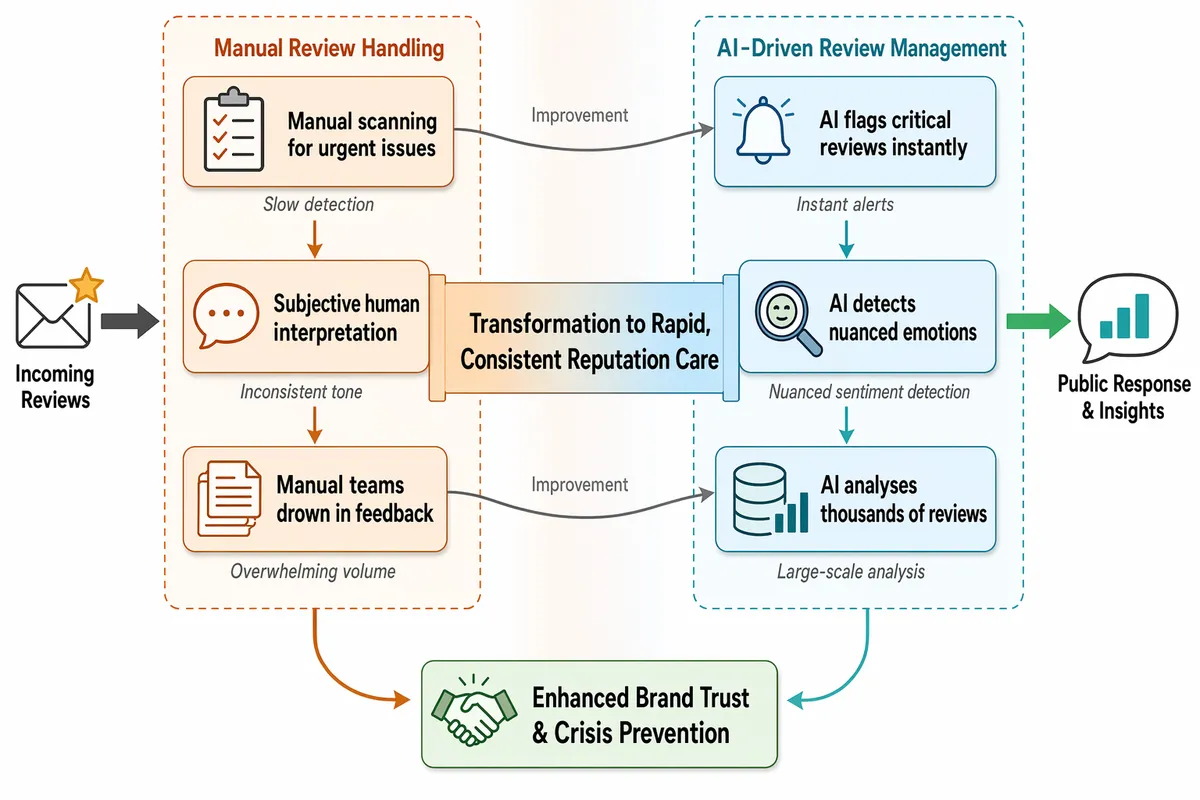
How Modern AI Solutions Bridge the Response Gap
Addressing these operational gaps requires tools that transform reactive firefighting into proactive reputation management. Modern AI solutions specifically tackle the core challenges where manual processes falter, balancing speed with authentic engagement. Below is a comparative analysis of key response obstacles and how AI overcomes them:
| Challenge | Manual Approach | AI-Powered Solution |
|---|---|---|
| Slow response times | Hours spent drafting/approving replies | Generates replies in seconds; achieves 47-minute median response time with workflows |
| Inconsistent brand voice | Varied writing styles across staff | Custom brand voice training maintains uniform tone; templates enforce guidelines |
| Negative review triage | Manual scanning for urgent issues | Flags critical reviews instantly; triggers crisis alerts for sentiment spikes |
| Volume management | Overwhelming for high-review businesses | Processes unlimited reviews; auto-replies to positives, queues negatives for review |
| Sentiment analysis | Subjective human interpretation | Detects nuanced emotions; identifies key topics and filters spam automatically |
Human-Like Responses Build Trust
Speed means little if replies feel robotic. When crafting an AI reply to google reviews, authenticity is non-negotiable. Custom brand voice training ensures responses match your unique tone—whether formal for legal firms working inside bar rules or friendly for cafes. This personalisation combats consumer scepticism: 72% lose trust if they suspect a review is AI-generated. The AI Review Response Generator helps maintain this balance, enabling quick yet human-sounding replies that reinforce brand identity.
Proactive Reputation Safeguards
AI doesn't just accelerate responses—it prevents crises. Spam detection automatically filters fake reviews, while sentiment analysis surfaces genuine complaints needing urgent attention. For multi-location businesses, this is transformative: a negative spike at one branch triggers instant alerts across the organisation. Teams can then address issues before they escalate, using guided workflows from the Google Review Management Software. This vigilance matters deeply, as 41% of shoppers completely bypass AI summaries to read individual reviews. Detection quality varies a lot between vendors, and our review of the best AI-powered reputation management software for 2026 covers which platforms catch fake reviews reliably and which only claim to.
Scaling Without Sacrificing Insight
High-volume review platforms like app stores demand specialised handling. Manual teams drown in feedback, missing critical patterns. AI analyses thousands of reviews to pinpoint recurring issues—68% of negative reviews go unanswered today, and that gap is where reputation damage compounds. These insights inform operational changes, turning complaints into improvement opportunities. For app-based businesses, the guide on managing App Store reviews at scale details how automation maintains quality control during growth surges. Remember: 37% of customers use AI summaries alongside written reviews, making comprehensive analysis essential for reputation accuracy.
Essential Features for 2026 Response Tools
Given the rising influence of AI in consumer interactions, UK businesses need response tools that balance automation with authenticity. With AI Overviews appearing in over 55% of product-related Google searches globally, your review responses directly impact how customers perceive your brand. Prioritise these six features when evaluating solutions:
| Feature | Core Function |
|---|---|
| Multi-platform aggregation | Centralises Google, Facebook, Apple App Store & Google Play reviews |
| Custom brand voice calibration | Maintains authentic tone across responses |
| Sentiment-driven response logic | Prioritises replies based on emotional urgency |
| Approval workflows | Enables auto-reply for positives & queues for negatives |
| Spam/toxic content filters | Automatically flags fake or harmful content |
| Crisis alert systems | Detects negative sentiment spikes in real-time |
Multi-platform aggregation consolidates feedback from all supported sources – Google Business Profile, Facebook, and both app stores – eliminating platform-hopping. This unified view is essential for UK businesses managing multiple locations. Centralisation reveals patterns across platforms, helping you spot regional service gaps. For local optimisation, combine this with effective Google review management strategies.
Custom brand voice calibration ensures AI-generated replies match your unique tone. Generic responses erode trust. The tool should learn from your existing communications to mirror your style. This combats consumer scepticism about AI-generated content while maintaining personality.
Sentiment-driven response logic analyses emotional tone to prioritise critical feedback. It automatically surfaces frustrated reviews needing immediate attention. This aligns with Google's emphasis on addressing negative feedback promptly to maintain search visibility.
Approval workflows streamline team collaboration. Set auto-reply rules for positive reviews while routing negatives to relevant staff. This maintains response consistency across franchises or departments. It prevents delays that damage local SEO performance.
Spam/toxic content filters automatically detect policy-violating reviews across platforms. This protects your overall rating from fake feedback. It ensures compliance with Google's prohibition on incentivised or fraudulent reviews.
Crisis alert systems monitor sentiment trends, triggering instant notifications for unusual negativity spikes. This allows swift intervention before issues escalate. For multi-location operations, integrate these alerts with dedicated Google review management tools to coordinate local teams.
These features form the foundation of reliable review response automation. They transform scattered feedback into actionable insights while respecting platform policies and consumer expectations.
Balancing Automation With Authenticity
| Challenge | Solution Approach |
|---|---|
| Consumer scepticism about AI-generated content | Custom tone training & selective disclosure |
| Risk of generic responses damaging trust | Human oversight for negative/complex reviews |
| Authenticity erosion from full automation | Hybrid workflows with escalation protocols |
Navigating the Trust Gap
Consumer wariness around AI-generated content is palpable, with nearly half expressing suspicion towards automated responses. This scepticism intensifies when replies feel generic or detached—studies highlight how synthetic responses can undermine brand perception. Google's dual role compounds this challenge: as both platform operator and curator of AI Overviews (which cite review platforms in 34.5% of cases), they prioritise authentic engagement. Tools detecting AI-generated reviews reinforce the need for human nuance in your ai google review reply strategy.
The Hybrid Response Model
Effective review management balances speed with sincerity through three key practices. First, customise your AI's tone using brand-specific language—train it on historical responses to mirror your voice. Second, implement tiered workflows: automate replies for positive feedback but escalate negative reviews to staff. This ensures sensitive issues receive personalised attention. Third, consider transparency. Some brands disclose AI assistance in responses, building trust through honesty. As 65% of businesses boost AI search presence by optimising reviews, authentic interactions become critical for visibility.
Practical Implementation Guide
Start by defining escalation protocols: route 1-3 star reviews to human agents while automating 4-5 star acknowledgements. Our guide to automating responses without losing quality builds this out into a full hybrid workflow, including what to measure once it is running. Regularly audit AI responses using sentiment analysis to spot generic phrasing. Calibrate tone settings quarterly to maintain brand alignment. Crucially, retain human oversight for nuanced scenarios—apologies, complex complaints, or emotional feedback. For businesses scaling efforts, ReviewSense enables this hybrid approach through custom workflows. Explore the negative response templates for crisis management or pricing tiers for team collaboration features.
Conclusion
Mastering Google review responses demands a strategic balance: using AI efficiency for scale while preserving authentic human connection to build trust. ReviewSense delivers this equilibrium with custom brand voice calibration, sentiment-driven prioritization, and hybrid workflows that ensure critical feedback gets human attention. By centralising reviews from Google, Facebook, and app stores, ReviewSense transforms scattered feedback into actionable insights that boost retention and reputation. Experience how ReviewSense's AI response generator streamlines engagement while maintaining authenticity—Start your 7-day free trial.