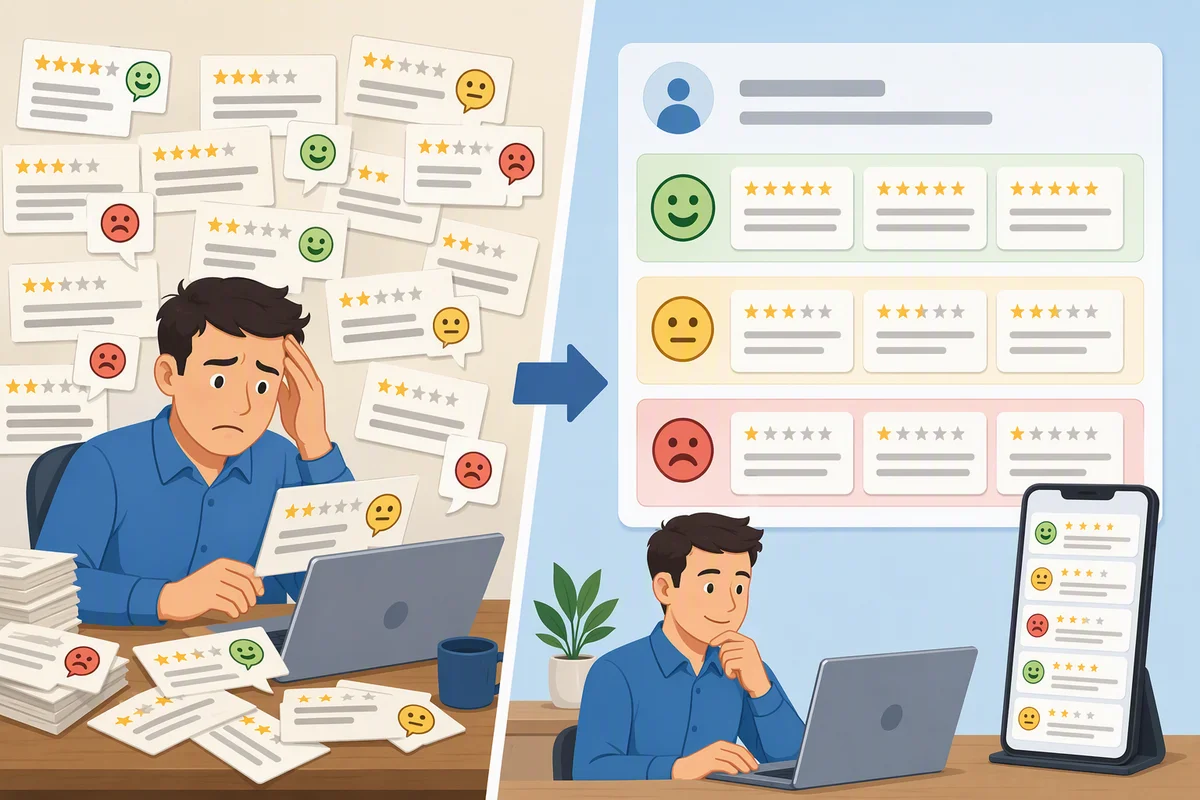
41% of consumers read every single review before evaluating a business. Star ratings tell you what customers think, but they hide the why. Google review sentiment analysis digs deeper—it surfaces the emotional drivers behind every comment, from praise about your staff to frustration over wait times. Without it, you're flying blind.
Managing this manually is hard. ReviewSense automates it.
Why Star Ratings Alone Are Not Enough for Google Review Sentiment Analysis
Nearly every consumer reads reviews before choosing a local business. According to recent industry research, 41% read them every time they evaluate a business. A 4.5-star average looks impressive. But that single number can hide recurring complaints about slow service, hidden fees, or rude staff.
| Problem with star ratings | What it misses |
|---|---|
| One score averages everything | Hides specific issues like wait times or cleanliness |
| Self-selected reviewers skew results | MIT Sloan warns that only extreme experiences get rated |
| Rating-text incongruence is common | A 5-star review can mention a broken item; a 3-star can praise the staff |
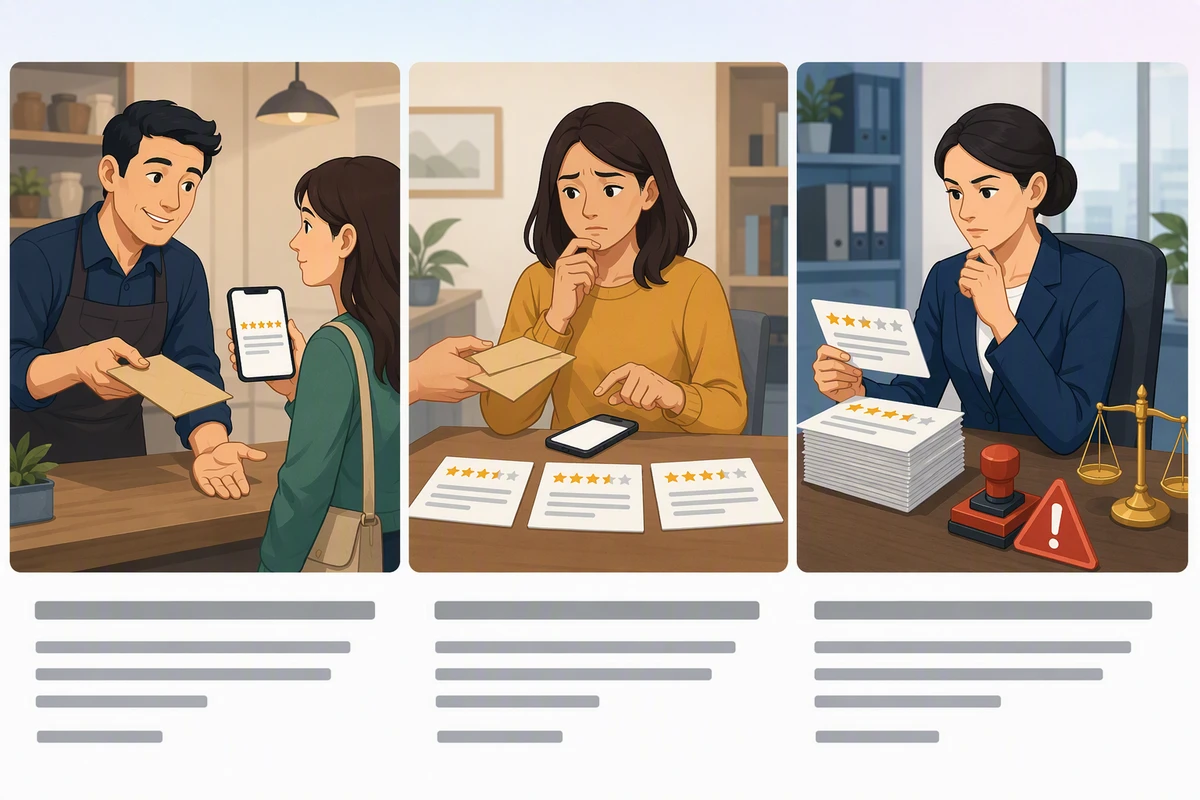
Star ratings and review text often conflict. A guest gives five stars but writes “room was dirty.” Another gives three stars and says “staff were lovely.” This rating-text incongruence makes the average misleading. You cannot fix what you cannot see.
Aspect-based sentiment analysis solves this. Instead of a single label, it breaks feedback into categories: cleanliness, staff, location, noise, food, price. A hotel might score 4.6 stars overall yet have a 2.1 rating for noise. That operational detail gets lost in the average. The MIT Sloan study on self-selected reviewers confirms that people who feel strongly—good or bad—are more likely to post. That bias inflates or deflates the star count.
To truly analyse google reviews, you must read the text. The star is a headline. The sentiment is the story. Google review insights come from patterns in language, not from a number. A restaurant with a 4.8 average might have 30% of reviews mentioning “cold food.” That is a kitchen problem, not a rating problem.
Star ratings alone cannot tell you what to fix. Sentiment analysis can. That is the difference between a score and a strategy.

How to Analyse Google Reviews for Actionable Business Insights
That star-rating gap between a 4.6 average and a 2.1 noise score is exactly where operational fixes hide. To surface those fixes, you need a structured method. Here is how to analyse google reviews for real business action.
Aggregate reviews from every platform where customers post. That means Google Business Profile, Facebook, Apple App Store, and Google Play. A single-location clinic might miss complaints on Facebook if staff only check Google. A home services franchise could lose Apple App Store feedback entirely. Pull everything into one place first.
Apply aspect-based sentiment extraction. Do not read every review as a whole. Break each one into categories.
| Aspect | Sentiment | Evidence | Business Action |
|---|---|---|---|
| Wait time | Negative | "Waited 45 minutes past appointment" | Review scheduling buffer and check-in process |
| Staff friendliness | Positive | "Receptionist remembered my name" | Reinforce training, reward that behaviour |
| Cleanliness | Negative | "Bathroom had no soap" | Add hourly cleaning checks |
| Billing clarity | Neutral | "Bill was confusing but staff explained it" | Simplify invoice templates |
Prioritise by recency. 68% require at least four stars, but they weigh recent feedback heavily. A spike of three bad reviews in one week matters more than a dozen good ones from six months ago. Sort by date. Act on the newest patterns first.
Detect sentiment trends over time using time-weighted scores. This is where genuine google review insights emerge. A monthly average hides a slow decline. Weight last month's sentiment double. If the trend line drops, investigate before the star rating follows.
Flag anomalies like sudden negative spikes. A single bad review is noise. Five in two days is a crisis. Set a threshold: three negative reviews within 48 hours triggers an alert. That pattern often signals a systemic failure, not a one-off complaint.
Cross-reference with operational data. Did wait times spike after a staff shortage? Did refund requests rise after a menu change? Match review dates to internal records. A home services company might see a complaint cluster after hiring new technicians. The reviews tell you what happened. Your data tells you why.

What Modern Google Review Sentiment Analysis Tools Must Include
Those six steps show how to turn raw feedback into action. But the tool you use to execute them matters. Not all sentiment analysis tools work the same way. Here is what a modern platform must include.
| Capability | Why It Matters | Common Pitfall |
|---|---|---|
| Aspect-level sentiment vs. whole-review polarity | A review that says "great location, rude staff" is mixed. Whole-review polarity labels it neutral. Aspect-level splits it: location positive, staff negative. That distinction surfaces the real problem. | Tools that only assign a positive/negative label miss half the story. You fix nothing. |
| Review recency weighting | Around 74% of consumers prioritise reviews from the last three months. A 4.8 average from last year hides a 3.2 from this month. Weighting recent feedback gives an accurate current picture. | Averaging all reviews equally buries recent drops. You react too late. |
| Spam and toxic content detection | Google removed over 12 million fake reviews in 2023. Fake reviews distort your sentiment score. A good tool flags suspicious language and bot patterns automatically. | Manual review of every comment is impossible at scale. Fake reviews stay in your data. |
| Multi-location comparison | A franchise with 20 locations needs to compare sentiment across sites. One store might have a 4.9 average but a 2.0 for cleanliness. That gap is invisible without location-level breakdowns. | Comparing only star ratings across locations hides operational differences. You reward the wrong store. |
| Response quality monitoring | Over 50% of consumers say a generic reply discourages them. A tool should track whether responses address the specific complaint or just say "thanks." | Replying to every review with the same template hurts trust. You waste the opportunity. |
| Integration with reply workflows | Spotting a negative sentiment spike is useless if you cannot respond fast. The tool must connect detection to action — auto-queue replies, route to the right team member, and track response time. | Detecting a problem but having no reply workflow means the issue goes unresolved. Customers notice. |

Common Mistakes That Undermine Google Review Insights
Connecting sentiment analysis to action is only half the battle. The other half is avoiding the traps that make those insights misleading. Here are the common mistakes that undermine google review insights.
| Mistake | What It Looks Like | Operational Consequence |
|---|---|---|
| Confusing sentiment with satisfaction | A 5-star review says "Great parking!" but says nothing about service. A 2-star review says "Food was cold, but staff fixed it fast." | You celebrate the positive but useless review. You miss the kitchen problem flagged by the negative but actionable one. |
| Ignoring selection bias | Only angry or ecstatic customers post. The silent majority stays quiet. | You act on a vocal minority. A 4.6 average might hide a 30% dissatisfaction rate among non-reviewers. |
| Reporting averages without sample size | A 4.8 average from 5 reviews looks identical to a 4.8 from 500. | You make a staffing decision based on noise. One bad review swings the average wildly. |
| Jumping from sentiment to impact without causality | Sentiment drops. You assume product quality fell. It could be a competitor's smear campaign. | You invest in a fix for the wrong problem. Money wasted. |
| Overlooking the data-access problem | Google's API limits how many reviews you can pull. You only see a fraction. | Your analysis is incomplete. You miss a pattern in the missing data. |
| Treating star ratings as ground truth | A 4-star review says "Terrible experience." The rating and text contradict each other. | You trust the number over the words. You miss the real complaint. |
Confusing Sentiment with Satisfaction
A review that says "The wait was long but the food was amazing" is positive on sentiment but neutral on satisfaction. The customer liked the food but disliked the wait. A tool that only labels the whole review "positive" hides the wait-time problem. You fix nothing. Research from the ACL shows that aspect-based sentiment extraction catches these splits. Without it, you act on a false trend.
Ignoring Selection Bias
Not every customer reviews. A 2024 study found that women are less likely to post negative reviews than men, skewing your data. You see a gender-distorted picture. Your response strategy targets the wrong audience.
Turning Google Review Analysis Into a Competitive Advantage
More than two-thirds of U.S. online adults now depend on ratings before buying, according to a 2026 Forrester study. That makes google review sentiment analysis a competitive necessity, not a nice-to-have. Businesses that ignore it lose ground to competitors who treat every review as a data point.
The winning approach follows a three-part workflow: detect, prioritise, act.
| Phase | Action | Outcome |
|---|---|---|
| Detect | Use aspect extraction to find recurring themes. A review says "staff friendly, wait time awful." The tool splits it: staff positive, wait time negative. | You surface the real operational problem, not a vague score. |
| Prioritise | Apply severity scoring and recency weighting. A 1-star review from yesterday matters more than a 5-star from six months ago. | You fix the urgent issue before it spreads. |
| Act | Respond with personalised, on-brand replies. Research shows 80% of consumers are more likely to use a business that replies to every review. | You build trust and recover at-risk customers. |
Why the Old Way of Reading Reviews Is Dying
Consumers no longer scroll through 50 reviews manually. AI is changing how they consume feedback. Google’s Gemini and Ask Maps features (June and August 2026) now generate conversational summaries. A user asks "Is this dentist good for kids?" and gets a synthesised answer from the whole profile. That shifts the game. You must now manage your entire profile’s narrative, not just individual replies.
Treat Review Analysis Like Incident Management
The businesses winning are those that treat review analysis as an incident-management system, not a reputation score. They spot a negative sentiment spike on a Tuesday. By Wednesday, they have a root cause and a fix. They use tools to analyse google reviews at scale, extracting google review insights that feed directly into operations. A restaurant chain might see "cold food" appear across three locations. That’s not a review problem. That’s a kitchen workflow problem.
Stop chasing star ratings. Start chasing patterns. The profile tells the story. The smartest teams read it like a dashboard, not a report card.
Conclusion
Chasing star ratings hides the real story. The winning teams read their full profile for patterns, not averages. They detect recurring complaints, prioritise urgent issues, and act with personalized replies. This approach turns scattered feedback into operational fixes. ReviewSense centralises every review from Google, Facebook, and app stores into one dashboard. Its sentiment analysis surfaces the specific topics that matter, from wait times to product quality. Stop guessing. Start reading your profile like a dashboard. Turn scattered reviews into actionable insights with ReviewSense. Start your 7-day free trial