
Only 35% of small and medium-sized businesses have claimed their Google Business Profile — and among those that have, 41% leave it incomplete. An outdated profile damages local visibility and invites reputation risks like unaddressed fake reviews. Our framework evaluates every component—from attributes to posts—against 2026 standards to prevent lost revenue.
ReviewSense automates your GBP audits, saving hours while ensuring compliance and optimisation.
The Critical Role of GBP Audits in Modern Local Visibility
Building on core GBP setup principles, regular audits have become essential armour against visibility erosion in today's AI-driven search environment. Consider these critical impacts of neglect:
| Audit Focus Area | Consequence of Neglect |
|---|---|
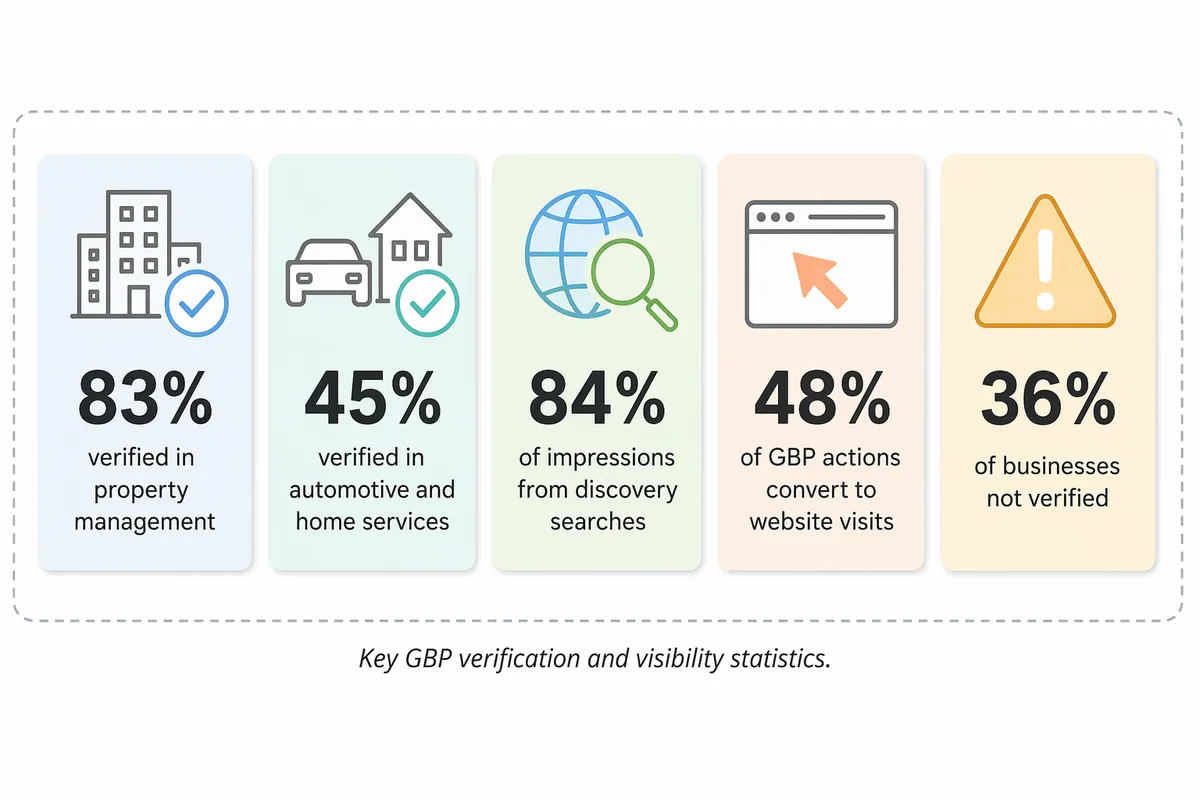
| Verification Status | Verified profiles average 1,800+ monthly impressions; 36% of businesses remain unverified; 48% of profile actions are website visits |
| Industry Disparity | Property management leads at 83% verified vs 45% in automotive/home services, creating competitive gaps |
| Profile Activity | Inactive listings trigger visibility declines as algorithms deprioritise stale information |
Verification's Direct Impact on Discovery
Unverified profiles surrender tangible opportunities. Verified profiles average approximately 1,800 monthly impressions, 84% of them from discovery searches where customers actively seek services - visibility an unverified profile does not earn. More critically, 48% of all GBP actions convert to website visits, representing lost traffic and potential conversions. For the 36% of businesses not verified, this isn't hypothetical: it's measurable revenue leakage. Industry verification gaps further compound this; while property management firms lead at 83%, automotive and home services languish at 45%, creating uneven competitive landscapes where basic verification becomes a market advantage.
Preventing Reputation and Visibility Erosion
Audits function as preventative care for your digital footprint. Outdated opening hours or incorrect contact details frustrate customers immediately, while unanswered reviews signal neglect. In AI-curated search environments, inconsistencies propagate faster - potentially appearing in summaries seen by thousands. Regular checks ensure NAP (Name, Address, Phone) accuracy and prompt review responses, maintaining trust signals that algorithms reward. This vigilance prevents the visibility drops that accompany prolonged inactivity, keeping your profile competitive in local pack rankings. Integrating these checks into your broader customer review management strategy creates a defence against reputation risks before they escalate.
Proactive audits transform GBP from a static listing into a dynamic visibility engine. They address verification gaps costing real traffic and rectify inconsistencies that damage credibility. For businesses in low-verification sectors like home services, this disciplined approach becomes a genuine differentiator in crowded markets. When negative feedback does surface, having a structured response approach - including using the negative review response generator - helps contain fallout, but prevention through audits remains paramount.
Essential Audit Components: A Step-by-Step Evaluation Framework
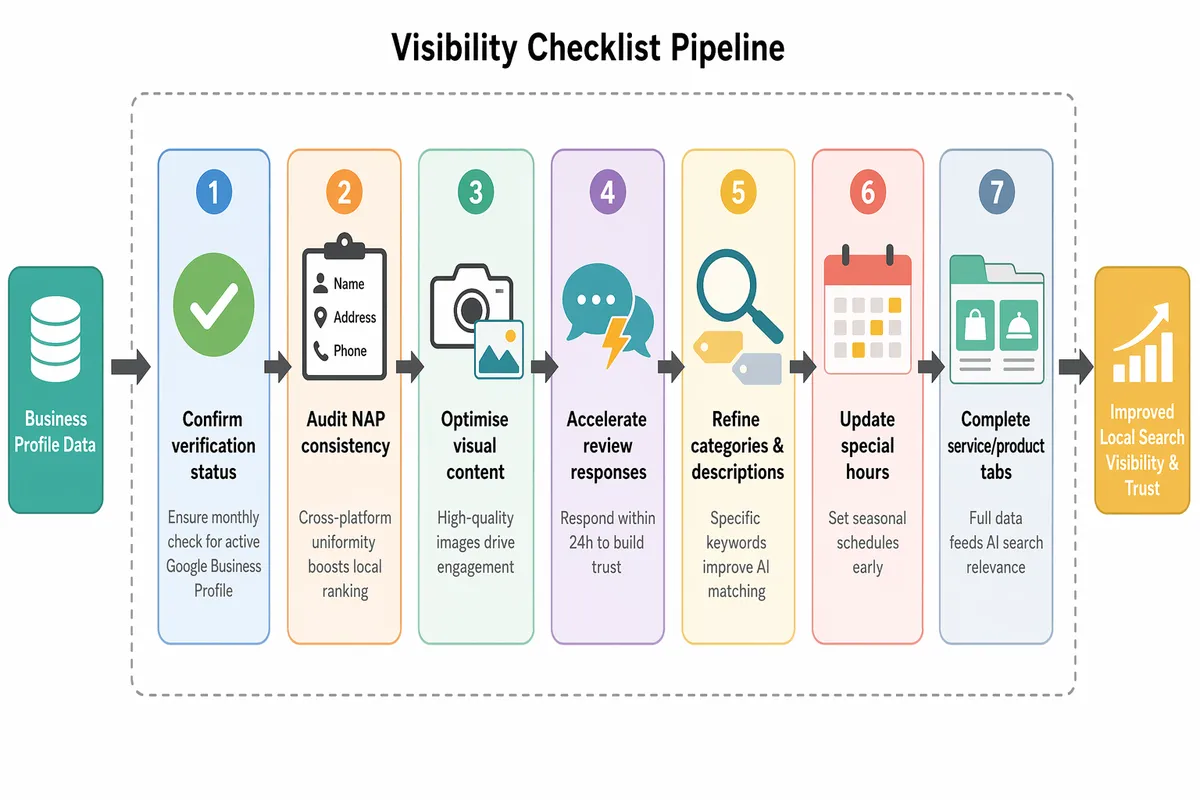
Building on proactive verification and reputation management, your audit framework must systematically address these seven critical components to maintain competitive visibility. Use this checklist monthly to prevent revenue leakage and ranking drops:
| Step | Component | Core Impact |
|---|---|---|
| 1 | Verification Status | Prevents missed discovery opportunities |
| 2 | NAP Consistency | Impacts 32% of local pack ranking |
| 3 | Photo Optimisation | Drives 42% more direction requests |
| 4 | Review Response Cadence | Builds trust and retention |
| 5 | Category Selection | Enhances AI matching for searches |
| 6 | Holiday Hours Accuracy | Avoids negative customer experiences |
| 7 | Service/Product Tabs | Fuels AI understanding of offerings |
1. Confirm verification status
Unverified profiles remain invisible in local search results, directly costing you leads. Businesses with active Google Business Profiles are 2.7 times more likely to earn customer trust. Check your dashboard's verification badge monthly.
2. Audit NAP consistency
Scrutinise name, address and phone details across all platforms. Inaccuracies here damage rankings since GBP signals account for roughly 32% of local pack ranking factors. For multi-location businesses, tools like the Google Place ID Finder ensure uniform data.
3. Optimise visual content
Businesses with photos receive 42% more direction requests and 35% more website clicks. Audit image quality monthly - include exterior shots, team photos and product imagery. Remove blurry or outdated visuals that undermine professionalism.
4. Accelerate review responses
Set alerts for new reviews and respond within 24 hours. Prompt engagement demonstrates attentiveness, particularly for negative feedback. Scale this process using the AI review response generator for consistent, on-brand replies.
5. Refine categories and descriptions
Select precise primary/secondary categories using customer-centric keywords. Google's AI relies on these for matching searches to services. Avoid generic terms - specificity increases relevance in local results.
6. Update special hours
Inaccurate holiday hours trigger negative experiences. Set seasonal schedules at least two weeks early. Remember 90% of weekday business calls originate from Google Business Profiles - incorrect hours mean missed calls.
7. Complete service/product tabs
Populate every service detail and product description. These tabs directly feed Google's AI algorithms, helping match your offerings to relevant searches. Incomplete data creates visibility gaps competitors exploit. For comprehensive management approaches, explore the review management software guide.
Industry-Specific Audit Challenges and Solutions
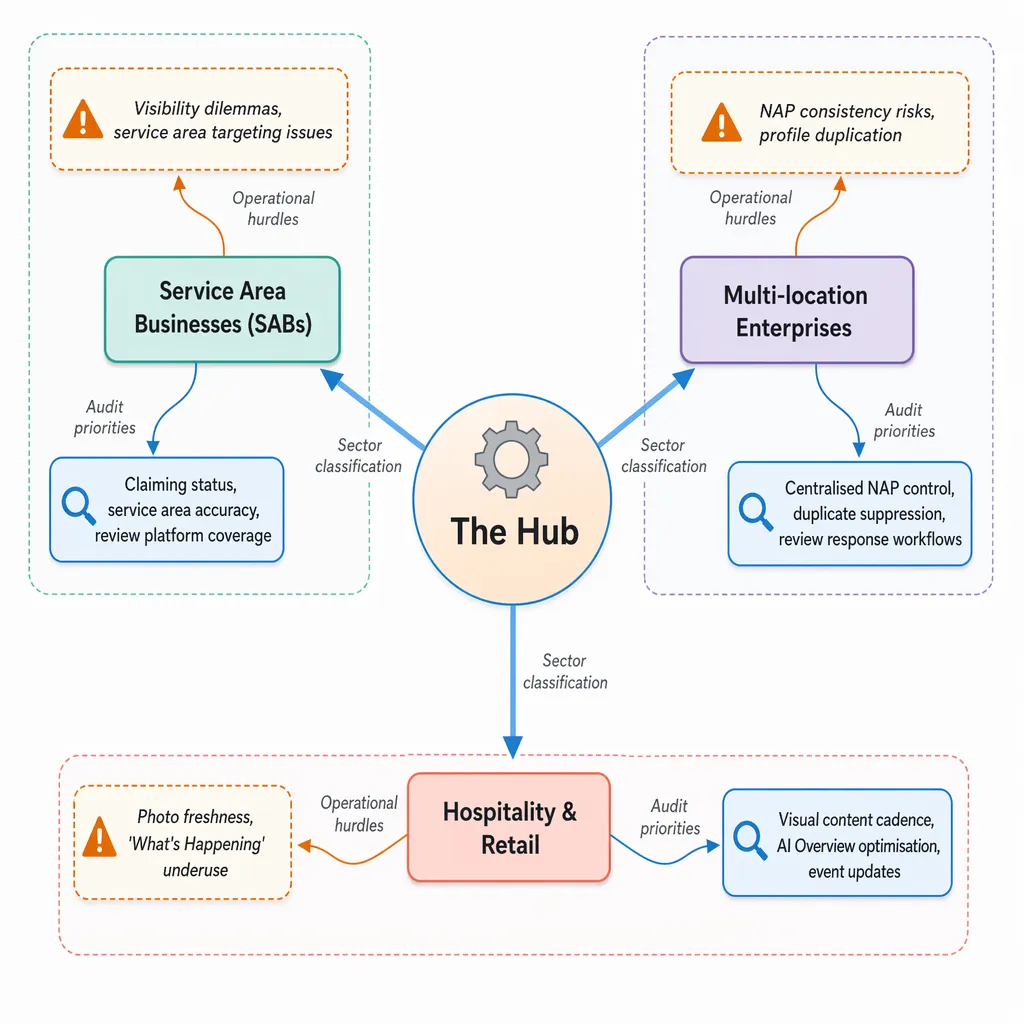
After optimising core profile elements, industry-specific challenges demand tailored audit approaches. Service area businesses, multi-location enterprises, and hospitality/retail operations face distinct hurdles requiring focused solutions:
| Business Type | Unique Challenges | Critical Audit Focus Areas |
|---|---|---|
| Service Area Businesses (SABs) | Address visibility dilemmas, service area targeting issues | Claiming status, service area accuracy, review platform coverage |
| Multi-location Enterprises | NAP consistency risks, profile duplication | Centralised NAP control, duplicate suppression, review response workflows |
| Hospitality & Retail | High engagement requiring photo freshness; retail's 'What's Happening' feature underuse | Visual content cadence, AI Overview attribute optimisation, event/promotion updates |
Service Area Businesses (SABs)
Only 35% of SMBs have claimed their GBP listing, leaving many SABs invisible. Among claimed profiles, 41% contain incomplete data and 34% have never posted updates. This neglect compounds SAB challenges: hiding addresses while accurately defining service areas requires careful configuration. Audits must verify service boundaries and ensure review coverage across Google and Facebook. Centralising feedback via a dedicated review management platform prevents missed interactions.
Multi-location Enterprises
Inconsistent NAP details fracture local SEO performance. A single location with incorrect information can trigger significant visibility drops. Centralised dashboards enforce data uniformity, while automated duplicate detection prevents ranking penalties. With reviews spanning Google, Facebook and app stores, response delays damage brand perception. Streamlined workflows are essential, particularly for businesses managing app store reviews at scale.
Hospitality and Retail
Businesses with over 100 photos see a 520% increase in calls versus sparse profiles, making visual freshness non-negotiable. Retailers must optimise 'What's Happening' features, as AI Overviews parse these attributes for conversational queries like "Where can I find Valentine's deals near me?". Complete descriptions (present in 75% of top-ranking pages) feed this AI understanding. For high-volume feedback, AI-generated responses maintain engagement quality.
Moving Beyond Compliance: Strategic Optimisation Tactics
After tackling industry-specific GBP challenges, forward-thinking businesses shift focus from reactive compliance to strategic optimisation. This approach transforms profiles into dynamic growth engines rather than static listings. Consider these advanced tactics:
| Tactic | Compliance Mindset | Strategic Optimisation |
|---|---|---|
| Entity Alignment | Basic NAP consistency | Semantic keyword integration |
| Review Management | Star rating obsession | Velocity/recency prioritisation |
| AI Response Handling | Generic automated replies | Brand-aligned personalisation |
| Visual Search Optimisation | Occasional photo uploads | Geo-tagged weekly image updates |
| Freshness Signals | Infrequent updates | Scheduled weekly content |
Semantic Entity Alignment
Google's algorithm now understands contextual relationships between businesses, services, and locations. Simply verifying NAP details misses opportunities. Businesses embedding keyword-rich descriptions saw 31% better local pack visibility. This semantic alignment helps Google connect your profile to relevant 'near me' searches, which drive 86% of visibility. For multi-location consistency, tools like the Google Place ID Finder ensure unified entity mapping.
Review Velocity Over Ratings
Recent feedback impacts decisions more than aggregate scores. With 76% of searchers visiting businesses within 24 hours of searching, fresh reviews significantly sway choices. Prioritise monitoring review recency across Google, Facebook, and app stores using proactive tracking tools. This reveals real-time sentiment shifts before they affect footfall.
AI-Powered Personalisation
Automation without customisation damages brand perception. While AI accelerates responses, tailoring them to your voice and specific feedback is essential. Generic replies feel impersonal. Learn effective techniques in the guide to AI review response generators for authentic engagement.
Geo-Tagged Visual Content
Images with embedded location data boost visibility for local searches. Yet 34% of claimed profiles have never posted an update. Upload geo-tagged photos weekly to signal relevance for 'near me' queries. This demonstrates active local presence better than outdated galleries.
Freshness as a Ranking Factor
Google rewards regularly updated profiles with better visibility. Implement weekly cadence for photos, posts, and service updates. This dynamic approach outperforms static profiles, particularly for time-sensitive searches like "Valentine's deals near me".
Integrate these tactics into your audit process. For comprehensive implementation across review platforms, explore the online review management guide or start optimising today.
Streamlining Audits Through Technology Integration
As businesses implement these strategic optimisations, technology becomes essential for maintaining audit efficiency. Manual checks simply can't keep pace with the dynamic nature of GBP and review platforms. Consider these technology applications:
| Technology Application | Key Audit Benefit |
|---|---|
| Automated NAP Monitoring | Detects inconsistencies across platforms in real-time, ensuring data accuracy |
| Centralised Review Management | Aggregates feedback from Google, Facebook and app stores for unified response |
| Sentiment Tracking | Flags negative spikes for immediate intervention |
| Competitor Benchmarking | Compares performance against local rivals to identify gaps |
| Custom Reporting | Provides location-specific insights for multi-site businesses |
Automated NAP Monitoring
Inaccurate business details confuse customers and damage local SEO. Automated tools scan GBP, Facebook and app store listings for discrepancies in name, address or phone number. This is critical: only 68% of business contact details match across AI tools like ChatGPT and Perplexity, leaving 32% of local businesses with inconsistent information. Real-time alerts allow immediate correction before visibility suffers.
Centralised Review Management
With 92% of local SEO marketers offering GBP management, consolidating feedback is vital. A unified dashboard aggregates reviews from Google Business Profile, Facebook, Apple App Store and Google Play. This prevents missed interactions and streamlines responses. Platforms like ReviewSense offer AI-generated replies and approval workflows, turning scattered feedback into actionable insights. Explore the Google review management software for efficient handling.
Sentiment Tracking and Crisis Alerts
Sudden review spikes require swift action. Sentiment analysis identifies negative trends before they escalate, triggering instant alerts. This allows teams to address issues promptly, protecting reputation. For challenging cases, the negative review response generator helps craft professional replies.
Competitor Benchmarking
Understanding your GBP performance relative to local competitors highlights improvement areas. Track metrics like review velocity, star ratings and response rates to identify gaps and opportunities. Doing this properly means setting your numbers against a sector baseline rather than against one rival, which is what review benchmarking tools are built for.
Custom Reporting for Multi-Location Businesses
For enterprises with multiple sites, location-specific reports are non-negotiable. Custom dashboards track performance per outlet, ensuring consistency while highlighting regional variations. This enables targeted interventions.
Adopting a dedicated Google Business Profile audit tool automates these processes. ReviewSense offers transparent pricing and a 7-day free trial, allowing businesses to evaluate its fit without commitment.
Conclusion
Consistent Google Business Profile audits are non-negotiable for local visibility, but manual processes can't scale with dynamic review platforms and shifting algorithms. By automating critical tasks—from real-time NAP monitoring across Google, Facebook, and app stores to centralising feedback and detecting sentiment spikes—you eliminate guesswork and protect your reputation. ReviewSense transforms this complexity into clarity, turning scattered reviews into actionable insights that drive customer experience improvements. Elevate your audit strategy with AI-powered efficiency: Start your 7-day free trial.