Outsourcing your entire reputation to algorithms is the quickest way to destroy customer trust. As we approach 2026, the shift towards agentic AI means businesses are drowning in automated responses whilst losing their authentic voice. You can't simply set and forget your reputation. True AI-powered review management requires a strategic balance between operational efficiency and genuine human oversight to navigate today's mounting trust crisis.
Managing this delicate balance manually is exhausting, but ReviewSense streamlines the process so you can focus on building trust and improving ratings.
The Transition to Agentic AI in Reputation Management
The shift from reactive tracking to proactive oversight is redefining how brands handle customer feedback. Basic monitoring tools simply cannot keep pace with modern consumer expectations. You need systems that anticipate issues before they escalate into public crises. This evolution marks the transition to agentic AI. It transforms passive data collection into active problem-solving.
Industry research shows the online reputation market will reach $1.47 billion by 2026. Experts predict 80% of companies will adopt AI review tools by 2025. Forrester highlights a clear move toward 'Opinion Intelligence' in this space. This advanced approach reduces time-to-insight by 65%. Brands stop reading comments in isolation. They extract strategic value from every interaction.
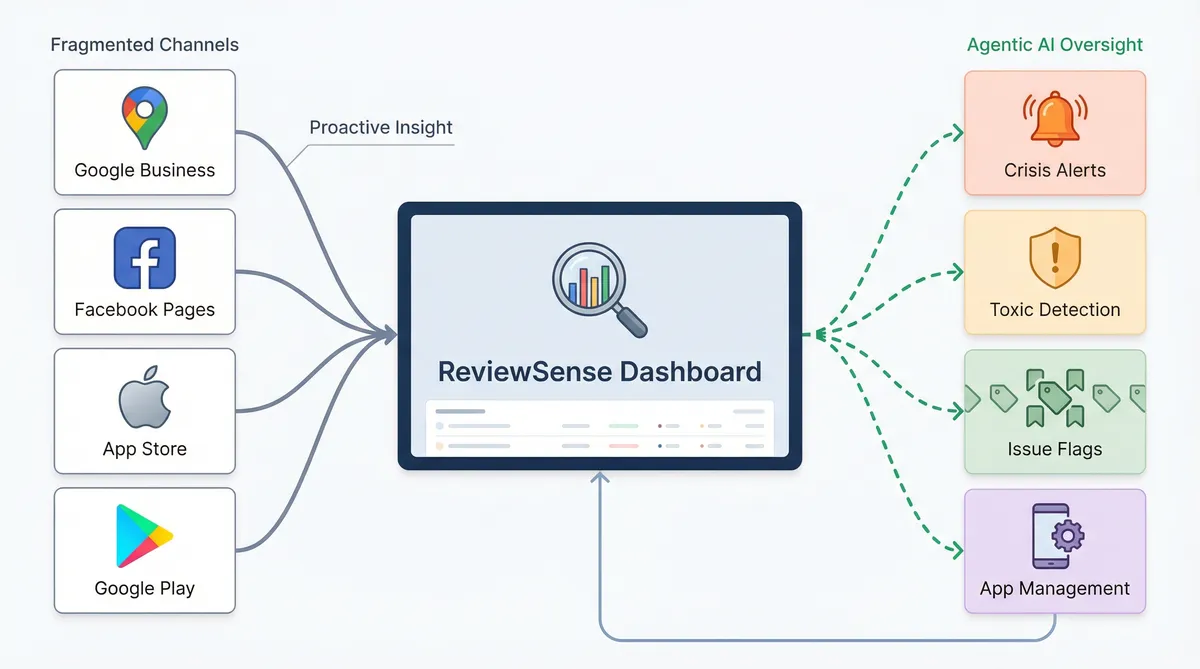
This rapid evolution is why businesses must centralize their feedback channels. Fragmented data creates blind spots that harm your brand reputation. Effective customer review management requires a unified approach to data analysis. ReviewSense facilitates this transition. It pulls data from Google Business Profile, Facebook, Apple App Store, and Google Play into one actionable dashboard.
Modern ai-powered review management goes beyond simple aggregation. It acts as an intelligent extension of your customer service team. The platform flags recurring issues and detects toxic content. You'll spot negative spikes through built-in crisis alerts. This allows your staff to focus on genuine feedback that impacts customer retention.
Managing app feedback is critical for digital-first brands. Finding the right Google Play Store review management software is a common challenge. ReviewSense solves this by bringing mobile app reviews into your central queue. You get a clear view of customer sentiment across all supported platforms. Your team can turn scattered opinions into measurable growth.
Quantifying the ROI: How Automation Impacts the Bottom Line
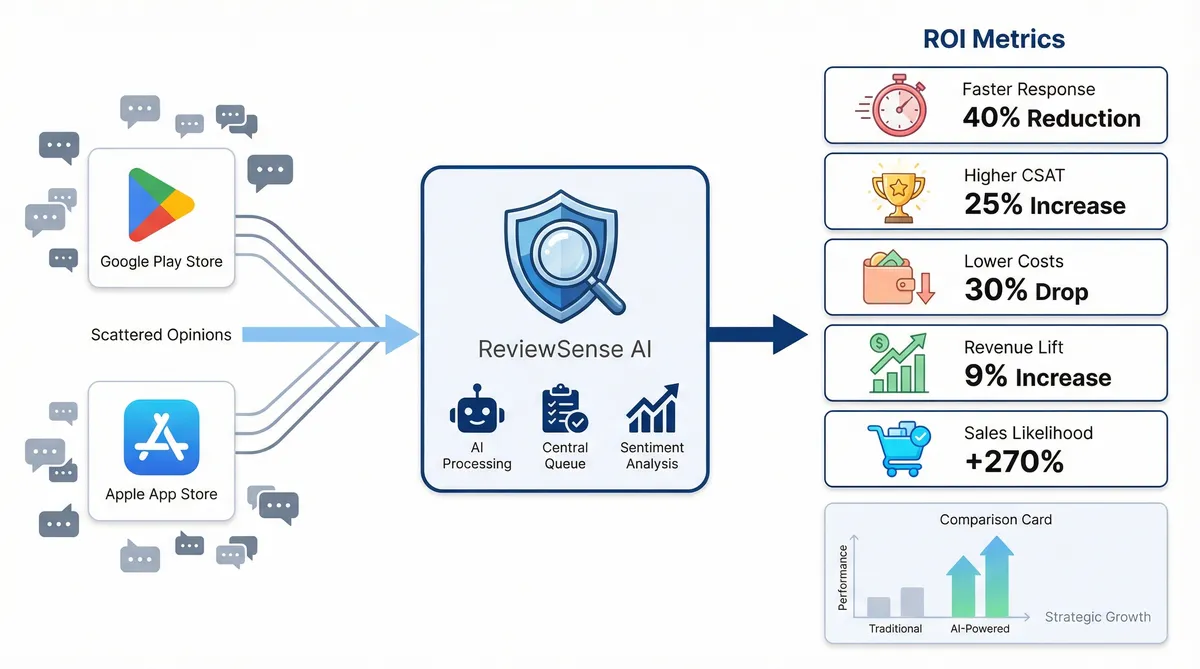
Turning scattered opinions into measurable growth requires clear financial tracking. Manual processes drain resources and delay critical responses. AI-powered review management changes this dynamic entirely. It replaces guesswork with precise data.
| Metric | Traditional Management | AI-Powered Management |
|---|---|---|
| First-Response Time | Hours or days | 30% to 40% reduction |
| CSAT Scores | Stagnant baselines | 15% to 25% increase |
| Operational Costs | High manual labour | 30% drop |
These efficiency gains translate into direct revenue. A one-star aggregate rating increase yields a 5% to 9% revenue lift. Even minimal engagement matters. Having at least five managed reviews makes products 270% more likely to sell. Customers trust brands that reply quickly.
Ratings drive investment across all sectors. The average rating for Australia’s 11 million existing homes remains below 3 stars, whereas the 2025–2026 standard for new builds is 7 stars. The Australian Government invested $32.7 million in 2025 to expand these calculators to existing homes, with a full rollout scheduled for mid-2026. You can explore complex scoring systems by Understanding 10-Star Rating Calculators: How to Compute and Interpret Customer Ratings.
ReviewSense tracks these exact sentiment trends and review velocities to prove your ROI. You can easily see how faster replies boost customer satisfaction. Discovering How to Use Free AI review Response Generators to Improve Customer Communication helps teams scale this effort. The analytics dashboard makes your financial impact clear. You stop wasting money on manual tracking. Instead, your team focuses on strategic improvements that retain loyal buyers.
Navigating the 'Trust Crisis' and the AI Productivity Tax
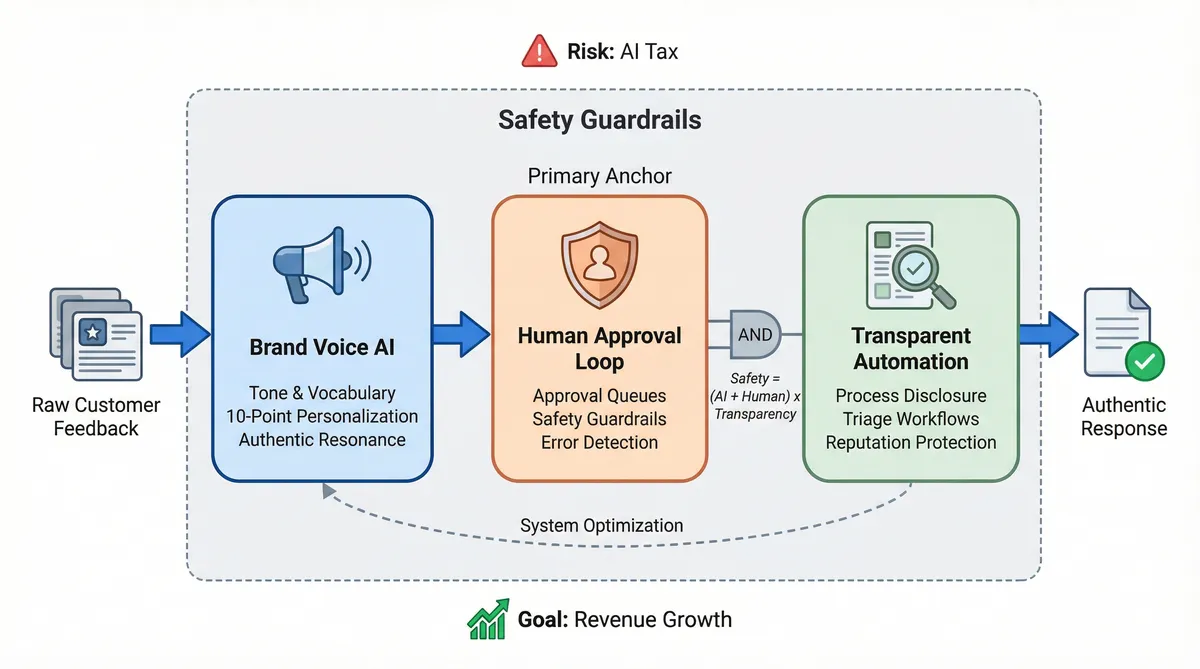
While AI frees your team to focus on strategy, careless automation creates new risks. Data shows 82% of shoppers read AI summaries, yet 62% fear synthetic reviews. This creates a trust crisis. Rushing into ai-powered review management without safeguards triggers an "AI Tax." Teams lose 37% of their saved time reworking poor responses.
Removing human oversight is dangerous. Air Canada and DPD recently faced public backlash due to AI hallucinations and prompt-hacking failures. Their chatbots invented refund policies and swore at customers. These costly errors highlight why unchecked automation damages brand trust. You can't afford to let bots run wild across your profiles.
You must balance rapid responses with absolute safety. A structured approach prevents these embarrassing failures. Follow this three-step framework to implement automation safely across your organisation.
Ground AI in brand voice. Generic replies alienate your loyal customers. You need an AI review Response Generator that learns your specific tone and vocabulary. This ensures every reply sounds authentic. In 2026, companies using AI-driven 10-point personalization saw a 40% revenue boost. True personalisation drives measurable growth.
Implement human-in-the-loop approvals. Research indicates 77% of heavy users review AI work carefully. ReviewSense offers auto-reply and queue workflows to manage this process. Teams generate personalised replies in seconds while maintaining strict guardrails. Managers catch factual errors before they go live.
Maintain transparent automation. Modern customers appreciate honesty regarding technology. When you explore How to Manage App Store Reviews at Scale: Workflows, Triage, and Automation, define which processes use AI. This transparency builds lasting confidence. It protects your reputation while keeping your support team productive.
Platform-Specific Algorithm Shifts in 2026
Maintaining this transparency is vital as major platforms overhaul their algorithms this year. The Zendesk CX Trends 2026 report notes that 81% of customers now interact with AI-driven support. Tech giants are adapting to this rapid shift. These sudden changes force brands to manage feedback with unprecedented rigor.
- Google's AI-Driven Review Purge (February 2026): Google actively targets unusual volumes. The updated algorithm prioritises authenticity over sheer quantity. Sudden spikes in five-star ratings trigger immediate flags. Understanding Why Google Is Deleting Your Reviews in 2026 (And How to Protect Them) helps you safeguard your reputation.
- The Launch of Google 'Ask Maps' (January 2026): This search feature replaces traditional Q&A. It extracts direct answers from user feedback. High-quality reviews become a primary factor. Vague comments fail to help your local visibility.
- Meta's AI-Summarised Reviews (March 2026): Facebook shops display automated summaries of customer sentiment. These AI overviews highlight recurring complaints at a glance. Proper Facebook Review Management: Strategies and Tools for Building Trust Online ensures these public summaries reflect your brand value.
These strict updates require constant vigilance. Manual monitoring fails growing businesses that receive daily feedback. ReviewSense delivers instant alerts when new comments appear across your profiles. The spam detection flags toxic content before it causes lasting harm.
This proactive approach protects your Google Business Profile and Facebook listings from algorithmic penalties. Ignoring these platform shifts risks visibility drops. Proper ai-powered review management keeps your digital presence secure. You'll maintain strict compliance while focusing on genuine interactions. Teams can quickly isolate spam and dispute fake claims. This ensures your public rating remains accurate and trustworthy for future buyers.
A Contrarian Strategy: Optimizing Internal Operations Over External Automation
While avoiding algorithmic penalties keeps your listings visible, relying on bots to write every public reply creates a new problem. Using ai-powered review management solely to churn out generic responses is a race to the bottom. It homogenises your brand voice until you sound like every other competitor.
The Power of Intentional Inefficiency. Instead of chasing automated perfection, smart brands embrace intentional inefficiency. An imperfect human response carries far more trust equity than a corporate paragraph. Customers want to know a real person read their complaint.
Turning AI Inward. The true power of artificial intelligence isn't talking to your customers. It should talk to your staff. You must shift your focus from external automation to internal operations. When Investigating Google Review Management Software: Capabilities, Limitations, and ROI, you'll find the best tools analyse data rather than writing text.
Extracting Actionable Themes. This is where ReviewSense excels. Its built-in sentiment analysis groups thousands of comments into actionable themes. It extracts key topics and flags recurring issues. A 7.5/10 average rarely means everyone thought your service was acceptable. It usually means 80% of people gave it a 10, and 20% gave it a 1 because they were furious.
Fixing Root Causes. ReviewSense highlights exactly why that angry 20% left a poor rating. Your human team can then fix the root causes of negative feedback. Meanwhile, your public replies remain authentic. Mastering AI-Powered Review Management: Strategies for Streamlining Customer Feedback Oversight means using technology to understand the problem, not just to auto-reply.
Conclusion
Effective AI-powered review management isn't about replacing human connection—it’s about making your operations smarter. As platforms like Google and Facebook update their algorithms to prioritize authenticity, relying solely on generic bots risks damaging your reputation. The winning strategy is turning AI inward.
By centralizing feedback from your Google Business Profile, Facebook, Apple App Store, and Google Play listings, your team can focus on meaningful improvements. ReviewSense does the heavy lifting by detecting toxic spam, alerting you to negative sentiment spikes, and extracting recurring themes so you can fix the root causes of customer complaints. This empowers your staff to maintain an authentic brand voice while efficiently managing your reputation at scale. Turn scattered reviews into actionable insights that improve customer experience and drive growth when you Start your 7-day free trial.