
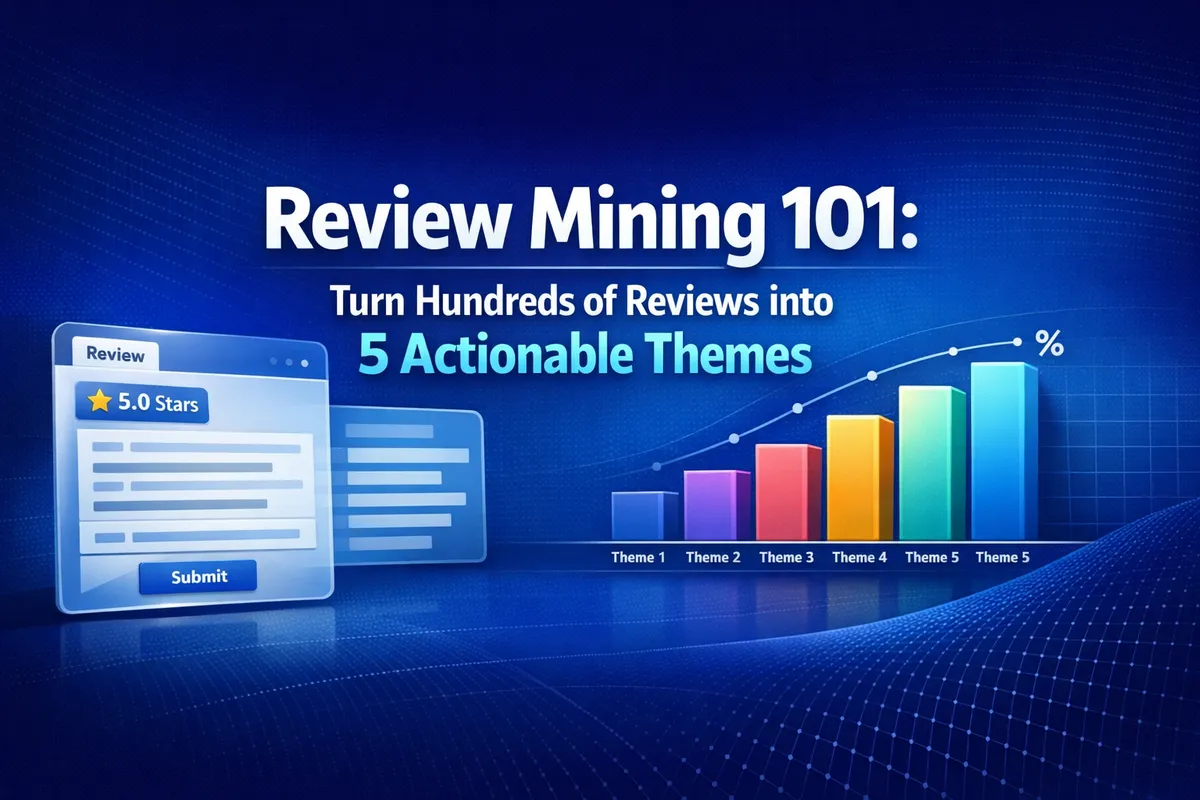
Your customer reviews contain valuable insights hiding in plain sight. While most businesses glance at star ratings, the real intelligence lives in the text—patterns that reveal exactly what customers love, what frustrates them, and what would make them return. Review mining is the process of extracting these patterns systematically, and you don't need a data science team to do it.
For businesses looking to automate review mining with AI-powered insights, ReviewSense offers topic clustering and sentiment analysis that surfaces recurring themes automatically.
Why Star Ratings Are Too Shallow
A 3-star review tells you almost nothing. Was the food excellent but the service slow? Was the product great but delivery delayed? Was the experience fine but not memorable enough to recommend?
The text is where the insight lives.
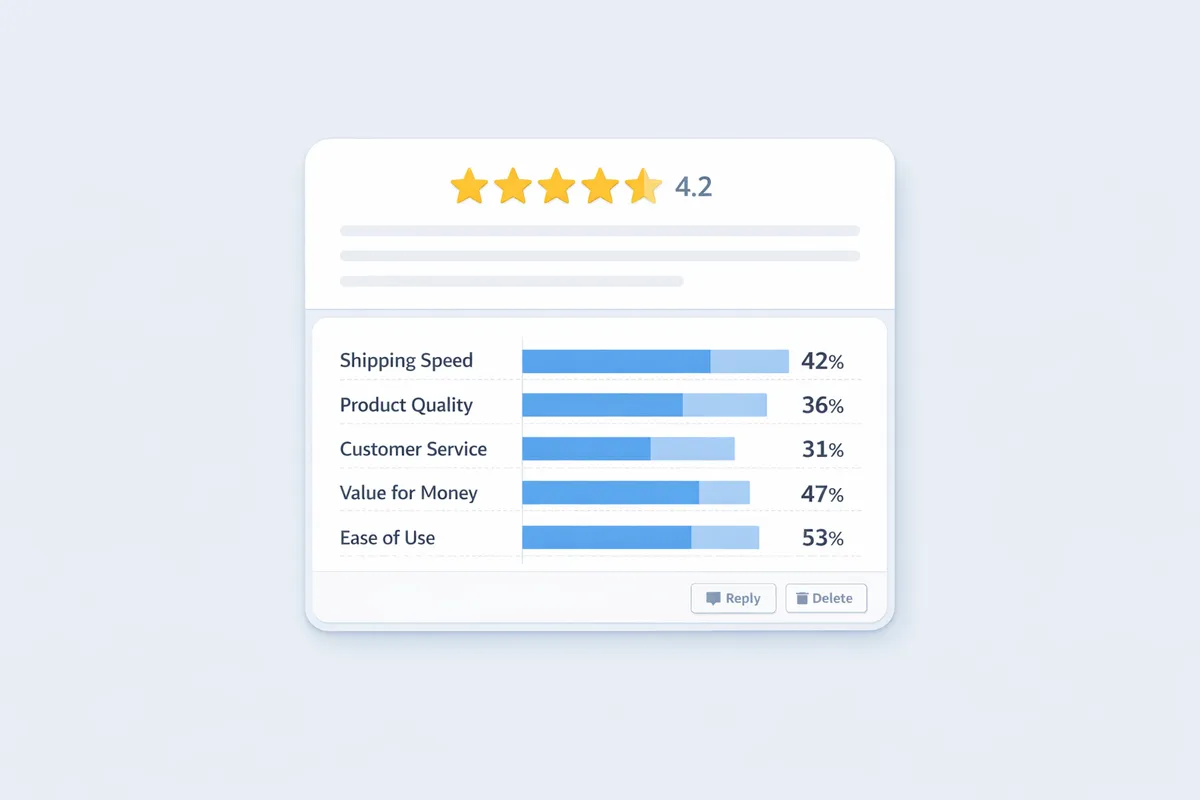
Research on customer feedback analysis has identified that customers consistently focus on specific dimensions when writing reviews: quality, service, price, logistics, and overall experience. By mining these themes from your reviews, you can:
- Identify your actual differentiators – What customers specifically praise
- Spot operational problems early – Before they tank your ratings
- Prioritise improvements – Focus resources where they'll have the biggest impact
- Track progress over time – See if changes are actually working
According to research published in the Journal of Theoretical and Applied Electronic Commerce Research, analysing customer reviews can identify the primary dimensions customers care about most, providing a clear entry point for business improvement.
The 5-Theme Method: A Step-by-Step Guide
You don't need sophisticated software to extract themes from reviews. Here's a practical method any business can implement:
Step 1: Collect Your Reviews
Gather reviews from all platforms into one place. This typically includes:
- Google Business Profile
- Trustpilot
- Industry-specific platforms (TripAdvisor, Yelp, etc.)
Tip: Focus on the last 6-12 months for relevance. Older reviews may reflect issues you've already addressed.
Step 2: Create Your Theme Categories
Start with these five universal categories that apply to most service businesses:
| Theme | What It Covers |
|---|---|
| Service Quality | Staff friendliness, helpfulness, professionalism |
| Wait Time / Speed | Delays, efficiency, responsiveness |
| Product / Core Offering | Quality of what you actually sell |
| Value / Pricing | Price perception, worth for money |
| Environment / Experience | Atmosphere, cleanliness, ambience |
Adjust these categories based on your industry. A restaurant might add "Food Quality" and "Portion Size." A dental practice might add "Pain Management" and "Explanation of Procedures."
Step 3: Tag Each Review
Go through each review and tag it with relevant themes. A single review often touches multiple themes:
Example review:
"Great coffee and friendly staff, but the wait was ridiculous—25 minutes for a latte. Prices are fair though."
Tags: Service Quality (positive), Wait Time (negative), Product (positive), Value (positive)
Step 4: Quantify Theme Frequency
Count how often each theme appears, separated by sentiment:
| Theme | Positive Mentions | Negative Mentions | Total |
|---|---|---|---|
| Service Quality | 45 | 12 | 57 |
| Wait Time | 8 | 38 | 46 |
| Product Quality | 52 | 7 | 59 |
| Value | 31 | 15 | 46 |
| Environment | 28 | 9 | 37 |
Step 5: Calculate Your Theme Priorities
Focus on themes that appear most frequently in negative reviews. Use this simple priority formula:
Priority Score = (Negative mentions / Total mentions) × 100
In the example above:
- Wait Time: (38/46) × 100 = 83% negative
- Value: (15/46) × 100 = 33% negative
- Service Quality: (12/57) × 100 = 21% negative
Clear winner for attention: Wait Time
The Pareto Rule: Fix the Few Themes Driving Most Negatives
The Pareto principle applies powerfully to review themes. Typically, 2-3 themes account for 60-80% of all negative feedback. Fix these, and you'll see disproportionate improvement in your overall ratings.
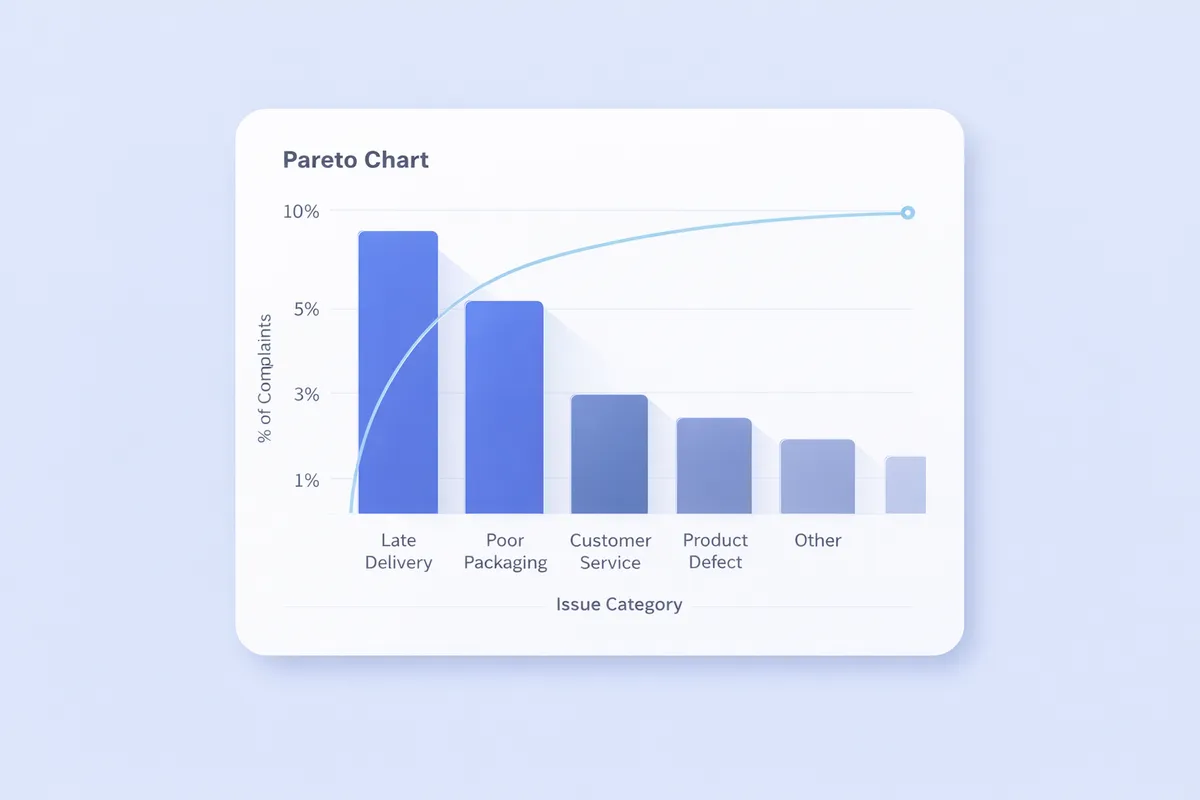
Case study pattern: A restaurant discovers that "wait time" accounts for 45% of all negative mentions, while "portion size" accounts for another 25%. Everything else combined represents only 30%. By focusing on service speed and portion sizes—just two issues—they can address 70% of customer complaints.
This is far more effective than trying to improve everything at once.
Turning Themes into Experiments: What to Change This Week
Identifying themes is only valuable if it leads to action. Here's how to convert insights into experiments:
The Theme-to-Action Table
For each high-priority negative theme, create an action plan:
| Theme | Root Cause Hypothesis | Proposed Fix | Success Metric |
|---|---|---|---|
| Wait Time | Kitchen understaffed during lunch rush | Add one prep cook 11am-2pm | Avg wait under 15 min |
| Parking | Lot too small for weekend volume | Partner with nearby lot for overflow | Zero "couldn't find parking" mentions |
| Staff Knowledge | New hires not properly trained | Implement 2-week training checklist | Reduce "didn't know" complaints by 50% |
Running the Experiment
- Implement one change at a time – Isolate variables to measure impact
- Set a timeframe – Give changes 30-60 days to show results
- Track the specific metric – Not just overall rating, but theme frequency
- Review and adjust – If it's not working, try a different approach
Tracking Impact Month-to-Month
Review mining isn't a one-time exercise—it's an ongoing process. Set up a monthly rhythm:
Monthly Theme Scorecard
Track these metrics each month:
┌─────────────────────────────────────────────────────────────┐
│  THEME            │  THIS MONTH  │  LAST MONTH  │  TREND   │
├─────────────────────────────────────────────────────────────┤
│  Wait Time        │  28%         │  35%         │  ↓ 7%    │
│  Service Quality  │  18%         │  22%         │  ↓ 4%    │
│  Product Quality  │  12%         │  11%         │  → 1%    │
│  Value            │  25%         │  24%         │  → 1%    │
│  Environment      │  17%         │  8%          │  ↑ 9%    │
└─────────────────────────────────────────────────────────────┘
In this example, wait time improved significantly (the experiment worked!), but environment complaints spiked—possibly a new issue requiring attention.
What to Do When Themes Shift
Theme patterns change over time. As you fix one issue, another may emerge or become more visible. This is normal and healthy—it means you're making progress.
Red flags to watch:
- A previously stable theme suddenly spikes
- A theme you thought you fixed returns
- New themes emerge that didn't exist before
Each of these signals requires investigation, not panic.
How ReviewSense Helps With Review Mining
Manually tagging hundreds of reviews is time-consuming. ReviewSense automates the process with:
- AI-Powered Topic Clustering – Automatically groups reviews by theme without manual tagging
- Sentiment Analysis – Identifies positive, negative, and neutral mentions within each theme
- Trend Tracking – Monitors how themes evolve over time so you can spot changes early
- Actionable Insights – Surfaces specific suggestions based on recurring feedback patterns
- Multi-Platform Aggregation – Pulls reviews from Google, Facebook, Trustpilot, and more into one analysis
Rather than spending hours in spreadsheets, you get instant visibility into what customers are saying—and what you should do about it.
Start Mining Your Reviews This Week
Review mining transforms customer feedback from noise into signal. The businesses that systematically extract and act on themes from their reviews outperform those that simply react to individual complaints.
Start with these three steps today:
- Export your last 100 reviews to a spreadsheet
- Create 5 theme categories relevant to your business
- Tag each review and count the themes
The patterns will emerge quickly. Act on what you find, and track the results.
Once you've identified your recurring themes, learn how to prioritise which issues to fix first in our guide to recurring review patterns and what to fix first.
![10 Best Review Management Software for 2026 [Expert Comparison]](/_next/image?url=%2Fimages%2Fposts%2Fbest-review-management-software-2026-featured.webp&w=3840&q=75 "10 Best Review Management Software for 2026 [Expert Comparison]")