
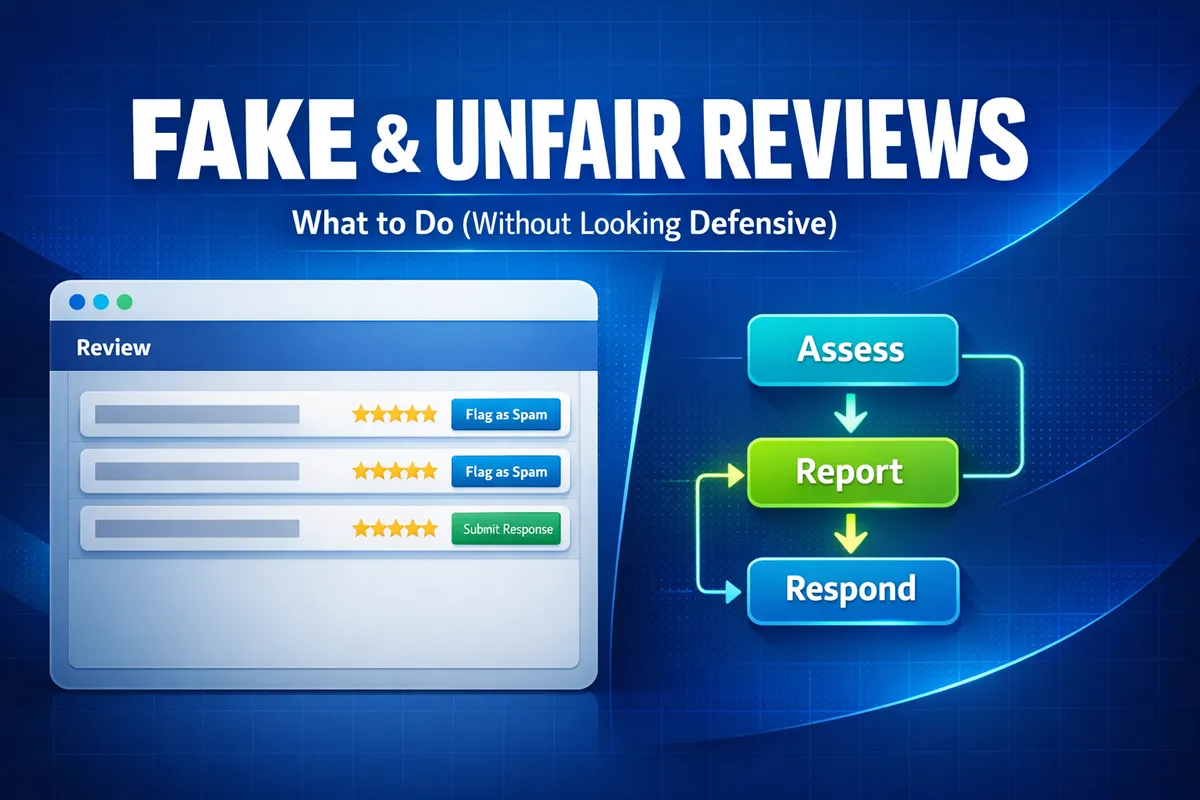
Not every negative review reflects a real customer experience. Fake reviews from competitors, disgruntled non-customers, or mistaken identity happen. The challenge is responding in a way that protects your reputation without appearing defensive or accusatory. Your response is for the observers reading it—not for the person who may have fabricated the review.
For businesses managing review authenticity concerns, ReviewSense helps you monitor patterns and craft appropriate responses to suspicious reviews.
A Calm Protocol for Suspected Fake Reviews
When you encounter a review that seems fake or unfair, resist the urge to react immediately. Follow this systematic process instead:
Step 1: Assess Legitimacy
Before assuming a review is fake, verify whether it could be legitimate:
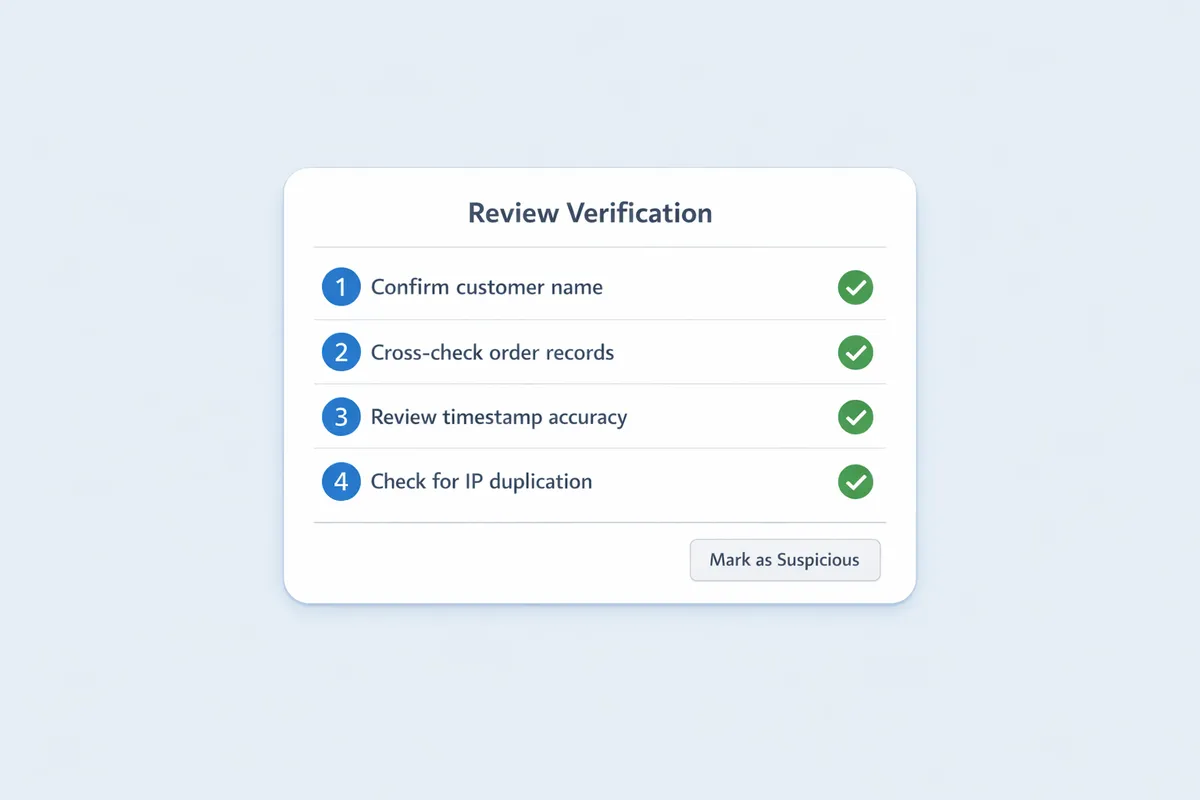
Transaction check:
- Search your records for the reviewer's name
- Check the date mentioned against your sales/appointment records
- Look for any customer contact history (emails, calls, bookings)
Profile check:
- Has this reviewer reviewed other local businesses?
- Do their other reviews seem legitimate?
- Is this their only review? (suspicious but not conclusive)
Content check:
- Does the complaint describe something your business actually offers?
- Are there specific details, or is it vague?
- Does the writing style match other fake reviews you've seen?
Timing check:
- Did this appear during a competitor promotion?
- Did multiple suspicious reviews appear at once?
- Does the timing coincide with any disputes (former employees, vendors, etc.)?
Step 2: Document Everything
Whether you can prove the review is fake or not, create an internal record:
┌─────────────────────────────────────────────────────────────────────────┐
│ SUSPICIOUS REVIEW DOCUMENTATION                                         │
├─────────────────────────────────────────────────────────────────────────┤
│ Platform:        Google                                                 │
│ Date posted:     March 15, 2025                                        │
│ Reviewer name:   "John S."                                             │
│ Rating:          1 star                                                 │
│ Content:         "Worst experience ever. Rude staff, terrible food."   │
├─────────────────────────────────────────────────────────────────────────┤
│ INVESTIGATION RESULTS                                                   │
├─────────────────────────────────────────────────────────────────────────┤
│ Customer found:  No                                                     │
│ Transaction:     No matching records                                    │
│ Profile:         Only 2 reviews, both 1-star, both local competitors   │
│ Content:         Generic, no specific details                          │
│ Timing:          Same week competitor opened nearby                     │
├─────────────────────────────────────────────────────────────────────────┤
│ CONCLUSION:      Likely competitor-driven fake review                   │
│ ACTION:          Report to platform, respond professionally             │
└─────────────────────────────────────────────────────────────────────────┘
This documentation serves two purposes:
- Supports your report to the platform
- Helps identify patterns if fake reviews become ongoing
Step 3: Report to the Platform
Most platforms have processes for flagging potentially fake reviews:
Google Business Profile:
- Log into your Google Business Profile
- Find the review and click the three-dot menu
- Select "Flag as inappropriate"
- Choose the relevant violation category
Yelp:
- Click "Report Review" below the review
- Select the reason for reporting
Facebook:
- Click the three dots on the review
- Select "Find support or report recommendation"
Important: Platform removal is not guaranteed. Even clearly fake reviews often remain. Plan your response assuming the review will stay visible.
Step 4: Respond Professionally
Your response must serve observers—future customers reading reviews. The goal is to appear professional, reasonable, and customer-focused even when dealing with illegitimate criticism.
Why Defensive Replies Reduce Trust
Research on consumer behaviour shows that how businesses respond to negative reviews significantly affects observers' purchase intentions. This applies even to fake reviews:
- Defensive responses make businesses look combative
- Accusatory responses make businesses look paranoid
- Professional responses make businesses look trustworthy
The reviewer may know they're lying. The observer doesn't. Your response teaches observers how you handle conflict. A calm, professional response to an unfair review demonstrates the character that legitimate customers will experience.
According to BrightLocal research, people read reviews and responses to assess trustworthiness. Your response to a fake review is still data they use to decide whether to choose you.
Response Templates for Different Fake Review Scenarios
Scenario 1: Can't Find Any Record of the Customer
Hi [Name],

I'm having trouble locating any record of your visit in our system.
I take all feedback seriously and would like to understand what happened.

Could you please contact me directly at [email/phone]? I'd appreciate
any details you can share—the date, time, or anything that might help
me identify your experience so I can look into this properly.

[Your name]
[Title]
Why it works: You're not calling them a liar, but you're signalling to observers that you've checked your records. The invitation to provide details puts the burden back on the reviewer without being confrontational.
Scenario 2: Review Describes Something You Don't Offer
Hi [Name],

Thank you for taking the time to leave feedback. I noticed you mentioned
[thing you don't offer], and I want to make sure you have the right
business—we don't actually offer [that service/product].

If you did visit us and had a concern about something else, I'd genuinely
like to hear about it. Please reach out at [email] so we can discuss.

[Your name]
Why it works: Factual correction without accusation. Observers can see the discrepancy and draw their own conclusions.
Scenario 3: Suspected Competitor or Coordinated Attack
Hi [Name],

I'm sorry to hear about your experience. I've looked through our records
and haven't been able to find details matching your visit.

We value honest feedback as it helps us improve. If you'd be willing to
share more details about when you visited and what specifically occurred,
please contact me at [email]. I'm committed to addressing any legitimate
concerns.

[Your name]
Why it works: Emphasising "honest feedback" and "legitimate concerns" subtly signals doubt without direct accusation. The invitation for specifics puts pressure on fake reviewers who can't provide them.
Scenario 4: Former Employee or Personal Dispute
Hi [Name],

I appreciate you sharing your perspective. We strive to treat everyone—
customers, partners, and team members—with respect and professionalism.

If there's something specific I can help address, I'm happy to discuss
it privately at [email]. We're always looking to learn and improve.

[Your name]
Why it works: Generic enough to avoid airing dirty laundry, professional enough to look reasonable to observers, and open to resolution without conceding wrongdoing.
Pattern Detection: When Fake Reviews Become a Campaign
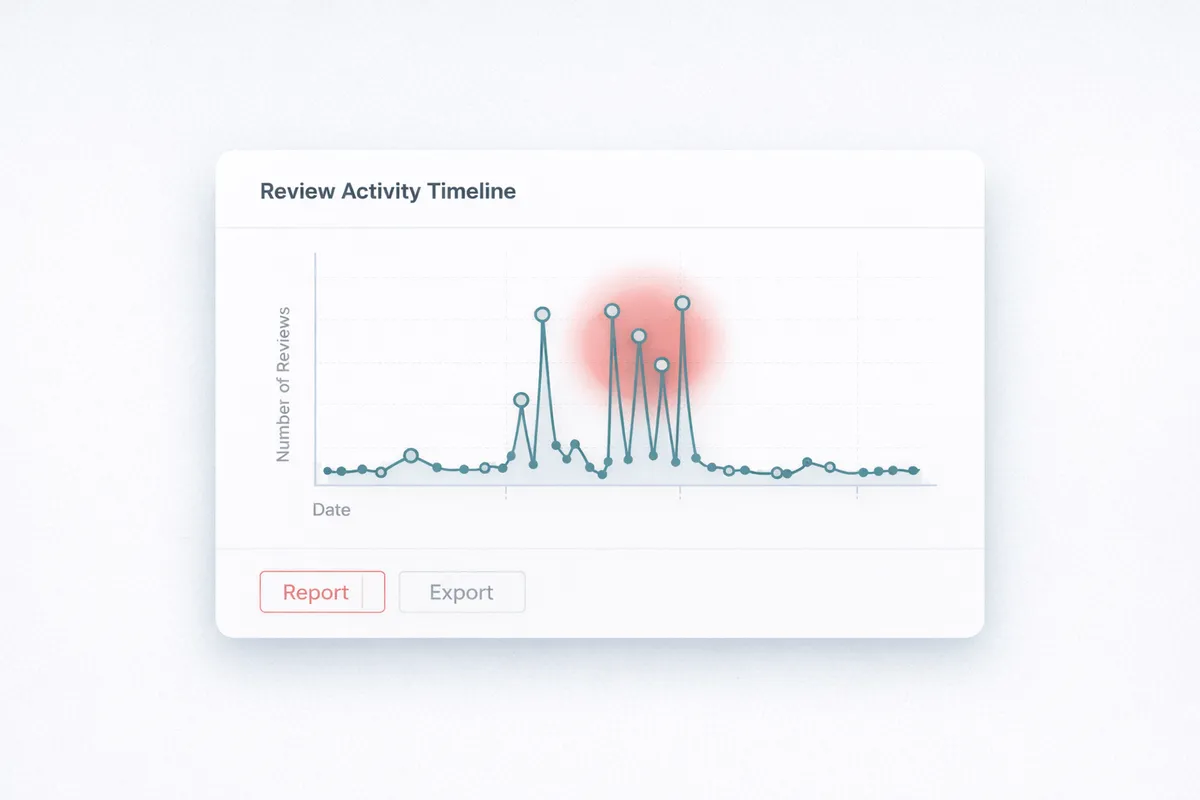
Sometimes fake reviews aren't isolated incidents—they're coordinated attacks. Watch for these patterns:
Multiple Suspicious Reviews in a Short Timeframe
March 1: ★☆☆☆☆ "Terrible!" - Generic, no details
March 2: ★☆☆☆☆ "Worst ever!" - Generic, no details
March 4: ★☆☆☆☆ "Don't go here!" - Generic, no details
Three generic 1-star reviews in one week from accounts with minimal history suggests coordination.
Similar Language Across Reviews
Review A: "The service was absolutely terrible and the staff were so rude."
Review B: "Staff were incredibly rude and the service was absolutely terrible."
Review C: "Terrible service, absolutely rude staff."
Repetitive phrasing across supposedly independent reviewers indicates a common author or template.
Timing Correlations
Track when suspicious reviews appear:
- After a negative interaction (dispute, firing, complaint)
- When a competitor opens or runs promotions
- After you leave a negative review for another business (retaliation)
Document these patterns—they strengthen your case when reporting to platforms.
When You Can't Get Reviews Removed
Platform removal requests often fail, even for obviously fake reviews. Here's how to live with illegitimate reviews:
Build Review Volume
The best defence against fake reviews is overwhelming legitimate ones. One fake 1-star among 50 legitimate 4-5 star reviews barely affects your average or perception.
Review generation strategies:
- Ask satisfied customers directly
- Follow up via email after positive experiences
- Make leaving reviews easy (QR codes, direct links)
Respond and Move On
Once you've responded professionally and reported the review, focus elsewhere. Obsessing over fake reviews wastes energy better spent on legitimate customer relationships.
Consider Legal Action Only as Last Resort
In extreme cases (defamation, coordinated competitor attacks), legal action may be appropriate. But this is expensive, time-consuming, and often draws more attention to the negative content. Consult a lawyer before proceeding.
How ReviewSense Helps With Fake Review Management
Managing fake reviews requires vigilance and appropriate response. ReviewSense supports this process:
- Pattern Detection – AI monitors for suspicious review clusters and alerts you to potential coordinated attacks
- Response Templates – Access pre-crafted responses designed for suspicious reviews that protect your reputation
- Documentation Tools – Track investigation results and maintain records for platform reports
- Tone Analysis – Ensure your responses to fake reviews don't come across as defensive
- Review Volume Tracking – Monitor your legitimate review generation to dilute the impact of fake reviews
With ReviewSense, you handle suspicious reviews systematically rather than emotionally—protecting your reputation while avoiding the traps of defensive responses.
Protect Your Reputation Without Losing Your Cool
Fake reviews are frustrating, but your response defines how future customers see you. A professional, measured response to an unfair review demonstrates the kind of business you are—one that handles adversity with grace.
Follow the protocol:
- Assess legitimacy before assuming the worst
- Document everything for platform reports
- Report through official channels
- Respond professionally for observers
- Build legitimate review volume as your best defence
The goal isn't winning an argument with a fake reviewer. It's showing everyone else that you're worth trusting.
Want to learn more about crafting effective responses to all types of negative reviews? Our comprehensive guide on responding to negative reviews covers the complete framework for turning criticism into trust.
![10 Best Review Management Software for 2026 [Expert Comparison]](/_next/image?url=%2Fimages%2Fposts%2Fbest-review-management-software-2026-featured.webp&w=3840&q=75 "10 Best Review Management Software for 2026 [Expert Comparison]")