
Seventy-eight per cent of CEOs say reputational weaknesses have reduced sales or trading activity in the past year. Yet fewer than half of organisations describe their reputation-management approach as highly effective or adaptable. For a multi-brand enterprise, the gap between risk and readiness is even wider — each subsidiary, product line, or regional brand carries its own reputation, but the parent company absorbs the aggregate damage. Treating reputation as a portfolio asset, not a series of isolated tasks, is the only way to protect the $7.07 trillion reputation economy your shareholders depend on.
Managing this manually is hard. ReviewSense automates enterprise reputation management across every brand you own.
Why Corporate Reputation Management Now Demands a Portfolio View
Managing a single brand’s reputation is hard enough. For a multi-brand enterprise, the challenge multiplies. Each brand carries its own customer base, voice, and risk profile. Yet the financial stakes now apply at the portfolio level, not just the brand level.
| Metric | What it indicates | Source |
|---|---|---|
| $7.07 trillion | Estimated global “reputation economy”—the shareholder value tied to corporate reputation. | Burson, The Global Reputation Economy (2026) |
| Up to 4.78% | Additional unexpected annual shareholder returns for companies with stronger reputations. | Burson, The Global Reputation Economy (2026) |
| 78% of CEOs | Said reputational weaknesses had reduced sales or trading activity in the prior year. | Sandpiper, Reputation Capital Scorecard 2026 |
That $7.07 trillion figure from Burson’s 2026 research quantifies what many executives already sense: reputation is a measurable asset. A strong corporate reputation can deliver up to 4.78% in unexpected annual shareholder returns. A weak one cuts sales directly.
The CEO blind spot
78% of CEOs told Sandpiper (Reputation Capital Scorecard 2026) that reputational weaknesses had reduced sales or trading activity. Yet fewer than half consider their current approach effective. That gap is dangerous for multi-brand firms. A single brand’s negative review spike can drag the parent company’s stock. Investors judge a fall like that against the return around it: ARIA PM’s free Calmar ratio calculator divides a share’s annual return by its worst peak-to-trough drop. You can’t manage that risk with siloed, brand-by-brand tactics.
The central tension
Multi-brand businesses face a core tension. Brand teams need autonomy to respond in their own voice. The corporate centre needs visibility into aggregate risk. A decentralised approach misses portfolio-level threats. A fully centralised one slows down local teams.
Why a portfolio view wins
Enterprise reputation management now demands a centralised-but-federated architecture. The corporate office sets standards and monitors sentiment trends across brands. Each brand retains control over daily responses. This hybrid model catches systemic issues—like a recurring complaint pattern across multiple locations—before they become a crisis. It also surfaces which brands drive the most positive sentiment, informing investment decisions.
For agencies managing multiple clients, this portfolio view is equally critical. The guide on review management software for agencies explains how to scale oversight without sacrificing brand-level authenticity.
The bottom line
Corporate reputation strategy is no longer optional. It’s a financial imperative. Businesses that treat reputation as a portfolio asset—monitored centrally, executed locally—will capture that 4.78% upside. Those that don’t risk joining the 78% of CEOs who already say reputational weaknesses have cut into sales.

The Five Structural Challenges Unique to Multi-Brand Reputation
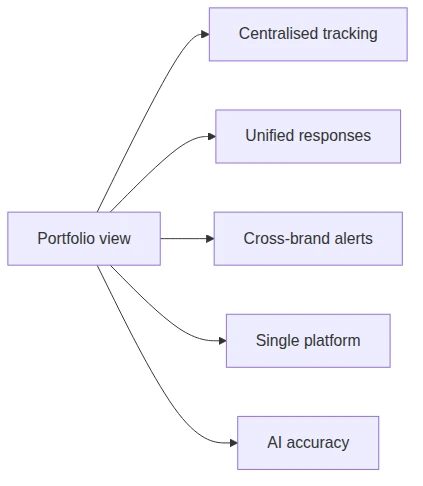
A portfolio view exposes the gaps that siloed brand management hides. Five structural challenges make multi-brand reputation management fundamentally harder than running a single brand.
| Challenge | Core Problem | What a Corporate Strategy Must Address |
|---|---|---|
| Fragmented visibility | Each brand generates reviews across Google, Facebook, and app stores. No single view of portfolio-wide patterns. | Centralised sentiment tracking across all brands and platforms. |
| Inconsistent response quality | Different teams use different tone and speed. Customers perceive mismatched brand standards. | Unified response guidelines with local execution autonomy. |
| Siloed crisis detection | A negative spike in one brand may signal a systemic issue like a supply chain fault. | Cross-brand alerting and escalation protocols. |
| Duplicative tooling | Each brand buys separate review tools. Budget waste prevents cross-brand analytics. | A single platform that serves all brands. |
| AI reputation blind spots | AI-generated answers can conflate or misrepresent sister brands. | Monitoring AI outputs for brand accuracy. |
1. Fragmented visibility
Each brand generates reviews across Google, Facebook, and app stores. No single dashboard exists to spot portfolio-wide patterns. Sandpiper’s 2026 research found that fewer than half of organisations consider their reputation-management approach highly effective or agile. A corporate reputation management strategy must centralise that data.
2. Inconsistent response quality
Different teams use different tone and speed. One brand replies within hours; another takes days. Customers notice the mismatch. Enterprise reputation management demands standardised response protocols.
3. Siloed crisis detection
A negative spike in one brand can signal a systemic issue. A recurring complaint about pricing across three brands points to a policy problem, not a local one. Grayling’s research shows 62% of leaders believe reputation threats will increase. A corporate reputation strategy must connect those dots.
4. Duplicative tooling
Each brand buying separate review tools wastes budget. It also prevents cross-brand analytics. A single platform like ReviewSense centralises feedback from all supported platforms into one dashboard. That saves money and surfaces portfolio-level insights. The review management software selection guide explains what to look for.
Building a Centralised Dashboard Without Losing Brand Autonomy
That hybrid model demands a specific kind of dashboard. One that surfaces portfolio-wide patterns without stripping local teams of their autonomy.
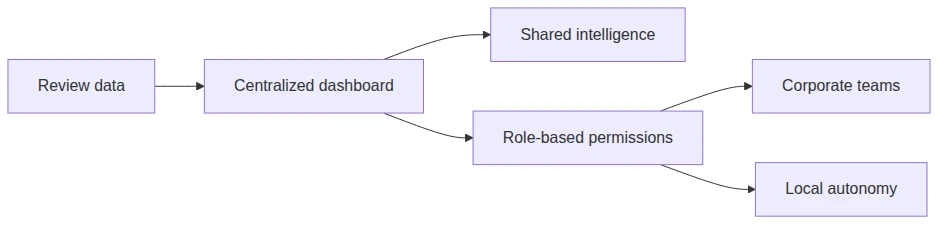
The shared intelligence layer
A centralised dashboard aggregates review data from Google Business Profile, Facebook, Apple App Store, and Google Play into a single view. This creates a shared intelligence layer. Corporate teams can analyse sentiment trends across all brands at once. A pricing complaint that appears in three different brand reviews signals a systemic issue, not a local one.
Sandpiper's 2026 research found that only 4 in 10 organisations feel prepared to use AI effectively in reputation management. Centralising data is the first step toward AI-ready governance. You can't train models on scattered spreadsheets.
Role-based permissions preserve autonomy
The dashboard must serve two distinct audiences. Corporate teams need aggregate trends and crisis alerts. Local brand teams need to manage their own reviews and replies.
Role-based permissions solve this tension. A corporate user sees a portfolio-wide sentiment heatmap. A brand manager sees only their own reviews and response queue. Each brand maintains its own response workflows and brand voice. No forced uniformity.
Grayling's research shows 62% of leaders believe threats to business will increase during 2026. Faster identification of cross-brand risks becomes critical. A centralised dashboard with role-based access lets you spot a negative spike in one brand and check if sister brands show the same pattern.
The principle: visibility without uniformity
The dashboard should make the whole portfolio visible. It should not force every brand to operate the same way. Each brand keeps its own voice, its own response templates, and its own approval workflows. The corporate centre gains oversight without adding friction.
For businesses managing multiple brands, this balance is essential. The Google Review Management Software: Capabilities, Limits & ROI guide explores how to evaluate platforms that support this model. The right enterprise reputation management tool centralises data while respecting brand-level autonomy.
What to Look for in an Enterprise Reputation Platform
That balance between visibility and autonomy sets the stage for evaluating specific platform capabilities. Not every reputation tool can handle the complexity of a multi-brand portfolio. Here is what to look for.
| Capability | Why It Matters for Multi-Brand |
|---|---|
| Multi-location and multi-brand support with granular user permissions | Corporate teams see portfolio-wide trends; brand managers control only their own reviews. No data leakage. |
| AI-powered response generation trained on distinct brand voices | Each brand maintains its own tone. A luxury hotel chain and a budget airline should never sound alike. |
| Sentiment analysis and topic clustering across brands | A recurring complaint about delivery delays in three brands points to a logistics problem, not a local one. |
| Crisis alerts configurable by brand, location, and severity threshold | Grayling found 85% of leaders remain optimistic about growth despite rising threats. Fast detection stops a local issue becoming a portfolio crisis. |
| White-label reporting for agencies or parent-brand reporting | Agencies rebrand reports for clients. Parent companies present unified data to the board without exposing brand-level detail. |
Multi-location and multi-brand permissions
A single login must serve both the corporate centre and each brand team. Role-based access ensures a regional manager sees only their locations. A group director sees the full portfolio. This prevents confusion and protects brand autonomy. The multi-platform review management strategy explains how to set this up.
AI responses that respect brand voice
Generic AI replies damage trust. The platform must let you train the AI on each brand's voice guidelines. A playful tone for a fast-food chain. A formal tone for a law firm. ReviewSense supports this with custom brand voice settings. For legal practices, see the law firm review management guide.
Sentiment analysis across brands
Topic clustering reveals shared issues. If three brands show a spike in complaints about a common supplier, you act once. Echo Research estimates corporate reputation drives 31.7% of market capitalisation in high-impact sectors. Centralised analysis protects that value.
Configurable crisis alerts
Set thresholds per brand. A 2-star average for one brand triggers an alert. A 3-star average for another does not. This prevents alert fatigue. The platform must only support Google, Facebook, Apple App Store, and Google Play. No unsupported platforms.
White-label reporting
Agencies need custom branding. Parent companies need aggregated reports. White-label capabilities deliver both.
Measuring What Matters: Moving Beyond Vanity Metrics
That centralised dashboard solves the visibility problem, but it also reveals a harder truth: most reputation dashboards measure the wrong things. Star ratings and review volume are vanity metrics. They tell you what happened, not why it matters for your corporate reputation management strategy.
A better approach is the 'reputation gap' framework. Compare three things: what your brand claims to stand for, what stakeholders actually experience, and what verifiable evidence shows. The gap between these three is your real reputational risk. Recent industry research shows corporate reputation drives $14.9 trillion in value. A gap that wide demands behaviour-based metrics, not surface-level scores.
Here are five metrics that actually predict reputation outcomes:
Response rate and time across all brands and platforms. A brand that replies to 95% of reviews within 4 hours signals attentiveness. One that replies to 40% within 48 hours signals neglect. This gap is measurable and fixable.
Sentiment trend correlation with customer retention. McKinsey's research shows action beats spin. If sentiment drops but retention holds, your brand has real equity. If both drop, you have a crisis forming. Track the correlation monthly.
Recurrence rate of specific complaint topics. A single billing complaint is noise. A 12% recurrence rate of billing complaints across three brands is a systemic failure. Tag and track topics like shipping, quality, and support.
Crisis detection latency. Measure the time from a negative spike to team notification. A 2-hour latency is acceptable. A 24-hour latency is dangerous. Strategic communications research shows fast detection stops local issues becoming portfolio crises.
AI representation accuracy. Check how AI systems describe your brand. A chatbot that calls your luxury hotel 'budget-friendly' damages trust. RepTrak's data shows AI misrepresentation erodes reputation faster than bad reviews.
A centralised review platform like ReviewSense makes these metrics possible. It aggregates data from Google, Facebook, Apple App Store, and Google Play into one view. You can't measure response rates across platforms without a single dashboard. You can't track topic recurrence without unified sentiment analysis.
Conclusion
Managing reputation across a multi-brand business demands more than a dashboard. It requires a system that respects brand voice, surfaces systemic issues, and measures what actually matters—response rates, sentiment trends, and crisis latency. Vanity metrics like star ratings obscure the real risk. The reputation gap between what you claim and what customers experience is where value erodes. ReviewSense centralises feedback from Google, Facebook, Apple App Store, and Google Play, then delivers the behavior-based metrics that protect your portfolio. Turn scattered reviews into actionable insights that drive growth. Start your 7-day free trial.