
Your competitors' reviews are hiding valuable intelligence in plain sight. While they're busy responding to feedback, you can analyse what their customers love, hate, and wish for—then use those insights to differentiate your business. Competitive benchmarking from reviews is the cheapest market research available, and most businesses completely ignore it.
For businesses looking to automate competitive analysis, ReviewSense offers competitor tracking that monitors how you compare across key themes.
Why Competitors' Reviews Are Your Cheapest Market Research
Traditional competitive intelligence costs thousands of dollars. Mystery shoppers, surveys, and market research reports all require significant investment. But your competitors' reviews? They're free, public, and brutally honest.
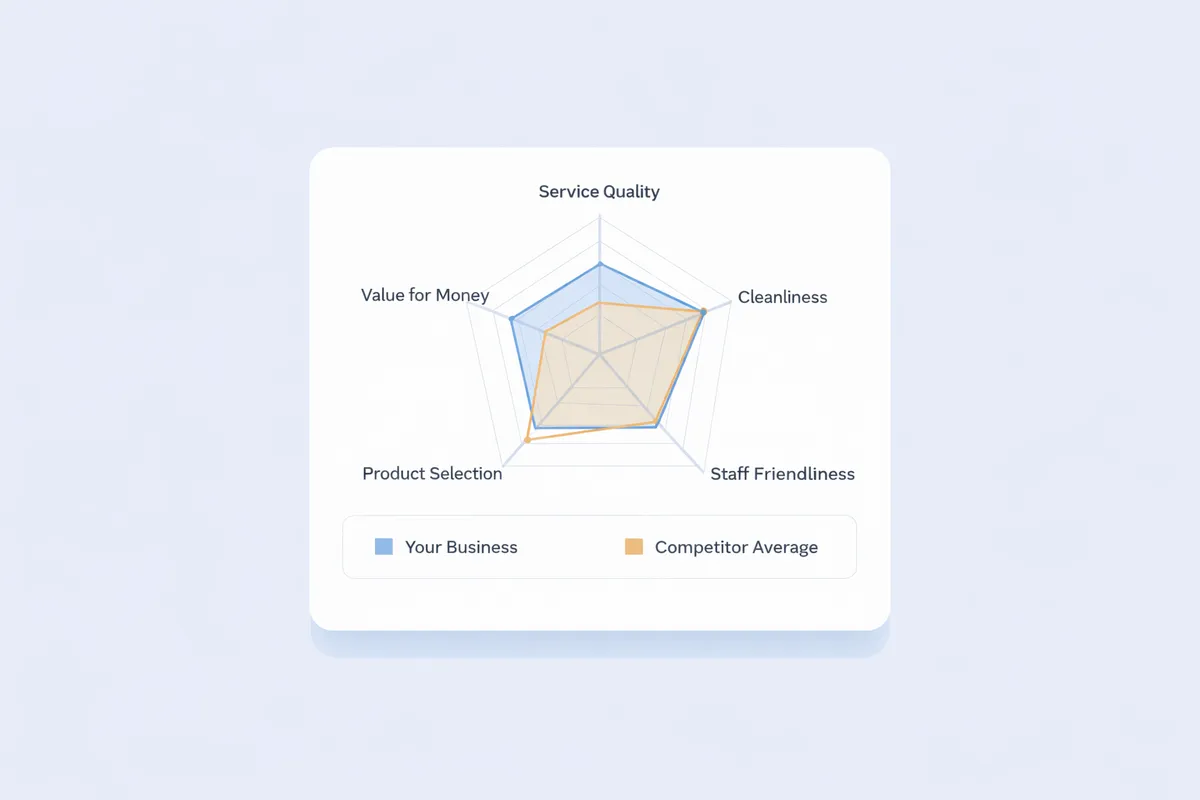
Here's what competitor reviews reveal:
- What they're winning on – Themes that appear frequently in their 5-star reviews
- Where they're vulnerable – Recurring complaints you could exploit
- What customers expect – Industry-standard experiences you need to match
- Unmet needs – Desires expressed but not satisfied by anyone
According to BrightLocal research, 84% of consumers use Google to find reviews, and they often compare multiple businesses before deciding. Understanding what they see when they look at your competitors gives you a strategic advantage.
How to Benchmark in 60 Minutes: A DIY Method
You don't need expensive tools to benchmark against competitors. Here's a practical process you can complete in about an hour:
Step 1: Identify Your Competitive Set (5 minutes)
Select 3-5 direct competitors in your market. For local businesses, these are typically:
- Businesses within your service area
- Similar price point and positioning
- Competing for the same customers
Pro tip: Include one aspirational competitor—a business you'd like to emulate—even if they're not a direct threat.
Step 2: Collect Recent Reviews (15 minutes)
For each competitor, gather the 30-50 most recent reviews from Google and any industry-specific platforms. You can do this manually or use browser extensions to export review data.
Focus on reviews from the last 12 months for relevance.
Step 3: Define Your Theme Categories (10 minutes)
Create 6-10 theme categories relevant to your industry. Here are starting points by vertical:
Restaurants:
- Food quality, Service speed, Staff friendliness, Ambience, Value, Cleanliness, Portion size
Professional Services:
- Communication, Expertise, Timeliness, Pricing transparency, Results, Responsiveness
Retail:
- Product selection, Staff helpfulness, Store layout, Prices, Return policy, Availability
Healthcare:
- Wait time, Bedside manner, Explanation quality, Facility cleanliness, Scheduling ease
Step 4: Tag and Count (25 minutes)
For each competitor, tag reviews by theme and sentiment (positive/negative). Create a simple spreadsheet:
| Competitor | Theme | Positive | Negative | Total |
|---|---|---|---|---|
| Competitor A | Service Speed | 12 | 18 | 30 |
| Competitor A | Staff Friendliness | 25 | 5 | 30 |
| Competitor B | Service Speed | 8 | 4 | 12 |
| Competitor B | Staff Friendliness | 15 | 12 | 27 |
| Your Business | Service Speed | 10 | 8 | 18 |
| Your Business | Staff Friendliness | 22 | 3 | 25 |
Step 5: Calculate Benchmarks (5 minutes)
For each theme, calculate the "negativity rate":
Negativity Rate = (Negative mentions / Total mentions) × 100
This gives you a comparable metric across businesses of different review volumes.
The 6-10 Dimensions That Matter in Your Vertical
Different industries have different dimensions that customers evaluate. Here's a framework for identifying yours:
Universal Dimensions (Apply to Most Businesses)
- Service Quality – How well staff treat customers
- Value/Pricing – Perception of worth for money
- Reliability – Consistency of experience
- Responsiveness – Speed of service or communication
Industry-Specific Dimensions
Research shows that customer feedback typically clusters around specific themes depending on the industry. The key is identifying which dimensions customers mention most frequently in your competitive set.
Method: Count theme frequency across all competitor reviews. The top 6-10 themes by volume are your industry's key dimensions.
Example for a Coffee Shop:
| Dimension | % of All Reviews Mentioning |
|---|---|
| Coffee Quality | 68% |
| Service Speed | 54% |
| Staff Friendliness | 47% |
| Atmosphere | 42% |
| Prices | 38% |
| Food Options | 31% |
| Seating Availability | 28% |
| WiFi/Power Outlets | 22% |
These eight dimensions define what customers evaluate when choosing a coffee shop in this market.
Turning Insight Into Action: Operations and Reply Messaging
Competitive benchmarking is only valuable if it changes what you do. Here's how to translate insights into action:
Operational Changes
If you're behind on a key dimension:
- Diagnose the root cause – Why are competitors doing better?
- Set a specific target – "Reduce wait time mentions by 50%"
- Implement changes – Staffing, processes, training, equipment
- Monitor progress – Track your theme frequency monthly
Example: Competitor A has 8% negative mentions for "wait time" while you have 25%. After investigation, you discover they use a ticket system for busy periods. Implementing a similar system could close this gap.
If you're ahead on a key dimension:
- Identify what's working – What specifically do customers praise?
- Double down – Reinforce and highlight this advantage
- Use it in marketing – Feature testimonials that mention this strength
- Protect it – Ensure staff know this is a differentiator
Reply Messaging Strategy
Your review responses should subtly highlight your competitive advantages:
When responding to positive reviews:
Thank you, [Name]! We're so glad you noticed [your competitive advantage].
Our team works hard to [specific thing you do better than competitors],
and it's wonderful to hear it made your experience special.
When responding to neutral/negative reviews mentioning a competitor strength you don't have:
Thank you for the feedback, [Name]. While we focus on [your strength] as
our priority, we're always looking for ways to improve. I'd love to hear
more about your experience—please reach out at [contact].
Key principle: Never directly mention competitors in responses. Focus on your strengths, not their weaknesses.
What to Track: Your Theme Scorecard vs Competitors
Set up a monthly tracking system to monitor your competitive position:
Monthly Competitive Scorecard
| Dimension | Your Score | Comp A | Comp B | Comp C | Your Rank |
|---|---|---|---|---|---|
| Service Speed | 75% pos | 68% | 82% | 70% | 2nd |
| Staff Friendliness | 88% pos | 80% | 75% | 85% | 1st |
| Food Quality | 82% pos | 85% | 78% | 90% | 3rd |
| Value | 70% pos | 65% | 72% | 68% | 2nd |
| Cleanliness | 90% pos | 88% | 85% | 92% | 2nd |
Reading the scorecard: You're winning on staff friendliness and competitive on most dimensions, but food quality is a weakness vs the market leader (Comp C).
Trend Analysis
Track how your relative position changes over time:
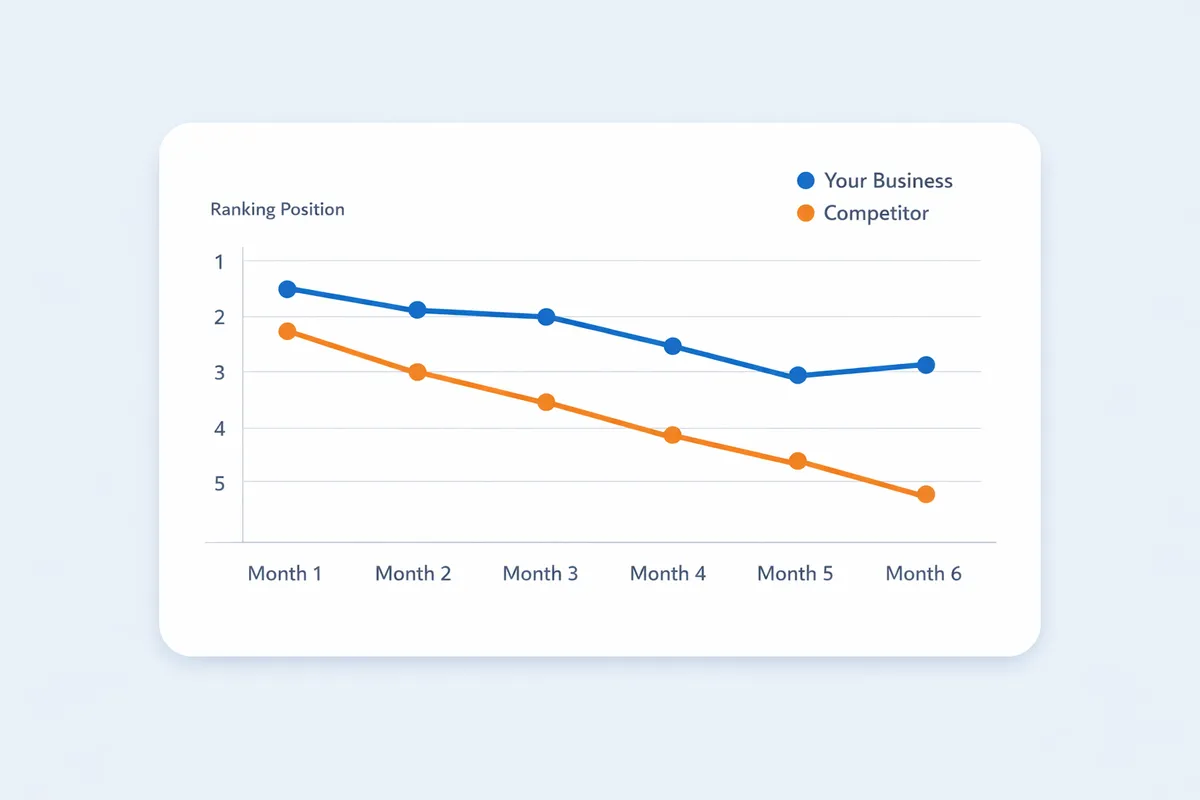
Staff Friendliness: Jan 1st → Jun 1st ✓ Maintained
Service Speed: Jan 3rd → Jun 2nd ✓ Improved
Food Quality: Jan 2nd → Jun 3rd ✗ Declined (investigate)
Value: Jan 2nd → Jun 2nd → Stable
Declining competitive position on any dimension requires investigation.
How ReviewSense Helps With Competitive Benchmarking
Manual competitive analysis is time-consuming and difficult to maintain consistently. ReviewSense automates the process:
- Competitor Tracking – Monitor competitor reviews automatically across Google, Facebook, and other platforms
- Theme Comparison – See how you rank vs competitors on key dimensions without manual tagging
- Alert System – Get notified when competitors receive significant praise or criticism on themes where you're vulnerable
- Trend Monitoring – Track competitive position changes over time with visual dashboards
- Opportunity Identification – AI surfaces gaps in competitor performance that you could exploit
Rather than spending hours each month on manual analysis, you get continuous competitive intelligence that informs both operations and marketing.
Benchmark Your Way to Market Leadership
Your competitors' customers are telling you exactly what they want—and whether they're getting it. The businesses that listen to this intelligence and act on it steadily pull ahead, while those that ignore it wonder why customers choose elsewhere.
Start this week:
- Identify 3-5 key competitors
- Analyse 30 reviews from each
- Build your competitive scorecard
- Identify one dimension where you can leap ahead
The insights are waiting. The question is whether you'll use them.
Want to learn the best way to respond when customers compare you unfavourably to competitors? Our guide on how to respond to negative reviews covers strategies for turning criticism into opportunity.
![10 Best Review Management Software for 2026 [Expert Comparison]](/_next/image?url=%2Fimages%2Fposts%2Fbest-review-management-software-2026-featured.webp&w=3840&q=75 "10 Best Review Management Software for 2026 [Expert Comparison]")